Agaricus blazei Safety
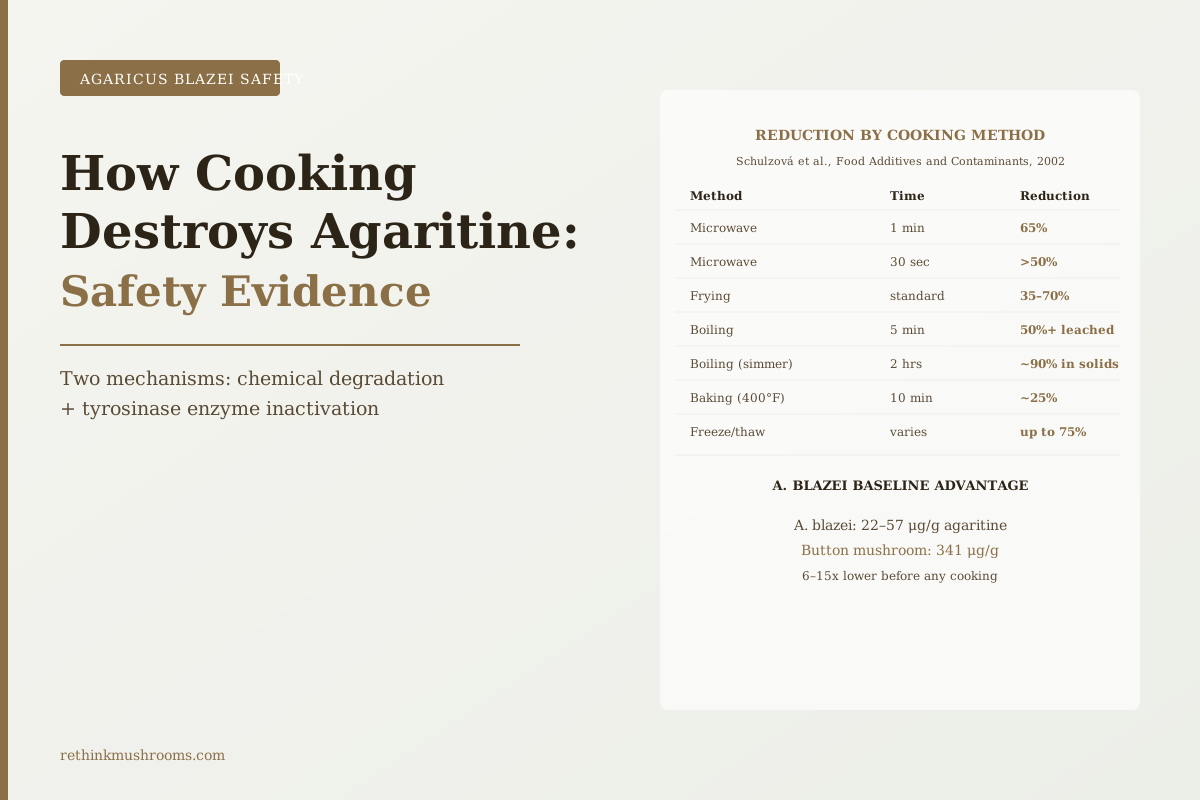
65% reduction in 1 minute
Microwaving Agaricus mushrooms for just one minute reduces agaritine content by 65%. Extended boiling removes over 90% from the solid mushroom. These reductions happen through two separate mechanisms.
Schulzová et al., Food Additives and Contaminants, 2002
22–57 μg/g
agaritine in A. blazei (Royal Sun) vs. 341 μg/g in common button mushrooms, before cooking (Kondo et al., 2006)
Tyrosinase
the mushroom enzyme that bioactivates agaritine to its mutagenic form, inactivated by heat (Walton et al., 2001)
2 mechanisms
cooking destroys agaritine chemically AND inactivates the enzyme that makes it dangerous: a double-protection effect
Schulzová et al., Food Additives and Contaminants, 2002
 View as image ↗
Cooking mushrooms significantly reduces their agaritine content. A 2002 study by Schulzová and colleagues measured agaritine reduction across every common household preparation method: microwaving for one minute cut levels by 65%, extended simmering reduced agaritine in the mushroom solids by over 90%, and even freezing and thawing reduced levels by up to 75%.[2] The question "does cooking remove agaritine from mushrooms" has a clear answer from the data: yes, substantially, and through two distinct mechanisms that most coverage misses.
This article covers the cooking data by method, the two-mechanism explanation for why cooking protects more than it might seem, and the baseline agaritine levels in Agaricus blazei specifically before cooking begins. For the broader picture of whether agaritine poses a meaningful cancer risk in the first place, see what is Agaricus blazei and what makes it distinct.
Key Takeaways
- Microwaving Agaricus mushrooms for 1 minute reduces agaritine by 65%; 30 seconds reduces it by more than 50% (Schulzová et al., 2002)
- Extended boiling (2-hour simmer) reduces agaritine in the mushroom solids by approximately 90%; 5 minutes of boiling removes 50% into the cooking water plus degrades another 20-25%
- Cooking protects through two mechanisms: (1) heat directly degrades agaritine chemically, and (2) heat inactivates mushroom tyrosinase, the fungal enzyme responsible for bioactivating agaritine into its mutagenic form
- A. blazei (Royal Sun mushroom) starts with only 22-57 μg/g agaritine before cooking, compared to 341 μg/g in common button mushrooms: a 6-to-15-fold lower baseline (Kondo et al., 2006)
- Dried mushroom products retain more agaritine than fresh cooked products; drying alone does not meaningfully reduce levels
- The combination of A. blazei's lower baseline agaritine and standard cooking reduces exposure to a fraction of what button mushroom consumers experience
The Agaritine Baseline: Why the Starting Number for A. blazei Matters
Agaritine is a hydrazine compound found naturally in mushrooms of the Agaricus genus. The concern about agaritine centers on laboratory evidence that it can be converted into mutagenic intermediates by certain enzymes. How much agaritine a mushroom contains before cooking determines how much exposure remains after cooking, so the starting level matters.
Kondo and colleagues quantified agaritine concentrations across mushroom species in 2006 using liquid chromatography-tandem mass spectrometry.[1] Their measurements:
- Common button mushroom (A. bisporus): 341 μg/g fresh weight
- Royal Sun mushroom (A. blazei): 22–57 μg/g fresh weight
A. blazei contains 6 to 15 times less agaritine than the mushroom species most people eat. If the agaritine concern was compelling for button mushrooms, it would be substantially less compelling for A. blazei at the same cooking level, and less compelling still once you factor in cooking's reductive effects on that already-lower starting concentration.
This species comparison sits at the core of the agaritine debate for A. blazei users, and it is absent from most coverage that treats agaritine as a uniform property of all Agaricus mushrooms. For the detailed comparison between species, see agaritine levels in Agaricus blazei vs. button mushrooms.
The Cooking Data: Reductions by Method
The most comprehensive cooking study in this area was published by Schulzová and colleagues in Food Additives and Contaminants in 2002.[2] They measured agaritine content in Agaricus mushrooms prepared by every common household method and quantified the reductions. Their data is the primary evidence base for answering how much cooking removes agaritine.
Agaritine reduction by cooking method (Schulzová et al., 2002):
| Method | Time | Reduction |
|---|---|---|
| Microwave | 30 seconds | >50% |
| Microwave | 1 minute | 65% |
| Frying (oil or butter) | Standard cooking | 35–70% |
| Boiling | 5 minutes | ~50% extracted into water + 20–25% degraded in solids |
| Boiling (simmer in sauce) | 2 hours | ~90% in mushroom solids |
| Baking (oven, 400°F) | 10 minutes | ~25% |
| Freezing then thawing | varies | Up to 75% |
Several observations from this data are worth noting.
Boiling distributes, then degrades: A 5-minute boil removes about 50% of agaritine into the cooking water (through leaching, not chemical destruction), while degrading another 20-25% in the mushroom solids themselves. If you discard the cooking water, both reductions apply. If you consume it, the extracted portion is not destroyed; it is relocated. Over a 2-hour simmer, the solids show 90% reduction, reflecting both continued leaching and genuine chemical breakdown.
Microwaving is remarkably efficient: One minute achieves 65% reduction, faster than any other method. The mechanism here is primarily thermal: rapid heating degrades agaritine faster than its concentration can re-equilibrate.
Oven baking at 10 minutes is the least effective listed method: 25% reduction is meaningful but less than the wet-heat methods. Higher temperatures and longer times increase this.
Freezing provides substantial reduction without heat: Up to 75% reduction through freeze-thaw cycles suggests that ice crystal formation damages cell structures in ways that either release agaritine to degradation or accelerate the chemical breakdown at low temperatures.
Two Reasons Why Cooking Protects More Than the Percentages Suggest
The Schulzová data shows how much agaritine cooking removes. What most coverage misses is that cooking provides a second layer of protection beyond simply reducing the total amount present.
Mechanism 1: Chemical degradation of agaritine
Agaritine is a hydrazine compound with a specific chemical stability profile. Hajslová and colleagues characterized this stability in 2002: agaritine is relatively stable in cold storage but degrades with heat, acidic conditions, and extended exposure.[3] The degradation products are not the bioactivatable form; they are chemically different breakdown products without the same mutagenic potential. So heat does not just reduce agaritine numerically; it converts it into less concerning molecular forms.
Mechanism 2: Inactivation of mushroom tyrosinase
This is the mechanism no competitor article covers, and it is arguably the more important of the two.
Agaritine is not inherently mutagenic on its own. It requires bioactivation (conversion into reactive intermediates) to produce the DNA-binding damage that makes it concerning. Walton and colleagues demonstrated in 1997 that the enzyme responsible for a significant portion of this bioactivation is mushroom tyrosinase, the same enzyme involved in mushroom browning.[4] Both mammalian enzymes and fungal tyrosinase contribute to agaritine bioactivation, but the mushroom's own enzyme is present in the raw mushroom itself.
In a follow-up analysis in 2001, Walton and colleagues confirmed that mushroom tyrosinase is heat-labile, meaning it loses its activity when exposed to temperatures reached by normal cooking.[5] Heat inactivates this bioactivating enzyme at the same time it degrades the substrate.
What this means in practical terms: when you cook mushrooms, you are not just reducing the total agaritine present (mechanism 1). You are simultaneously destroying the enzyme in the raw mushroom that would otherwise convert residual agaritine into its mutagenic form at the moment of consumption (mechanism 2). Raw mushroom cells contain both the compound and the enzyme. Cooking eliminates both.
This double-protection effect means the safety margin from cooking is larger than the reduction percentages alone communicate. Even if a cooked mushroom retains 35% of its original agaritine, the tyrosinase responsible for activating that residual compound in the mouth or stomach has also been inactivated.
For a deeper look at the metabolic pathway and how the body processes any agaritine that does reach systemic circulation, see agaritine metabolism in humans: how the body processes this compound.
What Real-World Processed Products Show
Laboratory cooking studies test controlled preparations. Andersson and colleagues extended the analysis to commercially processed mushroom products in 1999, examining products on the Nordic and Czech markets.[6]
Their findings aligned with the laboratory cooking data: canned and thermally processed mushroom products showed substantially reduced agaritine levels compared to raw mushrooms. Dried mushroom products retained significantly more agaritine than heat-processed products.
The dried product result is important for supplement consumers specifically. Mushroom powders and capsules made from dried mushroom material (whether lyophilized or air-dried) are processed at temperatures below those that meaningfully reduce agaritine. Drying removes water; it does not apply the thermal degradation that reduces agaritine in wet-heat cooking methods.
This distinction matters for A. blazei supplement users. A dried, unextracted A. blazei powder will retain more agaritine than a cooked or hot-water-extracted preparation. Given A. blazei's already-low baseline (22-57 μg/g vs. 341 μg/g for button mushrooms), the absolute residual in a dried preparation is still a fraction of what a person consuming raw button mushrooms would receive, but it is higher than what a cooked-product preparation would contain.
What Affects Agaritine Levels Before You Even Start Cooking
Agaritine is not fixed at a constant level in Agaricus mushrooms. Cultivation conditions significantly affect how much agaritine a mushroom contains before any cooking or processing begins.
A 2019 study published in the Journal of Agricultural and Food Chemistry characterized the cultivation factors that influence agaritine content in Agaricus bisporus (button mushrooms).[7] Light exposure, temperature during cultivation, and mushroom strain each significantly affected the measured agaritine concentration. Agaritine is environmentally modulated, not a fixed property of the genus.
For A. blazei specifically, this means the 22-57 μg/g range from Kondo 2006 reflects variation across growing conditions, not a single constant value. Lower-end A. blazei preparations could start below 22 μg/g; higher-end preparations might approach the upper range of that interval. The species-level difference from button mushrooms (6-15x lower) remains consistent, but the exact starting value varies with cultivation.
The practical takeaway: A. blazei's agaritine exposure risk is determined by three compounding factors working in the same direction. First, the species starts with far less agaritine than button mushrooms. Second, any standard cooking dramatically reduces that already-lower baseline. Third, the cooking process simultaneously inactivates the enzyme responsible for bioactivating residual agaritine into its mutagenic form. Each factor independently reduces exposure; together they reduce it substantially.
For the question of whether the agaritine that does reach human tissues poses a meaningful cancer risk based on human population data, see the agaritine controversy: carcinogen or harmless? For the specific safety evidence for Agaricus blazei across broader toxicology studies, see agaritine in Agaricus blazei: is it dangerous? and Agaricus blazei safety profile: what the research shows.
The Bottom Line
The evidence on cooking and agaritine is unusually clear for a food safety question. Schulzová and colleagues (2002) documented reductions of 65% (microwave, 1 min) to 90% (extended simmer) across standard household methods. The protective effect is doubled by a second mechanism: heat inactivates mushroom tyrosinase, the fungal enzyme responsible for converting agaritine into its mutagenic form. A. blazei begins with only 22-57 μg/g agaritine, 6 to 15 times less than common button mushrooms, before any cooking. Dried mushroom preparations retain more agaritine than wet-heat cooked ones. The combination of lower baseline and standard cooking reduces A. blazei users' exposure to a small fraction of what button mushroom consumers encounter.
Frequently Asked Questions
Sources & References
- 1. Source details for this reference are not yet available.
- 2. Source details for this reference are not yet available.
- 3. Source details for this reference are not yet available.
- 4. Source details for this reference are not yet available.
- 5. Source details for this reference are not yet available.
- 6. Source details for this reference are not yet available.
- 7. Source details for this reference are not yet available.