Antrodia Neuroprotection
IBA-1 reduced
Ergosterol from Antrodia camphorata decreased the microglial activation marker IBA-1, NF-kB phosphorylation, and pro-inflammatory cytokines while restoring synaptic protein expression in LPS-injected ICR mice.
Sun et al., Molecules, 2023
3 Pathways
NF-kB, AKT, MAPK inhibited
NLRP3
inflammasome suppressed in PD model
4 Compounds
ergosterol, EK100, antrodin C, ACP
Sun et al., Molecules, 2023
 View as image ↗
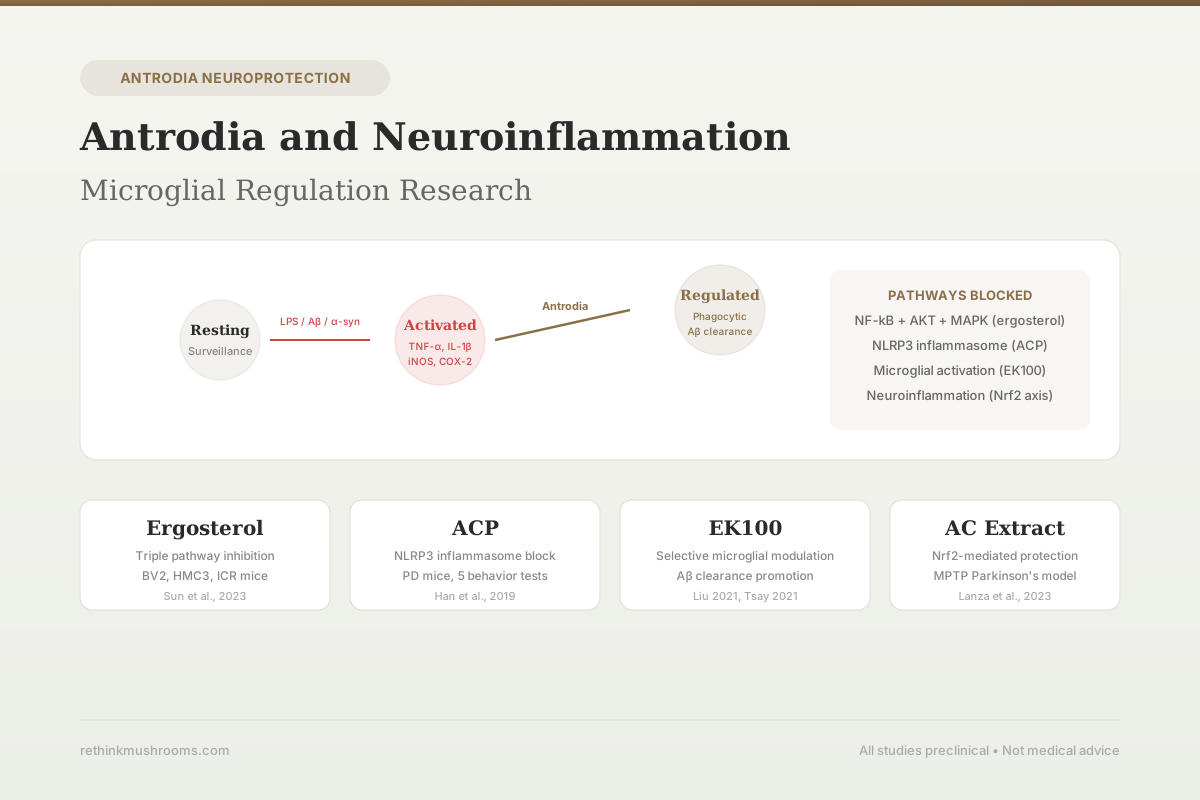
Microglia are the brain's resident immune cells. When they detect damage signals, pathogens, or protein aggregates like amyloid beta, they shift from a surveillance state to an activated state, releasing pro-inflammatory cytokines, reactive oxygen species, and nitric oxide. This neuroinflammatory response is protective in the short term but becomes destructive when sustained, driving neuron death in Alzheimer's disease, Parkinson's disease, and ischemic stroke. Antrodia camphorata produces at least four compound classes that regulate microglial activation through distinct molecular pathways: ergosterol inhibits NF-kB/AKT/MAPK signaling, EK100 modulates microglial morphology and phagocytosis, antrodin C promotes perivascular amyloid clearance, and polysaccharides suppress the NLRP3 inflammasome.[1] For how these anti-neuroinflammatory mechanisms connect to Antrodia's amyloid beta clearance research, microglial regulation is the bridge between inflammation control and plaque removal.
Key Takeaways
- Ergosterol from Antrodia camphorata suppressed LPS-induced IL-1beta and TNF-alpha in both BV2 and HMC3 microglial cell lines by inhibiting NF-kB, AKT, and MAPK signaling, with in vivo confirmation showing reduced IBA-1 levels and restored synaptic protein expression in LPS-injected ICR mice (Sun et al., 2023)
- Antrodia camphorata polysaccharide reduced NLRP3 inflammasome expression, IL-1beta, and caspase-1 in the striatum of 6-OHDA-induced Parkinson's disease mice, improving dopamine levels and motor behavior across five neurobehavioral tests (Han et al., 2019)
- EK100 from Antrodia rescued learning, memory, and motor function in Drosophila Alzheimer's models by reducing microglial activation markers without altering oxidative stress pathways (Liu et al., 2021)
- EK100 and antrodin C promoted plaque-associated microglia to express oxidative enzymes for amyloid clearance in APP/PS1 transgenic mice, with EK100 additionally improving hippocampal neurogenesis (Tsay et al., 2021)
- Antrodia camphorata extract at 10 to 100 mg/kg reduced alpha-synuclein-positive neurons and neuroinflammation while restoring myelination in MPTP-induced Parkinson's disease mice through Nrf2 activation (Lanza et al., 2023)
- Ganoderma lucidum polysaccharides attenuated Abeta42-induced microglial neuroinflammation and modulated phagocytosis through MCP-1 and C1q regulation in BV2 cells and zebrafish brain (Cai et al., 2017)
How Microglia Drive Neurodegeneration
Microglia constitute 5 to 12% of brain cells and function as both the immune system and the cleanup crew of the central nervous system. In their resting state, they continuously survey the local environment with branching processes. When they encounter damage-associated molecular patterns (like amyloid beta aggregates) or pathogen-associated molecular patterns (like bacterial lipopolysaccharide), they retract their processes, become amoeboid, and initiate an inflammatory response.
The activated state involves NF-kB nuclear translocation, which drives transcription of iNOS (producing neurotoxic nitric oxide), COX-2 (producing inflammatory prostaglandins), TNF-alpha, IL-1beta, and IL-6. These mediators recruit more microglia, activate astrocytes, and directly damage neurons. In Alzheimer's and Parkinson's disease, the persistent presence of amyloid plaques or alpha-synuclein aggregates creates a chronic activation state where microglia cause more damage than the original pathology.[2]
The research question is whether microglial activation can be dampened without eliminating the beneficial phagocytic function that clears debris and protein aggregates. Several Antrodia compounds appear to achieve exactly this balance.
Ergosterol: Triple Pathway Inhibition in Microglia
Sun et al. (2023) identified ergosterol from Antrodia camphorata as an anti-neuroinflammatory agent through screening a natural compounds library. In BV2 murine microglial cells and HMC3 human microglial cells stimulated with LPS, ergosterol significantly decreased pro-inflammatory cytokines IL-1beta and TNF-alpha.[1]
The mechanistic analysis revealed triple pathway inhibition: ergosterol suppressed the NF-kB pathway (blocking the master inflammatory transcription factor), the AKT pathway (blocking a survival/proliferation kinase that amplifies inflammatory signaling), and the MAPK pathway (blocking stress-activated kinases that promote cytokine production). This simultaneous inhibition of three parallel signaling cascades is broader than single-pathway inhibitors and may explain ergosterol's potent anti-neuroinflammatory effect.[1]
In vivo, ICR mice injected with LPS and treated with ergosterol showed significant decreases in IBA-1 (ionized calcium-binding adapter molecule-1, the standard marker for microglial activation), NF-kB phosphorylation, and pro-inflammatory cytokine levels in brain tissue. Ergosterol pretreatment also restored expression of synaptic proteins that LPS had reduced, indicating protection of neuronal connectivity.[1] The NF-kB inhibition mechanism connects directly to the anti-inflammatory triterpenoid research demonstrating NF-kB blockade in peripheral tissues.
NLRP3 Inflammasome Suppression in Parkinson's Disease
The NLRP3 inflammasome is a multi-protein complex in microglia that, when activated, triggers caspase-1-mediated processing of pro-IL-1beta into its active, secreted form. NLRP3 activation has been identified as a major driver of neuroinflammation in Parkinson's disease, where damaged mitochondria and alpha-synuclein aggregates provide the activation signals.
Han et al. (2019) tested Antrodia camphorata polysaccharide (ACP) in a 6-hydroxydopamine (6-OHDA)-induced Parkinson's disease mouse model. After ACP intervention, five neurobehavioral assessments (open field activity, rotary test, pole test, gait analysis, and swimming test) showed significant improvement. Striatal dopamine levels increased, and tyrosine hydroxylase expression was elevated, indicating preservation of dopaminergic neuron function.[3]
The mechanistic target was the NLRP3 inflammasome: immunohistochemistry showed decreased NLRP3 expression in the striatum, and Western blotting confirmed reduced NLRP3, IL-1beta, caspase-1, and procaspase-1 protein levels. ACP specifically dampened the inflammasome-driven inflammatory cascade while preserving dopaminergic neurotransmission.[3]
This finding is significant because NLRP3 inhibition represents a more targeted anti-inflammatory approach than general NF-kB blockade. By interrupting the inflammasome specifically, ACP prevents the processing and release of IL-1beta (the most damaging neuroinflammatory cytokine in Parkinson's) without broadly suppressing all NF-kB-dependent gene expression.
The breadth of neurobehavioral improvement is also notable. The 6-OHDA model produces PD-like symptoms including tremor, rigidity, reduced spontaneous activity, and bradykinesia. ACP improved performance across all five behavioral tests, and the elevated striatal dopamine levels confirmed that the behavioral improvements reflected genuine dopaminergic neuron protection rather than a non-specific motor stimulant effect. The polysaccharide fraction of Antrodia camphorata is structurally distinct from the triterpenoid and sterol fractions, indicating that both major compound classes in this fungus contribute to its neuroinflammatory effects through complementary mechanisms.
EK100: Selective Microglial Modulation Without Antioxidant Effects
Liu et al. (2021) used a Drosophila Alzheimer's model (pan-neuronal overexpression of human amyloid beta) to demonstrate that EK100 (ergosta-7,9(11),22-trien-3beta-ol) from Antrodia camphorata rescues neurodegenerative deficits specifically through microglial modulation. Treated flies showed improved lifespan, motor function, learning, and memory.[4]
The critical mechanistic dissociation: biomarkers of microglial activation and inflammation were reduced in EK100-treated animals, while lipid peroxidation, catalase activity, and superoxide dismutase activity remained unchanged. This clean separation demonstrates that EK100 does not work as a general antioxidant that happens to reduce inflammation as a secondary effect. Instead, it directly modulates microglial activation through a pathway that is independent of oxidative stress markers.[4]
This selectivity matters for drug development. Many natural compounds show anti-neuroinflammatory effects that turn out to be mediated by non-specific antioxidant activity, and general antioxidant approaches have largely failed in clinical trials for neurodegenerative diseases. Vitamin E, vitamin C, and coenzyme Q10 all failed to slow progression of Alzheimer's disease in randomized controlled trials despite strong in vitro antioxidant activity. EK100's targeted microglial mechanism bypasses this failure mode entirely by acting on the inflammatory signaling that drives neuronal damage, rather than attempting to scavenge the downstream oxidative damage products. The specific molecular target within the microglial activation cascade has not yet been identified, but its independence from oxidative stress markers narrows the candidate pathways considerably.
Microglial Phagocytosis: Clearing Amyloid Without Causing Damage
Tsay et al. (2021) demonstrated that EK100 and antrodin C from Antrodia cinnamomea reprogram microglial function from destructive neuroinflammation toward productive amyloid clearance. In APPswe/PS1dE9 transgenic Alzheimer's mice treated for 1 month, both compounds promoted plaque-associated microglia to express oxidative enzymes involved in amyloid beta degradation and enhanced perivascular deposition of amyloid beta for drainage along blood vessel walls.[5]
The two compounds differed in their microglial effects: EK100 and antrodin C showed significantly different patterns in activating astrocytes, regulating microglial morphology, and promoting plaque-associated microglial enzyme expression. This suggests they engage complementary aspects of microglial function. EK100 additionally improved hippocampal neurogenesis in the treated mice, a regenerative effect beyond inflammation control.[5]
The plaque reduction occurred without decreased soluble amyloid beta in hippocampus or serum, confirming that the mechanism is enhanced clearance rather than reduced production. This distinction is important: many failed Alzheimer's drug candidates targeted amyloid production (gamma-secretase and beta-secretase inhibitors), while clearance-promoting approaches may better address the existing plaque burden in established disease. For broader context on Antrodia and cognitive decline research, microglial clearance promotion is one of multiple cognitive protection mechanisms.
Nrf2-Mediated Neuroinflammation Control in Parkinson's Disease
Lanza et al. (2023) showed that Antrodia camphorata extract at 10, 30, and 100 mg/kg by daily oral gavage reduced neuroinflammation in MPTP-induced Parkinson's disease mice through Nrf2 activation. The treatment reduced alpha-synuclein-positive neurons (a Parkinson's hallmark), restored myelination of neurons, and increased tyrosine hydroxylase expression (the rate-limiting enzyme for dopamine synthesis).[6]
The Nrf2-dependent mechanism links neuroinflammation control to the broader cellular antioxidant mechanisms that Antrodia activates. By upregulating Nrf2 and its target genes (HO-1, NQO-1, SOD), Antrodia shifts microglial signaling from the pro-inflammatory NF-kB program toward the protective antioxidant program. This Nrf2/NF-kB seesaw effect has been independently confirmed in peripheral tissue models and appears to operate similarly in the central nervous system.[6]
Context: Other Mushroom Species and Microglial Regulation
Antrodia is not the only medicinal mushroom with demonstrated microglial effects. Cai et al. (2017) showed that Ganoderma lucidum polysaccharides (GLP) attenuated both LPS- and amyloid beta 42-induced neuroinflammation in BV2 and primary mouse microglia. GLP downregulated pro-inflammatory cytokines and promoted anti-inflammatory cytokine expression, while modulating microglial migration, morphology, and phagocytosis.[7]
The modulation of microglial phagocytosis is particularly relevant: GLP's effects were associated with MCP-1 and C1q expression changes, and were confirmed in zebrafish brain in vivo. The convergence of Antrodia and Ganoderma on microglial regulation through different active compounds (triterpenoids vs. polysaccharides) suggests that microglial modulation may be a common neuroprotective mechanism across medicinal mushrooms, mediated by diverse compound classes.[7]
Limitations and Evidence Gaps
All studies are preclinical. No human trial has measured Antrodia's effects on brain microglial activation, and such measurements would require specialized PET imaging with TSPO ligands, which has not been attempted. The cell culture studies (Sun 2023, BV2/HMC3 cells) use immortalized microglial cell lines that may not perfectly recapitulate primary microglial biology.
The animal models span different species and disease paradigms: LPS-injected ICR mice (acute neuroinflammation), 6-OHDA-induced PD mice (toxin-based Parkinson's model), MPTP-induced PD mice (different toxin-based model), APP/PS1 transgenic mice (genetic Alzheimer's model), and Drosophila with human amyloid beta overexpression. This diversity strengthens the evidence that Antrodia compounds regulate microglia across contexts, but each model has limitations that do not fully replicate human disease.
Blood-brain barrier penetration has been confirmed for antroquinonol but not specifically for ergosterol, EK100, or Antrodia polysaccharides. Whether these compounds reach effective concentrations in human brain tissue after oral dosing remains unknown. The polysaccharide fraction (Han et al., 2019) faces particular bioavailability questions given the large molecular size of polysaccharides and their typical digestion in the gut. For comprehensive analysis of Antrodia camphorata in neurodegenerative disease, the BBB penetration question remains the most significant translational barrier.
The Bottom Line
Antrodia camphorata regulates microglial neuroinflammation through at least four distinct mechanisms: ergosterol inhibits NF-kB/AKT/MAPK triple signaling in microglia and restores synaptic proteins in vivo, polysaccharides suppress the NLRP3 inflammasome in Parkinson's models, EK100 modulates microglial activation independently of antioxidant effects, and EK100 plus antrodin C reprogram microglia from destructive inflammation toward productive amyloid clearance. All evidence is preclinical, with BBB penetration confirmed for antroquinonol but not for most other active compounds.
Frequently Asked Questions
Sources & References
- 1RTHM-00853·Sun, Ping et al. (2023). “Ergosterol Isolated from Antrodia camphorata Suppresses LPS-Induced Neuroinflammatory Responses in Microglia Cells and ICR Mice..” Molecules (Basel.Study breakdown →PubMed →↩
- 2RTHM-00890·Li, Weiling et al. (2024). “Current and further outlook on the protective potential of Antrodia camphorata against neurological disorders..” Frontiers in pharmacology.Study breakdown →PubMed →↩
- 3RTHM-00558·Han, Chenyang et al. (2019). “Study on antrodia camphorata polysaccharide in alleviating the neuroethology of PD mice by decreasing the expression of NLRP3 inflammasome..” Phytotherapy research : PTR.Study breakdown →PubMed →↩
- 4RTHM-00703·Liu, Hsin-Ping et al. (2021). “Ergosta-7,9(11),22-trien-3β-ol Rescues AD Deficits by Modulating Microglia Activation but Not Oxidative Stress..” Molecules (Basel.Study breakdown →PubMed →↩
- 5RTHM-00724·Tsay, Huey-Jen et al. (2021). “EK100 and Antrodin C Improve Brain Amyloid Pathology in APP/PS1 Transgenic Mice by Promoting Microglial and Perivascular Clearance Pathways..” International journal of molecular sciences.Study breakdown →PubMed →↩
- 6RTHM-00836·Lanza, Marika et al. (2023). “The Transcription Factor Nrf2 Mediates the Effects of Antrodia camphorata Extract on Neuropathological Changes in a Mouse Model of Parkinson's Disease..” International journal of molecular sciences.Study breakdown →PubMed →↩
- 7RTHM-00462·Cai, Qing et al. (2017). “Polysaccharides from Ganoderma lucidum attenuate microglia-mediated neuroinflammation and modulate microglial phagocytosis and behavioural response..” Journal of neuroinflammation.Study breakdown →PubMed →↩