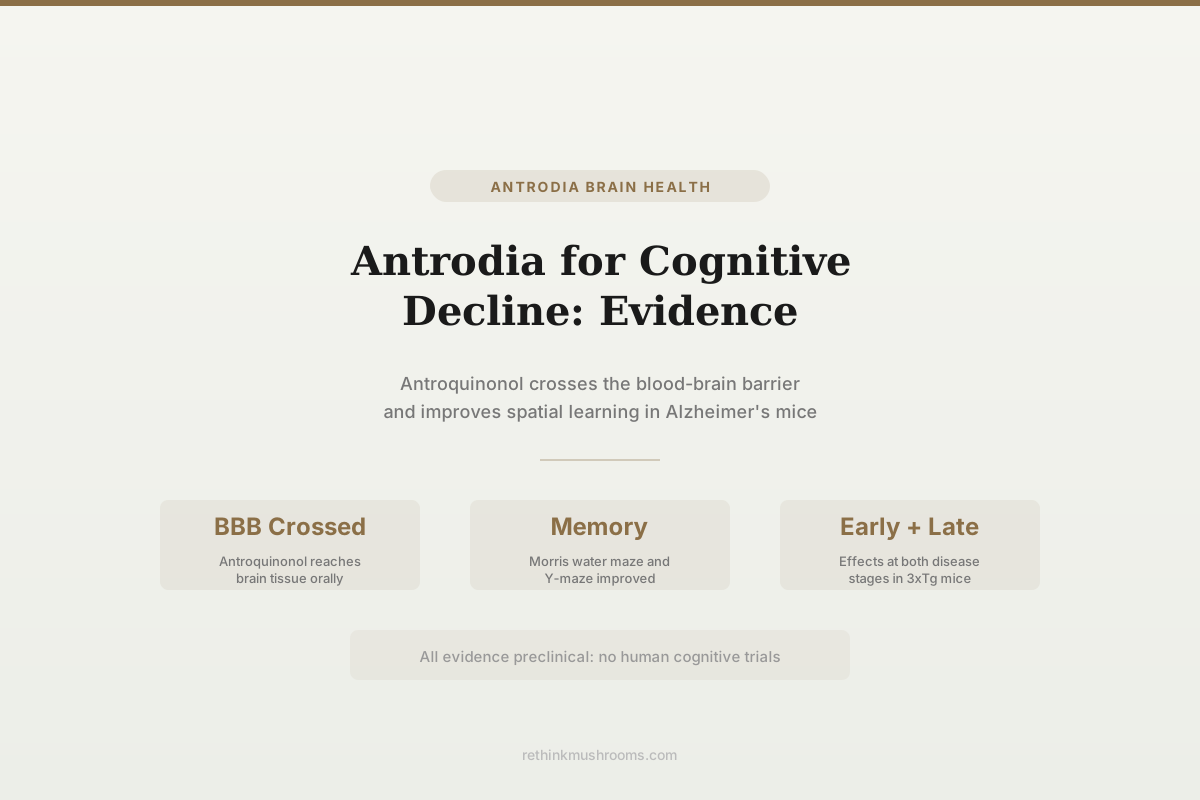
Antrodia Brain Health
BBB penetration
Antroquinonol from Antrodia camphorata crossed the blood-brain barrier and improved spatial learning and memory in APP transgenic Alzheimer's mice after 2 months of oral consumption.
Chang et al., Scientific Reports, 2015
Morris Maze
spatial learning improved
Aβ Reduced
hippocampal amyloid-beta lowered
5 Studies
with cognitive/behavioral endpoints
Chang et al., Scientific Reports, 2015
 View as image ↗
Cognitive decline defines the lived experience of neurodegenerative disease more than any molecular marker. A patient does not feel their amyloid-beta levels rise, but they notice when they cannot find their way home or remember a conversation from an hour ago. While most Antrodia camphorata brain research focuses on cellular pathology (neuronal death, protein aggregation, inflammation), a subset of studies has measured what matters most: whether the animal can still learn, remember, and navigate. For the molecular mechanisms behind these cognitive effects, see the companion article on Antrodia and neurodegenerative disease.
Five preclinical studies have measured cognitive and behavioral outcomes after Antrodia treatment in rodent models of Alzheimer's disease and Parkinson's disease. The standout finding is that antroquinonol, a ubiquinone derivative from Antrodia, crosses the blood-brain barrier after oral administration and improves spatial learning and memory in transgenic Alzheimer's mice. All evidence is in rodents. No human cognitive trials have been conducted.
Key Takeaways
- Antroquinonol crossed the blood-brain barrier and improved Morris water maze performance in APP transgenic Alzheimer's mice after 2 months of oral consumption, while reducing hippocampal amyloid-beta and astrogliosis (Chang et al., 2015)
- In 3xTg Alzheimer's mice, antroquinonol administered at early stage (11 weeks) reduced brain Aβ42 and systemic inflammation; at late stage (9 months) it improved memory impairment across multiple behavioral tests (Francesca et al., 2022)
- Antrodia fruiting body improved working memory more than mycelium in Alzheimer's model rats receiving continuous brain Aβ40 infusion, correlated with greater amyloid-beta reduction and tau suppression (Wang et al., 2012)
- Antrodia polysaccharides improved five motor-cognitive behavioral measures (open field, rotary, pole, gait, swimming) in 6-OHDA Parkinson's mice by restoring striatal dopamine (Han et al., 2019)
- Antrodia extract (10-100 mg/kg oral) restored motor function and reduced alpha-synuclein in MPTP Parkinson's mice through Nrf2 activation (Lanza et al., 2023)
Antroquinonol and Spatial Memory in Alzheimer's Mice
The strongest cognitive evidence for Antrodia comes from Chang et al. (2015), published in Scientific Reports, who tested antroquinonol in APP transgenic mice.[1] APP transgenic mice overexpress amyloid precursor protein and progressively develop amyloid-beta plaques, neuroinflammation, and cognitive deficits that model human Alzheimer's disease.
The study first established that antroquinonol can cross the blood-brain barrier after oral administration, addressing the fundamental pharmacokinetic question that limits many natural product candidates for brain diseases. Two months of oral antroquinonol consumption produced three measurable cognitive and pathological outcomes:
- Improved spatial learning and memory in the Morris water maze, the gold-standard behavioral test for hippocampal-dependent spatial cognition in rodents. Mice must learn to find a hidden platform in a pool using spatial cues; faster learning and better retention indicate preserved hippocampal function.
- Reduced hippocampal amyloid-beta levels, directly linking the cognitive improvement to reduced AD pathology in the brain region most critical for memory formation.
- Reduced astrogliosis (reactive astrocyte proliferation), indicating decreased neuroinflammation in the treated animals.
The proposed mechanism involves Nrf2 pathway activation. Antroquinonol activates nuclear transcription factor erythroid-2-related factor 2 (Nrf2), which is downregulated in Alzheimer's disease. Nrf2 activation upregulates antioxidant and anti-inflammatory defenses, potentially breaking the cycle of oxidative stress and inflammation that drives amyloid-beta toxicity and cognitive decline.[1]
The confirmed BBB penetration distinguishes antroquinonol from many other natural compounds studied for brain diseases. The blood-brain barrier blocks approximately 98% of small molecules and virtually all large molecules from entering brain tissue. A compound that demonstrably reaches the brain after oral dosing has cleared the most basic pharmacokinetic hurdle for a CNS-active agent.
Early vs. Late Intervention in Triple-Transgenic Mice
Francesca et al. (2022) extended the antroquinonol evidence using a more severe model (3xTg mice carrying PS1, APP, and tau mutations) and testing two clinically relevant scenarios: early intervention (before symptoms appear) and late intervention (after disease is established).[2]
Antroquinonol was administered daily for 8 weeks to male transgenic mice at either 11 weeks (early stage, before cognitive symptoms manifest) or 9 months (late stage, when disease pathology is established). The behavioral test battery was comprehensive: elevated plus maze (anxiety-related behavior), water maze (spatial memory), novel object recognition (recognition memory), and Y-maze (working memory and exploratory behavior).
At early stage, higher-dose antroquinonol reduced brain Aβ42 levels and systemic inflammatory markers. When administered at late stage, antroquinonol improved memory impairment across multiple behavioral tests, with the higher drug dose showing effects across all behavioral measures.[2]
The early-vs-late comparison is important because most Alzheimer's drug candidates show effects only in prevention (early) but fail to reverse established disease. That antroquinonol showed behavioral improvement even at 9 months, when the 3xTg model has substantial pathology, suggests it may have both preventive and therapeutic potential. However, this is a single study in one mouse model, and the degree of pathology in 9-month 3xTg mice still does not match the severity of moderate-to-advanced human Alzheimer's disease.
Fruiting Body vs. Mycelium: Different Cognitive Outcomes
Wang et al. (2012) provided the most direct comparison of how different Antrodia preparations affect cognitive function.[3] Rats received continuous brain infusion of amyloid-beta-40 to model Alzheimer's pathology, then were treated with either fruiting body or mycelium preparations.
The fruiting body produced greater improvement in working memory than mycelium. This cognitive advantage correlated with three molecular differences: stronger antioxidant capacity, greater reduction of brain amyloid-beta-40 accumulation, and suppression of hyperphosphorylated tau protein (p-tau). The mycelium did not suppress p-tau, a distinction that may explain the cognitive gap between preparations.[3]
Tau hyperphosphorylation is increasingly recognized as a better predictor of cognitive decline than amyloid-beta levels alone. The neurofibrillary tangles formed by hyperphosphorylated tau correlate more closely with cognitive symptom severity in human Alzheimer's patients than plaque density does. The fruiting body's ability to suppress p-tau expression, absent in the mycelium, may be the mechanistic reason it produced better cognitive outcomes. This difference is likely attributable to the higher triterpenoid concentration in fruiting body preparations. For more on how amyloid-beta reduction connects to broader Antrodia Alzheimer's research, the sibling article covers the molecular clearance mechanisms.
Motor-Cognitive Function in Parkinson's Models
Parkinson's disease impairs both motor and cognitive function. The behavioral tests used in Parkinson's models capture aspects of both domains that are inseparable in the disease experience.
Han et al. (2019) measured five behavioral endpoints in 6-OHDA-treated Parkinson's mice after Antrodia polysaccharide (ACP) treatment: open field activity (spontaneous exploration and anxiety), rotary test (motor coordination), pole test (motor planning and execution), gait analysis (walking pattern regularity), and swimming test (complex motor coordination).[4] ACP improved all five measures. The improvements correlated with elevated striatal dopamine levels and reduced NLRP3 inflammasome expression.
Lanza et al. (2023) confirmed functional improvement in a different Parkinson's model (MPTP) using oral Antrodia extract at 10, 30, and 100 mg/kg.[5] Treatment restored motor function alongside increased tyrosine hydroxylase expression and reduced alpha-synuclein aggregation. The Nrf2 pathway was identified as the mediating mechanism, connecting the Parkinson's motor improvements to the same transcription factor that drives cognitive improvement in the Alzheimer's antroquinonol studies.
This convergence on Nrf2 across both disease models is mechanistically significant. Nrf2 activation reduces the oxidative stress and neuroinflammation that drive cognitive and motor decline in both Alzheimer's and Parkinson's disease. A single compound class that addresses both conditions through a shared upstream mechanism has broader potential than disease-specific agents. For more on how Antrodia modulates the neuroinflammatory pathways that connect to cognitive decline, the sibling article covers microglial regulation in depth.
What Cognitive Tests in Mice Actually Measure
Interpreting these results requires understanding what rodent cognitive tests can and cannot tell us about human cognitive function.
The Morris water maze tests hippocampal-dependent spatial memory, a function that deteriorates early in Alzheimer's disease. Improved maze performance in mice correlates with preserved hippocampal structure and function. However, mice navigate by spatial cues in a pool, not by complex language-based memory and reasoning that characterizes human cognitive life.
The novel object recognition test measures recognition memory, which depends on perirhinal cortex function. Mice that remember a previously encountered object spend less time exploring it. This test captures a simpler cognitive function than human episodic memory.
The Y-maze tests working memory and spontaneous alternation, reflecting prefrontal cortex function. It is a relatively crude measure of executive function compared to the complex decision-making and planning abilities affected in human neurodegenerative disease.
These tests are standard and validated for their purpose: screening compounds that affect brain function. But they capture only a fraction of human cognitive experience. A compound that improves maze navigation in a mouse does not necessarily preserve the ability to manage finances, maintain social relationships, or recognize family members in a human patient.
Limitations and the Translation Gap
No human cognitive trials exist. The gap between mouse behavioral tests and human cognitive endpoints is among the largest in translational neuroscience. Hundreds of compounds have improved cognition in Alzheimer's mouse models and then failed in human trials.
Mouse models do not replicate human disease complexity. APP transgenic mice develop amyloid plaques but lack the full spectrum of human Alzheimer's pathology, including extensive neuronal loss, vascular pathology, and the decades-long disease course. The 3xTg model adds tau and presenilin mutations but is still an imperfect approximation.
Dosing durations are short relative to disease timescale. Two months (Chang et al., 2015) and 8 weeks (Francesca et al., 2022) of treatment in mice correspond to a small fraction of the disease course. Whether sustained treatment over years would maintain cognitive benefits, produce tolerance, or reveal cumulative toxicity is unknown.
Antroquinonol is one specific compound, not Antrodia. The cognitive studies used purified antroquinonol, not crude Antrodia extracts. Commercial Antrodia products contain variable amounts of antroquinonol depending on the preparation method and strain. The BBB penetration and cognitive effects demonstrated for purified antroquinonol cannot be assumed for whole-extract products. Antroquinonol content varies by orders of magnitude between different cultivation methods: fruiting body, dish culture, submerged fermentation, and solid-state culture all produce different chemical profiles. Without standardization to a specific antroquinonol content, product-to-study comparisons are invalid.
The fruiting body advantage lacks mechanistic confirmation. Wang et al. (2012) showed better cognitive outcomes with fruiting body, but the specific compound(s) responsible and the dose required for cognitive effects have not been isolated. The correlation with higher triterpenoid content is suggestive but not definitive.
Publication bias likely inflates the apparent effect size. Studies showing positive cognitive effects in animal models are far more likely to be published than null results. The true effect of Antrodia compounds on rodent cognition may be smaller than the published literature suggests. No systematic review or meta-analysis of Antrodia cognitive studies has been conducted.
Cognitive test validity varies. The Morris water maze is well-validated for spatial memory but is stress-inducing (mice do not enjoy swimming), which can confound results. Stressed mice may perform worse regardless of treatment, and any anxiolytic effect of the test compound could improve performance independently of genuine cognitive enhancement. The Y-maze and novel object recognition tests are less stressful but measure simpler cognitive functions.
The Bottom Line
Antroquinonol from Antrodia camphorata crosses the blood-brain barrier and improves spatial learning and memory in two transgenic Alzheimer's mouse models, with effects at both early (preventive) and late (therapeutic) disease stages. Fruiting body preparations outperform mycelium for cognitive outcomes, correlating with their higher triterpenoid content and unique ability to suppress tau phosphorylation. Antrodia polysaccharides improve motor-cognitive function in Parkinson's models through NLRP3 suppression and dopamine restoration. All evidence is preclinical, with no human cognitive trials conducted for any Antrodia compound.
Frequently Asked Questions
Sources & References
- 1RTHM-00366·Chang, Wen-Han et al. (2015). “Antroquinonol Lowers Brain Amyloid-β Levels and Improves Spatial Learning and Memory in a Transgenic Mouse Model of Alzheimer's Disease..” Scientific reports.Study breakdown →PubMed →↩
- 2RTHM-00758·Francesca, Fernandez et al. (2022). “Antroquinonol administration in animal preclinical studies for Alzheimer's disease (AD): A new avenue for modifying progression of AD pathophysiology..” Brain.Study breakdown →PubMed →↩
- 3RTHM-00269·Wang, Li-Chun et al. (2012). “In vitro and in vivo comparisons of the effects of the fruiting body and mycelium of Antrodia camphorata against amyloid β-protein-induced neurotoxicity and memory impairment..” Applied microbiology and biotechnology.Study breakdown →PubMed →↩
- 4RTHM-00558·Han, Chenyang et al. (2019). “Study on antrodia camphorata polysaccharide in alleviating the neuroethology of PD mice by decreasing the expression of NLRP3 inflammasome..” Phytotherapy research : PTR.Study breakdown →PubMed →↩
- 5RTHM-00836·Lanza, Marika et al. (2023). “The Transcription Factor Nrf2 Mediates the Effects of Antrodia camphorata Extract on Neuropathological Changes in a Mouse Model of Parkinson's Disease..” International journal of molecular sciences.Study breakdown →PubMed →↩