Antrodia Neuroprotection
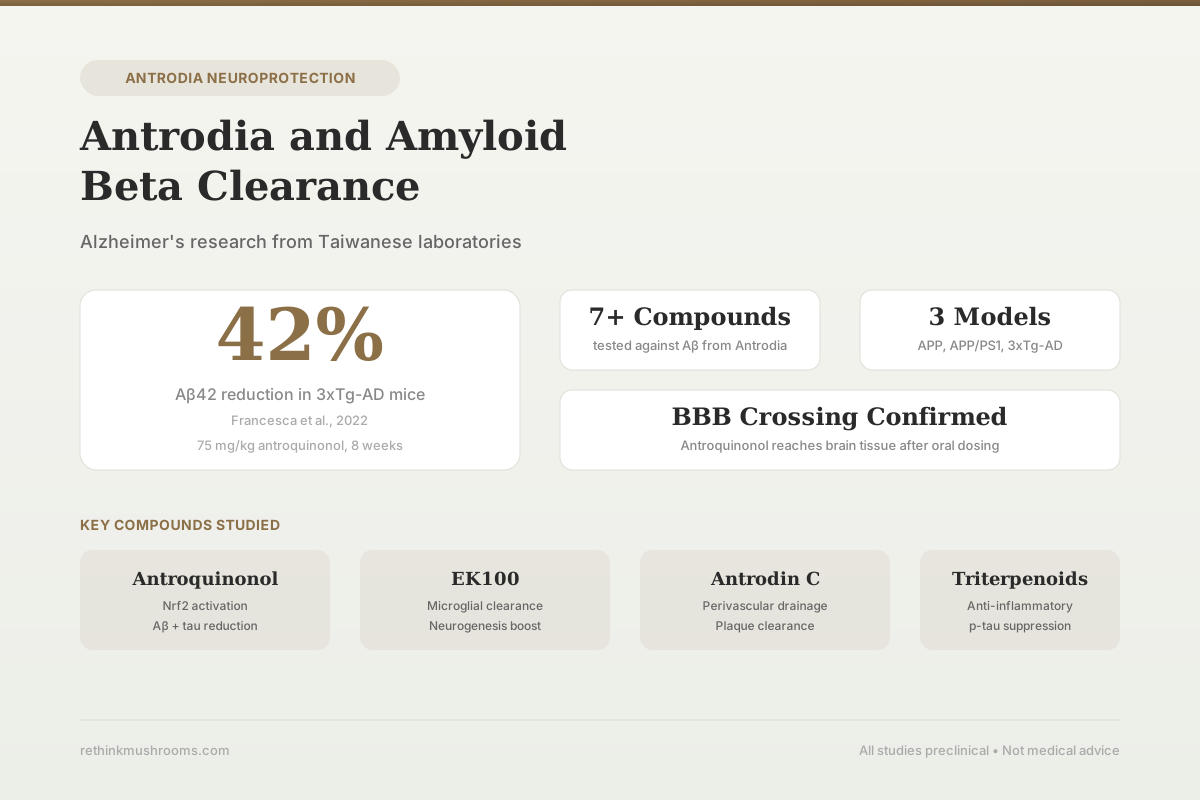
42% Aβ42 reduction
Antroquinonol at 75 mg/kg reduced brain amyloid beta 42 levels and tau protein in 3xTg-AD transgenic mice after 8 weeks of daily oral treatment.
Francesca et al., Brain, Behavior, & Immunity - Health, 2022
7+ Compounds
tested against Aβ from Antrodia
3 Models
APP, APP/PS1, 3xTg-AD mice used
BBB Crossing
antroquinonol confirmed to cross
Francesca et al., Brain, Behavior, & Immunity - Health, 2022
 View as image ↗
Amyloid beta peptides accumulate in the brains of Alzheimer's disease patients, forming plaques that disrupt synaptic function and trigger neuronal death. Antrodia camphorata, a medicinal fungus found exclusively on the inner heartwood of Cinnamomum kanehirai trees in Taiwan, produces multiple bioactive compounds that reduce these amyloid deposits in preclinical models. Research from Taiwanese laboratories has identified at least four distinct Antrodia-derived compounds with anti-amyloid activity, each working through different mechanisms: antroquinonol activates the Nrf2 pathway, EK100 promotes microglial clearance, antrodin C enhances perivascular drainage, and the fruiting body triterpenoids suppress tau phosphorylation.[1] For broader context on how Antrodia camphorata protects neurons through multiple pathways, see our overview of Antrodia neuroprotective research.
Key Takeaways
- Antroquinonol reduced hippocampal amyloid beta levels and improved spatial learning and memory in APP transgenic mice after 2 months of oral dosing (Chang et al., 2015)
- In 3xTg-AD mice carrying amyloid, tau, and presenilin mutations, antroquinonol at 75 mg/kg reduced brain Aβ42, tau, and phospho-tau while lowering systemic IL-1β and TNF-α (Francesca et al., 2022)
- EK100 and antrodin C reduced amyloid plaque number and burden in APP/PS1 mice by promoting microglial and perivascular clearance rather than inhibiting Aβ production (Tsay et al., 2021)
- Antrodia camphorata fruiting body extract provided stronger anti-amyloid and anti-tau effects than mycelium extract in Aβ40-infused rat brains, correlating with higher triterpenoid content (Wang et al., 2012)
- EK100 improved motor function, learning, and memory in a Drosophila Alzheimer's model by modulating microglial activation markers without altering oxidative stress pathways (Liu et al., 2021)
- All studies remain preclinical with no completed human Alzheimer's trials, though antroquinonol has passed Phase I safety evaluation for other indications
How Amyloid Beta Accumulates in Alzheimer's Disease
Amyloid beta peptides are cleaved from amyloid precursor protein (APP) by beta-secretase and gamma-secretase enzymes. In healthy brains, these fragments are cleared through multiple pathways: microglial phagocytosis, enzymatic degradation, perivascular drainage along blood vessel walls, and transport across the blood-brain barrier.[2] When production outpaces clearance, Aβ monomers aggregate into oligomers, then fibrils, and finally the dense plaques visible on brain imaging.
The Aβ42 variant is particularly prone to aggregation. It triggers a cascade: activating microglia and astrocytes, inducing oxidative stress through reactive oxygen species, promoting hyperphosphorylation of tau protein into neurofibrillary tangles, and disrupting synaptic signaling. This dual pathology of plaques and tangles defines Alzheimer's at the molecular level.
Antrodia camphorata compounds target multiple steps in this cascade. Rather than a single mechanism, the research from Taiwanese laboratories reveals a portfolio of compounds that address Aβ production, clearance, and downstream toxicity through distinct pathways.
Antroquinonol: Activating the Nrf2 Defense Pathway
Antroquinonol, a ubiquinone derivative isolated from Antrodia camphorata mycelium, is the most extensively studied Antrodia compound for Alzheimer's applications. Its mechanism centers on nuclear transcription factor erythroid-2-related factor 2 (Nrf2), a master regulator of antioxidant and anti-inflammatory gene expression that is downregulated in Alzheimer's disease brains.[3]
Chang et al. (2015) demonstrated that antroquinonol crosses the blood-brain barrier after oral administration. In APP transgenic mice, 2 months of antroquinonol consumption produced three measurable effects: improved learning and memory performance on the Morris water maze test, reduced hippocampal Aβ levels, and decreased astrogliosis (the reactive proliferation of astrocytes around plaques). These effects correlated with increased Nrf2 expression and decreased histone deacetylase 2 (HDAC2) levels in treated animals.[3]
A 2022 follow-up study by Francesca et al. tested antroquinonol in the more complex 3xTg-AD mouse model, which carries three human mutations (PS1M146V, APPSwe, and tauP301L) producing both amyloid and tau pathology. Daily oral dosing at 75 mg/kg for 8 weeks in early-stage (11-week-old) mice produced significant reductions in brain Aβ42 and tau levels, systemic inflammatory markers IL-1β and TNF-α, and behavioral impairment across all tested paradigms including elevated plus maze, water maze, object recognition, and Y-maze.[4]
When administered at a late stage (9-month-old mice with established disease), the 75 mg/kg dose still improved memory impairment and reduced tau, phosphorylated tau, and oxidative stress marker 3-nitrotyrosine, while increasing brain Nrf2 levels. The lower dose (34 mg/kg) produced partial effects, suggesting dose dependency.[4] Antroquinonol has been used without adverse effects in prior Phase I clinical trials for non-neurological indications, which provides a foundation for potential Alzheimer's trials, though none have been initiated.
EK100 and Antrodin C: Promoting Amyloid Clearance Through Microglia
A fundamentally different anti-amyloid mechanism was identified in two other Antrodia compounds: EK100 (ergosta-7,9(11),22-trien-3β-ol) and antrodin C. Tsay et al. (2021) screened seven Antrodia cinnamomea components for anti-inflammatory activity in BV2 microglial cells and selected EK100 and antrodin C for in vivo testing in APPswe/PS1dE9 transgenic mice.[5]
After 1 month of treatment, both compounds reduced the number and burden of amyloid plaques, reduced glial cell activation, and improved nesting behavior (a measure of daily function in mice). The researchers noted a distinction: EK100 and antrodin C reduced plaque number without reducing soluble Aβ levels in the hippocampus or serum, indicating that the reduction came from enhanced clearance rather than inhibited production.[5]
Two clearance pathways were identified. Microglial clearance: both compounds promoted plaque-associated microglia to express oxidative enzymes involved in Aβ degradation. Perivascular clearance: both compounds promoted perivascular deposition of Aβ, facilitating drainage along blood vessel walls. EK100 and antrodin C differed in their effects on astrocyte activation and microglia morphology, suggesting complementary mechanisms.[5] EK100 also significantly improved hippocampal neurogenesis in the treated mice, a finding with implications for neuronal replacement in damaged brain regions. For deeper analysis of how Antrodia compounds regulate microglial behavior, see Antrodia and neuroinflammation: microglial regulation.
EK100 in a Drosophila Alzheimer's Model
Liu et al. (2021) independently confirmed EK100's anti-Alzheimer's activity using a Drosophila model with pan-neuronal overexpression of human amyloid beta. EK100 treatment improved lifespan, motor function, learning, and memory compared to untreated controls.[6]
The mechanistic insight from this study narrowed the pathway: biomarkers of microglial activation and inflammation were reduced, while lipid peroxidation, catalase activity, and superoxide dismutase activity remained unchanged. This dissociation indicates that EK100 rescues Alzheimer's deficits specifically through modulation of microglial activation rather than through a general antioxidant effect.[6] The finding is relevant because many natural product candidates show anti-amyloid effects that turn out to be non-specific antioxidant activity, which has largely failed in clinical Alzheimer's trials. EK100's targeted microglial mechanism may represent a more promising therapeutic approach.
Fruiting Body vs. Mycelium: Triterpenoid Content Matters
Wang et al. (2012) compared the anti-amyloid effects of Antrodia camphorata fruiting body and mycelium preparations in both cell culture and an in vivo Alzheimer's rat model (continuous Aβ40 brain infusion). The fruiting body demonstrated stronger anti-oxidative and anti-inflammatory abilities in Aβ40-treated PC-12 neurons and in Aβ40-infused brain tissue.[7]
The performance gap extended to tau pathology: hyperphosphorylated tau (p-tau) expression was suppressed by fruiting body treatment but not by mycelium treatment in both in vitro and in vivo models. Working memory improvement was correspondingly more significant in the fruiting body group. The researchers attributed this difference to the fruiting body's higher content of triterpenoids and total phenols.[7]
This finding matters for supplement formulation: the bioactive compounds most active against amyloid pathology are concentrated in the fruiting body, which is the more expensive and difficult-to-cultivate form of Antrodia camphorata. For more about the distinct bioactive profiles of Antrodia's unique triterpenoid compounds, the chemistry underlying these differences is well characterized.
Deep Ocean Water Enhancement of Anti-Amyloid Activity
Shi et al. (2016) explored an unconventional approach: culturing Antrodia camphorata with deep ocean water (drawn from ocean depths exceeding 200 meters) to enhance its neuroprotective metabolite production. Using response surface methodology, the team optimized culture conditions at 80% deep ocean water concentration, initial pH 3.3, and 20% inoculum size.[8]
These optimized conditions increased Antrodia biomass from 302 to 452 mg per 100 mL, and mycelium-mediated Aβ40-induced cell viability improved from 49.2% to 65.0%. The enhanced neuroprotective activity came from two sources: increased mycelium-secreted components in the culture filtrate and higher intracellular antioxidant levels stimulated by the mineral-rich deep ocean water.[8] While this study is more relevant to cultivation methodology than direct therapeutic application, it demonstrates that Antrodia's anti-amyloid compound production can be significantly enhanced through culture condition optimization. Antrodia's antioxidant activity and free radical protection capacity is closely tied to these cultivation parameters.
Multiple Mechanisms from a Single Fungus
A 2024 comprehensive review by Li et al. mapped the full landscape of Antrodia camphorata's neuroprotective mechanisms. Beyond amyloid clearance, the bioactive metabolites operate through anti-oxidant, anti-inflammatory, anti-apoptotic, and NGF (nerve growth factor) synthesis stimulation pathways. The review also identified an indirect mechanism: gut-microbiome modulation that influences brain inflammation through the gut-brain axis.[9]
The review addressed a practical barrier: blood-brain barrier penetration. While antroquinonol has confirmed BBB crossing, the penetration profile for other Antrodia compounds remains incompletely characterized. The review also noted that crude extracts have passed safety evaluation for human use in clinical trials for non-neurological indications, establishing a safety baseline for potential Alzheimer's research.[9]
Antrodia is not the only medicinal mushroom under investigation for amyloid pathology. Ganoderma lucidum polysaccharides have been shown to attenuate Aβ42-induced microglial neuroinflammation and modulate microglial phagocytosis in BV2 cells and primary mouse microglia, with effects confirmed in zebrafish brain models.[10] The convergence of multiple mushroom species on microglial modulation as a neuroprotective mechanism reinforces the relevance of this pathway for cognitive decline research.
Limitations of the Current Evidence
Every study cited in this article is preclinical. No Antrodia compound has been tested in a human Alzheimer's trial. The transgenic mouse models used (APP, APP/PS1, 3xTg-AD) carry human mutations that cause familial Alzheimer's disease, which accounts for fewer than 5% of total Alzheimer's cases. Whether these compounds would be effective against the far more common sporadic form remains unknown.
Sample sizes across these studies are typical of preclinical research (10-15 animals per group), limiting statistical power. Most studies were conducted in Taiwanese laboratories with access to wild-harvested or cultivated Antrodia camphorata, and independent replication from non-Taiwanese research groups is limited.
The dose translation from mice to humans is uncertain. The 75 mg/kg dose effective in the Francesca et al. (2022) 3xTg-AD study would translate to approximately 6 mg/kg in humans using standard allometric scaling, but pharmacokinetic differences between species make such calculations rough estimates at best. The duration of treatment in most studies (1-2 months) is short relative to the decades-long course of Alzheimer's disease in humans.
Antrodia camphorata remains extremely expensive and difficult to cultivate at scale, with wild fruiting bodies growing exclusively on a single endangered tree species in Taiwan. This supply constraint would complicate any clinical development program, though laboratory cultivation methods continue to advance. For a broader perspective on Antrodia's role in neurodegenerative disease research, the challenges and opportunities extend beyond amyloid clearance alone.
The Bottom Line
Antrodia camphorata produces at least four distinct compound classes with demonstrated anti-amyloid activity in preclinical models: antroquinonol (Nrf2 activation, Aβ reduction, tau reduction), EK100 (microglial clearance promotion), antrodin C (perivascular clearance), and fruiting body triterpenoids (anti-inflammatory, anti-tau). All evidence is preclinical, with no human Alzheimer's trials completed. The specificity of EK100's microglial mechanism, rather than general antioxidant activity, may distinguish it from compounds that have failed in clinical translation.
Frequently Asked Questions
Sources & References
- 1RTHM-00890·Li, Weiling et al. (2024). “Current and further outlook on the protective potential of Antrodia camphorata against neurological disorders..” Frontiers in pharmacology.Study breakdown →PubMed →↩
- 2RTHM-00890·Li, Weiling et al. (2024). “Current and further outlook on the protective potential of Antrodia camphorata against neurological disorders..” Frontiers in pharmacology.Study breakdown →PubMed →↩
- 3RTHM-00366·Chang, Wen-Han et al. (2015). “Antroquinonol Lowers Brain Amyloid-β Levels and Improves Spatial Learning and Memory in a Transgenic Mouse Model of Alzheimer's Disease..” Scientific reports.Study breakdown →PubMed →↩
- 4RTHM-00758·Francesca, Fernandez et al. (2022). “Antroquinonol administration in animal preclinical studies for Alzheimer's disease (AD): A new avenue for modifying progression of AD pathophysiology..” Brain.Study breakdown →PubMed →↩
- 5RTHM-00724·Tsay, Huey-Jen et al. (2021). “EK100 and Antrodin C Improve Brain Amyloid Pathology in APP/PS1 Transgenic Mice by Promoting Microglial and Perivascular Clearance Pathways..” International journal of molecular sciences.Study breakdown →PubMed →↩
- 6RTHM-00703·Liu, Hsin-Ping et al. (2021). “Ergosta-7,9(11),22-trien-3β-ol Rescues AD Deficits by Modulating Microglia Activation but Not Oxidative Stress..” Molecules (Basel.Study breakdown →PubMed →↩
- 7RTHM-00269·Wang, Li-Chun et al. (2012). “In vitro and in vivo comparisons of the effects of the fruiting body and mycelium of Antrodia camphorata against amyloid β-protein-induced neurotoxicity and memory impairment..” Applied microbiology and biotechnology.Study breakdown →PubMed →↩
- 8RTHM-00446·Shi, Yeuching et al. (2016). “Increasing anti-Aβ-induced neurotoxicity ability of Antrodia camphorata-fermented product with deep ocean water supplementary..” Journal of the science of food and agriculture.Study breakdown →PubMed →↩
- 9RTHM-00890·Li, Weiling et al. (2024). “Current and further outlook on the protective potential of Antrodia camphorata against neurological disorders..” Frontiers in pharmacology.Study breakdown →PubMed →↩
- 10RTHM-00462·Cai, Qing et al. (2017). “Polysaccharides from Ganoderma lucidum attenuate microglia-mediated neuroinflammation and modulate microglial phagocytosis and behavioural response..” Journal of neuroinflammation.Study breakdown →PubMed →↩