Antrodia Brain Health
NLRP3 suppressed
Antrodia polysaccharides reduced NLRP3 inflammasome activation in dopaminergic neurons, improving motor function in Parkinson's disease mouse models.
Han et al., Phytotherapy Research, 2019
Alzheimer's
amyloid-beta neurotoxicity reduced
Parkinson's
dopaminergic neurons protected
7 Studies
on Antrodia neuroprotective effects
Han et al., Phytotherapy Research, 2019
 View as image ↗
Neurodegenerative diseases destroy neurons progressively and irreversibly. Alzheimer's disease, characterized by amyloid-beta plaques and tau tangles, affects over 55 million people worldwide. Parkinson's disease, driven by the loss of dopaminergic neurons in the substantia nigra, affects another 10 million. Current treatments manage symptoms but do not halt neuronal death. Antrodia camphorata, a rare Taiwanese medicinal mushroom, has generated preclinical evidence across both disease models through compounds that target neuroinflammation, oxidative stress, and protein aggregation pathways. For the broader picture of how Antrodia protects brain tissue, see Antrodia and brain health.
A 2024 review in Frontiers in Pharmacology cataloged the emerging evidence and identified multiple neuroprotective mechanisms, including antioxidant, anti-inflammatory, and anti-apoptotic activities, NGF synthesis stimulation, beta-amyloid inhibition, and gut-microbiome modulation.[1] All evidence is preclinical. No clinical trials have tested Antrodia in patients with Alzheimer's, Parkinson's, or other neurodegenerative conditions.
Key Takeaways
- Antrodia fruiting body was more effective than mycelium at reducing amyloid-beta neurotoxicity and improving working memory in Alzheimer's model rats, linked to higher triterpenoid content (Wang et al., 2012)
- Antrodia polysaccharides improved motor behavior in 6-OHDA Parkinson's mice by reducing NLRP3 inflammasome expression and restoring striatal dopamine levels (Han et al., 2019)
- A follow-up study confirmed Antrodia polysaccharides protect dopaminergic MES23.5 cells by inhibiting the ROS-NLRP3 signaling cascade (Han et al., 2020)
- Antrodia extract (10-100 mg/kg oral) reduced alpha-synuclein positive neurons, restored tyrosine hydroxylase expression, and attenuated neuroinflammation in MPTP Parkinson's mice through Nrf2 activation (Lanza et al., 2023)
- Diterpene compounds from Antrodia fruiting body protected neurons from amyloid-beta damage by 27-39% at 5-20 microM concentrations (Chen et al., 2006)
- Antrodia extract reduced cerebral infarct volume in embolic stroke rats without increasing hemorrhagic risk (Lee et al., 2014)
Alzheimer's Disease: Targeting Amyloid-Beta and Tau
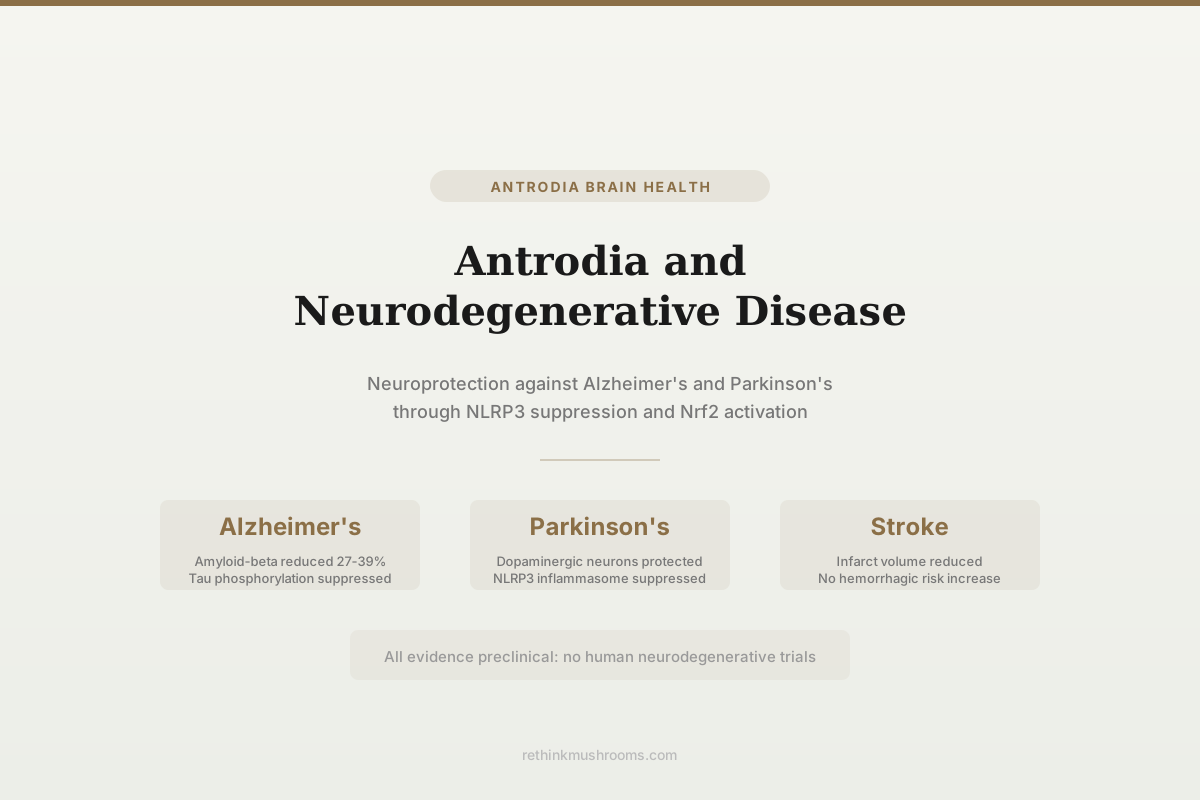
The first evidence that Antrodia could protect against Alzheimer's pathology came from Chen et al. (2006), who isolated diterpene compounds from the fruiting body and tested them against amyloid-beta-induced neurotoxicity in cell culture.[2] Five diterpenes protected neurons from amyloid-beta damage by 27.0% to 39.2% at concentrations between 5 and 20 microM. This was early but limited evidence: isolated compounds in a dish, with no in vivo confirmation.
Wang et al. (2012) substantially expanded this evidence by comparing Antrodia fruiting body and mycelium in both cell culture and a living Alzheimer's model.[3] In PC-12 cells treated with amyloid-beta-40, both preparations reduced neurotoxicity, but the fruiting body showed stronger effects. The fruiting body had greater antioxidant and anti-inflammatory capacity, consistent with its higher triterpenoid and total phenol content.
The in vivo component used rats with continuous brain infusion of amyloid-beta-40, a model that produces Alzheimer's-like pathology. Fruiting body treatment was more effective than mycelium at reducing amyloid-beta-40 accumulation in brain tissue. The fruiting body also suppressed hyperphosphorylated tau protein (p-tau) expression, a pathological hallmark that mycelium treatment failed to reduce. These molecular improvements corresponded to better working memory performance in the fruiting body group.[3]
The fruiting body versus mycelium comparison is practically relevant. Commercial Antrodia products exist in both forms, and this study suggests they are not interchangeable for neuroprotective applications. The superior activity of fruiting body preparations aligns with their higher concentration of triterpenoids, which are the primary neuroprotective compound class. For more detail on the amyloid-beta clearance mechanisms, see Antrodia and amyloid-beta clearance.
Parkinson's Disease: Protecting Dopaminergic Neurons
The Parkinson's disease evidence for Antrodia is more developed than the Alzheimer's data, with three complementary studies published between 2019 and 2023.
Han et al. (2019) established the foundation using 6-hydroxydopamine (6-OHDA) to create Parkinson's-like lesions in mice.[4] After Antrodia polysaccharide (ACP) intervention, the researchers measured neurobehavioral changes across five tests: open field activity, rotary test, pole test, gait analysis, and swimming test. ACP treatment improved motor function across all measures. At the molecular level, striatal dopamine levels increased (measured by HPLC), and the NLRP3 inflammasome, a key driver of neuroinflammation in Parkinson's, showed reduced activation. Expression of NLRP3, IL-1beta, caspase-1, and procaspase-1 all decreased with ACP treatment.
Han et al. (2020) followed up with a mechanistic study in dopaminergic MES23.5 cells.[5] They demonstrated that 6-OHDA induces ROS production, which activates NLRP3, which triggers caspase-1-mediated apoptosis of dopaminergic neurons. ACP interrupted this cascade at the ROS-NLRP3 junction: it inhibited ROS accumulation, prevented NLRP3 activation, and protected MES23.5 cells from apoptosis. Animal experiments confirmed that ACP reduced ROS-NLRP3 activation in the substantia nigra-striatum and improved exercise capacity in Parkinson's mice. For more on how Antrodia regulates neuroinflammation through microglial pathways, the dedicated sibling article covers those mechanisms in depth.
Lanza et al. (2023) provided independent confirmation from an Italian research group using a different Parkinson's model (MPTP instead of 6-OHDA) and identifying a different but complementary mechanism.[6] Antrodia extract administered orally at 10, 30, and 100 mg/kg daily for 7 days after MPTP induction produced several effects: it increased tyrosine hydroxylase expression (the rate-limiting enzyme in dopamine synthesis), reduced the number of alpha-synuclein-positive neurons (alpha-synuclein aggregation is a Parkinson's hallmark), restored the myelination process, and attenuated neuroinflammation. The mechanism centered on the transcription factor Nrf2, a master regulator of cellular antioxidant defenses. Antrodia activated Nrf2, which upregulated downstream antioxidant enzymes.
The Nrf2 pathway is distinct from the NLRP3 pathway targeted by the Han studies. Nrf2 acts upstream to prevent oxidative damage, while NLRP3 mediates the inflammatory response to damage that has already occurred. Having evidence for both pathways suggests Antrodia compounds may protect neurons through multiple, complementary mechanisms.
The NLRP3-Neuroinflammation Connection
The convergence of two independent studies on the NLRP3 inflammasome pathway in Parkinson's models deserves particular attention. Neuroinflammation mediated by microglia and astrocytes is increasingly recognized as a driver of neurodegeneration, not just a secondary response to it. In Parkinson's disease, dying dopaminergic neurons release damage-associated molecular patterns (DAMPs) that activate microglial NLRP3, triggering IL-1beta release that damages neighboring neurons. This creates a self-sustaining cycle of neuronal death and inflammation.
Antrodia polysaccharides appear to break this cycle at the ROS-NLRP3 junction. By reducing the reactive oxygen species that serve as the "ignition signal" for NLRP3 assembly, ACP prevents the downstream inflammatory cascade before it begins. The clinical relevance is that this same ROS-NLRP3 pathway is implicated in Alzheimer's disease as well, where amyloid-beta activates microglial NLRP3 to sustain chronic neuroinflammation. Whether Antrodia polysaccharides could similarly suppress amyloid-driven NLRP3 activation has not been directly tested.
The Nrf2 activation demonstrated by Lanza et al. (2023) provides a complementary upstream mechanism. Nrf2 upregulates phase II detoxification enzymes and antioxidant proteins (including HO-1, NQO1, and glutathione S-transferase), reducing the oxidative burden that would otherwise activate NLRP3. Together, these two pathways create a multi-level defense: Nrf2 prevents oxidative damage from accumulating, and NLRP3 suppression prevents inflammatory amplification if damage does occur.
Cerebrovascular Protection: Stroke Evidence
Lee et al. (2014) tested Antrodia in a rat embolic stroke model, extending the neuroprotection evidence beyond chronic neurodegenerative conditions to acute cerebrovascular injury.[7] Antrodia extract reduced cerebral infarct volume and improved neurological outcomes without increasing the risk of hemorrhagic transformation, a critical safety concern with stroke neuroprotectants.
The anti-inflammatory and antioxidant properties that protect against chronic neurodegeneration also operate in the acute phase after stroke, when oxidative stress and inflammation in the penumbral zone (the tissue surrounding the core infarct) determine how much brain tissue is ultimately lost. Hemorrhagic transformation occurs when tissue plasminogen activator (tPA) or other interventions restore blood flow to weakened vessels, causing bleeding. The fact that Antrodia provided neuroprotection without increasing hemorrhage risk distinguishes it from some other experimental neuroprotectants. This safety profile, if confirmed in larger studies, could be relevant for combination approaches with standard stroke therapies.
Compound Classes and Their Brain-Specific Actions
The neuroprotective effects of Antrodia involve at least three compound classes, each with distinct mechanisms:
Triterpenoids (including antcins and eburicoic acid derivatives): These provide the strongest neuroprotection in the Alzheimer's model. They are concentrated in fruiting body preparations and act as antioxidants and anti-inflammatory agents. Their lipophilic nature may facilitate blood-brain barrier penetration, though direct BBB pharmacokinetic studies are limited.
Polysaccharides: These are the primary Parkinson's disease-relevant compounds in the evidence base. The Han studies (2019, 2020) used polysaccharide fractions specifically. Polysaccharides are large molecules that typically do not cross the blood-brain barrier directly. Their neuroprotective effects may be mediated through peripheral immune modulation, gut-brain axis signaling, or metabolites generated by gut microbiota. The 2024 review by Li et al. specifically highlighted the gut-microbiome-brain axis as an underexplored mechanism.[1]
Diterpenes: Chen et al. (2006) identified these as direct neuroprotective agents against amyloid-beta toxicity at low micromolar concentrations. Their smaller molecular size compared to polysaccharides makes blood-brain barrier penetration more plausible, and their lipophilicity suggests favorable membrane permeability, but pharmacokinetic confirmation including brain tissue concentration measurements after oral administration is needed to validate this assumption.
What the Evidence Cannot Support
No human neurodegenerative disease trials exist. Every finding comes from cell lines (PC-12, MES23.5, HepG2), rodent models (6-OHDA mice, MPTP mice, amyloid-beta infused rats, embolic stroke rats), or in vitro preparations. The gap between "protects rat neurons" and "slows Alzheimer's progression in humans" is among the widest in translational medicine.
Blood-brain barrier penetration is assumed, not proven. Oral Antrodia showed effects in brain tissue of animal models, but the specific compounds reaching the brain and their concentrations have not been measured. The review by Li et al. (2024) identified BBB penetration as a key unresolved question for clinical translation.[1]
Different models test different aspects of disease. 6-OHDA and MPTP are chemical lesion models that mimic dopaminergic neuron death but not the progressive, multi-decade course of human Parkinson's. Amyloid-beta infusion mimics one aspect of Alzheimer's pathology but not the complex interplay of amyloid, tau, synaptic dysfunction, and vascular factors in human disease.
Dose translation is entirely speculative. The effective oral doses in mice (10-100 mg/kg) do not convert directly to human doses. Standard allometric scaling would suggest human-equivalent doses, but without pharmacokinetic data, these calculations are unreliable.
The Italian Lanza study is the only non-Asian replication. While valuable for independence, a single study from one non-Asian group does not constitute robust replication of the broader evidence base.
Polysaccharide BBB penetration is mechanistically unclear. The Han studies showed neuroprotective effects from oral polysaccharide administration, but polysaccharides generally cannot cross the blood-brain barrier due to their large molecular size and hydrophilicity. The neuroprotective effects observed may be mediated indirectly through peripheral immune modulation, vagal nerve signaling, or gut microbiome metabolites. Li et al. (2024) highlighted the gut-microbiome-brain axis as a plausible but unconfirmed mechanism. Until the route from oral polysaccharide to neuronal protection is mapped, the mechanistic explanation remains incomplete.
No dose-response optimization for neuroprotection. Lanza et al. (2023) tested three doses (10, 30, 100 mg/kg) but did not identify a clear dose-response curve or minimum effective dose. The Han studies used single polysaccharide doses. Optimal dosing for neuroprotective effects, which likely differs from hepatoprotective or immunomodulatory dosing, has not been established in any model.
The Bottom Line
Antrodia camphorata demonstrates neuroprotective effects against both Alzheimer's and Parkinson's pathology in preclinical models. For Alzheimer's, fruiting body preparations reduce amyloid-beta neurotoxicity and tau phosphorylation more effectively than mycelial extracts, likely due to higher triterpenoid content. For Parkinson's, polysaccharide fractions protect dopaminergic neurons through NLRP3 inflammasome suppression, while whole extracts activate the Nrf2 antioxidant defense system. Separate evidence shows cerebrovascular protection in stroke models. All findings are preclinical, with no human neurodegenerative disease trials conducted.
Frequently Asked Questions
Sources & References
- 1RTHM-00890·Li, Weiling et al. (2024). “Current and further outlook on the protective potential of Antrodia camphorata against neurological disorders..” Frontiers in pharmacology.Study breakdown →PubMed →↩
- 2RTHM-00092·Chen, Cheng-Chi et al. (2006). “Neuroprotective diterpenes from the fruiting body of Antrodia camphorata..” Journal of natural products.Study breakdown →PubMed →↩
- 3RTHM-00269·Wang, Li-Chun et al. (2012). “In vitro and in vivo comparisons of the effects of the fruiting body and mycelium of Antrodia camphorata against amyloid β-protein-induced neurotoxicity and memory impairment..” Applied microbiology and biotechnology.Study breakdown →PubMed →↩
- 4RTHM-00558·Han, Chenyang et al. (2019). “Study on antrodia camphorata polysaccharide in alleviating the neuroethology of PD mice by decreasing the expression of NLRP3 inflammasome..” Phytotherapy research : PTR.Study breakdown →PubMed →↩
- 5RTHM-00616·Han, Chenyang et al. (2020). “Antrodia camphorata polysaccharide resists 6-OHDA-induced dopaminergic neuronal damage by inhibiting ROS-NLRP3 activation..” Brain and behavior.Study breakdown →PubMed →↩
- 6RTHM-00836·Lanza, Marika et al. (2023). “The Transcription Factor Nrf2 Mediates the Effects of Antrodia camphorata Extract on Neuropathological Changes in a Mouse Model of Parkinson's Disease..” International journal of molecular sciences.Study breakdown →PubMed →↩
- 7RTHM-00335·Lee, Ye-Ming et al. (2014). “Extract of Antrodia camphorata exerts neuroprotection against embolic stroke in rats without causing the risk of hemorrhagic incidence..” TheScientificWorldJournal.Study breakdown →PubMed →↩