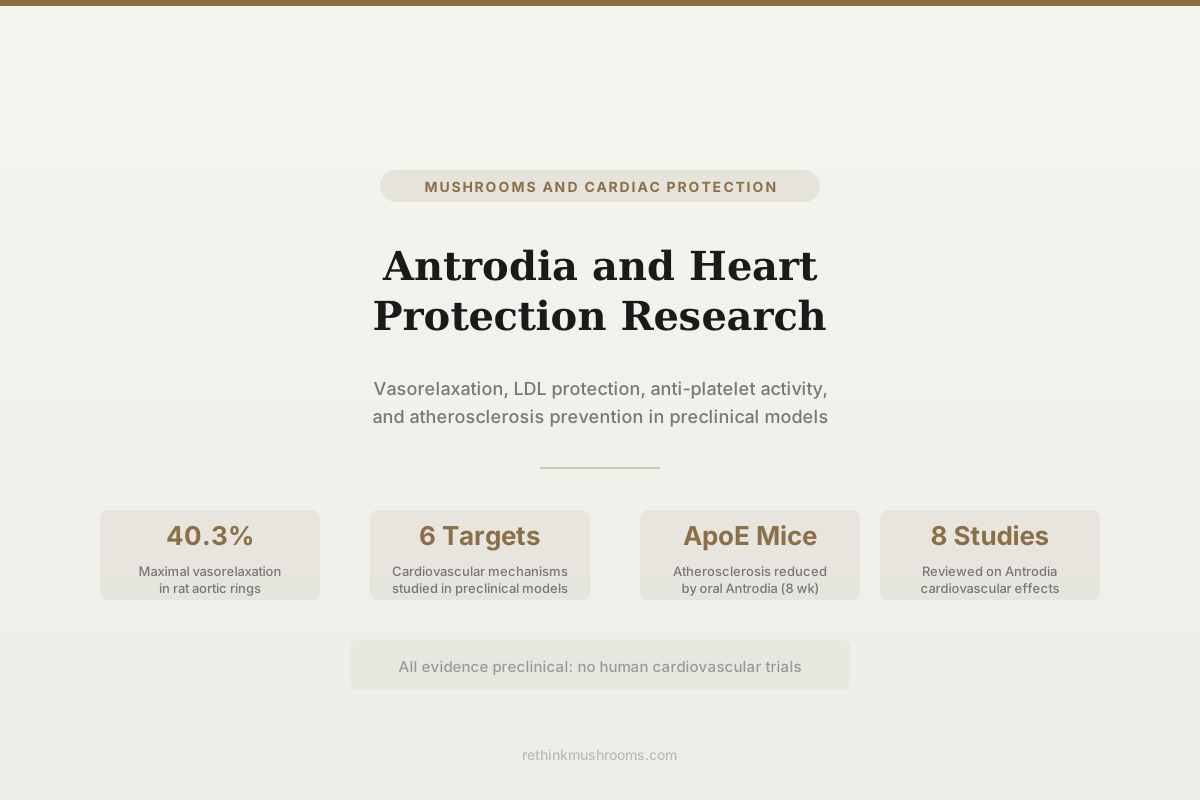
Mushrooms and Cardiac Protection
40% vasorelaxation
Antrodia camphorata mycelia extract produced maximal relaxation of 40.34% in isolated rat aortic rings through an endothelium-dependent pathway.
Wang et al., Life Sciences, 2003
6 Mechanisms
of cardiovascular protection studied
ApoE Mice
atherosclerosis reduced by oral AC
8 Studies
reviewed on Antrodia heart effects
Wang et al., Life Sciences, 2003
 View as image ↗
Cardiovascular disease remains the leading cause of death globally, and the search for compounds that protect blood vessels, reduce clotting risk, and prevent atherosclerosis drives a substantial portion of pharmacological research. Antrodia camphorata, a medicinal mushroom endemic to Taiwan, has accumulated a body of preclinical evidence across multiple cardiovascular targets. Researchers have documented its effects on blood vessel relaxation, endothelial cell protection, LDL oxidation, platelet aggregation, smooth muscle cell migration, and atherosclerotic plaque formation. For a broader view of how mushrooms defend the heart, see the overview on mushrooms and cardiac protection.
Every study reviewed here is preclinical. No randomized controlled trials in humans have tested Antrodia specifically for cardiovascular endpoints. The evidence comes from isolated tissue preparations, cell culture systems, and mouse models. This article examines what that preclinical evidence actually shows and where the gaps remain.
Key Takeaways
- Antrodia mycelia extract (strain B85) produced 40.34% maximal vasorelaxation in rat aortic rings through the endothelial Ca2+-NO-cGMP pathway (Wang et al., 2003)
- Fermented culture broth and mycelial extracts protected human endothelial cells from free radical damage by inhibiting DNA fragmentation, cytochrome c release, and caspase-3 activation (Hseu et al., 2008)
- Antrodia extracts inhibited copper- and AAPH-induced LDL oxidation in a concentration-dependent manner, preventing conjugated diene production and cholesterol degradation (Yang et al., 2006)
- Oral Antrodia administration (0.6 mg/day for 8 weeks) prevented cigarette smoke-accelerated atherosclerosis in ApoE-deficient mice while decreasing total cholesterol and triacylglycerol (Yang et al., 2017)
- Antrodia inhibited collagen-induced platelet aggregation at 56-224 microg/mL by blocking the Ca2+ and PKC cascade (Lu et al., 2014)
- Eburicoic acid from Antrodia lowered blood triglycerides and total cholesterol in high-fat diet mice through AMPK activation and PPARalpha upregulation (Lin et al., 2017)
Vasorelaxation: How Antrodia Relaxes Blood Vessels
The earliest cardiovascular study on Antrodia tested mycelia extracts from five different strains on isolated rat aortic rings.[1] Wang et al. (2003) found substantial variation between strains. Strain B86 produced concentration-dependent vasorelaxation with a maximal effect of 40.34%, while strains 35398, 35396, and B71 had only mild effects. Strain B85 showed the strongest vasorelaxation through a partly endothelium-dependent mechanism.
The mechanism involved the classic nitric oxide pathway. B85 stimulated nitric oxide (NO) release from endothelial cells and increased intracellular calcium concentrations. The vasorelaxation was blocked by L-NAME (an NO synthase inhibitor) and ODQ (a guanylyl cyclase inhibitor), confirming the Ca2+-NO-cGMP pathway. Potassium channel antagonists had no effect, ruling out that alternative relaxation mechanism.[1]
HPLC and LC-MS analysis revealed adenosine in the active fraction. Adenosine is a known vasodilator that acts through endothelial A2 receptors to stimulate NO production. This compound may partly explain the vasorelaxing properties, though the full complement of active molecules has not been characterized.
The strain-dependent variation is a critical detail. Different Antrodia strains produced dramatically different vascular effects. This means the specific cultivation conditions and strain selection matter for any potential cardiovascular application, and results from one preparation cannot be assumed to apply to another.
Protecting Endothelial Cells from Oxidative Damage
The endothelium, the single-cell layer lining all blood vessels, is the first target of oxidative stress in cardiovascular disease. Hseu et al. (2008) tested whether Antrodia could protect human umbilical vein endothelial cells from damage caused by the free radical generator AAPH.[2]
Both fermented culture broth (FCBA, 25-100 microg/mL) and aqueous mycelial extract (AEMA, 50-200 microg/mL) protected endothelial cells from oxidative damage in a dose-dependent manner. The protective mechanisms were specific: both preparations inhibited AAPH-induced DNA fragmentation, cytochrome c release from mitochondria, caspase-3 activation, and dysregulation of the Bcl-2/Bax apoptotic ratio. The extracts also preserved superoxide dismutase (SOD) activity and protein levels that AAPH exposure would otherwise suppress.[2]
An increase in prostacyclin (PGI2) production correlated positively with cell damage and negatively with extract concentration. PGI2 is a vasodilator and platelet aggregation inhibitor produced by healthy endothelium, so its normalization under oxidative stress suggests functional preservation of the endothelial layer. For more on how Antrodia's antioxidant systems work at the cellular level, see Antrodia and antioxidant activity.
Preventing LDL Oxidation
Oxidized LDL is a central driver of atherosclerotic plaque formation. When LDL particles undergo oxidative modification, they are taken up by macrophages in the arterial wall, forming foam cells that accumulate into plaques. Yang et al. (2006) tested Antrodia's ability to prevent this initial oxidation step.[3]
Both FCBA and AEMA inhibited LDL oxidation induced by either copper sulfate or AAPH in a time- and concentration-dependent manner. The researchers measured three independent markers of LDL oxidation: thiobarbituric acid-reactive substances (TBARS) formation, conjugated diene production, and cholesterol degradation. All three were suppressed by both extracts.[3]
The extracts also preserved the structural integrity of LDL particles: they prevented changes in electrophoretic mobility (a sign of surface charge alteration from oxidation) and protected the apolipoprotein B protein from fragmentation. When endothelial cells were exposed to copper-oxidized LDL that had been pre-treated with Antrodia extracts, cell damage was reduced compared to untreated oxidized LDL.
This study addresses one specific step in the atherosclerotic cascade. LDL oxidation prevention does not necessarily translate to reduced plaque formation in a living organism, where multiple overlapping pathways contribute. But later studies tested exactly that question in animal models.
Anti-Atherosclerotic Effects in ApoE-Deficient Mice
Yang et al. (2017) moved beyond cell culture to test Antrodia in ApoE-deficient mice, a standard model for accelerated atherosclerosis.[4] The study combined cigarette smoke exposure (which accelerates atherosclerosis through oxidative stress and inflammation) with oral Antrodia administration.
In vascular smooth muscle cells (A7r5 line), Antrodia fermented culture broth (30-120 microg/mL) ameliorated cigarette smoke extract-induced morphological damage, cell death, and DNA damage. The extract suppressed ROS production, upregulated SOD and catalase expression, and inhibited the NF-kappaB inflammatory pathway by preventing I-kappaBalpha degradation. It also blocked AP-1 transcription factor activity and suppressed overexpression of VEGF, PDGF, and EGR-1, growth factors involved in pathological vascular remodeling.[4]
In the animal model, oral Antrodia administration (0.6 mg/day for 8 weeks) prevented cigarette smoke-accelerated atherosclerosis. The treated mice showed increased serum total antioxidant status and decreased total cholesterol and triacylglycerol levels compared to smoke-exposed controls.[4]
This is the strongest single piece of cardiovascular evidence for Antrodia because it demonstrates functional protection in a whole-animal disease model with multiple measured endpoints. However, ApoE-knockout mice develop atherosclerosis through a different lipoprotein profile than typical human disease, and the cigarette smoke exposure model represents a specific inflammatory trigger, not the full spectrum of human cardiovascular risk.
Inhibiting Vascular Smooth Muscle Migration
After blood vessel injury (from procedures like angioplasty or from chronic damage), smooth muscle cells migrate from the vessel wall into the inner lumen, forming neointima that can narrow the vessel. Li et al. (2009) tested whether Antrodia could block this process.[5]
In both Transwell migration and wound scratch assays, Antrodia extract inhibited platelet-derived growth factor (PDGF)-induced smooth muscle cell migration. In proliferation assays (MTT and BrdU), it also inhibited PDGF-induced smooth muscle cell proliferation.
The in vivo test used a mouse carotid artery ligation model. After 4 weeks, the neointima-to-media (N/M) ratio in AC-treated mice was lower than controls: water-treated mice had an N/M ratio of 1.33, while mice receiving 250 mg/kg and 1,250 mg/kg Antrodia had ratios of 0.83 and 0.63, respectively (P < 0.05).[5]
This finding is distinct from the atherosclerosis data. It addresses vascular remodeling after injury, a process relevant to restenosis after stenting and to the chronic vascular damage seen in conditions like diabetes and metabolic syndrome.
Anti-Platelet Activity and Thrombosis Prevention
Platelet aggregation is the immediate trigger for most heart attacks and strokes. Lu et al. (2014) examined Antrodia's effects on human platelet activation.[6]
At concentrations of 56-224 microg/mL, Antrodia extract inhibited collagen-induced platelet aggregation. It did not inhibit aggregation induced by U46619 (a thromboxane A2 analog), thrombin, or arachidonic acid, indicating pathway specificity rather than general platelet toxicity. The mechanism involved inhibition of collagen-induced calcium mobilization and phosphorylation of protein kinase C (PKC) and Akt. In PDBu (phorbol ester)-stimulated platelets, Antrodia also reduced aggregation and PKC phosphorylation, confirming PKC as a central target.[6]
The specificity for collagen-induced aggregation is noteworthy. Collagen is exposed when the endothelial lining is damaged, making it a trigger for pathological clotting at sites of vascular injury. A compound that selectively blocks this pathway while leaving other aggregation pathways intact could theoretically reduce pathological clotting without completely disabling the clotting system. This remains speculative until tested in animal thrombosis models and human studies.
Eburicoic Acid: A Triterpenoid with Lipid-Lowering Effects
Two studies from the same research group examined eburicoic acid, a triterpenoid compound isolated from Antrodia, for its effects on blood lipids and glucose metabolism in high-fat diet mice.
Lin et al. (2017) showed that eburicoic acid lowered blood glucose, triglycerides, and free fatty acids in high-fat diet-fed C57BL/6 mice over 14 weeks.[7] The compound increased hepatic PPARalpha expression (enhancing fatty acid oxidation) while decreasing fatty acid synthase and PPARgamma expression (reducing fat synthesis). It also suppressed SREBP-1c and SREBP-2 mRNA levels, master regulators of lipid synthesis in the liver. Blood triglycerides and total cholesterol decreased in treated animals.
Lin et al. (2018) confirmed these findings in streptozotocin-induced diabetic mice, showing that eburicoic acid regulated Akt phosphorylation, gluconeogenesis, and PPARalpha to lower both blood glucose and lipid levels.[8]
These lipid-lowering effects are cardiovascular-relevant because dyslipidemia (elevated triglycerides, elevated LDL cholesterol) is a primary risk factor for atherosclerosis. Eburicoic acid is one of several bioactive triterpenoids from Antrodia, and its multi-target metabolic effects overlap with the anti-diabetic research covered in Antrodia and blood sugar.
What These Studies Cannot Tell Us
The cardiovascular evidence for Antrodia is broader than for most medicinal mushrooms, spanning six distinct mechanisms. But several limitations apply across the entire body of work.
No human cardiovascular trials exist. Every study uses isolated tissues, cell cultures, or mouse models. The gap between "relaxes a rat aorta in a dish" and "lowers blood pressure in a human" is substantial and often not bridged by most natural product candidates.
Dose translation is unclear. The effective concentrations in cell studies (25-800 microg/mL) and animal doses (0.6 mg/day to 1,250 mg/kg) do not convert straightforwardly to human oral doses. Bioavailability of Antrodia's active compounds after oral ingestion has not been characterized for cardiovascular-relevant tissues.
Strain and preparation variability is documented but unresolved. Wang et al. (2003) showed dramatically different vascular effects from five Antrodia strains. Commercial Antrodia products come from different strains, cultivation methods, and extraction processes. There is no quality standard linking specific products to the preparations used in published research.
The studies are largely from Taiwanese research groups. While this reflects Antrodia's endemic origin, independent replication by groups outside Taiwan's Antrodia research community would strengthen confidence in the findings.
Interaction with cardiovascular medications is unstudied. Antrodia's anti-platelet and vasodilatory effects could theoretically interact with anticoagulants, antihypertensives, or statins. No interaction studies have been conducted. For what is known about Antrodia and drug interactions generally, see the drug interactions overview.
The Bottom Line
Preclinical research on Antrodia camphorata reveals activity across six cardiovascular targets: vasorelaxation through the NO-cGMP pathway, endothelial cell protection from oxidative damage, LDL oxidation prevention, anti-atherosclerotic effects in ApoE-deficient mice, inhibition of vascular smooth muscle migration after injury, and collagen-specific platelet aggregation blockade. The triterpenoid eburicoic acid adds lipid-lowering effects through hepatic AMPK activation. All evidence is preclinical, with no human cardiovascular trials published. Strain-dependent variation and the absence of pharmacokinetic data represent major gaps between laboratory findings and any potential human application.
Frequently Asked Questions
Sources & References
- 1RTHM-00064·Wang, Guei-Jane et al. (2003). “The vasorelaxation of Antrodia camphorata mycelia: involvement of endothelial Ca(2+)-NO-cGMP pathway..” Life sciences.Study breakdown →PubMed →↩
- 2RTHM-00135·Hseu, You-Cheng et al. (2008). “Antioxidant activity of Antrodia camphorata on free radical-induced endothelial cell damage..” Journal of ethnopharmacology.Study breakdown →PubMed →↩
- 3RTHM-00109·Yang, Hsin-Ling et al. (2006). “Antrodia camphorata in submerged culture protects low density lipoproteins against oxidative modification..” The American journal of Chinese medicine.Study breakdown →PubMed →↩
- 4RTHM-00500·Yang, Hsin-Ling et al. (2017). “Antrodia camphorata attenuates cigarette smoke-induced ROS production, DNA damage, apoptosis, and inflammation in vascular smooth muscle cells, and atherosclerosis in ApoE-deficient mice..” Environmental toxicology.Study breakdown →PubMed →↩
- 5RTHM-00162·Li, Yi-Heng et al. (2009). “A novel inhibitory effect of Antrodia camphorata extract on vascular smooth muscle cell migration and neointima formation in mice..” International heart journal.Study breakdown →PubMed →↩
- 6RTHM-00338·Lu, Wan-Jung et al. (2014). “Effect of Antrodia camphorata on inflammatory arterial thrombosis-mediated platelet activation: the pivotal role of protein kinase C..” TheScientificWorldJournal.Study breakdown →PubMed →↩
- 7RTHM-00480·Lin, Cheng-Hsiu et al. (2017). “Eburicoic Acid, a Triterpenoid Compound from Antrodia camphorata, Displays Antidiabetic and Antihyperlipidemic Effects in Palmitate-Treated C2C12 Myotubes and in High-Fat Diet-Fed Mice..” International journal of molecular sciences.Study breakdown →PubMed →↩
- 8RTHM-00518·Lin, Cheng-Hsiu et al. (2018). “Antidiabetic and hypolipidemic activities of eburicoic acid, a triterpenoid compound from Antrodia camphorata, by regulation of Akt phosphorylation, gluconeogenesis, and PPARα in streptozotocin-induced diabetic mice..” RSC advances.Study breakdown →PubMed →↩