Challenging Experiences
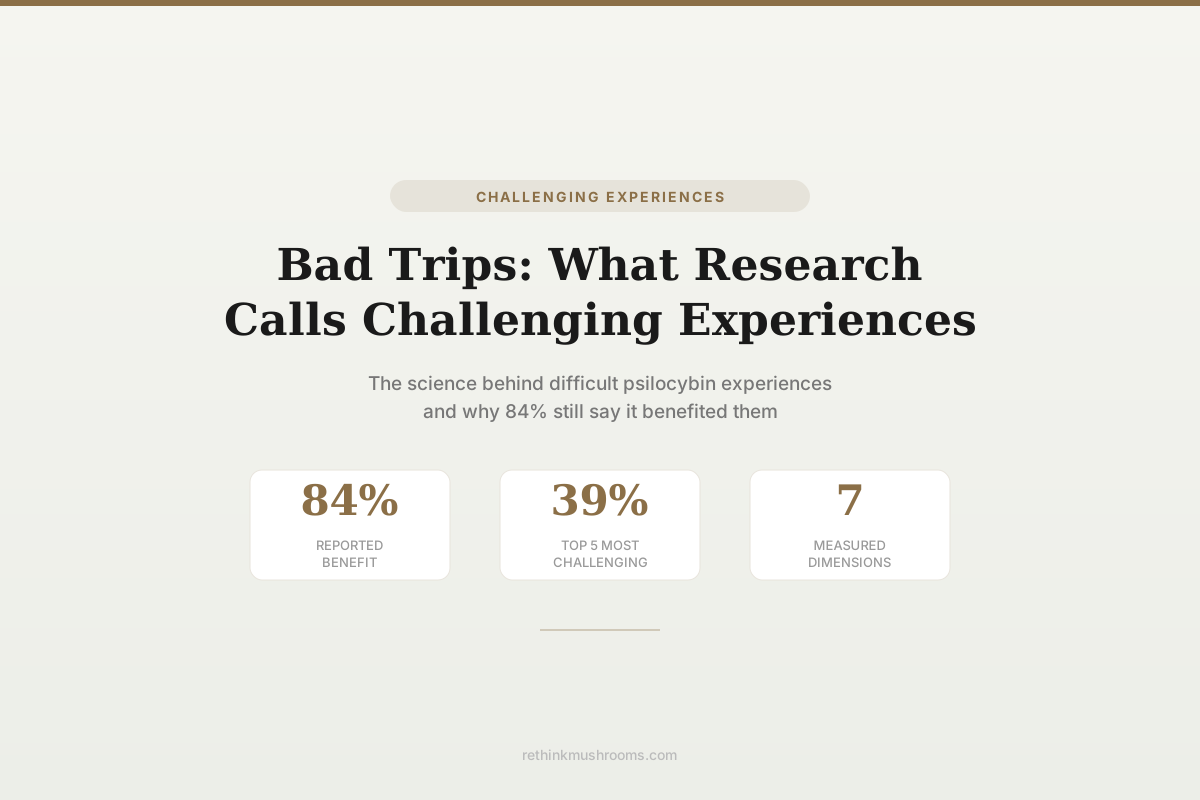
84% benefited
In a Johns Hopkins survey of 1,993 people describing their single worst psilocybin experience, 84% still reported the experience benefited them overall.
Carbonaro et al., Journal of Psychopharmacology, 2016
7 dimensions
fear, grief, death, insanity, isolation, physical distress, paranoia
39%
rated it among top 5 most challenging life events
11%
put themselves or others at risk of physical harm
Carbonaro et al., Journal of Psychopharmacology, 2016
 View as image ↗
The phrase "bad trip" has been part of psychedelic vocabulary since the 1960s, but researchers avoid it. The term collapses an entire spectrum of difficult psychological states into a single pejorative label that implies the experience was purely negative and without value. In clinical research, the standard term is "challenging experience," and it exists because the data demanded it. When Johns Hopkins surveyed 1,993 people about the single worst thing that ever happened to them on psilocybin mushrooms, 84% said the experience still benefited them.[1]
That paradox, an experience that is simultaneously among the most difficult and the most valuable in a person's life, is central to understanding what a "bad trip" actually is. It also explains why the research community needed a more precise vocabulary and a validated measurement tool.
Key Takeaways
- 84% of 1,993 survey respondents said their worst psilocybin experience still benefited them, and greater difficulty was positively associated with enduring increases in well-being (Carbonaro et al., 2016)
- The Challenging Experience Questionnaire (CEQ) measures 7 dimensions: fear, grief, death, insanity, isolation, physical distress, and paranoia (Barrett et al., 2016)
- 39% rated their worst psilocybin experience among the top 5 most challenging events of their entire lifetime (Carbonaro et al., 2016)
- 11% put themselves or others at risk of physical harm during the experience, with risk increasing alongside dose, duration, and absence of social support (Carbonaro et al., 2016)
- Neuroticism is the personality trait most consistently associated with challenging psilocybin experiences across two independent survey samples totaling nearly 3,000 participants (Barrett et al., 2017)
- In controlled clinical settings with screening, preparation, and support, the incidence of lasting psychological harm from challenging experiences drops dramatically compared to unsupported recreational use
The Challenging Experience Questionnaire: measuring what "bad" means
Before 2016, researchers had no standardized way to measure difficult psilocybin experiences. Several questionnaires existed for psychedelic experiences generally (the Hallucinogen Rating Scale, the States of Consciousness Questionnaire, the 5-Dimensional Altered States of Consciousness questionnaire), but none focused specifically on what goes wrong.
Barrett et al. (2016) constructed the Challenging Experience Questionnaire (CEQ) from items across those existing scales, using an internet survey of people who had experienced difficult psilocybin episodes.[2] Factor analysis revealed seven distinct dimensions of challenging experience:
- Fear - acute terror, panic, feeling frightened
- Grief - profound sadness, loss, mourning
- Death - conviction of dying, confrontation with mortality
- Insanity - feeling of losing one's mind, going crazy
- Isolation - disconnection from others, loneliness, abandonment
- Physical distress - nausea, discomfort, somatic symptoms
- Paranoia - suspicion, feeling persecuted or watched
The factor structure held across genders and across people with and without histories of anxiety or depression.[2] This means that the basic architecture of a challenging psilocybin experience, the types of distress that occur, does not fundamentally differ between demographic groups or between people with different psychiatric histories.
The CEQ also revealed something counterintuitive: higher scores on the challenging dimensions correlated with greater perceived meaningfulness, spiritual significance, and positive change in well-being.[2] Difficulty and value were not opposed. They tracked together. This finding is what separates "challenging experience" from "bad trip" as a concept. For more on why difficulty and therapeutic benefit can coexist, see Why challenging psychedelic experiences can still be therapeutic.
The Carbonaro survey: 1,993 worst experiences
The largest study of negative psilocybin outcomes to date comes from Carbonaro et al. (2016), who surveyed 1,993 adults (mean age 30, 78% male) about their single most psychologically difficult or challenging experience after consuming psilocybin mushrooms.[1]
The severity was real
The numbers are not reassuring at face value. Thirty-nine percent rated the experience among the top five most challenging events of their entire lifetime. Eleven percent put themselves or others at risk of physical harm. 2.6% behaved in a physically aggressive or violent manner. 2.7% required medical help.[1]
Among those whose experience occurred more than one year prior, 7.6% subsequently sought professional treatment for enduring psychological symptoms. Three cases were associated with the onset of persistent psychotic symptoms. Three cases were associated with a suicide attempt.[1]
These are not trivial numbers. Psilocybin can produce genuine psychological crises with lasting consequences in a meaningful minority of users.
The paradox was also real
Despite describing their worst experience, 84% of respondents said it benefited them overall. Multiple regression analysis revealed that greater difficulty was positively linked with enduring increases in well-being, suggesting that the intensity of the challenge itself contributed to long-term positive outcomes.[1]
What predicted harm
Factors that increased the likelihood of putting oneself or others at risk of physical harm included higher estimated dose, longer experience duration, greater overall difficulty, and the absence of physical comfort and social support.[1]
The last variable is the most actionable: the absence of support predicted harm more than the substance itself. This finding aligns with the observation that challenging experiences in controlled clinical settings (where participants are screened, prepared, and continuously supported) produce lasting harm at dramatically lower rates than unsupported recreational use. For clinical approaches to managing these situations, see Navigating a challenging psilocybin experience: clinical intervention strategies.
Who has challenging experiences: the neuroticism connection
Barrett et al. (2017) investigated whether personality traits predict who will have a challenging psilocybin experience. Across two independent online surveys with a combined sample of nearly 3,000 participants, one variable emerged consistently: neuroticism.[3]
CEQ scores were negatively associated with emotional stability (the inverse of neuroticism) in the first sample and positively associated with neuroticism scores in the second, using different personality inventories (TIPI and BFI respectively). The association held across all seven CEQ subscales: fear, grief, physical distress, insanity, isolation, death, and paranoia.[3]
This does not mean that neurotic individuals always have challenging experiences or that emotionally stable individuals never do. It means that across a large population, the personality trait most associated with negative emotional reactivity in everyday life also predicts more intense negative experiences under psilocybin. The drug appears to amplify existing emotional patterns rather than creating entirely novel ones.
The practical implication for clinical settings is screening. Neuroticism, measurable through standard personality inventories, could function as a risk stratification tool, not to exclude high-neuroticism individuals from psilocybin therapy, but to calibrate preparation, dosing, and support intensity. For what other variables influence psilocybin responses, see Risk factors for challenging psilocybin experiences.
Controlled vs. uncontrolled settings: why context matters
The Carbonaro survey deliberately sampled recreational users. The severity numbers (11% at risk, 7.6% seeking later treatment) reflect experiences in uncontrolled settings: unknown doses, no screening for psychiatric contraindications, no trained facilitators, and often no one present at all.
In controlled clinical trials, the picture differs. Griffiths et al. (2016) administered high-dose psilocybin (22 or 30 mg/70 kg) to 51 cancer patients with life-threatening diagnoses and symptoms of depression or anxiety in a randomized, double-blind, crossover trial.[4] Participants were carefully screened, received extensive preparation sessions, and were continuously monitored during the experience by trained facilitators.
Challenging psychological experiences occurred. Some participants reported transient anxiety, fear, and dysphoria during the high-dose sessions. But the incidence of lasting harm was minimal. At 6-month follow-up, approximately 80% of participants showed clinically significant decreases in depressed mood and anxiety, with high rates of enduring positive effects on attitudes about life, self, and relationships.[4]
The earlier Griffiths et al. (2006) landmark study in healthy volunteers established the same pattern. When psilocybin was administered under controlled conditions with proper support, participants attributed "substantial personal meaning and spiritual significance" to the experience at 2-month follow-up, even when acute sessions involved transient anxiety or fear.[5]
The contrast between uncontrolled (11% at risk) and controlled (minimal lasting harm) settings is the strongest evidence that the "bad trip" is partly a function of context. The pharmacology is the same. What changes is preparation, screening, physical safety, and interpersonal support. For the clinical perspective on how trained facilitators manage difficulty in real-time, see How to navigate a difficult psilocybin experience.
Mystical experience vs. challenging experience: different predictors of outcome
A distinction that the popular conversation often misses: in clinical research, the acute experience feature most consistently associated with positive therapeutic outcomes is the mystical experience, not the challenging one.
Garcia-Romeu et al. (2014) found that psilocybin-occasioned mystical-type experiences mediated smoking cessation outcomes in a pilot study, with participants who scored higher on mystical experience measures showing greater abstinence rates at 6-month follow-up.[6]
Griffiths et al. (2016) similarly found that mystical-type experience on the session day mediated the relationship between psilocybin dose and therapeutic outcomes in cancer patients.[4]
This does not contradict the finding that challenging experiences can benefit people. It refines it. The data suggest that difficulty is not the therapeutic ingredient. Mystical experience, characterized by unity, transcendence, noetic quality, and sacredness, more reliably predicts lasting positive change. Challenging experiences may facilitate growth when they are eventually integrated, but they are neither necessary nor sufficient for therapeutic benefit. For how the serotonin 2A receptor mediates these different experience types, see 5-HT2A receptor density and psilocybin response.
What the research does not answer
Several gaps limit the current understanding:
No experimental data on challenging experiences. The Carbonaro and Barrett surveys are retrospective self-reports from recreational users. Selection bias is inherent: people who were most harmed by psilocybin may not participate in online surveys about their experiences. People with positive experiences may also be overrepresented.
Dose-response relationships are imprecise. The survey data relies on participants' estimates of their dose, which are unreliable. In uncontrolled settings, users rarely know the exact psilocybin content of their mushrooms. Species variation, growing conditions, and storage all affect potency.
Cultural context is underrepresented. The survey populations are predominantly young, male, and Western. Challenging experience patterns may differ in populations with different cultural frameworks for interpreting psychedelic states.
The line between "challenging" and "harmful" is unclear. The same data show 84% benefiting and 7.6% seeking treatment for lasting symptoms. These populations may overlap. The research does not yet provide reliable tools to predict in advance who will land in which group.
Integration is unmeasured. The surveys did not assess whether participants received any form of psychotherapy or integration support after their challenging experience. The positive outcomes reported may reflect successful integration rather than an inherent benefit of difficulty itself.
The Bottom Line
Research has replaced the term "bad trip" with "challenging experience" because the data showed these events are not purely negative. The Challenging Experience Questionnaire measures seven dimensions of difficulty (fear, grief, death, insanity, isolation, physical distress, paranoia), and scores on these dimensions correlate with perceived meaningfulness and well-being. In the largest survey, 84% of people describing their worst psilocybin experience still said it benefited them, though 11% put themselves at risk and 7.6% later sought treatment. Neuroticism predicts who has more challenging experiences, and controlled settings dramatically reduce lasting harm compared to unsupported recreational use.
Frequently Asked Questions
Sources & References
- 1RTHM-00418·Carbonaro, Theresa M et al. (2016). “Survey study of challenging experiences after ingesting psilocybin mushrooms: Acute and enduring positive and negative consequences..” Journal of psychopharmacology (Oxford.Study breakdown →PubMed →↩
- 2RTHM-00417·Barrett, Frederick S et al. (2016). “The Challenging Experience Questionnaire: Characterization of challenging experiences with psilocybin mushrooms..” Journal of psychopharmacology (Oxford.Study breakdown →PubMed →↩
- 3RTHM-00460·Barrett, Frederick S et al. (2017). “Neuroticism is associated with challenging experiences with psilocybin mushrooms..” Personality and individual differences.Study breakdown →PubMed →↩
- 4RTHM-00426·Griffiths, Roland R et al. (2016). “Psilocybin produces substantial and sustained decreases in depression and anxiety in patients with life-threatening cancer: A randomized double-blind trial..” Journal of psychopharmacology (Oxford.Study breakdown →PubMed →↩
- 5RTHM-00096·Griffiths, R R et al. (2006). “Psilocybin can occasion mystical-type experiences having substantial and sustained personal meaning and spiritual significance..” Psychopharmacology.Study breakdown →PubMed →↩
- 6RTHM-00321·Garcia-Romeu, Albert et al. (2014). “Psilocybin-occasioned mystical experiences in the treatment of tobacco addiction..” Current drug abuse reviews.Study breakdown →PubMed →↩