Lion's Mane & Immune Function
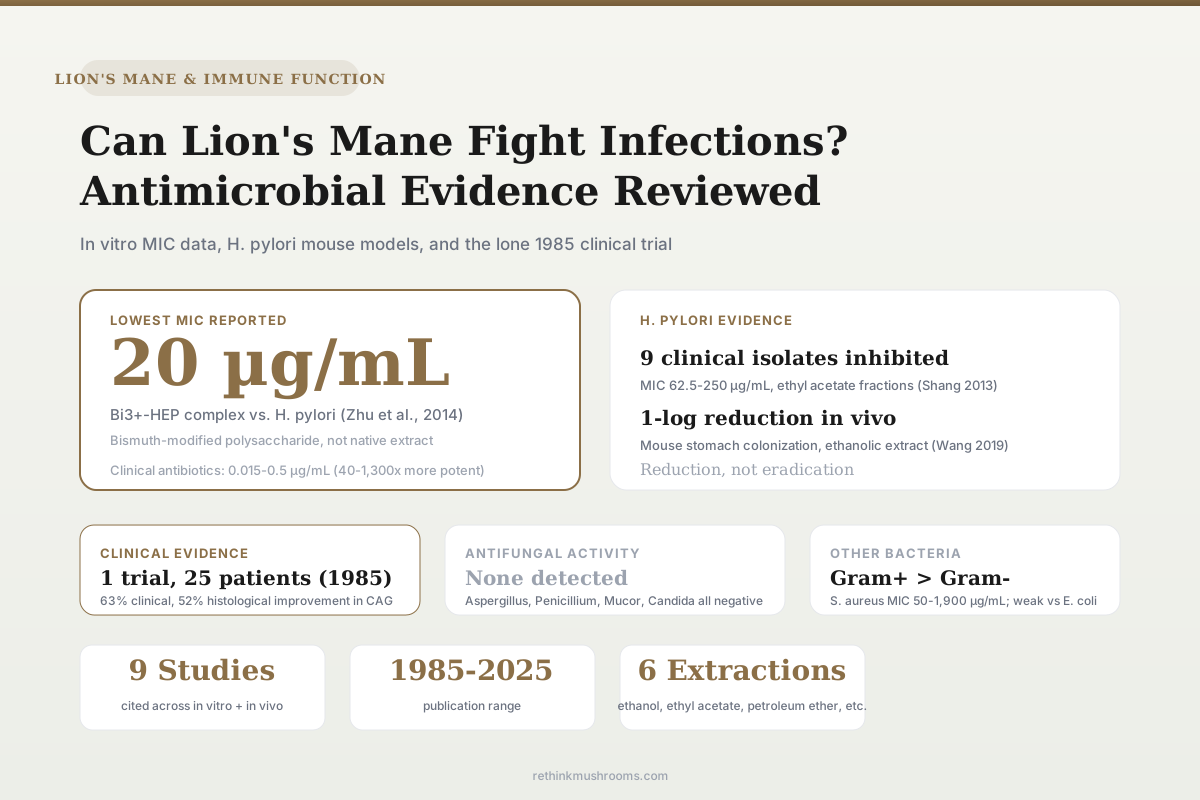
20 µg/mL MIC
A bismuth-bound lion's mane polysaccharide complex inhibited Helicobacter pylori growth at 20 µg/mL, the lowest minimum inhibitory concentration reported for any Hericium erinaceus preparation against the gastric pathogen.
Zhu et al., Carbohydrate Polymers, 2014
9 strains
of H. pylori inhibited by ethyl acetate fractions at 62.5 to 250 µg/mL
1 log
reduction in stomach H. pylori load in mice fed ethanolic extract
0 antifungal
Hericium erinaceus extracts have shown no activity against tested fungi
Zhu et al., Carbohydrate Polymers, 2014
 View as image ↗
The lion's mane antimicrobial story is narrower than the marketing suggests. Most of the published evidence concerns one bacterial target, Helicobacter pylori, the gram-negative organism that colonizes roughly half of the world's stomachs and drives gastric ulcers, atrophic gastritis, and gastric cancer risk. Outside the H. pylori work, antimicrobial findings exist but are scattered, dose-dependent, and almost entirely in vitro. There is one clinical trial from 1985, no modern human infection study, and a complete absence of antifungal activity in published screening. For the broader context of how Hericium engages immune cells rather than killing pathogens directly, see lion's mane and the immune system: immunomodulatory research.
This article maps the actual evidence for Hericium erinaceus as an antimicrobial. The strongest signal is consistent in vitro inhibition of H. pylori across multiple extraction methods and laboratories. The weakest signal, despite repeated marketing claims, is anything resembling a controlled human trial in living infected patients. Everything else sits between these poles.
Key Takeaways
- Ethanolic Hericium erinaceus extract inhibited six H. pylori strains in vitro at a minimum inhibitory concentration of about 2 mg/mL and reduced gastric colonization by roughly 1 log in mice (Wang et al., 2019)
- Ethyl acetate fractions inhibited 9 clinical H. pylori isolates with MIC values of 62.5 to 250 µg/mL, an IC50 of 73 µg/mL, and a minimum bactericidal concentration of 200 µg/mL against ATCC 43504 (Shang et al., 2013)
- A bismuth-bound H. erinaceus polysaccharide complex (Bi3+-HEP) reached an MIC of 20 µg/mL against H. pylori, the lowest reported for any Hericium preparation (Zhu et al., 2014)
- Petroleum ether and chloroform fractions of H. erinaceus showed bioactivity-guided MIC values from 12.5 to 400 µg/mL, with isolated diterpenoids responsible for the strongest inhibition (Liu et al., 2016)
- Ethanol extract from H. erinaceus basidiomes disrupted bacterial biofilm formation in vitro and contained gallic acid, catechin, and other phenolics correlated with antibiofilm activity (Darmasiwi et al., 2022)
- A 1985 double-blind trial in 25 patients with chronic atrophic gastritis reported clinical improvement in 63% and histological improvement in 52% after three months of oral H. erinaceus, the only controlled human trial in this evidence base (Xu et al., 1985)
What "Antimicrobial Activity" Means in the Lion's Mane Literature
Almost every antimicrobial finding for Hericium erinaceus comes from minimum inhibitory concentration (MIC) testing in a dish. A bacterial strain is exposed to a serial dilution of mushroom extract, and the lowest concentration that prevents visible growth becomes the MIC. The minimum bactericidal concentration (MBC) is the lowest dose that kills rather than merely halts growth. These are screening tools, not clinical endpoints. An MIC of 20 µg/mL in a test tube does not translate into a safe, effective human dose, because the gastrointestinal tract dilutes, degrades, and rejects most of what it receives, and because in vivo infection involves a host immune system, biofilms, and tissue penetration that flat agar cannot model.
A useful benchmark: clinical antibiotics that work against H. pylori, such as clarithromycin and amoxicillin, have MIC values in the range of 0.015 to 0.5 µg/mL against susceptible strains. The best Hericium preparation reported, the bismuth-polysaccharide complex at 20 µg/mL, is roughly 40 to 1,300 times less potent on a weight basis.[4] Lion's mane is not a stealth antibiotic. The interesting question is whether it can contribute to gastric microbial control as part of a combination approach, particularly given the rise of clarithromycin-resistant H. pylori.
Helicobacter pylori: The Strongest Antimicrobial Evidence
Wang et al. (2019) provided the most complete in vitro plus in vivo dataset. Ethanolic extract of Hericium erinaceus fruiting body inhibited six different H. pylori strains, including reference strain SS1, with comparable growth inhibition across all six and a minimum inhibitory concentration of approximately 2 mg/mL. The same group then fed the extract to C57BL mice colonized with H. pylori. The treated animals carried a mean stomach burden of 6 × 10⁴ CFU per gram, about 1 log lower than untreated controls.[1]
A 1-log reduction is biologically real but pharmacologically modest. Triple therapy with proton pump inhibitor plus two antibiotics typically clears H. pylori in 70 to 90% of compliant patients, a several-log reduction culminating in eradication. The Wang findings establish that Hericium extract reaches the gastric environment in a quantity sufficient to reduce, but not eliminate, the bacterial load in a mouse model. The extract also reduced bacterial adhesion to gastric epithelial cells, which the authors proposed as the primary mechanism: blocking attachment rather than killing free-floating organisms.
Shang et al. (2013) ran the most extensive clinical isolate panel. Ethyl acetate fractions of H. erinaceus were tested against nine clinical H. pylori isolates from patients with documented gastric disease. MIC values ranged from 62.5 to 250 µg/mL, the half-maximal inhibitory concentration against ATCC 43504 was 73 µg/mL, and the minimum bactericidal concentration against the same strain was 200 µg/mL.[2] This was the first study to demonstrate that the activity persisted across diverse strains rather than being an artifact of one laboratory-adapted line, an essential check given that H. pylori isolates vary widely in antibiotic susceptibility.
Liu et al. (2016) used bioactivity-guided fractionation to find the responsible chemistry. Petroleum ether and chloroform extracts produced the strongest inhibition, with MIC values from 12.5 to 400 µg/mL across fractions. After repeated chromatographic separation, the team isolated a series of diterpenoid compounds responsible for the activity. The structural characterization matters because lion's mane polysaccharides, the compounds most often marketed for immune effects, were not the antimicrobial drivers in this experiment. The active fraction was lipophilic, terpenoid, and isolable as discrete molecules.[3]
Zhu et al. (2014) produced the headline number with a bismuth-coordination strategy. Hericium erinaceus polysaccharide (HEP) was complexed with bismuth (Bi3+), generating a Bi3+-HEP polymer that combined the polysaccharide framework with bismuth's known anti-H. pylori activity. The complex inhibited H. pylori at an MIC of 20 µg/mL in vitro, substantially lower than HEP alone.[4] This is a useful proof-of-concept for chemical modification but does not represent the activity of unmodified, edible lion's mane.
For how the parent polysaccharides interact with intestinal immunity downstream of antimicrobial effects, see lion's mane polysaccharides and immune cell activation.
The 1985 Clinical Trial
Xu et al. (1985) conducted a double-blind preliminary trial in 25 Chinese patients with biopsy-confirmed chronic atrophic gastritis. Participants received oral Hericium erinaceus preparations for three months. Clinical improvement (symptom resolution) was reported in 63% of treated patients, and histological improvement on follow-up biopsy was reported in 52%.[6] This is the only controlled human trial of lion's mane in any infectious or quasi-infectious gastric condition, and it was published in Chinese Medical Journal as a preliminary report.
The trial has substantial limitations. It predates modern H. pylori diagnostics: the bacterium was identified in 1982 and routine testing did not exist when patients were enrolled, so the cohort was not stratified by H. pylori status. Sample size was small, the placebo arm was not described in detail, randomization procedures were not reported by current standards, and the histological reading was not blinded in the published abstract. Forty years later, no Western group has replicated this trial, and no registered Phase II or III study has tested H. erinaceus monotherapy in H. pylori-positive patients.
A more recent preclinical follow-up by Wang et al. (2015) characterized a polysaccharide isolated from cultured H. erinaceus mycelium and demonstrated activity against chronic atrophic gastritis in a rat model.[7] This work supports the original 1985 observation mechanistically but does not extend the human evidence base. For how gut-level immunity interacts with these gastric findings, see lion's mane and gut immunity: the intestinal immune connection.
Activity Against Other Bacteria and Antibiofilm Effects
Outside H. pylori, Hericium antimicrobial findings are inconsistent. Multiple screening studies report activity against Staphylococcus aureus, with MIC values typically in the 50 to 1,900 µg/mL range, depending on strain, extraction solvent, and cultivation conditions.[8] Gram-positive bacteria appear more susceptible than gram-negative bacteria in most reports, with limited inhibition of Pseudomonas aeruginosa, Salmonella Typhimurium, or Proteus mirabilis. The narrow spectrum suggests the active compounds engage targets exposed in the simpler gram-positive cell wall and struggle to cross the gram-negative outer membrane.
Darmasiwi et al. (2022) identified a different angle: antibiofilm activity. Ethanol extract from H. erinaceus basidiomes disrupted biofilm formation in vitro, with the effect correlated to the phenolic content of the extract, including gallic acid and catechin.[5] Antibiofilm activity is mechanistically distinct from direct killing: a compound that prevents bacteria from forming a protective biofilm matrix can sensitize them to immune clearance and to lower antibiotic doses, even without an impressive MIC of its own. This work has not been replicated in vivo.
For complementary evidence on how lion's mane beta-glucans engage host defense rather than directly killing pathogens, see lion's mane beta-glucans and macrophage activation: in vitro evidence.
Why No Antifungal Effect
Across multiple screening panels, Hericium erinaceus extracts have failed to show meaningful antifungal activity. Tests against Aspergillus niger, Penicillium polonicum, Mucor globosus, and Candida species have generally returned no measurable inhibition. The Friedman (2015) review of Hericium chemistry catalogued the major bioactive compound classes (polysaccharides, hericenones, erinacines, ergosterol, sterols, and phenolics) and noted that none of them have demonstrated reliable antifungal activity in published screening.[9]
This is a useful negative finding. Hericium is a fungus, and fungi often produce compounds that suppress competing fungi, so the absence of antifungal activity probably reflects evolutionary specialization toward chemical defenses against bacterial competitors rather than fungal ones. Whatever lion's mane is doing biochemically, it is not a candidate antifungal agent.
Proposed Mechanisms
The Contato et al. (2025) narrative review summarized the mechanistic hypotheses currently in play.[8] Three pathways recur in the literature:
Adhesion blockade. Wang's 2019 in vivo data suggested that the ethanolic extract reduced H. pylori adhesion to gastric epithelial cells rather than killing the bacteria outright. If lion's mane compounds bind to bacterial surface adhesins or to host receptors, they could prevent colonization without requiring high local concentrations.
Direct membrane disruption by terpenoids. The Liu 2016 fractionation identified diterpenoids in the petroleum ether fraction as the principal bactericidal molecules. Diterpenes can integrate into bacterial membranes and increase permeability, a mechanism shared with several plant-derived antibacterials.
Phenolic interference with biofilms and quorum sensing. The Darmasiwi 2022 antibiofilm activity tracked with phenolic content. Plant and fungal phenolics often interfere with bacterial communication systems that regulate biofilm formation, virulence factor expression, and group behaviors. This mechanism would explain antibiofilm activity even at concentrations too low to register on conventional MIC assays.
None of these mechanisms have been confirmed in human tissue. They are working hypotheses derived from in vitro chemistry. For how beta-glucans from various mushroom species interact with innate immunity in ways that could complement direct antimicrobial activity, see beta-glucans as natural vaccine adjuvants.
What This Evidence Does Not Support
The published data does not support taking lion's mane as a substitute for H. pylori eradication therapy. The mouse data shows reduction, not clearance. The 1985 clinical trial measured chronic atrophic gastritis rather than confirmed H. pylori eradication. No randomized trial has compared lion's mane to standard triple or quadruple therapy in infected patients. The MIC values, even for the bismuth-bound complex, are orders of magnitude weaker than first-line antibiotics.
The data also does not support lion's mane as a generalized antibacterial. The activity is selective: strongest against H. pylori, moderate against some gram-positive bacteria, weak against most gram-negative organisms outside H. pylori, and absent against fungi. Marketing language that frames lion's mane as a broad-spectrum antimicrobial misrepresents the literature.
Finally, the data does not support inferring antimicrobial benefits from immune-modulating effects. Hericium polysaccharides reliably activate macrophages and dendritic cells in vitro, which is a separate mechanism from direct pathogen inhibition. An immunomodulator can theoretically improve infection outcomes by enhancing host clearance, but improved cytokine output does not constitute antimicrobial activity in any conventional sense.
The Bottom Line
Hericium erinaceus shows consistent in vitro inhibition of Helicobacter pylori across multiple extraction methods and laboratories, with a 1-log reduction in mouse stomach colonization and a single small clinical trial from 1985 in chronic atrophic gastritis. Outside H. pylori, antimicrobial findings are narrow and modest, the antifungal evidence is essentially negative, and no modern human infection trial exists. The biological signal is real but the gap between in vitro activity and clinical utility has not been closed.
Frequently Asked Questions
Sources & References
- 1RTHM-00592·Wang, Ge et al. (2019). “In Vitro and In Vivo Inhibition of Helicobacter pylori by Ethanolic Extracts of Lion's Mane Medicinal Mushroom, Hericium erinaceus (Agaricomycetes)..” International journal of medicinal mushrooms.Study breakdown →PubMed →↩
- 2RTHM-00304·Shang, Xiaodong et al. (2013). “In vitro anti-Helicobacter pylori effects of medicinal mushroom extracts, with special emphasis on the Lion's Mane mushroom, Hericium erinaceus (higher Basidiomycetes)..” International journal of medicinal mushrooms.Study breakdown →PubMed →↩
- 3RTHM-00436·Liu, Jian-Hui et al. (2016). “Anti-Helicobacter pylori activity of bioactive components isolated from Hericium erinaceus..” Journal of ethnopharmacology.Study breakdown →PubMed →↩
- 4RTHM-00363·Zhu, Yang et al. (2014). “Preparation, characterization, and anti-Helicobacter pylori activity of Bi3+-Hericium erinaceus polysaccharide complex..” Carbohydrate polymers.Study breakdown →PubMed →↩
- 5RTHM-00751·Darmasiwi, Sari et al. (2022). “Antibiofilm activity and bioactive phenolic compounds of ethanol extract from the Hericium erinaceus basidiome..” Journal of advanced pharmaceutical technology & research.Study breakdown →PubMed →↩
- 6RTHM-00005·Xu, C P et al. (1985). “A double-blind study of effectiveness of hericium erinaceus pers therapy on chronic atrophic gastritis. A preliminary report..” Chinese medical journal.Study breakdown →PubMed →↩
- 7RTHM-00408·Wang, Mingxing et al. (2015). “A polysaccharide from cultured mycelium of Hericium erinaceus and its anti-chronic atrophic gastritis activity..” International journal of biological macromolecules.Study breakdown →PubMed →↩
- 8RTHM-00921·Contato, Alex Graça et al. (2025). “Lion's Mane Mushroom (Hericium erinaceus): A Neuroprotective Fungus with Antioxidant, Anti-Inflammatory, and Antimicrobial Potential-A Narrative Review..” Nutrients.Study breakdown →PubMed →↩
- 9RTHM-00371·Friedman, Mendel (2015). “Chemistry, Nutrition, and Health-Promoting Properties of Hericium erinaceus (Lion's Mane) Mushroom Fruiting Bodies and Mycelia and Their Bioactive Compounds..” Journal of agricultural and food chemistry.Study breakdown →PubMed →↩