Lion's Mane (Hericium erinaceus)
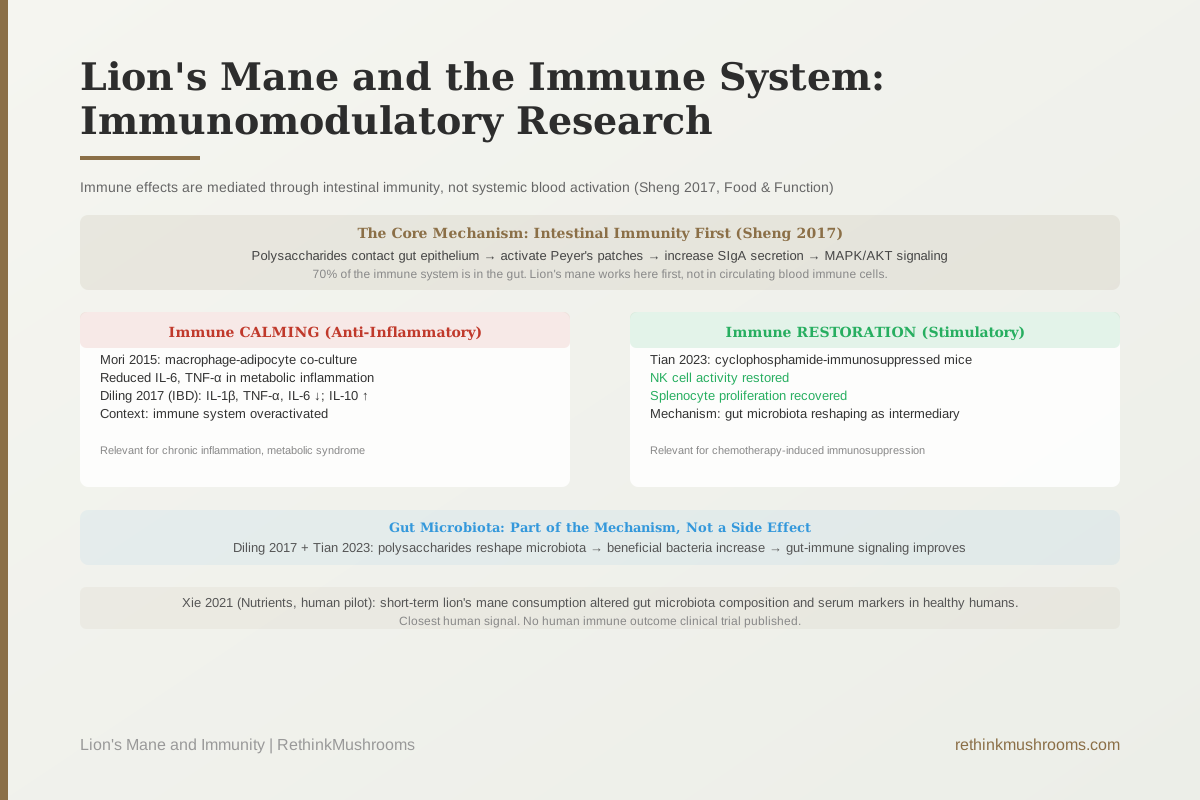
Intestinal immunity mediated: lion's mane polysaccharides activate Peyer's patches and increase SIgA secretion rather than directly stimulating blood immune cells (Sheng 2017)
Sheng and colleagues identified the primary mechanism by which lion's mane polysaccharides modulate immunity: they work through the intestinal immune system, activating Peyer's patches, increasing secretory IgA, and upregulating MAPK and AKT signaling in intestinal cells, rather than directly activating circulating immune cells.
Sheng et al., Food & Function, 2017
immunomodulatory
lion's mane both activates immune responses when suppressed (Tian 2023 NK cell restoration) and calms inflammation when overactive (Mori 2015 macrophage-adipocyte model)
gut microbiota
Diling 2017 and Tian 2023: gut microbiota reshaping is part of the immune mechanism, not a separate effect
human pilot
Xie 2021 (Nutrients): short-term lion's mane consumption in healthy humans altered gut microbiota composition and serum biochemical markers
Sheng et al., Food & Function, 2017
 View as image ↗
"Immune boost" is one of the most overused phrases in functional food marketing. It implies that more immune activity is always better, and that supplements can simply turn up a dial. The actual biology of immunity is more nuanced: immune responses can be too weak (immunosuppression, vulnerability to infection), but they can also be too strong (chronic inflammation, autoimmune conditions). What a good immune modulator does is help the system respond appropriately, not just more.
The lion's mane immune system research reveals a more specific story than generic immune support claims suggest. The key finding comes from a 2017 study identifying the mechanism: lion's mane polysaccharides primarily work through the intestinal immune system, activating the gut's immune training centers rather than directly boosting circulating blood immune cells. This distinction has practical implications for how and when lion's mane is consumed and what realistic effects to expect.
For a broader overview of lion's mane, see What Is Lion's Mane Mushroom? A Science-Based Overview.
Key Takeaways
- Sheng and colleagues (Food and Function, 2017) identified the primary immune mechanism: lion's mane polysaccharides activate Peyer's patches (the intestine's immune training centers), increase secretory IgA (SIgA, the gut's front-line antibody defense), and signal through MAPK and AKT pathways in intestinal cells: the study established that lion's mane immune effects are mediated through intestinal immunity, not direct blood immune cell activation
- Diling and colleagues (Oncotarget, 2017) found that H. erinaceus extracts relieved inflammatory bowel disease in animals through a dual mechanism: regulating intestinal immunity (reducing IL-1 beta, TNF-alpha, and IL-6; increasing anti-inflammatory IL-10) while simultaneously reshaping gut microbiota composition
- Mori and colleagues (International Journal of Medicinal Mushrooms, 2015) demonstrated anti-inflammatory macrophage modulation in a co-culture system: lion's mane extract reduced pro-inflammatory cytokine production from macrophages in the context of metabolic inflammation, establishing that lion's mane can calm an overactivated immune response, not only stimulate an underactive one
- Tian and colleagues (Journal of the Science of Food and Agriculture, 2023) found that H. erinaceus polysaccharides restored NK cell activity and splenocyte proliferation in cyclophosphamide-immunosuppressed mice by reshaping gut microbiota, demonstrating that the immune restoration mechanism runs through the gut ecosystem rather than direct cell activation
- Xie and colleagues (Nutrients, 2021) conducted a human pilot study and found that short-term H. erinaceus consumption in healthy people altered gut microbiota composition and affected serum biochemical markers, providing the closest available human signal for the gut-immune effects
- The core insight: lion's mane is "immunomodulatory" rather than simply "immunostimulatory": it adjusts immune activity toward appropriate responses, can reduce inflammation when immunity is overactive, and can restore immune function when immunosuppressed
The Core Insight: Lion's Mane Works Through the Gut's Immune System
Approximately 70% of the immune system is located in the gastrointestinal tract. The gut immune system includes Peyer's patches, which are clusters of lymphoid tissue embedded in the intestinal wall that sample gut contents, recognize pathogens and beneficial bacteria, and train immune cells to distinguish between the two. They are one of the primary sites where immune education occurs.
A 2017 study by Sheng and colleagues in Food and Function was the first to systematically investigate whether lion's mane polysaccharides act on this intestinal immune system specifically or on the systemic blood immune system.[1]
The finding: the immunomodulatory effects of H. erinaceus-derived polysaccharides are mediated through intestinal immunity. The specific mechanisms identified:
- Activation of Peyer's patches in the small intestinal wall
- Increased secretion of SIgA (secretory immunoglobulin A), the antibody that coats gut mucosal surfaces and represents the first-line antibody defense against intestinal pathogens
- Upregulation of immune signaling through the MAPK and AKT pathways in intestinal epithelial and immune cells
This matters for several practical reasons. An agent that works through intestinal immunity needs to be in contact with the intestinal wall to exert its effects, which means oral consumption with food (allowing the polysaccharides to interact with gut epithelium during digestion) is mechanistically supported. It also means the immune effects are gut-centric rather than systemic: lion's mane polysaccharides are not primarily circulating in the blood and activating immune cells throughout the body.
Immunomodulatory vs. Immunostimulatory: Why the Distinction Matters
Most consumer content describes lion's mane as an "immune booster," implying a one-directional push toward more immune activity. The research shows a bidirectional picture.
Immunomodulatory agents adjust immune activity in a context-dependent way: they can increase immune responses when immunity is suppressed (as in the Tian 2023 immunosuppressed mouse study) and decrease immune responses when immunity is overactivated (as in the Mori 2015 macrophage-adipocyte model). The same compound can produce opposite effects depending on the starting immune state.
This bidirectional activity is characteristic of polysaccharides from medicinal mushrooms generally, and the Sheng 2017 mechanism provides an explanation: by acting through Peyer's patches and gut immune signaling, lion's mane polysaccharides interact with the gut's immune regulatory machinery, which is itself designed to balance activation and tolerance. Activating this system can have calming or stimulating downstream effects depending on what the gut immune system encounters.
The practical implication: lion's mane is not simply turning up immune activity. It is modulating immune regulation through an intestinal mechanism. For people with overactive immune responses (including chronic inflammation), this could mean reduced inflammation. For people with underactive immune responses (immunosuppressed by medication or illness), this could mean improved immune function.
The IBD Evidence: Immunity, Inflammation, and Microbiota Together
Diling and colleagues published a 2017 study in Oncotarget examining how H. erinaceus extracts relieve inflammatory bowel disease in animal models.[2]
The study found a dual mechanism that integrates immune regulation and microbiota modulation simultaneously. On the immune side: pro-inflammatory cytokines IL-1 beta, TNF-alpha, and IL-6 decreased, while the anti-inflammatory cytokine IL-10 increased. The IBD inflammatory profile shifted toward a less inflammatory state. On the microbiota side: gut microbial diversity changed, with shifts toward bacterial communities associated with reduced inflammation.
The dual finding is mechanistically important. Gut microbiota composition directly influences immune signaling: certain bacterial species produce short-chain fatty acids that suppress inflammatory pathways, while others produce lipopolysaccharides that activate them. Lion's mane polysaccharides appear to act on the immune system partly through their effects on the microbiota, not only directly on immune cells.
This integration of immunity and microbiota is consistent with the Sheng 2017 intestinal mechanism: if the primary action is on Peyer's patches and intestinal signaling, then the microbiota shifts are part of the same gut-immune system response rather than a separate phenomenon.
Macrophage Modulation: Calming Metabolic Inflammation
Mori and colleagues published a 2015 study in the International Journal of Medicinal Mushrooms that examined lion's mane's anti-inflammatory activity in a context specific to metabolic disease.[3]
The study used a co-culture system of 3T3-L1 adipocytes (fat cells) and RAW264 macrophages, a model for the chronic low-grade inflammation that characterizes obesity and metabolic syndrome. In this state, macrophages in fat tissue become chronically activated, producing pro-inflammatory cytokines that drive insulin resistance and cardiovascular risk. This macrophage-adipocyte inflammatory crosstalk is a recognized driver of metabolic disease.
Lion's mane extract reduced pro-inflammatory cytokine production in this system. It inhibited the macrophage-adipocyte inflammatory crosstalk specifically, suggesting it can calm overactivated inflammatory macrophages in the context of metabolic inflammation.
This finding adds a specific application context: for people with metabolic syndrome, obesity, or chronic inflammatory conditions where macrophage overactivation is part of the pathology, lion's mane may have a role in reducing inflammatory tone rather than boosting immune activation. This is the anti-inflammatory face of immunomodulation.
NK Cell Restoration in Immunosuppressed Animals
Tian and colleagues published a 2023 study in the Journal of the Science of Food and Agriculture using cyclophosphamide-treated mice, a standard model for chemotherapy-induced immunosuppression.[4]
Cyclophosphamide severely reduces immune cell populations and function. The study tested whether H. erinaceus polysaccharides could restore immune function in these animals. The result: polysaccharide treatment increased NK (natural killer) cell activity and restored splenocyte proliferation. NK cells are critical for killing virus-infected cells and tumor cells without requiring prior activation by other immune cells; their restoration after cyclophosphamide treatment is a meaningful functional immune improvement.
The mechanism in Tian 2023 was primarily microbiota-mediated: polysaccharide treatment increased beneficial bacteria (Lactobacillus and Bifidobacterium) and decreased harmful bacteria in the gut. This microbiota shift was associated with the immune restoration. The study demonstrates that lion's mane immune effects can work through the gut microbial ecosystem as an intermediary rather than directly activating immune cells: polysaccharides feed beneficial bacteria, which in turn signal to the gut immune system, which then influences systemic immune function.
The Human Signal: What Xie 2021 Found
The closest available human evidence for lion's mane gut-immune effects is a 2021 pilot study by Xie and colleagues published in Nutrients.[5]
The study enrolled healthy human participants and had them consume H. erinaceus for a short period. After consumption:
- Gut microbiota composition changed: shifts in bacterial populations were detected
- Serum biochemical markers changed in patterns consistent with the preclinical immune and metabolic data
The limitations are important to state: this is a pilot study. The sample size is small. Without a control group matched for dietary changes, it cannot rule out that dietary changes associated with consuming lion's mane (rather than lion's mane itself) drove some of the observed differences.
What the Xie 2021 study establishes is that human gut microbiota is detectably altered by short-term lion's mane consumption, which is the first step in the intestinal immune mechanism identified in Sheng 2017. The human biological response to lion's mane consumption is consistent with the mechanistic model even if clinical immune outcomes have not been directly measured.
Can Lion's Mane Help with Autoimmune Conditions?
The immunomodulatory evidence raises a question about autoimmune conditions: if lion's mane can both stimulate and calm immune responses, could it affect autoimmune diseases where immune activity is misdirected against the body's own tissues?
No published clinical trial has tested lion's mane for any autoimmune condition. The animal and cell evidence shows immune calming in inflammatory contexts (Mori 2015, Diling 2017) and immune restoration in suppressed contexts (Tian 2023), but autoimmune conditions involve specific immune dysregulation (self-antigen recognition failures, regulatory T cell dysfunction) that is more complex than the models tested.
The IBD evidence (Diling 2017) is the closest preclinical analogy: IBD involves dysregulated intestinal immune responses that share features with autoimmunity. The anti-inflammatory effects seen in IBD models suggest a theoretically plausible benefit, but the translation to human autoimmune conditions requires specific clinical testing that has not been done.
For the gut-specific immunity evidence including the intestinal barrier repair data, see Lion's Mane and Gut Immunity: The Intestinal Immune Connection. For the antimicrobial evidence, see Can Lion's Mane Help Fight Infections? Antimicrobial Evidence.
What the Evidence Does and Doesn't Establish
What the research shows:
- Lion's mane polysaccharides work primarily through intestinal immunity: Peyer's patch activation, SIgA secretion, MAPK/AKT intestinal signaling (Sheng 2017)
- Both anti-inflammatory (Mori 2015, Diling 2017) and immune-restorative (Tian 2023) effects have been demonstrated, confirming immunomodulatory rather than simply immunostimulatory activity
- Gut microbiota reshaping is part of the immune mechanism across multiple studies
- Healthy human gut microbiota is detectably altered by short-term lion's mane consumption (Xie 2021)
What the evidence does not establish:
- Any human clinical trial demonstrating improved immune outcomes (reduced infection rates, faster recovery, improved inflammatory markers in disease conditions)
- Any direct comparison with standard immunomodulatory treatments
- Efficacy for any specific immune-related condition in human patients
- Whether the gut-mediated mechanism translates to the same effect magnitudes in humans as seen in animal models
For the polysaccharide compound details and beta-glucan mechanism, see Lion's Mane Polysaccharides and Immune Cell Activation.
The Bottom Line
Lion's mane polysaccharides modulate immunity primarily through the intestinal immune system: activating Peyer's patches, increasing SIgA secretion, and reshaping gut microbiota (Sheng 2017). The effect is bidirectional: anti-inflammatory in metabolic inflammation contexts (Mori 2015) and immune-restorative in immunosuppressed animals (Tian 2023 NK cell restoration). Dual immunity-microbiota modulation was demonstrated in an IBD animal model (Diling 2017). Human data is limited to a pilot study showing gut microbiota changes after short-term consumption (Xie 2021). No human immune clinical trial has been published.
Frequently Asked Questions
Sources & References
- 1RTHM-00912·Sheng, Xiaotong et al. (2017). “Immunomodulatory effects of Hericium erinaceus derived polysaccharides are mediated by intestinal immunology..” Food & function.Study breakdown →PubMed →↩
- 2RTHM-00470·Diling, Chen et al. (2017). “Extracts from Hericium erinaceus relieve inflammatory bowel disease by regulating immunity and gut microbiota..” Oncotarget.Study breakdown →PubMed →↩
- 3RTHM-00726·Mori, Koichiro et al. (2015). “The Anti-Inflammatory Effects of Lion's Mane Culinary-Medicinal Mushroom, Hericium erinaceus (Higher Basidiomycetes) in a Coculture System of 3T3-L1 Adipocytes and RAW264 Macrophages..” International journal of medicinal mushrooms.Study breakdown →PubMed →↩
- 4RTHM-01804·Tian, Baoming et al. (2023). “Modulating effects of Hericium erinaceus polysaccharides on the immune response by regulating gut microbiota in cyclophosphamide-treated mice..” Journal of the science of food and agriculture.Study breakdown →PubMed →↩
- 5RTHM-01458·Xie, Xiao-Qian et al. (2021). “Influence of Short-Term Consumption of Hericium erinaceus on Serum Biochemical Markers and the Changes of the Gut Microbiota: A Pilot Study..” Nutrients.Study breakdown →PubMed →↩