Lion's Mane & Immunity
2023 primate model
Lion's mane mycelium polysaccharide alleviated ulcerative colitis and reshaped gut microbiota in cynomolgus monkeys — the highest-organism preclinical evidence for lion's mane gut immune effects.
Ren et al., Molecular Nutrition & Food Research, 2023
Peyer's patches
The intestinal immune structures activated by lion's mane polysaccharides (Sheng 2017)
SIgA
The gut's antibody defense — increased by lion's mane polysaccharide supplementation
Gut-first
How lion's mane immune effects work — intestinal, not direct blood immune activation
Ren et al., Molecular Nutrition & Food Research, 2023
 View as image ↗
When supplement brands say lion's mane "boosts the immune system," they almost never explain what that means biologically. Most assume the mechanism is the same as other medicinal mushrooms — polysaccharides activating macrophages and NK cells directly in the blood. The research shows something more specific and, in some ways, more interesting.
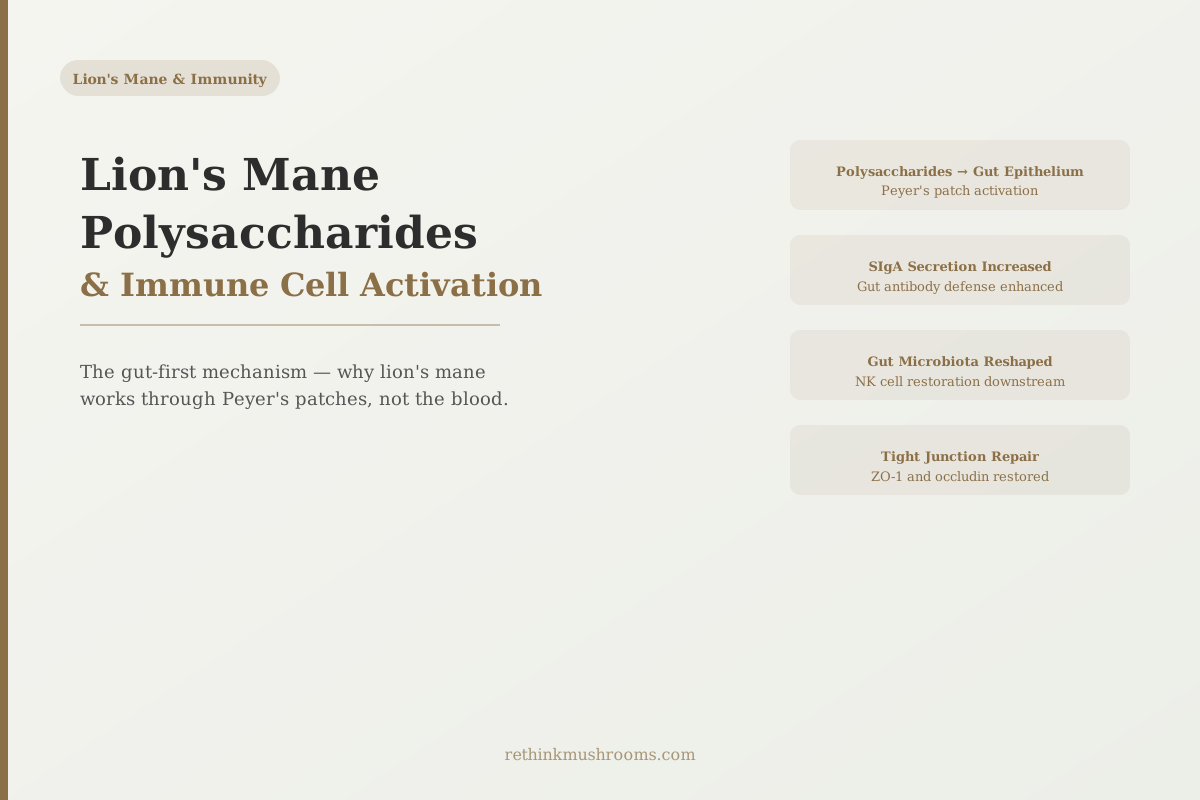
Sheng et al. (2017) published a foundational mechanistic study in Food & Function that answered the how question: lion's mane polysaccharides modulate immunity primarily through the intestinal immune system — specifically through Peyer's patches (the immune training centers of the gut wall) and secretory IgA (the antibody that protects mucosal surfaces).[1]
This distinction changes how the immune effects should be interpreted. It also explains when and how lion's mane is most likely to work as an immune agent — and why it is different from other medicinal mushrooms with immune claims. For a broader overview of what lion's mane is and its full research profile, see our science-based lion's mane overview.
Key Takeaways
- Sheng et al. (2017) found that lion's mane polysaccharide immune effects are mediated through intestinal immunity — specifically Peyer's patch activation and SIgA secretion — rather than direct systemic blood immune activation
- The distinction matters: lion's mane works through the gut-immune axis, which means oral consumption is specifically required (topical or IV forms wouldn't produce the same effect)
- Tian et al. (2023) found lion's mane polysaccharides restored NK cell activity in immunosuppressed mice — but the mechanism was gut microbiota reshaping first, then NK restoration second, not direct NK activation
- Tian et al. (2023) showed polysaccharides repaired intestinal barrier proteins (ZO-1 and occludin tight junction proteins) in immunocompromised mice, connecting gut barrier integrity to immune function
- Ren et al. (2023) demonstrated that lion's mane mycelium polysaccharide alleviated ulcerative colitis and reshaped gut microbiota in cynomolgus monkeys — the closest pre-human evidence available
- Ren et al. (2018) mapped three simultaneous mechanisms in mouse colitis models: oxidative stress reduction, NF-κB/MAPK signaling suppression, and gut microbiota composition changes
How Lion's Mane Polysaccharides Activate the Immune System
Lion's mane polysaccharides work through the intestinal immune system: they activate Peyer's patches (specialized immune structures in the gut wall that train the body's immune response), increase secretory IgA (the gut's main antibody defense), stimulate NK cell activity, and reshape gut microbiota to favor bacteria associated with immune support. They act primarily in the gut rather than directly activating blood immune cells — a mechanistic distinction that separates lion's mane from some other medicinal mushrooms.
Sheng et al. (2017) provided the most direct evidence for this pathway, finding that the immunomodulatory effects of lion's mane polysaccharides were specifically mediated through intestinal immunity — with MAPK and AKT signaling pathways as the downstream molecular mechanisms.[1]
Why the Gut-First Mechanism Sets Lion's Mane Apart
Most medicinal mushroom polysaccharides — turkey tail's PSK and PSP, reishi's beta-glucans, maitake's D-fraction — are studied for their ability to directly activate macrophages, dendritic cells, and NK cells in blood and lymphoid tissue. They bind to pattern recognition receptors like Dectin-1 on these cells and trigger immune signaling cascades.
Lion's mane polysaccharides do influence macrophages and NK cells. But Sheng 2017 established that the dominant route by which they do so is indirect — through the intestinal epithelium and its associated immune structures — rather than direct blood immune activation.[1]
This matters because the gut contains a disproportionately large share of the body's immune tissue. The intestinal wall is lined with sampling sites — Peyer's patches — that constantly monitor the gut contents and use what they find to train the broader immune system. An immune signal that enters through Peyer's patches initiates a different cascade than one that enters through the bloodstream.
The practical implication: oral consumption of lion's mane is specifically necessary to access this pathway. The polysaccharides must interact with the intestinal epithelium to produce the immune effects documented in the research. This is one reason why bioavailability discussions about lion's mane polysaccharides are different from bioavailability discussions about small-molecule drugs — the gut interaction is part of the mechanism, not just a barrier to overcome on the way to systemic circulation.
For more on how this gut-immune mechanism operates across medicinal mushrooms generally, see mushroom polysaccharide absorption: the gut immune connection.
Peyer's Patches and SIgA: What Sheng 2017 Found
To understand why Sheng 2017 matters, it helps to know what Peyer's patches and secretory IgA (SIgA) do.
Peyer's patches are clusters of immune cells — mostly B cells, T cells, and macrophages — embedded in the lining of the small intestine. They function as sampling stations: they capture bacteria, food particles, and other molecules from the gut contents, process them, and use that information to generate immune responses appropriate to the local gut environment. When a pathogen enters the gut, Peyer's patches are among the first immune structures to detect and respond to it.
Secretory IgA (SIgA) is the antibody that patrols the mucosal surfaces of the gut. Unlike the IgG antibodies that circulate in blood, SIgA operates in the gut lumen itself — coating pathogens, preventing them from adhering to gut cells, and neutralizing bacterial toxins before they cross the gut wall. Higher SIgA levels mean a better-prepared mucosal immune defense.
Sheng et al. (2017) found that lion's mane polysaccharides activated Peyer's patches and increased SIgA secretion through MAPK and AKT signaling pathways — both established immune signaling routes involved in lymphocyte activation and antibody production.[1]
The significance: lion's mane polysaccharides are not just vaguely "immunostimulatory." They specifically enhance the gut's local immune defense system and prime the broader immune response through training at Peyer's patches. This is a mechanistically coherent explanation for why lion's mane might reduce susceptibility to gut infections and support overall immune readiness.
NK Cell Restoration: What Tian 2023 Found (and How It Happened)
Natural killer (NK) cells are a type of immune cell that targets infected or cancerous cells directly, without needing prior exposure to a specific pathogen. NK cell activity tends to decline in states of immune suppression — from chemotherapy, chronic stress, malnutrition, or aging.
Tian et al. (2023) studied lion's mane polysaccharides in mice treated with cyclophosphamide — a chemotherapy agent that causes significant immunosuppression, suppressing NK cell activity along with other immune functions.[2]
The polysaccharides restored NK cell activity in these immunosuppressed mice. But critically, the mechanism was indirect: the polysaccharides first reshaped the gut microbiota — increasing beneficial bacteria like Lactobacillus and Bifidobacterium while reducing harmful species — and this gut microbiota shift was associated with the restoration of splenocyte proliferation and NK cell activity.
NK cells were not directly activated by lion's mane polysaccharides binding to them. The activation appears to have been driven by the change in gut bacteria, which communicated to the immune system through the gut-immune axis.
This finding reinforces the Sheng 2017 model: lion's mane polysaccharides act primarily in the gut, and immune effects in the blood and lymphoid tissue appear downstream of gut changes — not upstream.
Intestinal Barrier Repair: The Tight Junction Protein Data
A second 2023 paper from Tian et al., published in Food & Function, examined whether lion's mane polysaccharides could repair intestinal barrier damage — specifically, the degradation of tight junction proteins that maintain the gut wall's integrity.[3]
Tight junction proteins — including ZO-1 and occludin — are the molecular seals between intestinal cells. When they degrade, gut permeability increases: bacteria, toxins, and undigested food particles can pass more easily from the gut into the bloodstream. This increase in permeability is associated with systemic immune activation and chronic inflammatory states.
In immunocompromised mice with induced intestinal barrier damage, lion's mane polysaccharides improved ZO-1 and occludin expression — the gut wall's tight junction proteins recovered. Villus height (a measure of intestinal architecture) improved. Intestinal permeability decreased.
This connects directly to immune function: a more intact gut wall means fewer bacterial fragments reaching the bloodstream, less inappropriate systemic immune activation, and a better-regulated immune response overall. Gut barrier integrity is not just a gut health issue — it is an immune regulation issue.
The Mouse-to-Monkey Evidence Progression
In most preclinical research, the concern is whether mouse data will translate to humans. One intermediate step is non-human primate models, which share substantially more biological similarity to humans.
Ren et al. (2018) established the mouse-model evidence for lion's mane polysaccharides in colitis: polysaccharide from H. erinaceus attenuated DSS-induced colitis in C57BL/6 mice through three simultaneous mechanisms — reduced oxidative stress, suppressed NF-κB and MAPK inflammatory signaling, and altered gut microbiota composition toward a healthier profile.[5]
NF-κB (nuclear factor kappa B) is the main molecular switch for inflammation — when it is activated, it turns on the production of pro-inflammatory proteins. Suppressing NF-κB is one of the primary mechanisms by which anti-inflammatory drugs work. Lion's mane polysaccharides suppressed this pathway in mouse gut tissue.
Ren et al. (2023) extended this to cynomolgus monkeys — non-human primates much closer to humans in biology and immune function.[4] Mycelium-derived H. erinaceus polysaccharide alleviated ulcerative colitis and improved gut microbiota composition in these monkeys. The translational significance of a primate model over a rodent model is substantial — it represents the closest available preclinical evidence to how the compound might behave in humans.
What the Polysaccharides Actually Are (Structural Context)
Lion's mane polysaccharides are not a single compound. They include beta-glucans (glucose-based chains with specific branching patterns) and heteropolysaccharides (chains with multiple types of sugar molecules). The exact structures vary depending on whether the extract comes from fruiting bodies or mycelium, and which extraction method was used.
This structural diversity is partly why lion's mane polysaccharides can influence multiple immune targets simultaneously — different molecular structures bind different immune receptors and activate different pathways. It also means that "lion's mane polysaccharide" as a category is not interchangeable with any specific polysaccharide fraction.
The immune research covered in this article spans extracts from both fruiting body and mycelium sources. The Sheng 2017 and Ren 2023 studies used specific polysaccharide fractions rather than whole mushroom extracts, which gives them greater mechanistic precision but limits direct comparison to dietary or supplement consumption.
Lion's Mane vs. Other Medicinal Mushrooms: A Mechanistic Comparison
Turkey tail (Trametes versicolor) is the most studied medicinal mushroom for immune activation. Its polysaccharopeptides (PSK, PSP) are approved as cancer adjunct therapies in Japan and China, based on clinical evidence for immune support during chemotherapy.
Reishi (Ganoderma lucidum) beta-glucans bind directly to Dectin-1 and other pattern recognition receptors on macrophages and dendritic cells, activating them to produce cytokines and enhance tumor surveillance.
Lion's mane polysaccharides appear to work more through intestinal immunity and gut-microbiota-mediated immune modulation — a different primary mechanism, though with overlapping downstream effects (NK cell activation, cytokine modulation) by the end of the pathway.
This doesn't make lion's mane stronger or weaker than other mushrooms for immune support — it makes it different. An approach that works through the gut-immune axis has distinct applications, particularly in gut-related immune conditions like IBD, intestinal infections, and gut-mediated immune regulation. For the lion's mane immune picture as it relates specifically to gut inflammation, see lion's mane and gut immunity: the intestinal immune connection. For the broader overview of how lion's mane modulates the immune system, see lion's mane and the immune system: immunomodulatory research.
Related reading: the beta-glucan macrophage activation data specifically is covered in lion's mane beta-glucans and macrophage activation: in vitro evidence. For the infection-fighting angle, see can lion's mane help fight infections? antimicrobial evidence.
The Bottom Line
Lion's mane polysaccharide immune cell activation operates primarily through intestinal immunity — a mechanism established by Sheng et al. (2017), who found that immune effects are mediated by Peyer's patch activation and SIgA secretion rather than direct blood immune cell stimulation. Subsequent research confirmed NK cell restoration in immunosuppressed mice (via gut microbiota reshaping), intestinal barrier protein repair (ZO-1 and occludin), and alleviation of colitis in a non-human primate model. The evidence base spans mouse models, monkey models, and one human pilot study for related gut microbiota effects; no human RCT has tested lion's mane specifically for immune outcomes.
Frequently Asked Questions
Sources & References
- 1RTHM-00912·Sheng, Xiaotong et al. (2017). “Immunomodulatory effects of Hericium erinaceus derived polysaccharides are mediated by intestinal immunology..” Food & function.Study breakdown →PubMed →↩
- 2RTHM-01804·Tian, Baoming et al. (2023). “Modulating effects of Hericium erinaceus polysaccharides on the immune response by regulating gut microbiota in cyclophosphamide-treated mice..” Journal of the science of food and agriculture.Study breakdown →PubMed →↩
- 3RTHM-01803·Tian, Baoming et al. (2023). “Ameliorating effects of Hericium erinaceus polysaccharides on intestinal barrier injury in immunocompromised mice induced by cyclophosphamide..” Food & function.Study breakdown →PubMed →↩
- 4RTHM-01776·Ren, Zhengyu et al. (2023). “Hericium erinaceus mycelium-Derived Polysaccharide Alleviates Ulcerative Colitis and Modulates Gut Microbiota in Cynomolgus Monkeys..” Molecular nutrition & food research.Study breakdown →PubMed →↩
- 5RTHM-00529·Ren, Yilin et al. (2018). “Polysaccharide of Hericium erinaceus attenuates colitis in C57BL/6 mice via regulation of oxidative stress, inflammation-related signaling pathways and modulating the composition of the gut microbiota..” The Journal of nutritional biochemistry.Study breakdown →PubMed →↩