Beta-Glucans & Vaccination
16 clinical trials
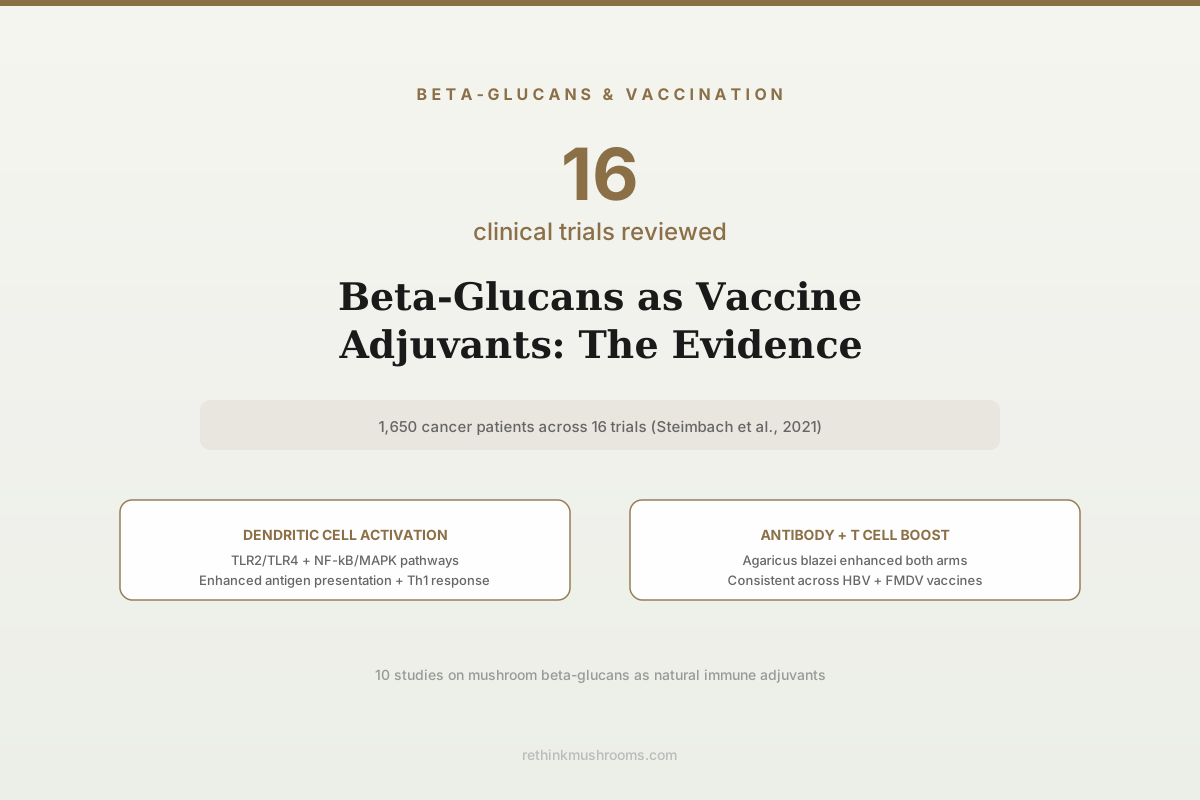
A 2021 systematic review identified 16 clinical trials involving 1,650 cancer patients receiving fungal beta-glucans as adjuvant therapy alongside conventional treatment.
Steimbach et al., Clinical Nutrition, 2021
5 Receptors
Dectin-1, CR3, CD5, TLR, lactosylceramide
DNA Vaccine Boost
Agaricus blazei enhanced antibody + T cell response
DC Activation
Antrodia polysaccharides matured dendritic cells
Steimbach et al., Clinical Nutrition, 2021
 View as image ↗
Vaccine adjuvants are substances added to vaccines to amplify the immune response. Most adjuvants in clinical use are synthetic (aluminum salts, oil-in-water emulsions). Beta-glucans from fungal cell walls represent a natural alternative with a distinct mechanism: they activate dendritic cells, bridge innate and adaptive immunity, and can enhance both antibody production and T cell responses. Jin et al. (2018) reviewed the adjuvanticity of beta-glucans in the journal Vaccine, concluding that among different carbohydrate polymers tested, glucans were the most promising vaccine adjuvant, stimulating various immune reactions including antibody production without negative side effects.[1] A 2021 systematic review of 16 clinical trials involving 1,650 cancer patients found that fungal beta-glucan co-administration with chemotherapy or radiotherapy was safe, well-tolerated, and reduced immune depression caused by treatment.[2]
For how beta-glucans create lasting immune memory, see beta-glucans and innate immune memory. For species-specific immune evidence, see can mushrooms improve vaccine effectiveness?.
Key Takeaways
- Beta-glucans are the most promising carbohydrate-based vaccine adjuvants, activating immune responses through at least five receptors including Dectin-1, CR3, and CD5 (Jin et al., 2018)
- Agaricus blazei extract co-administered with hepatitis B DNA vaccine increased both antibody responses and T cell proliferation in mice (Chen et al., 2004)
- Antrodia cinnamomea high-molecular-weight polysaccharides activated dendritic cells via TLR2/TLR4 and enhanced HER-2/neu DNA vaccine anti-tumor efficacy in a mouse tumor model (Lin et al., 2015)
- A systematic review of 16 clinical trials (1,650 cancer patients) found fungal beta-glucan adjuvant therapy was safe and reduced chemotherapy-induced immune depression (Steimbach et al., 2021)
- Agaricus blazei hot water extract increased antibody-producing spleen cells (P < 0.01) by stimulating macrophages and T cells to release IL-1beta and IL-6 (Nakajima et al., 2002)
- Oral mushroom powder shifted bone marrow progenitor cells toward myeloid-committed lineages, altering immune cell production at the source (Case et al., 2024)
How Beta-Glucans Enhance Vaccine Responses
Vaccines work by presenting antigens to the immune system. Adjuvants amplify that presentation. Beta-glucans function as adjuvants through a mechanism distinct from traditional aluminum-based adjuvants: they directly activate antigen-presenting cells (particularly dendritic cells and macrophages) through pattern recognition receptors.[1]
Jin et al. (2018) identified five receptors through which beta-glucans connect innate and adaptive immunity: Dectin-1, complement receptor 3 (CR3), CD5, lactosylceramide, and Toll-like receptors. When beta-glucans bind these receptors on innate immune cells, the resulting activation cascade improves antigen presentation to T cells and enhances B cell antibody production. This dual activation of cellular and humoral immunity is what makes beta-glucans attractive as vaccine adjuvants.[1]
Murphy et al. (2020) reviewed the broader immunomodulatory properties of beta-glucans, noting their dual nature as both metabolic fibers and immune signals. Two beta-glucan isolates (lentinan from shiitake and schizophyllan from Schizophyllum commune) were licensed as drugs in Japan in 1980 as immune-adjuvant therapy for cancer, making them the earliest clinical application of beta-glucan adjuvanticity.[3]
Dendritic Cell Activation: The Key Mechanism
Dendritic cells are the immune system's primary antigen-presenting cells. They capture antigens, process them, and present them to T cells, initiating the adaptive immune response. Beta-glucans from mushrooms activate and mature dendritic cells, making them more effective at this critical function.
Lin et al. (2015) isolated high-molecular-weight polysaccharides (greater than 100 kDa) from Antrodia cinnamomea and tested them on dendritic cells. The polysaccharides promoted pro-inflammatory cytokine production and DC maturation. DC-induced antigen-specific T cell activation and Th1 differentiation both increased. The molecular mechanism involved activation of MAPK and NF-kB pathways through TLR2 and TLR4.[4]
In a mouse tumor model, these polysaccharides enhanced the anti-tumor efficacy of a HER-2/neu DNA vaccine by facilitating specific Th1 responses. Only the high-molecular-weight fraction (greater than 100 kDa) exhibited the activating effect, demonstrating that polysaccharide size matters for adjuvant activity.[4]
Huang et al. (2010) confirmed this adjuvant mechanism with whole Antrodia camphorata extract. Co-treatment with the HER-2/neu DNA vaccine suppressed tumor growth and extended survival in mice. The effect was attributed to enhanced Th1-like cellular immunity: increased IFN-gamma mRNA expression in CD4+ T cells, more functional antigen-specific cytotoxic T lymphocytes (CTLs), and increased tumor infiltration by both CD4+ and CD8+ T cells. DC activation and production of Th1-activating cytokines (IL-12, IFN-alpha) in draining lymph nodes drove the enhanced T cell response.[5]
For how beta-glucan structure affects molecular weight and immune activity, see beta-glucan molecular weight and biological activity.
Agaricus blazei: The Most-Studied Mushroom Vaccine Adjuvant
Agaricus blazei (also classified as A. brasiliensis or A. subrufescens) has the deepest evidence base for mushroom-derived vaccine adjuvanticity, with studies spanning two decades.
Nakajima et al. (2002) provided early evidence that A. blazei hot water extract enhances antibody production. Intraperitoneal administration at 25 mg/kg increased the number of antibody-producing plaque-forming cells in the spleen (P < 0.01). Mac-1-positive and CD25-positive cell populations increased (P < 0.01, P < 0.001), while CD19-positive B cell numbers did not change. IL-6 and IL-1beta mRNA expression was augmented in both peritoneal macrophages and spleen cells. The mechanism: A. blazei stimulated T cells and macrophages to release cytokines that enhanced antibody production rather than directly activating B cells.[6]
Chen et al. (2004) applied this to a specific vaccine. Co-immunization of A. blazei extract with hepatitis B virus core protein DNA vaccine produced both increased HBcAg-specific antibody responses and enhanced T cell proliferation compared to vaccine alone. The extract acted as a true adjuvant: it amplified the immune response to a specific antigen without being antigenic itself.[7]
Chen and Shao (2006) replicated this approach with a veterinary application. A. blazei extract co-administered with foot-and-mouth disease virus DNA vaccine produced the same pattern: increased antigen-specific antibody response and enhanced T cell proliferation compared to vaccine alone.[8]
Two different antigens, two different DNA vaccines, the same adjuvant effect. This consistency across vaccine targets supports the conclusion that A. blazei acts as a general immune potentiator rather than an antigen-specific enhancer. For the bioactive compounds responsible, see Agaricus blazei bioactive compounds.
Trained Immunity: The Bridge to Vaccination
The concept of trained immunity adds another dimension to beta-glucan adjuvanticity. Beta-glucans do not just boost the immediate immune response. They reprogram innate immune cells to respond more vigorously to future challenges, including vaccine antigens encountered days or weeks later.
Case et al. (2024) demonstrated this with Agaricus bisporus (white button mushroom). Oral mushroom powder shifted bone marrow hematopoietic stem and progenitor cells toward myeloid-committed lineages. Mature macrophages derived from these mice showed enhanced responses to restimulation, particularly to TLR2 ligands. Human monocytes were also trained by the mushroom preparations in vitro.[9]
Stothers et al. (2021) showed that beta-glucan-trained macrophages maintained enhanced phagocytosis, ROS production, and sustained metabolic changes for more than 7 days. Adoptive transfer of these trained macrophages into naive mice conferred protection against Pseudomonas aeruginosa infection.[10]
The implication for vaccination: if beta-glucan exposure before or during vaccination creates trained innate immune cells, those cells may respond more effectively when processing vaccine antigens. This trained immunity mechanism is distinct from the direct DC activation described above and could provide a complementary pathway for enhancing vaccine responses. For the full trained immunity picture, see beta-glucans and innate immune memory and trained immunity: why mushroom benefits may be long-lasting.
Clinical Evidence: Cancer Adjuvant Therapy
Steimbach et al. (2021) conducted the most comprehensive review of fungal beta-glucan adjuvant therapy in humans. Their systematic review following PRISMA guidelines identified 16 clinical trials involving 1,650 cancer patients with arm sizes ranging from 9 to 200 patients, published between 1992 and 2018.[2]
The beta-glucan sources across trials included lentinan (from Lentinula edodes/shiitake), schizophyllan (from Schizophyllum commune), and yeast-derived preparations. Patients had diagnoses across 9 cancer types.[2]
Key findings from the review:
Safety: Beta-glucan administration was safe and well-tolerated across all 16 trials. No serious adverse events were attributed to the beta-glucan component.[2]
Immune recovery: Most trials found that beta-glucan co-administration with chemotherapy or radiotherapy reduced the immune depression caused by these treatments and accelerated recovery of white blood cell counts.[2]
Limitations: Some trials found no statistical difference between beta-glucan and control groups. The diversity of methodologies, beta-glucan sources, cancer types, and dosing regimens across the 16 trials prevented meta-analysis. The reviewers noted that insufficient standardization makes it difficult to draw definitive conclusions about efficacy.[2]
For mushroom-specific clinical evidence on vaccination, see mushrooms and flu shot response and mushroom supplements before vaccination.
Where the Evidence Stands
The preclinical evidence for beta-glucan vaccine adjuvanticity is consistent across multiple mushroom species, vaccine types, and animal models. Agaricus blazei extracts enhance DNA vaccine responses, Antrodia polysaccharides activate dendritic cells and boost anti-tumor vaccines, and beta-glucan-trained macrophages show enhanced immune function.
The human evidence is more limited. The 16 clinical trials reviewed by Steimbach et al. focus on cancer adjuvant therapy (beta-glucans given alongside conventional treatment) rather than preventive vaccination. A small number of human trials have explored beta-glucan supplementation alongside influenza vaccination, but these used yeast-derived, not mushroom-derived, beta-glucans.
The gap between preclinical promise and clinical proof remains wide. The molecular mechanisms are well-characterized: receptor engagement, dendritic cell maturation, T cell activation, antibody enhancement. What is missing is a body of large, well-controlled human trials using standardized mushroom-derived beta-glucan preparations alongside specific vaccines.
The Bottom Line
Beta-glucans from mushrooms enhance vaccine responses through dendritic cell activation, T cell priming, and antibody production enhancement. Agaricus blazei and Antrodia species show consistent adjuvant effects across multiple preclinical vaccine models. A systematic review of 16 human clinical trials confirms safety and some evidence of immune recovery during cancer treatment. The trained immunity pathway adds a second mechanism: beta-glucan pre-exposure reprograms innate immune cells to respond more effectively to future challenges. Clinical evidence for mushroom beta-glucans as preventive vaccine adjuvants in healthy humans is still lacking.
Frequently Asked Questions
Sources & References
- 1RTHM-00513·Jin, Yiming et al. (2018). “β-glucans as potential immunoadjuvants: A review on the adjuvanticity, structure-activity relationship and receptor recognition properties..” Vaccine.Study breakdown →PubMed →↩
- 2RTHM-00719·Steimbach, Laiza et al. (2021). “Fungal beta-glucans as adjuvants for treating cancer patients - A systematic review of clinical trials..” Clinical nutrition (Edinburgh.Study breakdown →PubMed →↩
- 3RTHM-00639·Murphy, Emma J et al. (2020). “β-Glucan Metabolic and Immunomodulatory Properties and Potential for Clinical Application..” Journal of fungi (Basel.Study breakdown →PubMed →↩
- 4RTHM-00391·Lin, Chi-Chen et al. (2015). “The adjuvant effects of high-molecule-weight polysaccharides purified from Antrodia cinnamomea on dendritic cell function and DNA vaccines..” PloS one.Study breakdown →PubMed →↩
- 5RTHM-00185·Huang, Chia-Hsin et al. (2010). “Promoting effect of Antrodia camphorata as an immunomodulating adjuvant on the antitumor efficacy of HER-2/neu DNA vaccine..” Cancer immunology.Study breakdown →PubMed →↩
- 6RTHM-00048·Nakajima, A et al. (2002). “Effect of hot water extract from Agaricus blazei Murill on antibody-producing cells in mice..” International immunopharmacology.Study breakdown →PubMed →↩
- 7RTHM-00068·Chen, L et al. (2004). “Coimmunization of Agaricus blazei Murill extract with hepatitis B virus core protein through DNA vaccine enhances cellular and humoral immune responses..” International immunopharmacology.Study breakdown →PubMed →↩
- 8RTHM-00093·Chen, Liang et al. (2006). “Extract from Agaricus blazei Murill can enhance immune responses elicited by DNA vaccine against foot-and-mouth disease..” Veterinary immunology and immunopathology.Study breakdown →PubMed →↩
- 9RTHM-00867·Case, Sarah et al. (2024). “β-glucans from Agaricus bisporus mushroom products drive Trained Immunity..” Frontiers in nutrition.Study breakdown →PubMed →↩
- 10RTHM-00721·Stothers, Cody L et al. (2021). “β-Glucan Induces Distinct and Protective Innate Immune Memory in Differentiated Macrophages..” Journal of immunology (Baltimore.Study breakdown →PubMed →↩