Mushrooms & Vaccine Response
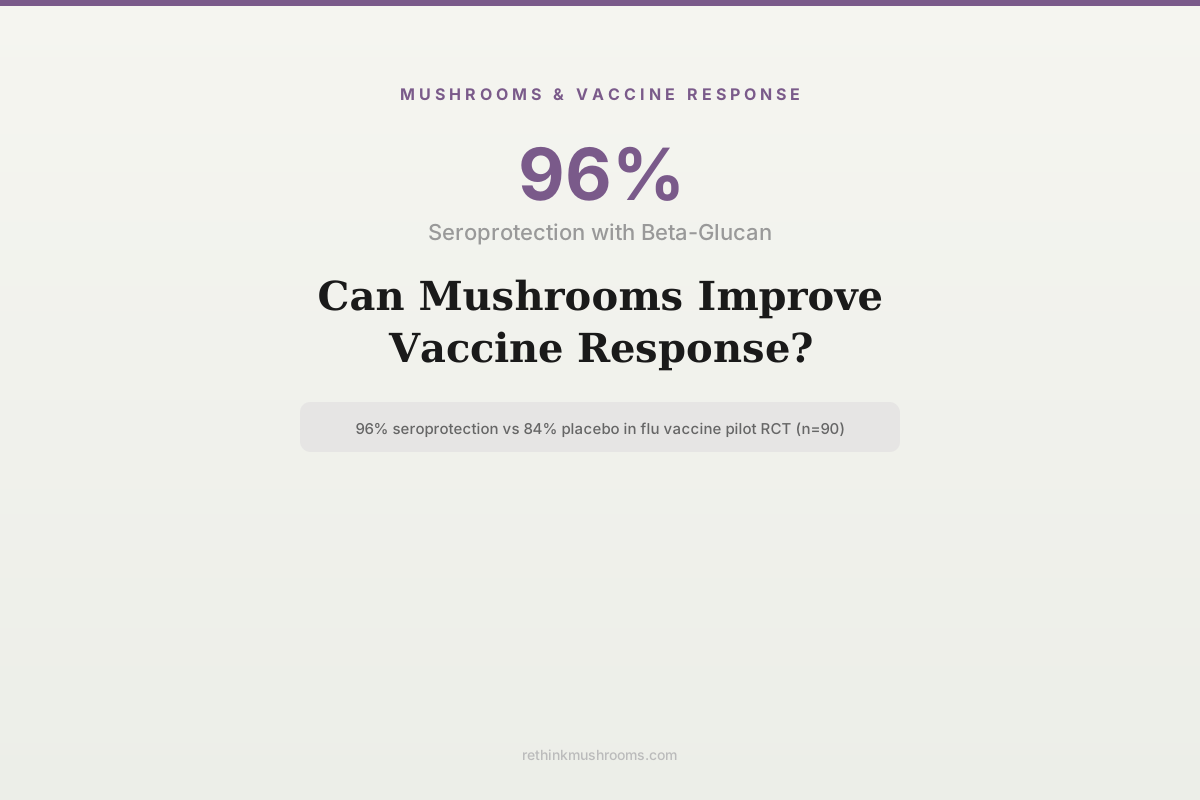
96% Seroprotection
In a pilot RCT, 96% of adults aged 50+ taking 500 mg/day yeast beta-glucan achieved seroprotective antibody titers against influenza after vaccination, versus 84% on placebo.
Moreno et al., J Dietary Suppl, 2025
Dectin-1
primary receptor through which immune cells recognize fungal beta-glucans
Trained Immunity
beta-glucan reprograms macrophages for enhanced pathogen response lasting weeks
DNA Vaccines
Agaricus blazei extract boosted antibody + T cell responses in mice
Moreno et al., J Dietary Suppl, 2025
 View as image ↗
Mushroom cell walls are built from beta-glucans, polysaccharides that the human immune system recognizes as foreign through pattern recognition receptors, primarily Dectin-1. This recognition triggers a cascade of immune responses: macrophage activation, dendritic cell maturation, cytokine production, and a phenomenon called trained immunity where innate immune cells are epigenetically reprogrammed for enhanced future responses. The question of whether this immune activation can be harnessed to improve vaccine effectiveness has been explored in animal models with mushroom-derived extracts and in a small number of human trials with yeast-derived beta-glucans. The evidence is suggestive but early-stage. For the broader beta-glucan immune story, see beta-glucans as natural vaccine adjuvants.
Key Takeaways
- In a pilot RCT, adults aged 50+ taking 500 mg/day yeast beta-glucan showed 86% higher post-vaccination influenza antibody titers versus 12% in the placebo group (p=0.037), with 96% vs. 84% achieving seroprotection (Moreno et al., 2025)
- Co-administration of Agaricus blazei extract with hepatitis B DNA vaccine significantly increased HBcAg-specific antibody responses and T cell proliferation in mice compared to vaccine alone (Chen et al., 2004)
- A. blazei extract similarly enhanced antibody and T cell responses when co-administered with foot-and-mouth disease DNA vaccine in mice (Chen et al., 2006)
- Antrodia camphorata co-treatment with HER-2/neu DNA vaccine suppressed tumor growth and extended survival in mice by enhancing Th1 cellular immune responses (Huang et al., 2010)
- Beta-glucan induces trained immunity in macrophages: adoptive transfer of beta-glucan-trained macrophages into naive mice protected them from Pseudomonas aeruginosa infection for over 7 days (Stothers et al., 2021)
- Beta-glucans connect innate and adaptive immunity by activating Dectin-1, complement receptor 3, and TLR2/TLR4, enhancing dendritic cell antigen presentation and Th1 differentiation (Jin et al., 2018)
How Beta-Glucans Activate the Immune System
Understanding why beta-glucans might improve vaccine responses requires understanding how the immune system detects them. Goodridge et al. (2009) reviewed the receptor biology: beta-glucans are recognized by multiple innate immune receptors, with Dectin-1 being the primary pattern recognition receptor on macrophages, dendritic cells, and neutrophils.[1] When Dectin-1 binds the (1,3)-beta-glucan backbone, it triggers phagocytosis, reactive oxygen species production, and cytokine release (TNF-alpha, IL-6, IL-12). Other receptors including complement receptor 3 (CR3), TLR2, TLR4, and CD5 also contribute to beta-glucan recognition.
Jin et al. (2018) reviewed the adjuvanticity of beta-glucans specifically and concluded that they "can regulate immune responses when administered alone and can connect innate and adaptive immunity to improve immunogenicity of vaccines."[2] The bridge between innate and adaptive immunity is the key to the vaccine adjuvant hypothesis. Vaccines work by stimulating adaptive immunity (antibodies, memory T cells). If beta-glucans activate innate immune cells (dendritic cells, macrophages) in ways that enhance their antigen-presenting function, the downstream adaptive response to a co-administered vaccine antigen should be stronger.
Akramiene et al. (2007) documented the broader immunostimulatory profile of beta-glucans, noting that mushroom-derived polysaccharides have been used for immunostimulation in Eastern medicine for thousands of years before the molecular mechanisms were understood.[3] The beta-glucans belong to a large family of biological response modifiers that share structural features (glucose polymers with (1,3) and (1,6) linkages) but vary substantially in molecular weight, branching pattern, and solubility depending on source organism. These structural differences affect which receptors are engaged and how strongly.
Animal Evidence: Mushroom Extracts as Vaccine Adjuvants
The most direct evidence for mushroom compounds improving vaccine responses comes from three animal studies using mushroom extracts co-administered with DNA vaccines.
Chen et al. (2004) tested Agaricus blazei Murill (ABM) extract as an adjuvant for a hepatitis B virus core antigen DNA vaccine in mice.[4] Mice receiving the HBcAg DNA vaccine plus ABM extract showed significantly higher HBcAg-specific antibody responses and T cell proliferation compared to mice receiving the vaccine alone. A. blazei is particularly rich in beta-glucans and other polysaccharides, and the extract appeared to enhance both humoral (antibody) and cellular (T cell) arms of the adaptive immune response. For more on Agaricus blazei's immune properties, see Agaricus blazei for immune-compromised patients.
Chen et al. (2006) extended this approach to foot-and-mouth disease virus (FMDV) DNA vaccine, again using ABM extract as a co-administered adjuvant.[5] The results were consistent: mice receiving vaccine plus ABM extract produced significantly higher FMDV-specific antibody responses and greater T cell proliferation than those receiving vaccine alone. Two independent studies from the same group using different vaccine antigens both showed the same adjuvant pattern, which strengthens the finding by demonstrating it is not antigen-specific.
Huang et al. (2010) tested Antrodia camphorata as an immunomodulating adjuvant for a HER-2/neu DNA vaccine in a mouse tumor model.[6] The MBT-2 tumor cells overexpressed p185neu, making them targets for anti-HER-2 immunity. Mice receiving the DNA vaccine plus Antrodia camphorata showed suppressed tumor growth and extended survival compared to vaccine alone. The enhanced antitumor efficacy was attributed to increased Th1-like cellular immune responses, the type of T helper cell response most effective for clearing intracellular pathogens and cancer cells. For related Antrodia immune research, see Antrodia and the immune system: immunomodulatory research.
Dendritic Cell Activation: The Mechanistic Bridge
Lin et al. (2015) identified the molecular mechanism by which mushroom polysaccharides enhance vaccine responses. High-molecular-weight polysaccharides (greater than 100 kDa) purified from Antrodia cinnamomea activated dendritic cells (DCs), the antigen-presenting cells that initiate adaptive immune responses.[7]
The polysaccharides promoted pro-inflammatory cytokine production by DCs, induced DC maturation, and enhanced DC-mediated antigen-specific T cell activation with a bias toward Th1 differentiation. The signaling pathway involved TLR2 and TLR4 engagement, which activated MAPK and NF-kB pathways. In a mouse tumor model, these polysaccharides enhanced the anti-tumor efficacy of a HER-2/neu DNA vaccine by facilitating specific Th1 responses.
This study is mechanistically important because dendritic cells are the critical link between innate and adaptive immunity. Traditional vaccine adjuvants (aluminum salts, MF59) work partly by activating DCs. If mushroom polysaccharides activate DCs through a different receptor pathway (TLR2/TLR4 and Dectin-1 rather than inflammasome activation), they could theoretically complement existing adjuvants or provide adjuvant activity for vaccines that currently lack one.
The limitation is that all of this DC activation work is in cell culture and mouse models. DC biology differs between mice and humans, and the in vitro activation of DCs does not guarantee that oral or parenteral mushroom polysaccharide administration would achieve the same activation in a living human body.
Trained Immunity: Beta-Glucan's Lasting Effect
Perhaps the most conceptually important finding for the vaccine question comes from trained immunity research. Stothers et al. (2021) demonstrated that beta-glucan induces distinct and protective innate immune memory in differentiated macrophages.[8]
Trained immunity is fundamentally different from the adaptive immune memory that vaccines rely on. It refers to epigenetic reprogramming of innate immune cells (macrophages, monocytes) that enhances their response to subsequent infections, even infections caused by entirely different pathogens from the original stimulus. Beta-glucan exposure causes histone modifications (H3K4 trimethylation and H3K27 acetylation) at promoter regions of pro-inflammatory and antimicrobial genes in macrophages, leaving them in a primed state for weeks to months.
Stothers et al. showed that beta-glucan protected mice from Pseudomonas aeruginosa infection by augmenting recruitment of innate leukocytes to the infection site and facilitating local bacterial clearance, with the protective effect persisting for more than 7 days. Critically, adoptive transfer of beta-glucan-trained macrophages into naive mice also conferred protection, proving that the trained macrophages themselves carry the protective capacity independent of other immune changes.
The relevance to vaccine effectiveness is indirect but substantive. If beta-glucan pre-treatment primes the innate immune system into a more responsive state, the initial innate response to vaccine antigens may be faster and stronger, potentially leading to enhanced adaptive immune responses downstream. This has not been tested in a controlled human vaccine study using mushroom-derived beta-glucans specifically.
The Human Evidence Gap
Murphy et al. (2020) reviewed the metabolic and immunomodulatory properties of beta-glucans and their clinical application potential, noting that while the preclinical immune data are extensive, human clinical evidence for beta-glucan as a vaccine adjuvant is sparse.[9]
Auinger et al. (2013) conducted a double-blind, randomized, placebo-controlled, multicentric clinical trial in which 162 healthy participants with recurring infections received 900 mg/day of yeast (1,3)-(1,6)-beta-D-glucan or placebo.[10] The study found that beta-glucan "helps to maintain the body's defence against pathogens" based on reduced common cold episodes. This is not a vaccine study, but it demonstrates that oral beta-glucan supplementation produces measurable immune effects in humans, which is a necessary prerequisite for any vaccine adjuvant application.
A 2025 pilot RCT (Moreno et al.) provided the first direct evidence that beta-glucan supplementation can enhance vaccine antibody responses in humans. Adults aged 50 and older (n=90) received either 500 mg/day of yeast beta-glucan or placebo alongside seasonal influenza vaccination. The beta-glucan group showed an 86% increase in post-vaccination antibody titers compared to 12% in the placebo group (p=0.037), and 96% achieved seroprotective titers versus 84% in the placebo group. This is a pilot study with a small sample size, and it used yeast-derived rather than mushroom-derived beta-glucan, but it provides proof-of-concept that oral beta-glucan supplementation can enhance vaccine immune responses in older adults, a population known for diminished vaccine effectiveness.
The gap between yeast beta-glucans and mushroom beta-glucans matters. Yeast (1,3)-(1,6)-beta-glucans and mushroom (1,3)-(1,6)-beta-glucans share structural features but differ in molecular weight, branching patterns, and purity. Whether the flu vaccine adjuvant effect translates directly to mushroom-derived beta-glucans is plausible but unconfirmed. For context on how different mushroom beta-glucans activate immune cells, see mushroom supplements before vaccination: immune priming evidence.
What the Evidence Supports and What It Does Not
| Evidence type | Finding | Confidence |
|---|---|---|
| Animal vaccine adjuvant | A. blazei extract enhanced antibody + T cell responses to DNA vaccines in mice | Moderate |
| Tumor vaccine | Antrodia co-treatment improved HER-2 DNA vaccine anti-tumor efficacy in mice | Low to moderate |
| DC activation | Antrodia polysaccharides activate DCs via TLR2/TLR4, enhance Th1 responses | Low to moderate |
| Trained immunity | Beta-glucan-trained macrophages protect naive mice from bacterial infection | Moderate |
| Human flu vaccine | Yeast beta-glucan improved seroprotection 96% vs 84% (pilot RCT, n=90) | Low to moderate |
| Mushroom-derived human vaccine | No study has tested mushroom beta-glucans specifically in a human vaccine trial | None |
The animal evidence consistently shows that mushroom-derived polysaccharides can enhance immune responses to co-administered vaccines. The human evidence is limited to yeast-derived beta-glucans, and only a single pilot study has tested the vaccine adjuvant application directly. The trained immunity mechanism provides a compelling biological rationale for why pre-treatment with beta-glucans might improve subsequent vaccine responses, but this specific hypothesis has not been tested in a human clinical setting. For the broader picture of mushroom supplements and immune function, see can mushroom supplements boost vaccine effectiveness? Clinical evidence, and for beta-glucans in cancer immunotherapy specifically, see beta-glucans and anti-tumor immunity: mechanisms explained.
The Bottom Line
Mushroom-derived beta-glucans enhance vaccine antibody and T cell responses in animal models, activate dendritic cells through TLR2/TLR4 and Dectin-1 pathways, and induce trained immunity in macrophages that persists for weeks. A single human pilot trial showed yeast beta-glucan improved influenza vaccine seroprotection in older adults. No study has tested mushroom-derived beta-glucans as a vaccine adjuvant in humans.
Frequently Asked Questions
Sources & References
- 1RTHM-00154·Goodridge, Helen S et al. (2009). “Beta-glucan recognition by the innate immune system..” Immunological reviews.Study breakdown →PubMed →↩
- 2RTHM-00513·Jin, Yiming et al. (2018). “β-glucans as potential immunoadjuvants: A review on the adjuvanticity, structure-activity relationship and receptor recognition properties..” Vaccine.Study breakdown →PubMed →↩
- 3RTHM-00110·Akramiene, Dalia et al. (2007). “Effects of beta-glucans on the immune system..” Medicina (Kaunas.Study breakdown →PubMed →↩
- 4RTHM-00068·Chen, L et al. (2004). “Coimmunization of Agaricus blazei Murill extract with hepatitis B virus core protein through DNA vaccine enhances cellular and humoral immune responses..” International immunopharmacology.Study breakdown →PubMed →↩
- 5RTHM-00093·Chen, Liang et al. (2006). “Extract from Agaricus blazei Murill can enhance immune responses elicited by DNA vaccine against foot-and-mouth disease..” Veterinary immunology and immunopathology.Study breakdown →PubMed →↩
- 6RTHM-00185·Huang, Chia-Hsin et al. (2010). “Promoting effect of Antrodia camphorata as an immunomodulating adjuvant on the antitumor efficacy of HER-2/neu DNA vaccine..” Cancer immunology.Study breakdown →PubMed →↩
- 7RTHM-00391·Lin, Chi-Chen et al. (2015). “The adjuvant effects of high-molecule-weight polysaccharides purified from Antrodia cinnamomea on dendritic cell function and DNA vaccines..” PloS one.Study breakdown →PubMed →↩
- 8RTHM-00721·Stothers, Cody L et al. (2021). “β-Glucan Induces Distinct and Protective Innate Immune Memory in Differentiated Macrophages..” Journal of immunology (Baltimore.Study breakdown →PubMed →↩
- 9RTHM-00639·Murphy, Emma J et al. (2020). “β-Glucan Metabolic and Immunomodulatory Properties and Potential for Clinical Application..” Journal of fungi (Basel.Study breakdown →PubMed →↩
- 10RTHM-00278·Auinger, Annegret et al. (2013). “Yeast (1,3)-(1,6)-beta-glucan helps to maintain the body's defence against pathogens: a double-blind, randomized, placebo-controlled, multicentric study in healthy subjects..” European journal of nutrition.Study breakdown →PubMed →↩