Vaccination Response
3 human RCTs — two null
A 2026 double-blind trial gave adults aged 60 and over 5 grams of Agaricus bisporus powder daily for eight weeks around their influenza vaccination. It did not significantly improve antibody titres.
Zwaan et al., Food & Function, 2026
5.0 g/day
of white button mushroom powder for 8 weeks produced no significant change in influenza antibody titres (n=85, adults 60+)
p = 0.09
for the IgM difference in that trial — a 73% larger median rise that still missed statistical significance
rs3901533
the dectin-1 receptor variant that predicted who responded to oral beta-glucan in a phase 2 cancer vaccine trial
Zwaan et al., Food & Function, 2026
 View as image ↗
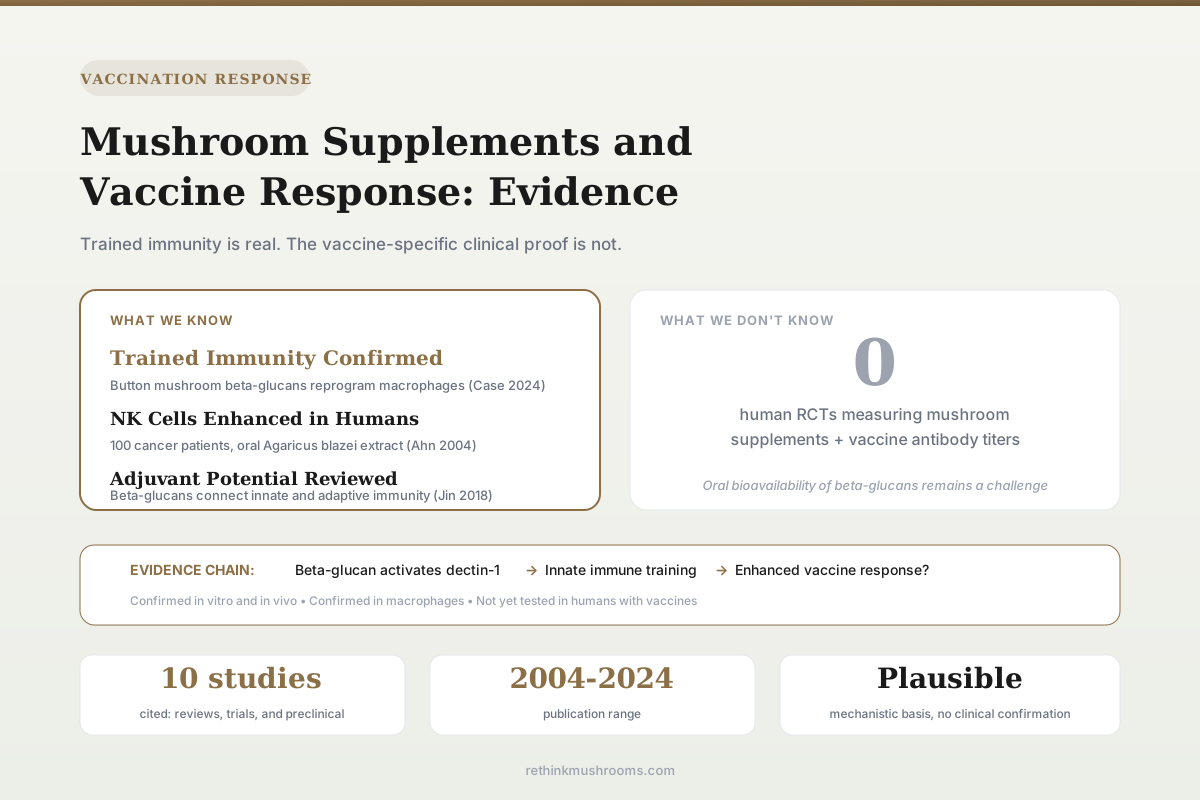
The idea that taking a mushroom supplement before or alongside vaccination could improve the immune response is mechanistically plausible, widely marketed, and — until recently — genuinely untested. That last part has changed. Three randomized controlled trials have now given people a mushroom-derived supplement and measured what happened to their vaccine antibody response. Two were null. The third was positive for a single influenza strain in thirty people and has never been replicated. Meanwhile the more encouraging signals in this literature come from yeast-derived beta-glucan, not mushroom-derived beta-glucan — an ordering that the laboratory work had already predicted. This article maps what the human trials actually found, why the mechanism was more fragile than the marketing implied, and the one genetic finding that suggests the question may need rephrasing rather than abandoning. For the specific beta-glucan adjuvant mechanisms, see beta-glucans as natural vaccine adjuvants.
Key Takeaways
- The most direct test to date was null: 5.0 g/day of Agaricus bisporus powder for eight weeks around influenza vaccination did not significantly change antibody titres in 85 adults aged 60 and over. Median IgM rose 73% more than control but missed significance (p = 0.09), and IgG was unchanged (p = 0.65) (Zwaan et al., Food & Function, 2026)[4]
- A second trial reached the same conclusion by a different route: among 239 adults aged 50–79 given one of five non-digestible polysaccharides before influenza vaccination, the shiitake beta-glucan arm showed no significant benefit. The only trend belonged to arabinoxylan, a cereal fibre (Laue et al., Nutrients, 2021)[6]
- The one positive mushroom result is small and narrow: AHCC, a shiitake mycelia extract, improved protective antibody titers to influenza B and raised CD8 T cells (P < .05) in 30 healthy adults — but dosing began after vaccination and the finding has not been repeated (Roman et al., Nutrition Research, 2013)[5]
- The laboratory work predicted this. Whole mushroom powder did induce trained immunity, but the response was explicitly "modest compared to training observed with yeast-derived beta-glucans" and scaled with how much available beta-glucan the preparation contained (Case et al., Frontiers in Nutrition, 2024)[1]
- Trained immunity is also not a simple dectin-1 story: beta-glucan-trained macrophages protected mice from Pseudomonas aeruginosa, yet induction of the trained phenotype was independent of both dectin-1 and TLR-2 (Stothers et al., Journal of Immunology, 2021)[2]
- The most intriguing human signal is genetic: in a phase 2 trial of oral beta-glucan alongside a cancer vaccine, antibody titer correlated significantly with the dectin-1 SNP rs3901533, while overall seroconversion did not move (Cheung et al., JAMA Oncology, 2023)[7]
The Human Trials That Do Exist
Six Randomized Trials Have Tested a Glucan Supplement Against a Vaccine
Sorted by how directly each one tests the consumer claim. The three mushroom-sourced trials are the ones that answer it — and two of the three were negative.
Trial
Verdict
What it found
Why it is not proof
Agaricus bisporus + flu vaccine[4]
Zwaan 2026 · double-blind RCT, n=85, age 60+
MushroomNo significant effect. IgM rose 73% more than control but missed significance (p=0.09); IgG unchanged (p=0.65)
Largest, most direct test to date — and the species the mechanism research relies on
Shiitake beta-glucan + flu vaccine[6]
Laue 2021 · double-blind RCT, n=239, age 50-79
MushroomAntibody titres and seroprotection non-significantly enhanced; the shiitake arm showed no signal
The one trend was arabinoxylan (a cereal fibre), not a mushroom glucan
AHCC (shiitake mycelia) + flu vaccine[5]
Roman 2013 · RCT, n=30 healthy adults
MushroomImproved protective antibody titers to influenza B; CD8 T cells up (P<.05)
Small, single strain only, dosing began after vaccination, never replicated
Oral beta-glucan + GD2/GD3 cancer vaccine[7]
Cheung 2023 · phase 2 RCT, n=107
YeastHigher anti-GD2 IgG1 during priming (P=.08 vs a pre-set 0.10 threshold)
Confined to dectin-1 genetic responders; seroconversion rates unchanged
Yeast beta-glucan + flu vaccine[8]
Moreno 2025 · double-blind pilot RCT, n=90, age ~70
YeastSeason 1 H3N2 titer response favored beta-glucan (p=0.037)
Season 2 antigen detection too poor to interpret; pilot-scale
Yeast beta-glucan + Se/Zn, flu or COVID vaccine[9]
Rodriguez 2021 · double-blind RCT, n=72
YeastLarger IgG and IgM increases in the COVID-19 vaccine cohort
Combination product — selenium, zinc and probiotic yeast were given together
The pattern is consistent: where the glucan came from a mushroom and the endpoint was a vaccine antibody titre, the result was null in the two larger trials. The positive signals cluster in yeast-derived glucans, in a cancer vaccine, and in a 30-person study that has never been repeated.
Sources: Zwaan et al. (2026) [ref 4]; Roman et al. (2013) [ref 5]; Laue et al. (2021) [ref 6]; Cheung et al. (2023) [ref 7]; Moreno et al. (2025) [ref 8]; Rodriguez et al. (2021) [ref 9].
The Direct Human Evidence
For years the honest answer to "do mushroom supplements boost vaccines?" was that nobody had run the experiment. That is no longer true, and the results deserve to be read before the mechanism.
The Agaricus bisporus trial
Zwaan and colleagues, publishing in Food & Function in 2026, ran the study the field had been waiting for. Adults aged 60 and over — the population in which vaccine responses genuinely decline, and therefore the population with the most to gain — took capsules containing 5.0 grams per day of powder from a specific Agaricus bisporus strain (MES01706) or placebo. Supplementation ran for roughly four weeks before influenza vaccination and four weeks after, eight weeks in total, across the 2023/2024 influenza season. Forty-two participants received mushroom powder and 43 received placebo.[4]
Compliance was not in doubt: ergothioneine, a mushroom-derived amino acid that serves as a biomarker of intake, rose significantly in the intervention group (group × time, p < 0.01). People were taking the product, and it was reaching their bloodstream.
The antibody results did not follow. Median IgM titres increased by 73% more in the mushroom group than in control, but the difference did not reach significance (p = 0.09). IgG concentrations — the antibody class that carries durable protection — showed no difference whatsoever (p = 0.65). Nor did the trial find between-group differences in total or differential leukocyte counts, metabolic markers, quality of life, or influenza-like illness across the season. The authors' conclusion was unambiguous: daily consumption of 5.0 grams of Agaricus bisporus powder for eight weeks did not significantly affect vaccination responses.[4]
Zwaan et al. (2026) · Food & Function
- Population
- 85 community-dwelling adults aged 60 years or older, 2023/2024 influenza season
- Intervention
- 5.0 g/day Agaricus bisporus (strain MES01706) powder in capsules, ~4 weeks pre- to 4 weeks post-vaccination
- Comparator
- Placebo capsules
- Finding
- Median IgM titres rose 73% more than control but missed significance (p = 0.09); IgG was unchanged (p = 0.65). No differences in leukocyte counts, quality of life, or influenza-like illness. Compliance was confirmed by a significant rise in ergothioneine (p < 0.01).
null This is the cleanest available test of the consumer claim — the right population, a realistic food-form dose, confirmed intake, and a pre-vaccination loading window — and it did not find the effect. The IgM trend is worth a larger trial, but a trend is not a result.
Zwaan et al., Food & Function, 2026
The shiitake arm nobody talks about
A larger trial had already probed the same question from a different angle. Laue and colleagues randomized 239 adults aged 50 to 79 to consume one of five non-digestible polysaccharides — yeast beta-glucan, shiitake beta-glucan, oat beta-glucan, arabinoxylan, or a bacterial exopolysaccharide — or a control product, daily for five weeks. Participants were vaccinated against seasonal influenza after two weeks of supplementation.[6]
Post-vaccination increases in haemagglutination-inhibition antibody titres and seroprotection rates were, in the authors' words, non-significantly enhanced across the polysaccharide groups compared with control. The shiitake beta-glucan arm produced no signal worth reporting. The one arm that trended was arabinoxylan — a cereal fibre, not a mushroom compound — which showed a higher mean log2 fold increase (uncorrected p = 0.074) and a seroprotection rate of 48.7% versus 25.6% in control for the influenza A H1N1 strain (uncorrected p = 0.057), alongside fewer common colds (1 versus 8, p = 0.029). No adverse effects were reported for any preparation.[6]
That is a quietly important result. When a mushroom beta-glucan was placed head-to-head against four other fibres in the same vaccination model, it lost to oat-derived arabinoxylan.
The positive outlier
The exception is older and much smaller. Roman and colleagues gave 3 grams per day of active hexose correlated compound (AHCC) — an extract of Lentinula edodes (shiitake) mycelia — to healthy adults in a randomized controlled study of 30 people receiving the 2009–2010 seasonal influenza vaccine. Analysis three weeks post-vaccination found that AHCC supplementation significantly improved protective antibody titers to influenza B, while the improvement in the control group was not significant. Flow cytometry showed increased CD8 T cells (P < .05) and NKT cells (P < .1).[5]
Three caveats keep this from settling the question. The trial enrolled 30 people. The benefit appeared for influenza B only, not across the vaccine's strains. And supplementation began immediately after vaccination rather than before it, which makes it a test of post-vaccination support rather than of the pre-vaccination priming that supplement marketing describes. The authors themselves called for future studies on the kinetics of AHCC dosing. Those studies have not arrived.
Trained Immunity: The Mechanism, Read Honestly
The biological case for mushroom supplements and vaccines rests on trained immunity — a form of innate immune memory in which prior exposure to certain microbial components epigenetically reprograms monocytes and macrophages to respond more vigorously to later, unrelated stimuli. Unlike adaptive memory, which is antigen-specific and mediated by T and B cells, trained immunity is nonspecific: it raises the baseline reactivity of innate cells to whatever comes next.
Case and colleagues, publishing in Frontiers in Nutrition in 2024, tested whether ordinary culinary mushrooms could do this. Mouse macrophages pre-treated with whole Agaricus bisporus powder showed enhanced responses to restimulation with Toll-like receptor ligands, and were particularly sensitive to TLR-2 stimulation. Both whole and digested preparations retained beta-glucans by NMR analysis, and both trained human monocytes. In a genuine strengthening of the oral-route argument, mice given whole mushroom powder by oral gavage showed altered bone-marrow progenitor dynamics — a shift toward myeloid-committed progenitors — and macrophages derived from those mice showed enhanced restimulation responses.[1]
That is a real result, and it does establish that eating mushrooms can train innate immune cells in an animal. But the paper contains a sentence that most summaries omit: the trained response to whole mushroom powder was modest compared to training observed with yeast-derived beta-glucans, and it correlated with the amount of available beta-glucan in the preparation. The effect exists; it is simply weaker, from the mushroom, than from the reference material — and it scales with a quantity that whole mushroom powder does not contain much of.
Stothers and colleagues supplied the mechanistic framework in the Journal of Immunology, showing that beta-glucan protects mice from Pseudomonas aeruginosa infection by augmenting recruitment of innate leukocytes and facilitating local bacterial clearance, an effect that persisted for more than seven days. Adoptive transfer of trained macrophages into naive mice conferred comparable protection. The trained cells showed enhanced phagocytosis and reactive oxygen species production alongside sustained increases in glycolytic and oxidative metabolism, mitochondrial mass, and membrane potential.[2]
One finding in that paper deserves far more attention than it gets in supplement marketing: induction of the trained phenotype was independent of the classic beta-glucan receptors dectin-1 and TLR-2. The tidy story in which mushroom beta-glucan binds dectin-1, dectin-1 trains the macrophage, and the trained macrophage improves your vaccine response is not what this experiment showed. Trained immunity is real; the receptor pathway that produces it is less settled than the marketing suggests.
Mechanism Predicted the Outcome
The Lab Said Mushroom Glucans Were the Weaker Trainer. The Trials Agreed.
Case et al. found that whole mushroom powder did train immune cells — but only modestly next to yeast-derived beta-glucan, in proportion to how much available beta-glucan the preparation actually contained.
Read the bars as rank, not size. Case et al. reported the direction of the difference, not a numeric ratio, so this figure encodes reported ordering only. The point is the alignment: the preparation people actually buy sits at the bottom of the potency ladder and at the bottom of the results table.
Sources: Case et al. (2024) [ref 1]; Zwaan et al. (2026) [ref 4]; Laue et al. (2021) [ref 6]; Cheung et al. (2023) [ref 7]; Moreno et al. (2025) [ref 8]; Rodriguez et al. (2021) [ref 9].
Why the Yeast Trials Look Better
If the mushroom trials disappoint, the adjacent yeast beta-glucan literature is modestly more encouraging — which is precisely what Case and colleagues' potency comparison would predict.[1]
Moreno and colleagues randomized 90 adults, mean age 70.7, to 500 mg of yeast beta-glucan or 500 mg cellulose placebo daily across two influenza vaccination seasons, measuring strain-specific antibody titers by haemagglutination inhibition. In season 1, the post-vaccination antibody titer response favored beta-glucan over placebo (p = 0.037) for the H3N2 strain. Season 2 was uninterpretable because antigen detection was poor.[8]
Rodriguez and colleagues gave a yeast-based product combining a beta-1,3/1,6-glucan complex with selenium- and zinc-enriched heat-treated Saccharomyces cerevisiae to 72 volunteers the day after they received either an influenza (n = 34) or a COVID-19 (n = 38) vaccine. In the COVID-19 cohort, increases in both IgG and IgM were larger in the supplement group than in placebo, and mean CD4+ T cell levels rose from 910.7 to 1000.2 cells/µL after the second dose while falling from 1055.1 to 929.8 in placebo.[9] The obvious limitation is that this was a combination product: selenium, zinc and probiotic yeast were delivered alongside the glucan, so no part of the result can be attributed to beta-glucan alone.
Route of administration also separates these trials from the adjuvant literature that supplement marketing borrows from. Jin and colleagues' review in Vaccine documented that beta-glucans "can regulate immune responses when administered alone and can connect innate and adaptive immunity to improve immunogenicity of vaccines," describing recognition through dectin-1, complement receptor 3, CD5 and lactosylceramide.[3] But most of that adjuvant evidence comes from beta-glucans co-formulated with vaccine antigens and injected together, not swallowed as a capsule alongside a standard vaccine. Injected beta-glucans bypass the gut entirely and meet immune cells at the injection site. An oral supplement must survive digestion and act largely through gut-associated lymphoid tissue.
Structure matters too. Akramiene and colleagues, reviewing in Medicina, concluded that these polysaccharides "increase host immune defense by activating complement system, enhancing macrophages and natural killer cell function," and emphasized that biological activity depends on molecular weight, degree of branching, conformation and solubility.[13] Cerletti and colleagues noted the concrete structural difference: mushroom beta-glucans carry beta-1,3 and beta-1,6 linkages with branching, whereas cereal beta-glucans have no 1,6 linkages and no branching at all.[14] Yeast, mushroom and cereal beta-glucans are not interchangeable, which is why a positive yeast trial is not evidence for a mushroom capsule. For a broader look at how mushrooms might prime immune responses before vaccination, see mushroom supplements before vaccination: immune priming evidence.
The Genotype Lead
The most interesting human result in this entire literature is not about mushrooms at all, and it hints that "does it work?" may be underspecified.
Cheung and colleagues ran a phase 2 randomized trial in 107 patients with high-risk neuroblastoma receiving a GD2/GD3 ganglioside cancer vaccine. Fifty-three received an oral beta-glucan regimen during the first five weeks of vaccine priming; 54 did not. Adding oral beta-glucan during priming produced a higher anti-GD2 IgG1 antibody response — an effect of 1.80 (90% CI, 0.12–3.39; P = .08 against a planned type I error of 0.10, meaning the trial met its own pre-specified threshold). Antibody titer correlated significantly with the dectin-1 single nucleotide polymorphism rs3901533. An anti-GD2 IgG1 titer of 230 ng/mL or greater by week 8 was associated with statistically favorable progression-free survival. Seroconversion rates, genotype frequency and vaccine-related toxic effects were similar between groups.[7]
Why “Does It Work?” May Be the Wrong Question
The Response Tracked the Receptor Gene, Not Just the Dose
In the one randomized trial that genotyped its participants, how much antibody a person made after oral beta-glucan depended on which version of the dectin-1 receptor gene they carried — while the share of people who responded at all did not move.
1.80
90% CI 0.12–3.39
Increase in anti-GD2 IgG1 antibody response from adding oral beta-glucan during vaccine priming
P = .08
vs a planned 0.10 threshold
Met the trial’s pre-specified type I error — a positive result by its own design, not by the usual 0.05 convention
rs3901533
dectin-1 SNP
Antibody titer correlated significantly with this receptor variant — response tracked genotype
Unchanged
seroconversion
The proportion of patients who converted at all did not differ between groups
What this implies for supplements. A trial that averages responders and non-responders together will report a weak or absent effect even if the compound genuinely works in a subset. That is one plausible reading of the null mushroom trials — but it is a hypothesis the mushroom trials were never designed to test, because none of them genotyped participants.
Note the population: children and young people with high-risk relapsed neuroblastoma receiving a cancer vaccine, not healthy adults receiving a flu shot. The genotype signal is a lead worth following, not a finding that transfers directly.
Source: Cheung et al., JAMA Oncology, 2023 [ref 7] — phase 2 randomized clinical trial, n=107, NCT00911560.
The implication is worth stating carefully. If response to oral beta-glucan depends on which dectin-1 variant a person carries, then a trial that averages responders and non-responders will understate the effect in the people who do respond. That is a plausible partial explanation for the null mushroom trials — and it is entirely untested, because none of the mushroom vaccination trials genotyped their participants. It is also a finding from children and young adults with relapsed cancer receiving a ganglioside vaccine, which is a long way from a healthy 65-year-old getting a flu shot.
What the Cancer Trials Did and Did Not Show
Before the direct vaccination trials existed, the strongest human evidence for oral mushroom immunomodulation came from oncology. It remains genuine, and it remains narrower than it is usually reported.
Ahn and colleagues treated 100 cervical, ovarian and endometrial cancer patients undergoing carboplatin-based chemotherapy with or without oral Agaricus blazei Murill Kyowa (ABMK) extract. Natural killer cell activity was significantly higher in the ABMK group (ANOVA, n = 39, P < 0.002) than in the untreated group (n = 61), and chemotherapy-associated problems including appetite, alopecia, emotional stability and general weakness all improved.[10] The part that usually goes unmentioned: no significant difference was observed in lymphokine-activated killer activity, in monocyte activity, or in the counts of specific immune cell populations. One immune parameter moved, several did not.
Tangen and colleagues ran a double-blind randomized trial of AndoSan — an extract containing 82% Agaricus blazei Murill — in 40 patients with multiple myeloma undergoing high-dose chemotherapy and autologous stem cell transplantation, 19 on active product and 21 on placebo, for roughly seven weeks from stem cell mobilization through the end of aplasia. In the leukapheresis product, the AndoSan group showed increased percentages of regulatory T cells and plasmacytoid dendritic cells, significant increases in serum IL-1ra, IL-5 and IL-7, and increased expression of immunoglobulin, killer immunoglobulin receptor and HLA genes on whole-genome microarray.[11] Those are real immunological shifts, including in immunoglobulin gene expression. And yet there were no statistically significant differences in treatment response, overall survival or time to new treatment. Markers moved; outcomes did not.
Steimbach and colleagues assembled the systematic review, following PRISMA-P guidance, of fungal beta-glucans as adjuvants in cancer patients. From 1,018 initial records they retained 16 trials totalling 1,650 patients, published between 1992 and 2018, across nine cancer types, with arm sizes ranging from 9 to 200. The beta-glucan sources were yeast (Saccharomyces cerevisiae), mushrooms (Lentinula edodes and Schizophyllum commune), and non-described fungal material. Administration was safe and well tolerated, and most trials reported that concomitant beta-glucan reduced chemotherapy- or radiotherapy-induced immune depression and accelerated white blood cell recovery. But the review was explicit that some studies found no statistical difference versus control, which it described as giving a controversial conclusion, and that methodological diversity prevented pooled statistical analysis. Its closing position was that further evidence is required to determine efficacy.[12] For how these findings relate to NK cell biology specifically, see agaricus blazei and NK cell activation: research review.
- Cell & Lab Studiescompleted
Mushroom beta-glucans train mouse macrophages and human monocytes, with TLR-2 sensitivity — though the response is modest next to yeast-derived beta-glucan (Case 2024)
- Animal Studiescompleted
Oral gavage of whole mushroom powder shifts bone-marrow progenitor dynamics in mice; beta-glucan-trained macrophages protect mice from Pseudomonas aeruginosa (Case 2024; Stothers 2021)
- Early Human Series & Cancer Trialscompleted
Oral Agaricus extracts raised NK activity and shifted immune cell populations in cancer patients, without changing survival outcomes (Ahn 2004; Tangen 2015)
- Small Human Trialscompleted
AHCC improved influenza B titers in 30 adults (Roman 2013); the shiitake beta-glucan arm of a 239-person trial did not (Laue 2021)
- Adequately Powered RCTcurrent
The 85-person Agaricus bisporus trial was the first properly targeted test and returned a null result, with an unresolved IgM trend at p = 0.09 (Zwaan 2026)
- Meta-Analysismissing
Too few mushroom-specific vaccination trials, using too many different preparations, to pool
The claim has climbed further than it had a year ago — and the rung it reached did not hold. Mechanism through animal work is well supported; the one adequately targeted human vaccination trial was negative. The honest position is not 'untested' and not 'disproven', but 'tested once properly, and it did not work'.
Case et al. 2024; Stothers et al. 2021; Ahn et al. 2004; Tangen et al. 2015; Roman et al. 2013; Laue et al. 2021; Zwaan et al. 2026
Claim check — 'boost your vaccine'
Does taking a mushroom supplement make your vaccine work better?
The claim
“Mushroom beta-glucans activate innate immunity through dectin-1 and induce trained immunity, so taking a mushroom supplement around your vaccination will produce a stronger antibody response.”
A real mechanistic literature — trained immunity, dectin-1 signalling, and review articles describing beta-glucans as 'potential immunoadjuvants' — read forward into a clinical promise the trials had not yet tested.
What research shows
UnsupportedThe mechanism is genuine but weaker than advertised, and it has now been tested directly. Whole mushroom powder trains immune cells only modestly compared with yeast beta-glucan, trained immunity can be induced independently of dectin-1 altogether, and the best-designed human trial found no significant effect on influenza antibody titres.
This is not a claim that mushrooms do nothing immunologically — oral extracts have measurably shifted NK activity and immune cell populations in cancer patients. It is a narrower point: the specific step from 'modulates immune markers' to 'improves your vaccine response' has been attempted in people and has not been demonstrated.
Zwaan et al. 2026; Laue et al. 2021; Case et al. 2024; Stothers et al. 2021
Where This Leaves the Claim
The reviews that supplement marketing quotes are accurate about potential and vague about proof, and both halves matter. Timm and colleagues noted that mushroom beta-glucans have been highlighted as adjuvants for COVID-19 vaccines, while cautioning that extraction method, purification technique and molecular characterization all affect biological activity — standardization remains an unmet need.[15] Cerletti and colleagues described immunomodulatory and anti-inflammatory effects from purified beta-glucans and fungal extracts, with clinical testing in recurrent respiratory tract infections and complications of major surgery.[14]
Murphy and colleagues provide the most useful framing. Their review records that two glucan isolates were licensed as drugs in Japan as immune-adjuvant cancer therapy as far back as 1980 — this is not a fringe idea — while identifying the key knowledge gap as an incomplete understanding of the diverse mechanisms of action, compounded by important differences between apparently similar beta-glucan preparations arising from differences in sources and extraction procedures.[16] That last point is the practical one for anyone standing in a supplement aisle: two products labelled "mushroom beta-glucan" may not contain comparable material, and the trial that failed used a characterized, strain-specified preparation with confirmed absorption.
What would change the picture? A trial that dosed before vaccination, in a population with impaired vaccine responses, using a beta-glucan-enriched fraction rather than whole powder, and stratified by dectin-1 genotype. Every one of those design choices is supported by something in the evidence above. None of them have been combined. Until they are, the mechanistically interesting question remains open while the consumer claim remains unsupported. For the flu vaccine evidence specifically, see mushrooms and flu shot response: clinical evidence. For the broader question of pre-vaccination immune priming, see can mushrooms improve vaccine effectiveness? beta-glucan research.
Safety — supplements around vaccination
ModerateNothing here is a reason to change your vaccination plan
Concern
The trials in this article tested supplements taken alongside vaccines, never instead of them. Mushroom preparations were well tolerated across every study reviewed, with no adverse effects reported in the 239-person polysaccharide trial and no serious adverse events in the yeast glucan trials. The risk is not toxicity — it is substitution, and the assumption that an immune 'boost' is universally desirable. Immune-stimulating supplements have not been studied in people taking immunosuppressants, living with autoimmune disease, or undergoing transplant care, and the myeloma and neuroblastoma trials were run under specialist oncology supervision.
What the research says
Get the vaccine on schedule. If you want to take a mushroom supplement around it, the evidence says it is unlikely to help your antibody response and unlikely to harm you — but clear it with a clinician first if you take immunosuppressants, have an autoimmune condition, are in cancer treatment, or have surgery scheduled.
Particularly relevant for: People on immunosuppressants, with autoimmune disease, in active cancer treatment, or considering a supplement as a vaccine substitute
What to do
Discuss any immune-active supplement with your physician before use. This article is educational and is not medical advice.
Safety framing based on Zwaan et al. 2026; Laue et al. 2021; Tangen et al. 2015; Cheung et al. 2023
The Bottom Line
Mushroom beta-glucans genuinely induce trained immunity, activate NK cells and shift immune markers in cancer patients — but the step from immune modulation to better vaccine protection has now been tested in people and has not held up. A 2026 double-blind trial of 5 g/day Agaricus bisporus powder in 85 adults aged 60+ found no significant effect on influenza antibody titres, and the shiitake arm of a 239-person polysaccharide trial found nothing either. The single positive mushroom result — improved influenza B titers from AHCC in 30 people — is small, strain-specific, dosed after vaccination, and unreplicated. The laboratory work anticipated this: mushroom-derived beta-glucan trains immune cells only modestly compared with yeast-derived beta-glucan, and the yeast trials are indeed where the better human signals sit. The most promising open lead is genetic, not botanical: antibody response to oral beta-glucan tracked dectin-1 genotype in a phase 2 cancer vaccine trial, which no mushroom vaccination trial has yet accounted for. Take the vaccine; the supplement is not what makes it work.
Frequently Asked Questions
Sources & References
- 1RTHM-00867·Case, Sarah et al. (2024). “β-glucans from Agaricus bisporus mushroom products drive Trained Immunity..” Frontiers in nutrition.Study breakdown →PubMed →↩
- 2RTHM-00721·Stothers, Cody L et al. (2021). “β-Glucan Induces Distinct and Protective Innate Immune Memory in Differentiated Macrophages..” Journal of immunology (Baltimore.Study breakdown →PubMed →↩
- 3RTHM-00513·Jin, Yiming et al. (2018). “β-glucans as potential immunoadjuvants: A review on the adjuvanticity, structure-activity relationship and receptor recognition properties..” Vaccine.Study breakdown →PubMed →↩
- 4RTHM-02293·Zwaan, Willem et al. (2026). “The effects of Agaricus bisporus strain MES01706 on influenza vaccination responses: a double-blind, randomized, placebo-controlled intervention study in men and women aged 60 years or older..” Food & function.Study breakdown →PubMed →↩
- 5RTHM-02294·Roman, Brooke E et al. (2013). “Short-term supplementation with active hexose correlated compound improves the antibody response to influenza B vaccine..” Nutrition research (New York.Study breakdown →PubMed →↩
- 6RTHM-02295·Laue, Christiane et al. (2021). “Adjuvant Effect of Orally Applied Preparations Containing Non-Digestible Polysaccharides on Influenza Vaccination in Healthy Seniors: A Double-Blind, Randomised, Controlled Pilot Trial..” Nutrients.Study breakdown →PubMed →↩
- 7RTHM-01675·Cheung, Irene Y et al. (2023). “Effect of Oral β-Glucan on Antibody Response to Ganglioside Vaccine in Patients With High-Risk Neuroblastoma: A Phase 2 Randomized Clinical Trial..” JAMA oncology.Study breakdown →PubMed →↩
- 8RTHM-02276·Moreno, Melissa L et al. (2025). “Yeast Beta-Glucan Enhances Antibody Response Following Influenza Vaccination - A Double-Blind, Randomized, Placebo-Controlled Pilot Trial..” Journal of dietary supplements.Study breakdown →PubMed →↩
- 9RTHM-02297·Rodriguez, Julián Andrés Mateus et al. (2021). “Effect and Tolerability of a Nutritional Supplement Based on a Synergistic Combination of β-Glucans and Selenium- and Zinc-Enriched Saccharomyces cerevisiae (ABB C1®) in Volunteers Receiving the Influenza or the COVID-19 Vaccine: A Randomized, Double-Blind, Placebo-Controlled Study..” Nutrients.Study breakdown →PubMed →↩
- 10RTHM-00066·Ahn, W-S et al. (2004). “Natural killer cell activity and quality of life were improved by consumption of a mushroom extract, Agaricus blazei Murill Kyowa, in gynecological cancer patients undergoing chemotherapy..” International journal of gynecological cancer : official journal of the International Gynecological Cancer Society.Study breakdown →PubMed →↩
- 11RTHM-00404·Tangen, Jon-Magnus et al. (2015). “Immunomodulatory effects of the Agaricus blazei Murrill-based mushroom extract AndoSan in patients with multiple myeloma undergoing high dose chemotherapy and autologous stem cell transplantation: a randomized, double blinded clinical study..” BioMed research international.Study breakdown →PubMed →↩
- 12RTHM-00719·Steimbach, Laiza et al. (2021). “Fungal beta-glucans as adjuvants for treating cancer patients - A systematic review of clinical trials..” Clinical nutrition (Edinburgh.Study breakdown →PubMed →↩
- 13RTHM-00110·Akramiene, Dalia et al. (2007). “Effects of beta-glucans on the immune system..” Medicina (Kaunas.Study breakdown →PubMed →↩
- 14RTHM-00676·Cerletti, Chiara et al. (2021). “Edible Mushrooms and Beta-Glucans: Impact on Human Health..” Nutrients.Study breakdown →PubMed →↩
- 15RTHM-00854·Timm, Thaynã Gonçalves et al. (2023). “Mushroom β-glucans: application and innovation for food industry and immunotherapy..” Applied microbiology and biotechnology.Study breakdown →PubMed →↩
- 16RTHM-00639·Murphy, Emma J et al. (2020). “β-Glucan Metabolic and Immunomodulatory Properties and Potential for Clinical Application..” Journal of fungi (Basel.Study breakdown →PubMed →↩