Chaga and Liver Protection
5 Injury Models Protected
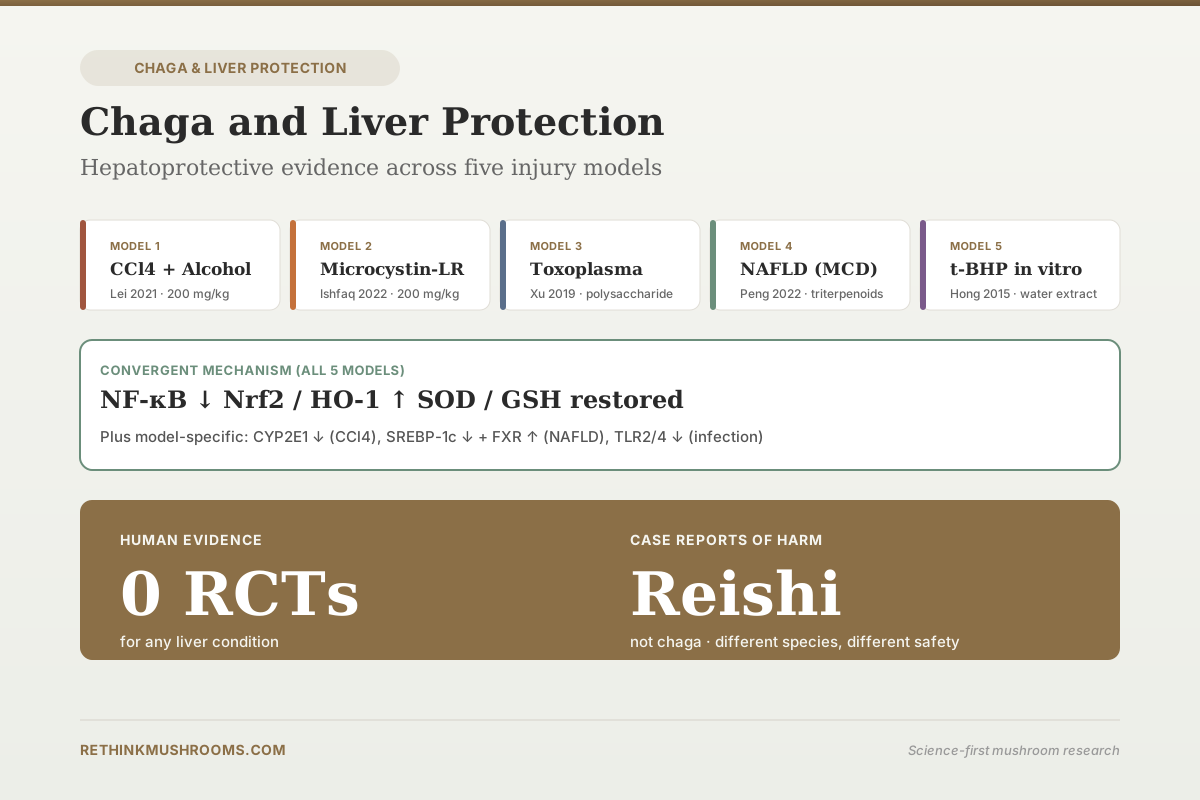
Across CCl4, ethanol, microcystin-LR, Toxoplasma gondii infection, and high-fat-diet NAFLD, chaga extracts and polysaccharides have reduced liver injury markers in independent rodent studies through a convergent NF-κB/Nrf2 mechanism.
Lei 2021; Ishfaq 2022; Xu 2019; Peng 2022; Hong 2015
Five mechanisms
NF-κB↓, Nrf2↑, CYP2E1↓, SREBP-1c↓, AMPK↑ across tested models
Human RCTs
zero published trials of chaga for any liver condition
Reishi contrast
a different mushroom has caused human liver injury, a reminder that species-specific safety matters
Lei 2021; Ishfaq 2022; Xu 2019; Peng 2022; Hong 2015
 View as image ↗
Chaga (Inonotus obliquus) occupies an unusual position in the mushroom-and-liver research space. On one hand, its preclinical hepatoprotection record is broader and more consistent than most natural products: five distinct liver injury models in published rodent studies, all showing protective effects with overlapping mechanistic targets. On the other hand, it has zero human clinical trials for any liver condition, and a related species (reishi) has documented human hepatotoxicity case reports. This article synthesizes the full chaga hepatoprotection literature. For the CCl4-specific deep dive, see our dedicated chaga and carbon tetrachloride liver damage article.
The mechanistic through-line: across every injury model tested, chaga extracts suppress NF-κB-driven inflammation, activate Nrf2-driven antioxidant response, and reduce markers of hepatocyte damage (ALT, AST, MDA). Specific models add specific mechanism details: CYP2E1 suppression in CCl4/alcohol injury, SREBP-1c/FXR regulation in NAFLD, TLR2/TLR4 downregulation in infectious injury. No human trial has tested whether any of this translates.
Key Takeaways
- Phaeoporus (Inonotus) obliquus polysaccharide at 100-200 mg/kg reduced ALT, AST, ALP, MDA, and TNF-α (p<0.01) in CCl4- and alcohol-induced acute liver injury mice with CYP2E1 downregulation (Lei et al., Pakistan Journal of Pharmaceutical Sciences, 2021)
- Chaga aqueous extract at 200 mg/kg reversed microcystin-LR-induced SGOT, SGPT, and LDH elevations and restored GSH from 19.83 μM to 50.83 μM in mouse liver (Ishfaq et al., Current Research in Pharmacology and Drug Discovery, 2022)
- Chaga polysaccharide reduced ALT, AST, MDA, and NO while activating Nrf2/HO-1 and downregulating TLR2/TLR4 and NF-κB p65 phosphorylation in Toxoplasma-induced liver injury (Xu et al., International Journal of Biological Macromolecules, 2019)
- Chaga water extract protected rat hepatocytes against tert-butyl hydroperoxide oxidative injury by quenching free radicals and inhibiting ALT/AST leakage (Hong et al., International Journal of Medicinal Mushrooms, 2015)
- Chaga extract and its triterpenoids (inotodiol, lanosterol, trametenolic acid) alleviated lipid accumulation in MCD diet-induced NAFLD mice by downregulating SREBP-1c, ACC1, FASN and upregulating FXR and SHP (Peng et al., European Journal of Pharmacology, 2022)
- Zero published human trials of chaga for NAFLD, hepatitis, alcoholic liver disease, or any other liver condition
Why Multiple Injury Models Matter
Testing a hepatoprotective candidate against multiple injury models is more informative than testing it against one. Each model captures a different piece of the liver injury landscape:
- CCl4 injury: CYP2E1-dependent radical formation, lipid peroxidation, acute hepatocyte necrosis (screens for antioxidant and upstream metabolism effects)
- Ethanol injury: CYP2E1 activation, fatty liver, direct hepatocyte toxicity (overlaps with CCl4 mechanism)
- Microcystin-LR injury: protein phosphatase inhibition, oxidative stress, apoptosis (environmental toxicant model)
- Toxoplasma gondii infection: innate immune-driven injury via TLR/NF-κB signaling (infectious model)
- High-fat / MCD diet NAFLD: lipid accumulation, de novo lipogenesis, mitochondrial dysfunction (metabolic model)
- tert-butyl hydroperoxide: direct oxidative injury to hepatocytes in culture (in vitro mechanism screen)
A compound that protects against only one model is a candidate for that specific injury type. A compound that protects across six (chaga's current record) is a candidate for broader hepatoprotection, though multi-model protection in rodents still does not equal efficacy for any specific human liver disease.
The Acute Chemical Injury Data
Lei and colleagues' 2021 CCl4-plus-alcohol study provides the most detailed dose-response data for chaga against acute chemical liver injury.[1] Phaeoporus (Inonotus) obliquus polysaccharide at 100 and 200 mg/kg reduced ALT, AST, ALP, MDA, and TNF-α (all p<0.01) and increased SOD activity, with 200 mg/kg producing stronger protection. CYP2E1 mRNA expression was significantly reduced (p<0.05).
CYP2E1 suppression is mechanistically informative. This cytochrome P450 enzyme activates CCl4 to its toxic trichloromethyl radical and contributes to ethanol metabolism. A compound that reduces CYP2E1 expression attacks the upstream step where these toxicants become hepatotoxic. The same mechanism explains why Lei's preparation worked against both CCl4 and alcohol in the same study: they share this upstream activation pathway.
The CCl4-specific details, including the molecular mechanism and how it sits within the classical hepatoprotection framework, are covered in the dedicated chaga CCl4 article. What belongs in this overview is the recognition that acute chemical injury is only one of several injury types chaga has been tested against.
The Environmental Toxicant Data
Ishfaq and colleagues in 2022 tested chaga aqueous extract (IOAE) against microcystin-LR (MC-LR), a cyanobacterial toxin released during harmful algal blooms.[2] MC-LR at 20 μg/kg intraperitoneally for 4 weeks produced:
- 1.9-fold SGOT elevation
- 1.7-fold SGPT elevation
- 2.2-fold LDH elevation
- GSH depletion to 19.83 ± 3.3 μM (from 52 μM normal)
- Reduced catalase activity
- Degenerative histology
- Increased caspase-3 (apoptosis marker)
IOAE at 200 mg/kg co-treatment restored each of these parameters toward control levels. GSH returned to 50.83 ± 3.0 μM. The mechanism included NF-κB inhibition (with molecular docking showing ergosterol peroxide binding to NF-κB-NIK) and restoration of the glutathione antioxidant system.
This matters for chronic exposure scenarios: MC-LR is a real environmental contaminant in freshwater. For a related chemical injury article covering broader toxicant chemistry, see our chaga and chemical liver damage piece.
The Infectious Liver Injury Data
Xu and colleagues in 2019 used Toxoplasma gondii infection as a biological liver insult.[3] Chaga polysaccharide treatment reduced ALT, AST, MDA, and NO while elevating SOD and GSH. More importantly for mechanism, it:
- Downregulated TLR2 and TLR4 (upstream NF-κB activators)
- Reduced phosphorylation of NF-κB p65 and IκBα
- Upregulated Nrf2 and HO-1
- Reduced TNF-α, IL-6, IL-1β, IFN-γ, IL-4
The TLR/NF-κB suppression pairs with Nrf2/HO-1 antioxidant activation to produce the classical hepatoprotective signaling shift: inflammation down, antioxidant defense up. The same pattern appears in the Ishfaq microcystin work and the broader inflammation literature (Shen 2022, Chen 2019, covered in our chaga and NF-κB inflammation article).
The Metabolic Liver Injury Data: NAFLD
Peng and colleagues in 2022 tested chaga extract and three of its isolated triterpenoid compounds (inotodiol, lanosterol, trametenolic acid) against methionine-choline-deficient (MCD) diet-induced non-alcoholic fatty liver disease in mice.[4] Key findings:
- Reduced hepatic lipid accumulation
- Downregulated mRNA of lipogenic genes: SREBP-1c, ACC1, FASN
- Upregulated FXR and SHP (bile acid receptor signaling)
- Parallel effects in oleic acid-induced LO2 hepatocytes in vitro
FXR (farnesoid X receptor) is a nuclear receptor that regulates bile acid homeostasis and, via its downstream effector SHP, represses de novo lipogenesis. Targeting this axis is an active area of NAFLD drug development (obeticholic acid, a synthetic FXR agonist, is approved for primary biliary cholangitis and has been tested extensively for NASH). Chaga's effect on the same axis via natural compounds is a mechanistically relevant finding, though substantial development work separates this preclinical signal from any clinical NAFLD application.
For the NAFLD-specific deep dive, see our chaga for fatty liver disease article. For the related detoxification enzyme perspective, see chaga and liver detoxification enzymes.
The In Vitro Confirmation
Hong and colleagues in 2015 tested chaga water extract in primary cultured rat hepatocytes exposed to tert-butyl hydroperoxide.[5] The extract:
- Quenched free radicals
- Inhibited ALT and AST leakage from cells
- Decreased MDA formation
In vitro findings do not prove in vivo efficacy, but they localize the effect to the hepatocyte itself rather than systemic anti-inflammatory or metabolic pathways acting at a distance. The cell-level antioxidant effect is consistent across all the whole-animal studies discussed above.
The Convergent Mechanism
Six independent studies converge on a shared hepatoprotective signaling profile:
- NF-κB pathway suppression: reduced p65 phosphorylation, reduced IκBα degradation, downregulated TLR2/4
- Nrf2/HO-1 activation: antioxidant response element upregulation
- Antioxidant enzyme restoration: SOD, catalase, GSH-Px
- Lipid peroxidation reduction: decreased MDA
- Injury marker reduction: ALT, AST, ALP, LDH
- Model-specific additions: CYP2E1↓ (CCl4/alcohol), SREBP-1c↓ (NAFLD), caspase-3↓ (apoptosis)
The active compound classes span triterpenoids (dominant in the 70% ethanol and ethyl acetate fractions), polysaccharides (dominant in water extracts and purified preparations), and polyphenols (contributing across preparations). Different compound classes contribute differentially depending on injury model: triterpenoids drive the NAFLD signal, polysaccharides drive the infectious and colitis signals, and phenolic-rich fractions drive the CCl4 oxidative signal.
The Human Evidence Picture
Zero randomized controlled trials of chaga for any liver condition have been published. The structural reasons are the usual ones: no pharmaceutical sponsorship (unpatentable), supplement regulation (no efficacy trial required), and chaga's oxalate safety signal constraining chronic-use trial design. For the safety counterweight, see our articles on chaga long-term safety and combination safety.
Two human case reports exist in the mushroom-and-liver literature, but they involve reishi (Ganoderma lucidum), not chaga. Wanmuang and colleagues reported fatal fulminant hepatitis after 1-2 months of reishi powder.[6] Guedikian and colleagues reported acute hepatitis after combined reishi powder and alcohol use.[7] These cases are not chaga, but they are worth citing as a reminder: "medicinal mushroom" is a category, not a uniform safety profile. Different species have different safety signals. Chaga's documented signal is renal (oxalate nephropathy). Reishi's documented signal is hepatic (idiosyncratic hepatotoxicity with powder preparations). The mushroom most plausibly protective for the liver in preclinical research is a different species than the one with published human liver injury reports.
Why the Compound-Class Findings Matter for Product Selection
The chaga liver studies consistently implicate different compound classes for different injury types. This is not a trivial detail for anyone evaluating commercial chaga products.
Triterpenoids (inotodiol, lanosterol, trametenolic acid, betulinic acid, inotodiols) are the active class in the NAFLD and 70% ethanol anti-inflammatory work. They are mid-polarity lipophilic compounds, extracted more efficiently with alcohol than with water. Dual-extracted products (water plus ethanol) would be expected to capture these.
Polysaccharides are the active class in the infectious injury (Xu 2019 Toxoplasma) and the CCl4/alcohol work (Lei 2021). They are water-soluble, high molecular weight compounds captured by hot water extraction. Products labeled "polysaccharide-enriched" or with characterized β-glucan content would be expected to be effective in these indications.
Polyphenols (chlorogenic acid, gallic acid, syringic acid, and others) contribute to the in vitro antioxidant activity and the microcystin protection work. Polyphenol extraction depends on preparation method, with varying yield across water, ethanol, and hydroalcoholic solvents.
Raw chaga powder contains all three classes plus significant oxalate content. Extracts separate the active compounds from varying amounts of the oxalate load. Consumers evaluating a product's plausible hepatoprotective match to a specific condition would need preparation-specific compound characterization that is rarely provided on supplement labels. For the broader preparation discussion, see the preparation-matters section of our chaga and blood sugar article.
What Would Confirm the Effect
A meaningful human chaga trial for liver health would need: standardized extract with characterized polysaccharide, triterpenoid, and oxalate content; a patient population with an active liver condition (NAFLD, early alcoholic liver disease, drug-induced injury); duration matched to the condition's natural course (12-24 weeks minimum for NAFLD endpoints); and hard endpoints (ALT, AST, GGT, liver stiffness by elastography, histology where feasible, and kidney function monitoring given oxalate). The preclinical evidence base is substantial enough to justify such a trial. The fact that it has not been run reflects funding and regulatory pathway issues rather than evidentiary gaps on the mechanism side.
An adjacent point worth noting: NAFLD affects roughly 25% of adults globally and has no approved pharmacotherapy with broadly accepted efficacy. The drug development pipeline for NAFLD has produced multiple high-profile Phase III failures over the past decade. In that context, a well-characterized natural product with a preclinical FXR/SHP/SREBP-1c mechanism is not an unreasonable candidate for academic or consortium-funded trial work. The chaga-NAFLD human trial gap is therefore more notable than the chaga-CCl4 gap (where the injury model itself has limited clinical analog).
The Bottom Line
Chaga (Inonotus obliquus) extracts and polysaccharides have produced hepatoprotective effects across six independent rodent studies using five distinct liver injury models: CCl4, ethanol, microcystin-LR, Toxoplasma gondii infection, NAFLD, and in vitro tert-butyl hydroperoxide. The convergent mechanism involves NF-κB suppression, Nrf2/HO-1 activation, antioxidant enzyme restoration, and reduction of injury biomarkers. Model-specific mechanisms include CYP2E1 downregulation (CCl4 and alcohol), SREBP-1c/ACC1/FASN suppression plus FXR/SHP upregulation (NAFLD), and TLR2/TLR4 downregulation (infection). Active compound classes span triterpenoids, polysaccharides, and polyphenols. No human clinical trial for any liver condition has been published. A separate line of case report evidence establishes that reishi, a different mushroom, has caused human hepatotoxicity, underscoring that mushroom-by-mushroom safety evaluation is required.
Frequently Asked Questions
Sources & References
- 1RTHM-00697·Lei, Zhang et al. (2021). “Protective effect of Phaeoporus obliquus polysaccharide against acute liver injury induced by carbon tetrachloride and alcohol in mice..” Pakistan journal of pharmaceutical sciences.Study breakdown →PubMed →↩
- 2RTHM-00768·Ishfaq, Pir Mohammad et al. (2022). “Inonotus obliquus aqueous extract prevents histopathological alterations in liver induced by environmental toxicant Microcystin..” Current research in pharmacology and drug discovery.Study breakdown →PubMed →↩
- 3RTHM-00601·Xu, Lu et al. (2019). “The polysaccharide from Inonotus obliquus protects mice from Toxoplasma gondii-induced liver injury..” International journal of biological macromolecules.Study breakdown →PubMed →↩
- 4RTHM-00789·Peng, Ankang et al. (2022). “Inonotus obliquus and its bioactive compounds alleviate non-alcoholic fatty liver disease via regulating FXR/SHP/SREBP-1c axis..” European journal of pharmacology.Study breakdown →PubMed →↩
- 5RTHM-00374·Hong, Ki Bae et al. (2015). “Hepatoprotective Activity of Water Extracts from Chaga Medicinal Mushroom, Inonotus obliquus (Higher Basidiomycetes) Against Tert-Butyl Hydroperoxide-Induced Oxidative Liver Injury in Primary Cultured Rat Hepatocytes..” International journal of medicinal mushrooms.Study breakdown →PubMed →↩
- 6RTHM-00122·Wanmuang, Harirak et al. (2007). “Fatal fulminant hepatitis associated with Ganoderma lucidum (Lingzhi) mushroom powder..” Journal of the Medical Association of Thailand = Chotmaihet thangphaet.Study breakdown →PubMed →↩
- 7RTHM-00826·Guedikian, Roupen et al. (2023). “Ganoderma lingzhi (Reishi Mushroom)-Induced Acute Liver Injury in the Setting of Alcohol Use: A Case Report and Review of the Literature..” Cureus.Study breakdown →PubMed →↩