Mushroom-Adaptogen Stacks
10.5% metabolic threshold rise
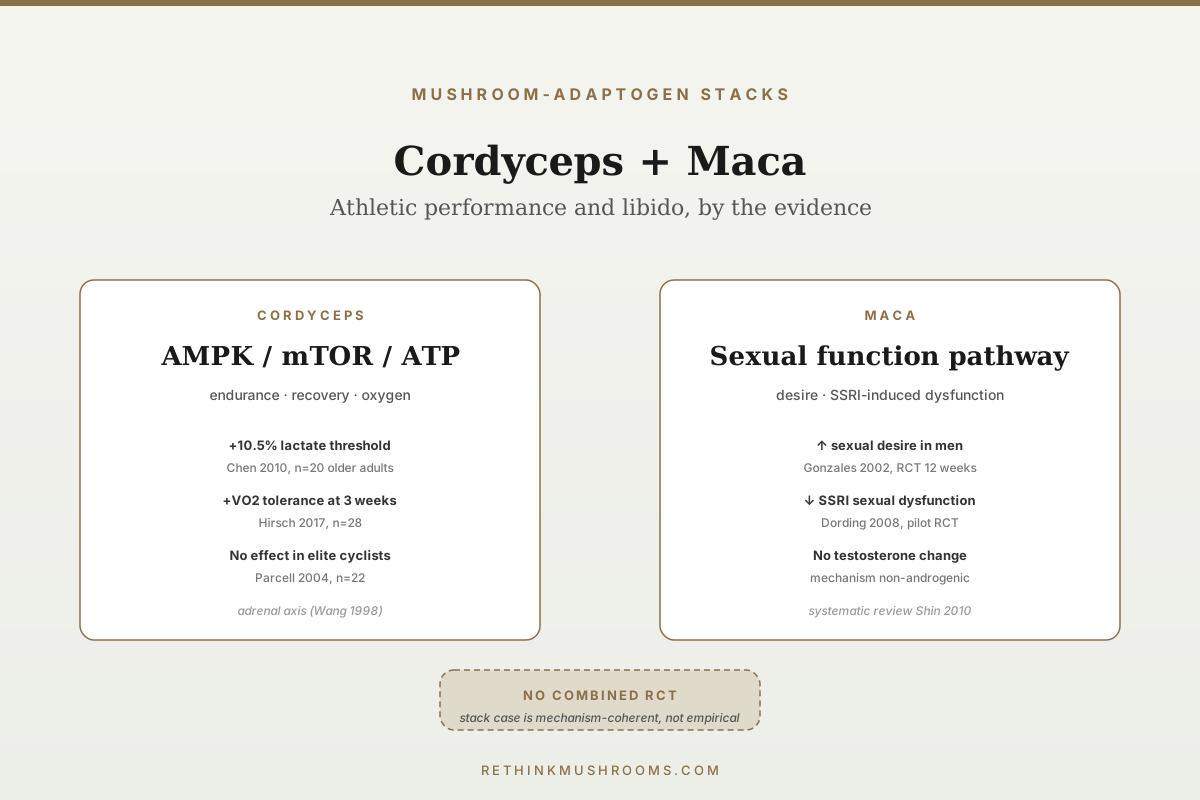
A 12-week double-blind RCT of Cs-4 Cordyceps sinensis in older adults (Chen et al., 2010) raised the lactate threshold by 10.5% and ventilatory threshold by 8.5%. No published RCT has tested cordyceps and maca stacked together. The case for combining them rests on independent evidence for each, not on head-to-head data.
Chen et al., J. Altern. Complement. Med., 2010
Cordyceps → AMPK/mTOR
ATP, endurance, VT effects in RCTs
Maca → sexual function
controlled trials in men and women
No combined RCT
stack case rests on additive mechanism logic
Chen et al., J. Altern. Complement. Med., 2010
 View as image ↗
The cordyceps-plus-maca combination is one of the most commercially popular adaptogen-stack formulas, marketed for a combination of athletic performance, endurance, libido and general vitality. The marketing story is tidy: Cordyceps for the energy and oxygen side, maca (Lepidium meyenii) for the hormonal and sexual-function side. The research story is more fragmented. Each compound has its own body of evidence, the mechanisms are real but partially overlapping, and no published randomised trial has evaluated the two together. This article maps what the evidence actually says for each compound, where the mechanisms intersect, and what the gaps are when the stack is treated as a single intervention.
For related framings, see mushroom-adaptogen stacks: what the research supports, mushrooms + ashwagandha: stacking adaptogens for stress and fatigue, mushrooms and ashwagandha: the ultimate stress stack?, and reishi + rhodiola for stress and energy: research review.
Key Takeaways
- Chen and colleagues (2010) reported a 10.5% rise in metabolic (lactate) threshold and 8.5% rise in ventilatory threshold after 12 weeks of Cs-4 Cordyceps sinensis supplementation in older adults in a double-blind placebo-controlled trial
- Hirsch and colleagues (2017) reported improved tolerance to high-intensity cycle exercise after three weeks of a Cordyceps militaris-containing mushroom blend in 28 adults; acute one-week supplementation did not show the effect
- Choi and colleagues (2020) demonstrated C. militaris ethyl acetate extract increased ATP generation pathway biomarkers in exercise-performance animal models, providing preclinical mechanism for the AMPK/mTOR energy-sensor story
- Parcell and colleagues (2004) ran a 5-week RCT of Cs-4 at 3 g/day in trained cyclists and found no improvement in VO2peak or time trial, illustrating that the Cordyceps exercise signal is not uniform across populations
- Wang and colleagues (1998) showed Cordyceps sinensis water-soluble extract stimulated corticosteroid production directly in cultured rat adrenocortical cells, establishing a preclinical HPA-axis engagement distinct from AMPK
- Maca (Lepidium meyenii) has independent controlled evidence for sexual function outcomes in men and women, with mechanism independent of adenosine-receptor or AMPK pathways
- No published randomised trial has evaluated cordyceps and maca stacked together; the combined case rests on independent evidence bases and mechanism complementarity
- The principal unknowns for stacking are additive-versus-synergistic effects, dose interactions, and population-specific response
Cordyceps: The Athletic Performance Evidence
The exercise-performance evidence for Cordyceps has accumulated across both Cordyceps sinensis (traditional Tibetan/Chinese medicinal species, now reclassified as Ophiocordyceps sinensis) and Cordyceps militaris (cultivated alternative with a similar bioactive profile). Controlled trials have used both species and various extract formats, and the results are mixed in ways that matter for interpreting any stack.
Chen and colleagues (2010) conducted a 12-week double-blind, placebo-controlled trial of Cs-4 (a Cordyceps sinensis mycelial extract, 333 mg three times daily) in 20 healthy adults aged 50–75.[1] The metabolic (lactate) threshold increased by 10.5% and the ventilatory threshold by 8.5%, both statistically significant. These are meaningful indicators of improved endurance capacity, particularly in an older population where exercise tolerance commonly declines.
Hirsch and colleagues (2017) conducted a randomised, double-blind, placebo-controlled trial of a Cordyceps militaris-containing mushroom blend (4 g/day) in 28 adults.[2] Acute (one-week) supplementation did not improve high-intensity cycle performance measures, but chronic (three-week) supplementation did. The pattern is consistent with a cumulative mechanism rather than an acute stimulant effect.
Chen and colleagues (2014) tested a Rhodiola crenulata and Cordyceps sinensis combination supplement during two weeks of high-altitude training at 2200 m in 18 male subjects.[3] The RC arm showed improvements in aerobic exercise capacity and autonomic and hormonal profile changes consistent with better stress adaptation during altitude training. This is notable because it tested a combined adaptogen formulation rather than cordyceps alone, though it paired cordyceps with rhodiola rather than with maca.
In contrast, Parcell and colleagues (2004) ran a five-week trial of Cs-4 at 3 g/day in 22 trained male cyclists measuring VO2peak and work-based time trial and found no improvement.[4] The discrepancy with Chen 2010 is meaningful: older, less-conditioned subjects showed a response, well-trained younger cyclists did not. The ceiling effect in elite endurance athletes is a real constraint on the cordyceps performance story.
The Cordyceps Mechanism
The mechanism underpinning the cordyceps exercise signal has been characterised across preclinical and translational studies. Choi and colleagues (2020) demonstrated that C. militaris ethyl acetate extract increased biomarkers related to ATP generation pathways in animal models, though with limited effect on direct fatigue biomarkers.[5] Song and colleagues (2015) linked C. militaris fruit body extract to AMPK phosphorylation and AKT/mTOR pathway activity in anti-fatigue mouse models, with raised ATP and reduced lactic acid.[6]
The active principle for these effects is widely attributed to cordycepin (3'-deoxyadenosine), the adenosine-analogue alkaloid that engages adenosine receptors and modulates AMPK signalling. For the molecular-level detail, see cordycepin and adenosine signaling: the energy connection. The practical implication for the athletic-performance story is that cordyceps supplementation behaves as a cellular-energy-sensor modulator rather than as an acute stimulant.
Wang and colleagues (1998) identified a second mechanistic track in Cordyceps sinensis: direct stimulation of corticosteroid production in cultured rat adrenocortical cells.[7] This is an HPA-axis-relevant finding and is part of the classical "adaptogen" framing of the compound. Corticosterone support is mechanistically plausible for exercise-tolerance and stress-recovery effects, though the translation from isolated adrenal cells to human exercise phenotypes is indirect.
Maca: The Independent Evidence Base
Maca (Lepidium meyenii) is a Peruvian Andean cruciferous plant traditionally consumed as a root vegetable and increasingly used as a dried or extracted supplement for sexual function, energy and fertility support. The controlled-trial base is narrower than for cordyceps in the exercise domain but more specifically focused on sexual function.
Gonzales and colleagues (2002), in Andrologia, reported that maca root at 1500 or 3000 mg daily for 12 weeks improved sexual desire in healthy adult men in a randomised controlled trial, with the effect dissociable from changes in serum testosterone. The sexual desire effect appeared without a testosterone-mediated pathway, distinguishing maca's mechanism from conventional androgen pharmacology.
Dording and colleagues (2008), in CNS Neuroscience & Therapeutics, reported that maca root at 3000 mg/day reduced selective serotonin reuptake inhibitor (SSRI)-induced sexual dysfunction in depressed patients in a pilot double-blind, placebo-controlled trial. This is clinically relevant because SSRI-induced sexual dysfunction is a principal reason for SSRI discontinuation, and adjuvant interventions with evidence are limited.
Shin and colleagues (2010), in BMC Complementary and Alternative Medicine, conducted a systematic review of randomised clinical trials of maca for improving sexual function and concluded that there was preliminary evidence supporting efficacy, but trial quality was limited and further rigorous trials were warranted.
Stone and colleagues (2009), in the Journal of Ethnopharmacology, reported improved time-trial cycling performance in trained male cyclists after 14 days of maca extract supplementation, plus increased self-reported sexual desire. The study was small but doubled as one of the few maca-in-athletic-performance datasets.
These trials establish maca as an independently evidenced compound with sexual-function outcomes its principal endpoint and some athletic-performance overlap. None of them involved cordyceps.
The Maca Mechanism
Maca's mechanism is incompletely understood but does not appear to proceed through conventional androgen pathways. The Gonzales 2002 observation that sexual desire improved without testosterone change ruled out a simple androgen-stimulation model. Candidate mechanisms characterised in the literature include:
- Macamides and macaenes (fatty-acid derivatives unique to maca) as proposed bioactives, with effects on anandamide signalling and central monoamines
- Glucosinolates and isothiocyanates, which may influence endocrine and hepatic metabolism
- Sterol and mineral components supporting steroidogenic substrate availability, though without evidence of direct hormone elevation
- Mitochondrial and oxidative-stress-handling effects in preclinical cardiovascular and neurological models
The precise molecular target for maca's sexual-function effect has not been definitively identified, and the mechanism story is more speculative than cordyceps's AMPK-centred account. This matters for stack design because the two compounds' mechanisms appear not to overlap at any well-characterised node, making synergy versus simple additivity an open question.
The Stacking Question
When cordyceps and maca are combined in a single supplement (as they commonly are in commercial products), the ostensible rationale is mechanism-complementarity: cordyceps supports cellular energy and endurance, maca supports sexual function and hormonal resilience, and together they cover an "athletic-plus-libido" phenotype that neither fully addresses alone.
This is a plausible framing. It is not an evidence-based claim of synergy. No randomised controlled trial has evaluated cordyceps plus maca as a combined intervention with a separate control arm isolating each component. The closest precedent is the Chen 2014 rhodiola-plus-cordyceps trial, which demonstrated that a combined adaptogen supplement can produce measurable exercise-performance and autonomic effects during high-altitude training, but that was rhodiola not maca.
Three specific unknowns apply to the cordyceps-plus-maca combination:
Additive versus synergistic effect. If the two compounds operate through non-overlapping mechanisms (adenosine/AMPK versus maca's less-characterised sexual-function pathways), additive effects on different endpoints are biologically plausible. True synergy, where combined effect exceeds the sum of individual effects on a shared endpoint, is not supported by current mechanism understanding.
Dose interactions. Effective doses for cordyceps (often 1–3 g/day of crude extract, or 250–500 mg of standardised mycelial preparations) and maca (1.5–3 g/day of root powder) are independently established. Whether combining the two shifts effective doses in either direction has not been studied.
Population-specific response. The cordyceps exercise signal is stronger in older and less-trained populations (Chen 2010) than in elite athletes (Parcell 2004). Maca's sexual-function effects have been shown in both younger and older men. Whether the two compounds' response profiles align or diverge by population is unknown.
The Commercial Formulation Reality
Cordyceps-maca combination supplements vary substantially in composition. A consumer evaluating a specific product should consider several factors.
Cordyceps species identity. Labels may list "Cordyceps sinensis" (which is now taxonomically Ophiocordyceps sinensis, and most commercial supplements are actually cultivated Cordyceps militaris or mycelial fermentation products rather than true wild-harvested O. sinensis). The active compound profile can differ.
Extraction and standardisation. A "cordyceps" ingredient can be a raw powder, a water extract, a dual extract (water plus ethanol), or a concentrate standardised to a specific bioactive marker (typically adenosine and/or cordycepin content). Phull and colleagues (2022) noted that functional food applications of C. militaris benefit from specific cordycepin-content disclosure.[8]
Maca form. Gelatinised maca has been dehydrated and partially cooked to remove starches and improve digestibility, concentrating the bioactives relative to raw maca. Yellow, red and black maca varieties have different phytochemical profiles, with black maca specifically associated with memory and sperm-count studies and red maca with prostate studies in animal models.
Adenosine content. Ontawong and colleagues (2024) studied a functional beverage developed from submerged-fermentation C. militaris and reported on adenosine, cordycepin, cordycepic acid, ergosterol and other marker constituents, highlighting that standardised extracts carry a measurable bioactive profile that raw powders do not guarantee.[9]
Mechanism Intersection: Adrenal And Energy-Axis Effects
The closest mechanistic intersection between cordyceps and maca sits in the adrenal/energy domain. Wang 1998 established direct adrenocortical stimulation for C. sinensis, and Panossian and colleagues (2009) summarised the broader adaptogen literature with convergent findings across several compounds that modulate the HPA axis and cellular stress response.[10] Panossian (2021) updated this framing as the adaptogen concept evolved from traditional use to pharmacologically characterised molecular mechanisms.[11]
Maca is not typically framed as an HPA-axis adaptogen in the same sense as cordyceps, rhodiola or ashwagandha, but preclinical evidence suggests some convergent effects on stress-response biology. If cordyceps supports adrenal steroidogenic capacity and AMPK-mediated cellular energy, and maca supports sexual-function pathways that are often downregulated under chronic stress, then a joint effect on the "stress-resilience plus sexual-function" axis is a coherent framing even without head-to-head data.
Safety And Practical Considerations
Cordyceps supplementation has an established safety profile in short-term controlled trials at doses up to 3–4 g/day of crude extract or equivalent standardised preparations. Adverse effects reported are mild and uncommon. Specific concerns include theoretical interactions with anticoagulants (based on preclinical antiplatelet findings) and immunomodulatory effects that may be relevant in autoimmune disease or during immunosuppression.
Maca supplementation at typical doses (1.5–3 g/day) is also well-tolerated in published trials. Mild gastrointestinal effects are occasionally reported. Because maca is a cruciferous plant, high intake may theoretically affect thyroid function through goitrogen content, though documented clinical thyroid effects are uncommon.
The combined supplement has no specific safety literature. Absence of evidence for harm is not evidence of safety, but the individual safety profiles are reassuring.
Limitations Of The Evidence
No head-to-head trial of cordyceps plus maca exists. Any claim about the combined effect is mechanism-informed extrapolation, not evidence-based demonstration.
Individual cordyceps trials are often small and heterogeneous in species, extraction method and dose. The ventilatory/lactate threshold rises in Chen 2010 are persuasive for older adults but may not translate to other populations.
Individual maca trials are small and often open-label or with limited blinding. Shin 2010's systematic review concluded that the evidence was preliminary and that trial quality limited strong inference.
Stack commercial composition varies so widely that "cordyceps plus maca" as a category masks meaningful product-to-product differences. A supplement trial of one specific product does not transfer cleanly to a different brand.
What The Evidence Establishes
The evidence base supports a precise set of claims:
- Cordyceps sinensis (Cs-4) at 1 g/day for 12 weeks raised lactate and ventilatory thresholds in older adults (Chen 2010), and C. militaris-containing blends at 4 g/day for three weeks improved high-intensity exercise tolerance (Hirsch 2017)
- Well-trained endurance athletes did not show improvement from Cs-4 over five weeks (Parcell 2004), suggesting a ceiling effect
- Preclinical mechanism for cordyceps exercise effects maps to AMPK/mTOR signalling, ATP generation support and direct adrenocortical stimulation (Choi 2020; Song 2015; Wang 1998)
- Maca has independent controlled-trial evidence for sexual function effects in men and women, with mechanism not mediated by testosterone changes (Gonzales 2002; Dording 2008; Shin 2010), plus limited athletic-performance data (Stone 2009)
- No randomised trial has evaluated cordyceps and maca as a combined intervention; the stack case rests on independent evidence bases and mechanism complementarity rather than head-to-head data
The Bottom Line
Cordyceps has a meaningful but mixed athletic-performance evidence base, with thresholds improving in older adults and less-conditioned subjects (Chen 2010; Hirsch 2017) but not in well-trained cyclists (Parcell 2004), mediated through AMPK/mTOR and adrenocortical pathways. Maca has a separate evidence base focused on sexual function in men and women, with mechanism distinct from androgen pharmacology. No published trial has evaluated the two stacked together. The combined supplement story is mechanism-coherent but empirically unverified, and commercial product variability makes generalisation difficult.
Frequently Asked Questions
Sources & References
- 1RTHM-00176·Chen, Steve et al. (2010). “Effect of Cs-4 (Cordyceps sinensis) on exercise performance in healthy older subjects: a double-blind, placebo-controlled trial..” Journal of alternative and complementary medicine (New York.Study breakdown →PubMed →↩
- 2RTHM-00473·Hirsch, Katie R et al. (2017). “Cordyceps militaris Improves Tolerance to High-Intensity Exercise After Acute and Chronic Supplementation..” Journal of dietary supplements.Study breakdown →PubMed →↩
- 3RTHM-00313·Chen, Chung-Yu et al. (2014). “Rhodiola crenulata- and Cordyceps sinensis-based supplement boosts aerobic exercise performance after short-term high altitude training..” High altitude medicine & biology.Study breakdown →PubMed →↩
- 4RTHM-00075·Parcell, Allen C et al. (2004). “Cordyceps Sinensis (CordyMax Cs-4) supplementation does not improve endurance exercise performance..” International journal of sport nutrition and exercise metabolism.Study breakdown →PubMed →↩
- 5RTHM-00613·Choi, Eunhyun et al. (2020). “Beneficial Effect of Cordyceps militaris on Exercise Performance via Promoting Cellular Energy Production..” Mycobiology.Study breakdown →PubMed →↩
- 6RTHM-00401·Song, Jingjing et al. (2015). “Studies on the Antifatigue Activities of Cordyceps militaris Fruit Body Extract in Mouse Model..” Evidence-based complementary and alternative medicine : eCAM.Study breakdown →PubMed →↩
- 7RTHM-00027·Wang, S M et al. (1998). “Effects of a water-soluble extract of Cordyceps sinensis on steroidogenesis and capsular morphology of lipid droplets in cultured rat adrenocortical cells..” Journal of cellular biochemistry.Study breakdown →PubMed →↩
- 8RTHM-00790·Phull, Abdul-Rehman et al. (2022). “Cordyceps militaris as a Bio Functional Food Source: Pharmacological Potential, Anti-Inflammatory Actions and Related Molecular Mechanisms..” Microorganisms.Study breakdown →PubMed →↩
- 9RTHM-00899·Ontawong, Atcharaporn et al. (2024). “A randomized controlled clinical trial examining the effects of Cordyceps militaris beverage on the immune response in healthy adults..” Scientific reports.Study breakdown →PubMed →↩
- 10RTHM-00168·Panossian, Alexander et al. (2009). “Evidence-based efficacy of adaptogens in fatigue, and molecular mechanisms related to their stress-protective activity..” Current clinical pharmacology.Study breakdown →PubMed →↩
- 11RTHM-00711·Panossian, Alexander G et al. (2021). “Evolution of the adaptogenic concept from traditional use to medical systems: Pharmacology of stress- and aging-related diseases..” Medicinal research reviews.Study breakdown →PubMed →↩