Mushroom-Adaptogen Stacks
12-week multi-mushroom RCT: cortisol, anxiety, fatigue all reduced
Hisamuddin and colleagues tested a 5-mushroom blend including reishi in 50 adults: significant reductions in anxiety, cortisol, ACTH, depression, and fatigue across a 12-week double-blind trial.
Hisamuddin et al., Brain and Behavior, 2026
p=0.002
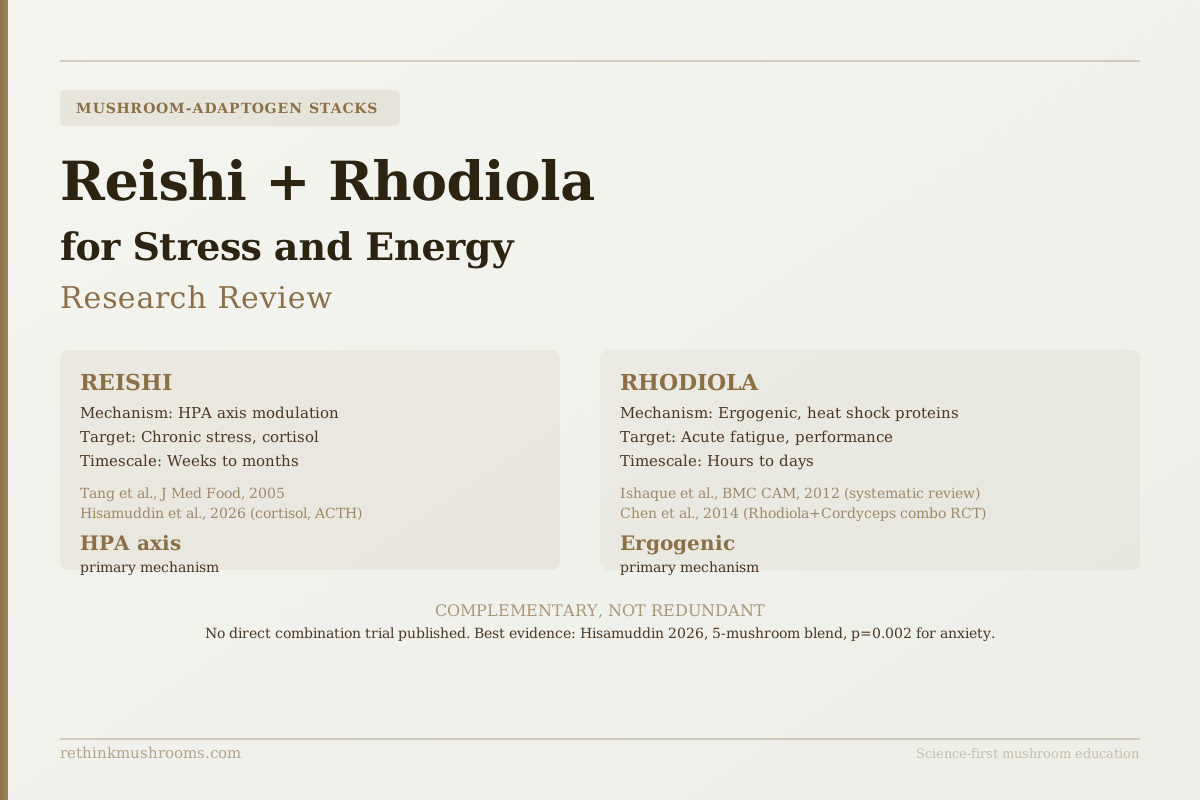
anxiety reduction (HAM-A) in 5-mushroom blend trial including reishi
HPA axis
reishi's primary mechanism: long-term cortisol regulation over weeks
0 RCTs
direct clinical trials testing reishi and rhodiola in combination
Hisamuddin et al., Brain and Behavior, 2026
 View as image ↗
Reishi and rhodiola appear together in a growing number of supplement blends marketed for stress and energy. The pairing has an intuitive logic: both are classified as adaptogens, both have clinical research behind them, and both are positioned for the same general use case. That framing misses something important.
Reishi and rhodiola do not work the same way. Reishi primarily targets the HPA axis, the hormonal system that controls cortisol output and long-term adaptation to chronic stress. Rhodiola is primarily an ergogenic compound that reduces the perception of fatigue and improves performance under acute mental and physical demands. These are different mechanisms operating on different timescales. The case for combining them is not that they duplicate each other; it is that they address different parts of a problem that most stressed adults share.
What the research actually shows for each compound is more nuanced than most coverage suggests, and no direct trial of the reishi+rhodiola combination has been published. This article covers what the individual evidence says, what the only comparable combination trial found, and what it means to stack two adaptogens with different mechanisms. For the broader picture of how adaptogenic mushrooms combine with herbal adaptogens, see Combining Medicinal Mushrooms: The Ultimate Stacking Guide.
Key Takeaways
- Reishi and rhodiola target different mechanisms: reishi modulates the HPA axis for long-term cortisol regulation; rhodiola reduces acute fatigue and improves performance via separate pathways
- Tang and colleagues (Journal of Medicinal Food, 2005) found reishi polysaccharide extract significantly improved fatigue, anxiety, and quality of life versus placebo in adults with neurasthenia, a condition defined by chronic fatigue and stress-related symptoms[1]
- Ishaque and colleagues' systematic review (BMC Complementary and Alternative Medicine, 2012) found Rhodiola rosea shows some evidence for fatigue reduction, but with high variability across studies; the magnitude of benefit is uncertain[2]
- The only published combination trial of a rhodiola species with a mushroom used Rhodiola crenulata (not rosea) plus Cordyceps sinensis: aerobic performance improved after high-altitude training (Chen et al., High Altitude Medicine & Biology, 2014)[3]
- No direct clinical trial of reishi and rhodiola in combination has been published; the stack rationale rests on individual compound data and theoretical mechanism complementarity
- A 2026 double-blind RCT of a 5-mushroom blend (including reishi, lion's mane, cordyceps, shiitake, and maitake) found significant reductions in anxiety, depression, cortisol, ACTH, and fatigue in 50 adults over 12 weeks (Hisamuddin et al., Brain and Behavior, 2026)[5]
Why Reishi and Rhodiola Target Different Parts of the Stress Response
The HPA axis (hypothalamic-pituitary-adrenal axis) is the hormonal control system that determines how much cortisol your body produces in response to stress. When a perceived threat signals the hypothalamus, it releases a hormone that tells the pituitary gland to release ACTH (a signaling hormone), which then tells the adrenal glands to produce cortisol. Sustained activation of this cascade, which happens in chronic stress, produces the familiar pattern of chronically elevated cortisol, disrupted sleep, suppressed immunity, and depleted energy.
Reishi (Ganoderma lucidum) appears to work primarily at this system level. Its triterpenes and polysaccharides interact with pathways that regulate cortisol output and promote the kind of deep, non-anxious baseline that reduces the frequency and intensity of HPA axis activation. This is a slow mechanism; the relevant timescale is weeks, not hours. You are not taking reishi for an acute meeting and expecting to feel calmer 45 minutes later.
Rhodiola works differently. Panossian and Wikman's 2009 foundational review of adaptogen mechanisms identified that rhodiola reduces fatigue and improves stress tolerance partly through effects on heat shock proteins and the neurotransmitters involved in the cellular stress response, rather than primarily through HPA axis modulation.[4] Rhodiola is an ergogenic compound: it improves performance under demanding conditions, reduces the perception of effort, and shortens cognitive recovery time after sustained mental work. Its effects can be perceived within a single dose in some studies.
The two compounds are complementary in the sense that they address the same problem from different angles and on different timescales, rather than working through the same pathway. That is a genuine mechanism-based rationale for combining them, even without direct combination evidence. For a comparison of how reishi and rhodiola each differ from ashwagandha in this context, see Mushrooms and Ashwagandha: The Ultimate Stress Stack?.
What the Clinical Research Shows for Reishi Alone
The primary human clinical evidence for reishi's effects on stress and fatigue comes from Tang and colleagues' 2005 randomized, double-blind, placebo-controlled trial published in the Journal of Medicinal Food.[1]
The trial enrolled adults with neurasthenia, a diagnostic category used primarily in East Asian medicine that describes chronic fatigue, anxiety, and functional impairment related to sustained stress. Although neurasthenia is not used in Western diagnostic systems, it maps closely to what Western medicine recognizes as stress-related burnout or chronic fatigue syndrome. Participants received a reishi polysaccharide extract or placebo. The trial found significant improvements in fatigue, anxiety, and quality of life in the treatment group compared to placebo.
This is the most direct clinical evidence available for reishi's adaptogenic effects. Its limitations are real: the sample was a clinical population with a specific stress-fatigue syndrome, not healthy adults dealing with everyday work stress, and the results may not generalize equally well across populations.
The more recent evidence from mushroom blend trials extends this picture. Hisamuddin and colleagues (2026) found that a 5-mushroom blend containing reishi, lion's mane, cordyceps, shiitake, and maitake produced statistically significant reductions in cortisol and ACTH alongside subjective improvements in anxiety, depression, and fatigue in a 12-week double-blind RCT.[5] This does not isolate reishi's specific contribution (all five mushrooms were administered together), but it demonstrates that reishi-containing mushroom combinations produce measurable HPA axis effects in a clinical trial setting.
For a deeper look at the standalone reishi evidence for stress and anxiety, see Reishi for Stress: The Calming Mushroom Research Review.
What the Clinical Research Shows for Rhodiola Alone
Rhodiola's clinical evidence base is larger in volume but more heterogeneous in results than reishi's.
Ishaque and colleagues published a systematic review of Rhodiola rosea for physical and mental fatigue in BMC Complementary and Alternative Medicine (2012), examining the available randomized controlled trials.[2] The review found some evidence of benefit (reduced fatigue and improved mental performance in acute stress situations), but noted substantial variability across studies. Trial quality was generally low, outcomes were measured differently across studies, and effect sizes ranged widely. The overall conclusion was that Rhodiola rosea probably helps with fatigue, but the magnitude and consistency of benefit is difficult to pin down.
A few clarifications about what the evidence actually covers are worth noting. Most rhodiola trials test it in acute or subacute stress situations: shift workers, medical students before exams, people undergoing physical exhaustion. This is the compound's primary niche: not long-term HPA axis regulation, but performance maintenance under demanding conditions. This is why combining rhodiola with an HPA-axis-focused compound like reishi makes more logical sense than combining two HPA-axis modulators.
One other note: the scientific literature on rhodiola covers multiple species, and Rhodiola rosea and Rhodiola crenulata are chemically distinct. The combination evidence discussed below involves Rhodiola crenulata, not Rhodiola rosea. They share a genus and some bioactive compounds, but they are different plants with different active constituent profiles.
The Only Combination Evidence: Rhodiola + Cordyceps at High Altitude
No combination trial of reishi and rhodiola has been published. The closest available evidence is a study combining a rhodiola species with a different mushroom.
Chen and colleagues (High Altitude Medicine & Biology, 2014) tested a supplement containing Rhodiola crenulata and Cordyceps sinensis in athletes undergoing training at high altitude.[3] High altitude represents a combined stress model: physical exertion + hypoxia (reduced oxygen availability) + environmental challenge. The combination supplement boosted aerobic exercise performance compared to a control condition. This is the only published randomized trial of a rhodiola species combined with a mushroom.
What this evidence does and does not tell us requires careful framing. It tells us that the conceptual approach of combining an ergogenic plant adaptogen (rhodiola) with an adaptogenic mushroom (cordyceps in this case) showed an additive performance benefit in one specific high-demand context. It does not tell us whether reishi and rhodiola specifically would produce the same benefit, whether the effect extends to everyday stress management, or whether the altitude performance context generalizes to office-related mental fatigue.
Cordyceps and reishi are different mushrooms with different primary mechanisms. Cordyceps is better characterized as an energy-performance compound, while reishi is better characterized as a stress-regulatory and sleep-promoting compound. The Chen 2014 combination targeted the same ergogenic/performance niche as rhodiola. A reishi+rhodiola combination would theoretically target a different pair of niches: long-term stress regulation (reishi) paired with acute performance (rhodiola).
The Case for the Stack: Different Entry Points, No Combined Evidence
The theoretical case for reishi + rhodiola is straightforward, even without combination trial data.
Both compounds work within the broader stress-response framework that Panossian and Wikman described in their 2009 review of adaptogen mechanisms: reducing the biological and psychological cost of stress by modulating the systems that respond to it.[4] But they do so at different points. Reishi's effects are chronic and systemic, working at the level of cortisol regulation over weeks. Rhodiola's effects are more acute and performance-oriented, acting within the nervous system's fatigue and resilience circuitry in the shorter term.
This is the legitimate rationale for combining them: if you want to address both the chronic HPA dysregulation that underlies burnout and the acute fatigue that impairs day-to-day performance, you are targeting two different systems. Two compounds with two different mechanisms could, in principle, cover both targets. This is not synergy in the pharmacological sense; the compounds are not working on the same pathway to amplify each other. It is more accurately described as complementarity: covering more ground than either alone.
What is missing is the clinical validation. No trial has tested reishi and rhodiola together in humans. The combination rationale rests on: (a) individual compound evidence in separate trials, (b) the Chen 2014 rhodiola+cordyceps combination precedent, and (c) the Panossian framework for how adaptogens work on different stress-response targets. That is a reasonable basis for the theoretical case. It is not a basis for claiming combination efficacy. For a full overview of which mushroom-adaptogen combinations have the most direct evidence, see Mushroom-Adaptogen Stacks: What the Research Supports.
The 2026 Multi-Mushroom RCT: Best Available Context for Mushroom Adaptogen Blends
For readers who want the most current evidence on whether mushroom-based adaptogen stacks actually affect stress physiology in measurable ways, Hisamuddin and colleagues' 2026 double-blind RCT provides the most relevant clinical data.[5]
The trial enrolled 50 adults and tested a 5-mushroom blend containing lion's mane, cordyceps militaris, reishi, shiitake, and maitake over 12 weeks. The primary outcomes included self-reported anxiety (STAI-S) and clinician-rated anxiety (HAM-A), depression (BDI), cortisol, ACTH, fatigue, and sleep quality (PSQI). The results showed significant improvements across every primary outcome: anxiety STAI-S p=0.025 at 6 weeks and p=0.011 at 12 weeks; HAM-A p=0.002; BDI p less than 0.001; cortisol and ACTH both significantly reduced. Sleep quality improved significantly. Fatigue scores decreased significantly.
This is important for several reasons. First, it demonstrates that a reishi-containing mushroom blend produces measurable reductions in cortisol and ACTH (the core HPA-axis hormones that reishi's individual studies suggest it targets). Second, it shows that these effects accumulate over 12 weeks, which is consistent with the slow-acting cortisol-regulation mechanism that distinguishes reishi from acute-acting adaptogens like rhodiola. Third, the trial was double-blind, placebo-controlled, and tested objective biomarkers (cortisol, ACTH), not only self-report scales.
The limitation is that the 5-mushroom blend does not tell us what reishi's specific contribution was relative to the other four mushrooms. This is the fundamental challenge of combination trials: they show that the blend works but cannot isolate individual ingredients.
A 12-week commitment appears to be the relevant timeframe for peak effects when reishi is part of the blend. If the same timeline applies to a reishi+rhodiola combination, the acute fatigue-reduction effects of rhodiola might be perceptible earlier (within days to a few weeks), while the HPA-regulatory and cortisol effects attributed to reishi's component would take longer to fully express. For a practical look at onset timing across mushroom supplements, see How Long Before You Feel Mushroom Supplement Effects?.
The Bottom Line
Reishi and rhodiola have distinct mechanisms and occupy different niches in the stress-and-energy landscape: reishi primarily works through HPA-axis modulation for long-term cortisol regulation, while rhodiola is primarily an ergogenic compound that reduces acute fatigue. Individual compound evidence supports both, with Tang 2005 (reishi) and Ishaque 2012 (rhodiola) providing the primary systematic data. No direct reishi+rhodiola combination trial has been published. The closest combination evidence is Chen 2014's trial of Rhodiola crenulata plus Cordyceps sinensis, which showed aerobic performance benefits at altitude. A 2026 five-mushroom blend RCT including reishi demonstrated that mushroom-based adaptogen combinations do produce significant, measurable reductions in cortisol, ACTH, and anxiety over 12 weeks. The theoretical case for stacking reishi with rhodiola is mechanism-based and reasonable; the clinical evidence to confirm it specifically has not been done yet.
Frequently Asked Questions
Sources & References
- 1RTHM-00088·Tang, Wenbo et al. (2005). “A randomized, double-blind and placebo-controlled study of a Ganoderma lucidum polysaccharide extract in neurasthenia..” Journal of medicinal food.Study breakdown →PubMed →↩
- 2RTHM-00462·Ishaque, Sana et al. (2012). “Rhodiola rosea for physical and mental fatigue: a systematic review..” BMC complementary and alternative medicine.Study breakdown →PubMed →↩
- 3RTHM-00313·Chen, Chung-Yu et al. (2014). “Rhodiola crenulata- and Cordyceps sinensis-based supplement boosts aerobic exercise performance after short-term high altitude training..” High altitude medicine & biology.Study breakdown →PubMed →↩
- 4RTHM-00168·Panossian, Alexander et al. (2009). “Evidence-based efficacy of adaptogens in fatigue, and molecular mechanisms related to their stress-protective activity..” Current clinical pharmacology.Study breakdown →PubMed →↩
- 5RTHM-00959·Hisamuddin, Ahmad Safiyyu'd-Din et al. (2026). “Adaptogenic Effects of Mushroom Blend Supplementation on Stress, Fatigue, and Sleep: A Randomised, Double-Blind, and Placebo-Controlled Trial..” Brain and behavior.Study breakdown →PubMed →↩