Mushroom-Adaptogen Stacks
499 adults tested
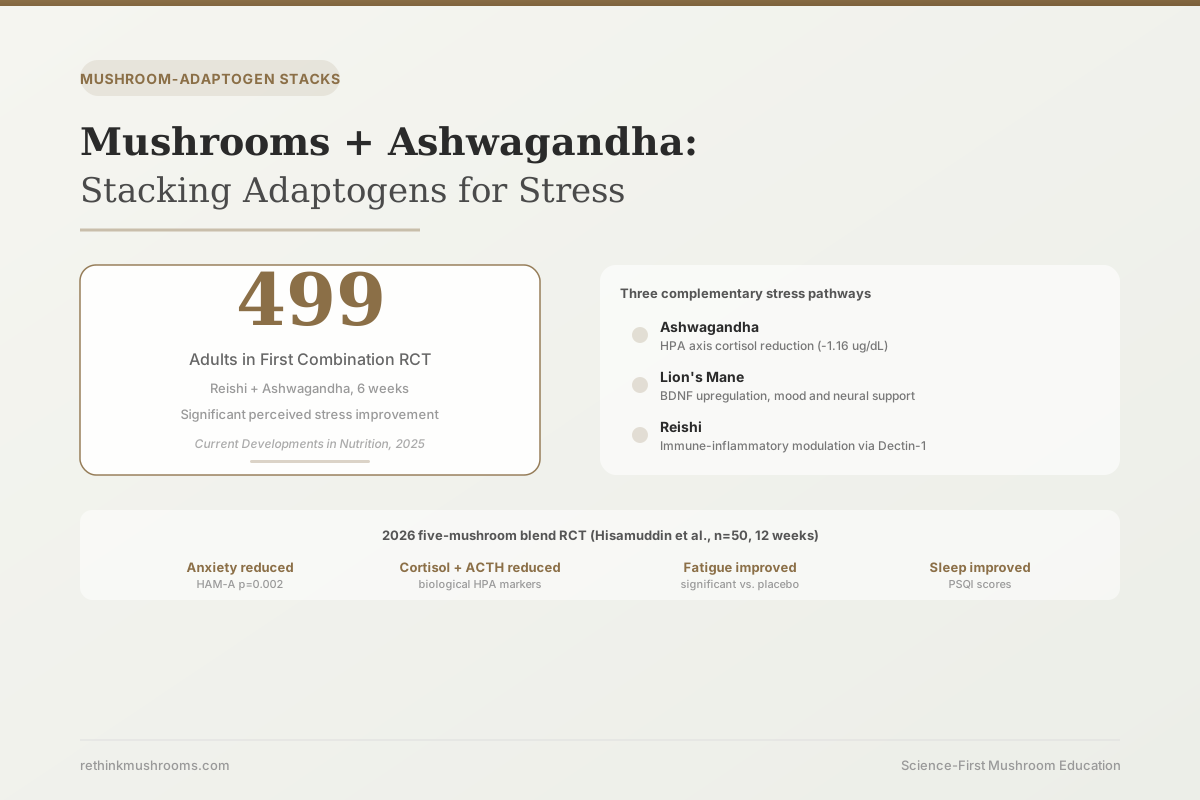
The only randomized test of a reishi and ashwagandha combination enrolled 499 healthy adults for 6 weeks and reported significant improvement in perceived stress versus placebo. It has been published only as a sponsor-funded conference abstract, so its doses, effect size, and safety data remain unavailable.
Gundermann et al., NUTRITION 2025 abstract, Current Developments in Nutrition
2 × 500 mg/day
five-mushroom blend dose that reduced anxiety, cortisol, and fatigue versus placebo over 12 weeks in a sponsor-funded per-protocol RCT (Hisamuddin et al., Brain and Behavior, 2026)
240 mg/day
ashwagandha dose that lowered morning cortisol (P < 0.001) and HAM-A anxiety (P = 0.040) in 60 adults over 60 days (Lopresti et al., Medicine, 2019)
Two verdicts
pooled reviews agree ashwagandha lowers cortisol but disagree on perceived stress: no significant effect in Albalawi 2025, a significant one in Arumugam 2024
Gundermann et al., NUTRITION 2025 abstract, Current Developments in Nutrition
 View as image ↗
Until 2025, the case for combining medicinal mushrooms with ashwagandha rested entirely on extrapolation. Both categories had their own clinical evidence. Both were described as adaptogens. The logical inference was that combining them would produce additive effects on the stress response. No one had tested the combination directly.
That changed when a randomized, double-blind, placebo-controlled trial enrolled 499 healthy adults and tested a reishi mushroom and ashwagandha supplement over 6 weeks. Perceived stress improved significantly compared to placebo.[1] It is the first and still the only direct human test of this specific stack.
It is also, importantly, a conference abstract rather than a peer-reviewed research paper, which changes how much weight it can carry. This article takes that finding seriously and then examines what it actually establishes.
Separately, a double-blind RCT of a five-mushroom blend (lion's mane, cordyceps, reishi, shiitake, maitake) in 50 analyzed adults reported reductions in anxiety, depressive symptoms, cortisol, ACTH, and fatigue over 12 weeks.[2] Both trials point the same direction. Both were paid for by the companies selling the products.
This article reviews the combination evidence, explains why these ingredient categories target stress through different biological pathways, and extracts the practical dose and timing data from each trial. For the broader framework of mushroom combinations, see Combining Medicinal Mushrooms: The Ultimate Stacking Guide.
Key Takeaways
- The only clinical trial of a reishi and ashwagandha combination found significant perceived stress improvement versus placebo in 499 healthy adults over 6 weeks. It was funded by MegaFood and published as a NUTRITION 2025 conference abstract, so no doses, effect sizes, or adverse-event data are available (Gundermann et al., Current Developments in Nutrition, 2025)
- A five-mushroom blend at 2 × 500 mg/day reduced HAM-A anxiety (−33.5% vs −13.1%, p = 0.002), cortisol (−5.5% vs +0.8%, p < 0.001), and physical fatigue versus placebo over 12 weeks in 50 analyzed adults. The trial was sponsor-funded, analyzed per-protocol rather than intention-to-treat, and reported a norepinephrine increase that cuts against a simple stress-reduction story (Hisamuddin et al., Brain and Behavior, 2026)
- Ashwagandha at 240 mg/day lowered morning cortisol (P < 0.001) and HAM-A anxiety (P = 0.040) in 60 adults over 60 days. Its broader DASS-21 stress score only approached significance (P = 0.096), and sleep was not among the measured outcomes (Lopresti et al., Medicine, 2019)
- Two meta-analyses disagree about whether ashwagandha changes how stressed people feel. Albalawi 2025 found no significant effect on perceived stress (SMD −0.355, P = 0.40) despite a clear cortisol reduction; Arumugam 2024 found a significant perceived stress benefit (MD −4.72). Both agree cortisol falls
- Lion's mane evidence for mood is weaker than commonly stated. In Nagano 2010, depression and complaint scores fell within the lion's mane group, but the overall between-group comparisons versus placebo were not significant, and only two minor subscales separated from placebo
- Vigna 2019 is routinely cited as showing lion's mane raises BDNF. It found the opposite detail: circulating pro-BDNF rose while BDNF itself did not significantly change
- The pathways are genuinely complementary in theory: ashwagandha acts on the adrenal cortisol response, lion's mane on neurotrophic signaling, reishi on immune-inflammatory tone. No trial has yet shown that combining them beats any single ingredient alone
Why These Ingredients Target Stress Through Different Pathways
"Adaptogen" is a broad label that gets applied to any substance showing stress-protective effects in research. The problem with that framing is it treats all adaptogens as interchangeable. The clinical data suggests they are not.
Ashwagandha (Withania somnifera) is primarily studied for its effects on the HPA (hypothalamic-pituitary-adrenal) axis, the hormonal cascade that drives cortisol production under stress. Lopresti et al. (2019) tested 240 mg/day of a standardized root extract (Shoden) versus placebo in 60 adults with self-reported high stress.[3] After 60 days, morning cortisol was significantly lower in the ashwagandha group (P < 0.001), and anxiety fell on the Hamilton Anxiety Rating Scale (P = 0.040).
Two details usually get dropped when this trial is cited. The DASS-21, which measures depression, anxiety and stress together, only approached significance (P = 0.096) rather than reaching it. And DHEA-S, an adrenal androgen, fell alongside cortisol (P = 0.004), which is a reminder that suppressing adrenal output is not selectively beneficial. The proposed mechanism is that withanolides modulate adrenal signaling, damping the magnitude of the cortisol response.
Lion's mane (Hericium erinaceus) targets a different part of the stress system: neurobiology rather than hormones. Its active compounds, hericenones and erinacines, stimulate nerve growth factor (NGF) in laboratory systems. The human evidence for the neurotrophic story is thinner than the marketing implies. Vigna et al. (2019) supplemented 77 people with overweight or obesity, all on a low-calorie diet, for 8 weeks and reported improvements in depression, anxiety and sleep.[4] The biomarker result is the part that gets misreported: lion's mane increased circulating pro-BDNF without producing any significant change in BDNF itself.
Reishi contributes a third pathway. The beta-glucans in reishi modulate macrophage and dendritic cell activity via the Dectin-1 receptor, affecting cytokine signaling throughout the body. Chronic psychological stress is associated with elevated inflammatory markers, and immune-neurological crosstalk is a recognized mechanism in stress and mood disorders. Both the reishi-plus-ashwagandha abstract and the five-mushroom blend RCT included reishi, and neither isolated its individual contribution.
The stacking argument is that HPA cortisol regulation, neurotrophic support, and immune-inflammatory modulation address different contributors to chronic stress. That argument is mechanistically reasonable and clinically untested. No trial has compared a combination against its own individual ingredients.
The 2025 Reishi + Ashwagandha Study: What It Found and What It Doesn't Tell Us
The 2025 study by Gundermann and colleagues (DOI: 10.1016/j.cdnut.2025.106183) is the most directly relevant research for anyone considering this specific stack.[1]
It enrolled 499 healthy adults in a virtual (remote) randomized, double-blind, placebo-controlled design and ran for 6 weeks. Participants received either the reishi-plus-ashwagandha combination product or placebo. Perceived stress improved significantly versus placebo (P < 0.05).
Gundermann et al. (2025) · Current Developments in Nutrition (NUTRITION 2025 abstract)
- Population
- 499 healthy adults, enrolled remotely
- Intervention
- Combination supplement containing Ganoderma lucidum fruiting-body extract and Withania somnifera extract, 6 weeks
- Comparator
- Matched placebo
- Finding
- Perceived stress improved significantly versus placebo (P < 0.05). The abstract reports no effect size, no confidence interval, no component doses, no biological stress markers, and no adverse-event data.
preliminary A large, well-designed trial reported in a format that cannot be independently appraised. Funded by MegaFood, which sells the tested product.
Gundermann et al., Current Developments in Nutrition, 9(Suppl 2), 106183, 2025
Three context points matter, and they compound.
It is a conference abstract, not a peer-reviewed paper. The result was presented at NUTRITION 2025, the American Society for Nutrition's annual meeting, and appears in that meeting's abstract supplement. Meeting abstracts are screened by a programme committee rather than fully peer reviewed, and they carry no PubMed record. Practically, this means the reported significance cannot be checked against a methods section, an analysis population, or a results table, because none of those have been published.
The doses are unavailable. The abstract does not state how many milligrams of reishi extract or ashwagandha extract the product delivered. A trial that cannot tell you what dose produced the effect cannot be used to justify a dose.
It was funded by the manufacturer. MegaFood, a Pharmavite brand, sells the reishi-and-ashwagandha product and paid for the study; the author group includes sponsor-affiliated and contract-research personnel. Industry funding is not disqualifying and is close to universal in supplement research, but combined with abstract-only reporting it removes most of the checks that would normally catch selective outcome reporting.
What the study does establish: in the largest randomized sample yet assembled for this question, a reishi-and-ashwagandha combination outperformed placebo on self-reported stress over 6 weeks. That is a real signal and it is genuinely the best available direct evidence. What it does not establish is how large the benefit was, what dose produced it, whether any biological marker moved, or whether the combination beats ashwagandha on its own.
The 2026 Five-Mushroom Blend RCT: Cortisol, ACTH, and an Awkward Biomarker
Hisamuddin et al. (2026) published a full peer-reviewed trial in Brain and Behavior testing a five-mushroom capsule blend (lion's mane, Cordyceps militaris, reishi, shiitake, and maitake) against placebo for 12 weeks.[2] Fifty-one participants were randomized and 50 were analyzed, at 2 × 500 mg capsules daily.
On the paper's percentage-change analysis, the blend separated from placebo on several endpoints by week 12: HAM-A anxiety fell 33.5% versus 13.1% (p = 0.002), serum cortisol fell 5.5% versus a 0.8% rise (p < 0.001), sleep quality on the PSQI improved 11.1% versus 1.0% (p < 0.001), physical fatigue fell 9.2% versus 2.1% (p < 0.001), and CRP, an inflammatory marker, fell 6.3% against a 4.9% rise in placebo (p = 0.042). Anxiety also improved on the STAI-S at both the 6-week and 12-week measurement points, and depressive symptoms improved on the BDI. ACTH, the pituitary signal that triggers cortisol release, was reduced as well, which suggests the effect acted earlier in the HPA cascade rather than only at the adrenal gland.
This is the strongest evidence in the article, and it still needs three qualifications.
The analysis was per-protocol, not intention-to-treat: participants who fell below an 80% adherence threshold were excluded rather than analyzed in their assigned groups, which systematically favors the intervention. The trial was sponsor-funded, with the blend supplied by the company that sells it, and the paper carries no separate competing-interests statement. And one biomarker moved the wrong way: norepinephrine rose 10.4% in the blend group against a 0.8% fall in placebo (p = 0.033). Norepinephrine is a stress-response catecholamine, so an increase does not fit a straightforward "this calms the stress system" narrative. The paper also reports no detailed adverse-event table.
None of this makes the trial unusable. A 50-person, 12-week, placebo-controlled study reporting movement in both self-reported scores and biological markers is meaningfully better evidence than anything else in this space. It is simply encouraging rather than definitive.
The Cortisol Versus Perceived Stress Problem
Here is the complication that sits underneath every product in this category, and it is the reason the 499-person abstract deserves more scrutiny than its headline suggests.
Ashwagandha is marketed almost entirely on cortisol reduction, with the implicit promise that lower cortisol means feeling calmer. Two recent meta-analyses tested both halves of that promise and reached different verdicts on the second half.
Albalawi (2025), in Nutrition and Health, pooled 7 cortisol comparisons and 6 perceived-stress comparisons across 488 participants.[5] Cortisol fell significantly, by 1.16 µg/dL (95% CI −1.64 to −0.69, P < 0.001). Perceived stress did not: SMD −0.355, 95% CI −1.188 to 0.47, P = 0.40. The confidence interval crosses zero, so the honest description is a null result, not a smaller effect.
Arumugam et al. (2024), in Explore, pooled 9 randomized trials across 558 patients and reached a different conclusion on the subjective endpoint.[6] They found a significant improvement on the Perceived Stress Scale (MD −4.72, 95% CI −8.45 to −0.99), alongside a significant reduction in Hamilton Anxiety Scale scores (MD −2.19) and in cortisol (MD −2.58 µg/dL, 95% CI −4.99 to −0.16).
Evidence audit · Two meta-analyses, one herb
Ashwagandha moves the hormone. Whether it moves the feeling is contested.
Both pooled reviews agree that cortisol falls. They disagree about perceived stress, the subjective endpoint that most combination products are actually marketed on.
Albalawi 2025
Nutrition and Health
7 cortisol / 6 PSS comparisons · n = 488
Arumugam 2024
Explore
9 RCTs · n = 558
Cortisol
Blood / salivary stress hormone
−1.16 µg/dL
95% CI −1.64 to −0.69
P < 0.001
−2.58 µg/dL
95% CI −4.99 to −0.16
significant
Perceived stress
How stressed people say they feel (PSS)
SMD −0.355
95% CI −1.188 to 0.47
P = 0.40
MD −4.72
95% CI −8.45 to −0.99
significant
Why this matters here: the 2025 reishi-plus-ashwagandha conference abstract reported a single endpoint, perceived stress, and no biological marker at all. That places its only result inside the exact zone where the pooled evidence for ashwagandha does not agree with itself.
Both reviews agree that ashwagandha lowers cortisol. They disagree about whether it changes how stressed people report feeling, most likely because they used different search windows and inclusion criteria. When two competent meta-analyses of the same herb disagree on an endpoint, the correct reading is that the evidence for that endpoint is unsettled.
Marketing claim under scrutiny
Does lowering cortisol mean you feel less stressed?
The claim
“Ashwagandha lowers cortisol, therefore it makes you feel less stressed.”
Supplement marketing, which treats a measurable hormone change as a stand-in for the subjective benefit customers actually want.
What research shows
OverstatedThe cortisol reduction is real and consistent: both pooled reviews found it. The subjective benefit is not consistent. Albalawi 2025 found no significant change in perceived stress (SMD −0.355, P = 0.40) despite a clear cortisol drop in the same analysis.
Arumugam 2024 did find a significant perceived-stress benefit, so this is a genuine disagreement rather than a settled null. Both pooled samples are small, and neither review establishes that a roughly 1 to 2.5 µg/dL cortisol change is clinically meaningful in people whose cortisol was never abnormal.
Albalawi, Nutrition and Health, 2025; Arumugam et al., Explore, 2024
This matters directly for interpreting the reishi-plus-ashwagandha study. That study measured perceived stress and nothing else. Its single endpoint is precisely the one where the pooled ashwagandha evidence contradicts itself, and it reported no biological marker that could corroborate the self-reported change.
What Each Mushroom Specifically Contributes
The Hisamuddin trial tested a blend and cannot isolate individual mushroom contributions. Two of its mushrooms have relevant standalone evidence for mood and stress endpoints, and one of them is weaker than its reputation.
Lion's mane. Nagano et al. (2010) randomized 30 women with self-reported indefinite complaints to lion's mane cookies (2 g/day of powdered fruiting body) or placebo for 4 weeks; 26 were analyzed, 12 in the active arm and 14 in placebo.[7] This trial is very widely cited as showing that lion's mane reduces depression and anxiety. What it actually reports is more limited. Depression scores fell within the lion's mane group (CES-D 13.9 to 10.3, P = 0.033) and overall complaint scores fell within that group as well (ICI 46.1 to 29.6, P = 0.004), but the paper reports no significant between-group difference versus placebo on either overall measure. Only two of the complaint subscales separated from placebo: palpitation (P = 0.032) and incentive (P = 0.047). Notably, the anxiety subscale did not reach significance (P = 0.067).
Reishi. Reishi appears in both combination trials, and in neither was its individual contribution isolated. Its own standalone human record is thinner than that ubiquity suggests, and the most relevant trial was null. Pazzi et al. (2020) gave women with fibromyalgia 6 g/day of micro-milled Ganoderma lucidum or placebo for 6 weeks in a double-blind randomized pilot and found no statistically significant between-group differences in happiness, depression, satisfaction with life, or health-related quality of life.[8] A within-group trend toward improvement appeared in the reishi arm, which is the same pattern seen in Nagano's lion's mane data and carries the same limitation. The trial was a small pilot in a clinical pain population, so it does not settle the question, but it is the clearest standalone test available and it did not separate from placebo. Reishi's immune-inflammatory mechanism remains plausible and remains largely untested against stress endpoints in people.
- Cell & Lab Studiescompleted
Withanolides on adrenal signaling; hericenones and erinacines stimulating NGF; reishi beta-glucans acting through the Dectin-1 receptor. Mechanistically well developed for each ingredient separately.
- Animal Studiescompleted
Extensive rodent stress-model work for ashwagandha and for individual mushroom species, largely testing single ingredients rather than combinations.
- Case Reports & Early Seriescompleted
Long traditional-use record for both categories, with no controlled outcome data attached.
- Small Human Trialscurrent
Hisamuddin 2026: 50 analyzed adults, 12 weeks, five-mushroom blend versus placebo, with cortisol, ACTH and CRP endpoints. Sponsor-funded and per-protocol. Lopresti 2019: 60 adults on ashwagandha alone. Nagano 2010: 26 analyzed, lion's mane alone, mostly null between groups. Pazzi 2020: reishi alone versus placebo in fibromyalgia, null on all mood and quality-of-life endpoints.
- Large Randomized Trialscurrent
Gundermann 2025: 499 adults on reishi plus ashwagandha, the only direct combination test. Large and well designed, but reported only as a sponsor-funded conference abstract with no published doses or effect sizes.
- Meta-Analyses & Systematic Reviewsmissing
Pooled reviews exist for ashwagandha alone (Albalawi 2025, Arumugam 2024) and disagree on perceived stress. No meta-analysis exists for mushroom-plus-ashwagandha combinations, and no trial has compared a combination against its own individual ingredients.
The combination has reached a large randomized trial, which is further than most supplement stacks get. But that trial is unpublished beyond an abstract, and the fundamental stacking question — does combining these beat taking one of them — has never been tested in any design.
Gundermann et al. 2025; Hisamuddin et al. 2026; Albalawi 2025; Arumugam et al. 2024; Pazzi et al. 2020; Lopresti et al. 2019; Nagano et al. 2010
For stress specifically, the combination evidence favors pairing ashwagandha with reishi, because that is the only pairing anyone has actually tested, or using a multi-mushroom formula on the strength of the Hisamuddin data. For mood and anxiety endpoints within a stack, lion's mane has the most direct evidence, but that evidence is considerably weaker than it is usually presented as being.
For an overview of the broader anxiety evidence base for functional mushrooms, see Functional Mushrooms for Anxiety: What the Research Shows.
Dose and Timing: What the Research Parameters Show
The trials provide specific parameters readers can use to evaluate products, though no dose-ranging study has established an optimal combination protocol.
Ashwagandha. Lopresti 2019 used 240 mg/day of a standardized root extract and showed effects at 60 days.[3] Other trials have used 300–600 mg/day. Albalawi's meta-analysis restricted inclusion to trials using at least 250 mg/day for at least two weeks. No trial has established a minimum effective dose.
Reishi plus ashwagandha. The 2025 study reported perceived stress effects at 6 weeks but did not publish component doses. This is a direct consequence of abstract-only publication, and it means the trial cannot guide dosing.
Multi-mushroom blend. Hisamuddin 2026 used 2 × 500 mg capsules daily for 12 weeks, with anxiety and biomarker improvements already visible at the 6-week measurement point and larger at 12 weeks.
Lion's mane. Nagano 2010 used 2 g/day of powdered fruiting body delivered in cookies over 4 weeks. Vigna 2019 supplemented for 8 weeks alongside a low-calorie diet.
The consistent pattern across trials is that stress and anxiety endpoints take weeks to respond, not days. The shortest timeline is 4 weeks, cortisol effects in the Lopresti trial appeared by 60 days, and the Hisamuddin blend showed additional gains between 6 and 12 weeks. Anyone evaluating one of these products should plan on at least 6 to 8 weeks before judging it, and should be skeptical of any product promising same-week results.
Safety
ModerateAdaptogen stacks are not a treatment for anxiety, depression, or a stress disorder
Concern
These products are marketed for exactly the symptoms that also characterize diagnosable anxiety and mood disorders, which creates a real risk that someone delays effective care while trialing supplements for weeks. Ashwagandha specifically has documented case reports of liver injury and can interact with thyroid medication, sedatives, and immunosuppressants; it is generally advised against in pregnancy. Reishi may add to the effect of anticoagulants. None of the trials described here reported a detailed adverse-event table.
What the research says
Treat mushroom and ashwagandha stacks as low-stakes experiments layered on top of proper care, not as substitutes for it. If stress or low mood is persistent, impairing, or worsening, that warrants a clinician rather than a supplement. Review any adaptogen with a pharmacist or physician if you take thyroid medication, sedatives, anticoagulants, or immunosuppressants, or if you have liver disease. This article is educational and is not medical advice.
Particularly relevant for: Adults considering an adaptogen stack for ongoing stress or fatigue
What to do
Check for thyroid, sedative, anticoagulant and immunosuppressant interactions before starting, and seek clinical assessment rather than self-treating persistent or worsening symptoms.
Lopresti et al., Medicine, 2019; Hisamuddin et al., Brain and Behavior, 2026
For a look at how lion's mane stacks with other cognitive ingredients, see Lion's Mane + Nootropics: The Best Cognitive Stacks.
For more on the broader adaptogen stacking research, see Mushroom-Adaptogen Stacks: What the Research Supports.
The Bottom Line
Two trials now provide direct evidence for mushroom-ashwagandha stacking, and both come with real caveats. A 2025 study of reishi plus ashwagandha in 499 adults reported significant perceived stress improvement, but it was funded by MegaFood and published only as a NUTRITION 2025 conference abstract, without doses, effect sizes, or safety data. A 2026 peer-reviewed RCT of a five-mushroom blend at 2 × 500 mg/day in 50 analyzed adults found reductions in HAM-A anxiety, cortisol, ACTH, fatigue and CRP, though it was sponsor-funded, analyzed per-protocol, and reported a norepinephrine increase that complicates the story. The combination rationale is mechanistic: ashwagandha acts on the HPA cortisol pathway, lion's mane on neurotrophic signaling, reishi on immune-inflammatory tone. That rationale is untested, because no trial has compared a stack against its own individual ingredients. Underneath all of it sits an unresolved problem: two meta-analyses agree ashwagandha lowers cortisol but disagree on whether it changes how stressed people actually feel. Expect 6 to 8 weeks minimum before judging any of these products, and treat them as adjuncts rather than treatment.
Frequently Asked Questions
Sources & References
- 1RTHM-02468·Gundermann, David et al. (2025). “A conference abstract reporting that a reishi-plus-ashwagandha supplement lowered perceived stress in 499 adults over 6 weeks.” Current Developments in Nutrition.Study breakdown →↩
- 2RTHM-00959·Hisamuddin, Ahmad Safiyyu'd-Din et al. (2026). “Adaptogenic Effects of Mushroom Blend Supplementation on Stress, Fatigue, and Sleep: A Randomised, Double-Blind, and Placebo-Controlled Trial..” Brain and behavior.Study breakdown →PubMed →↩
- 3RTHM-01102·Lopresti, Adrian L et al. (2019). “An investigation into the stress-relieving and pharmacological actions of an ashwagandha (Withania somnifera) extract: A randomized, double-blind, placebo-controlled study..” Medicine.Study breakdown →PubMed →↩
- 4RTHM-00590·Vigna, Luisella et al. (2019). “Hericium erinaceus Improves Mood and Sleep Disorders in Patients Affected by Overweight or Obesity: Could Circulating Pro-BDNF and BDNF Be Potential Biomarkers?.” Evidence-based complementary and alternative medicine : eCAM.Study breakdown →PubMed →↩
- 5RTHM-02467·Albalawi, Ahmad Abdualrazag (2025). “A meta-analysis finding ashwagandha reliably lowers cortisol but does not significantly change how stressed people say they feel.” Nutrition and health.Study breakdown →PubMed →↩
- 6RTHM-01851·Arumugam, Velan et al. (2024). “Effects of Ashwagandha (Withania Somnifera) on stress and anxiety: A systematic review and meta-analysis..” Explore (New York.Study breakdown →PubMed →↩
- 7RTHM-00194·Nagano, Mayumi et al. (2010). “Reduction of depression and anxiety by 4 weeks Hericium erinaceus intake..” Biomedical research (Tokyo.Study breakdown →PubMed →↩
- 8RTHM-01274·Pazzi, Francesco et al. (2020). “A placebo-controlled pilot trial in which reishi did not significantly beat placebo on mood or quality of life in women with fibromyalgia.” Healthcare (Basel.Study breakdown →PubMed →↩