Mushroom Stacking & Combinations
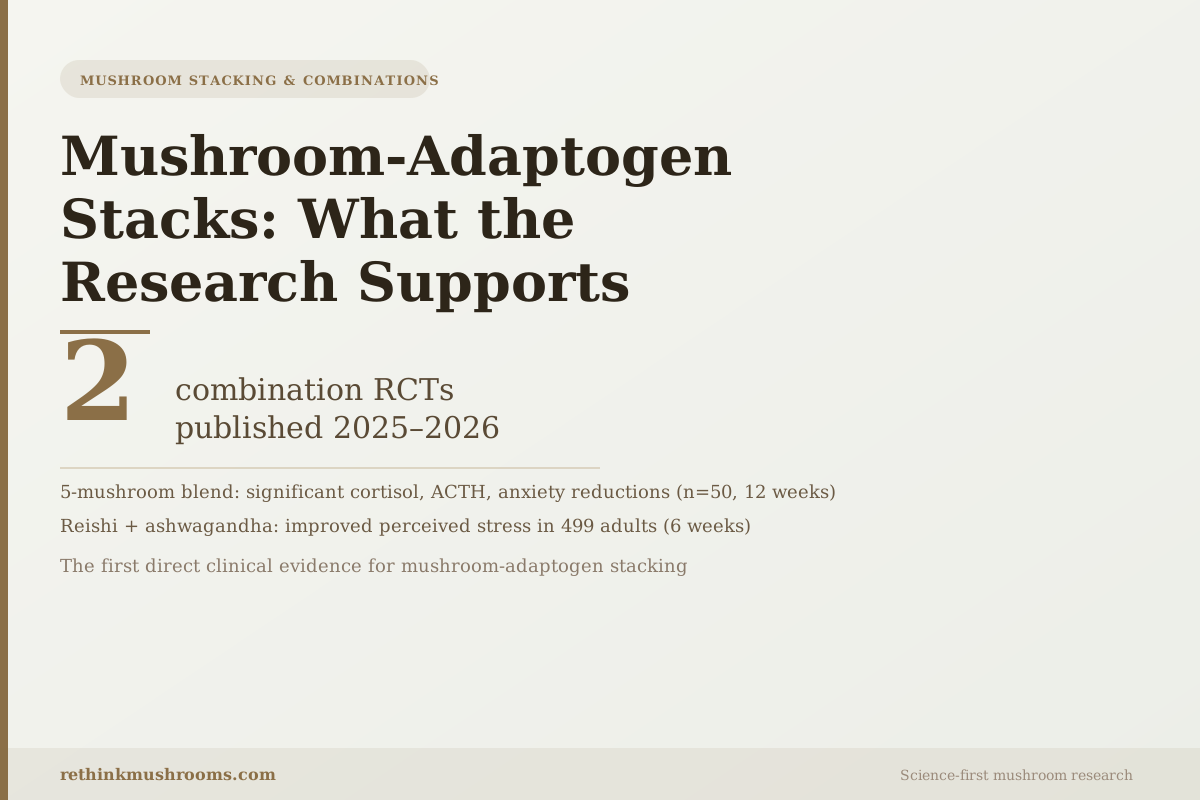
2 combination RCTs
Two randomized controlled trials now provide direct evidence for mushroom-adaptogen combinations: a 2026 trial of a 5-mushroom blend showing significant cortisol, ACTH, and anxiety reductions, and a 2025 trial of reishi combined with ashwagandha showing improved perceived stress in 499 adults.
Hisamuddin et al., Brain and Behavior, 2026; Current Dev Nutr, 2025
12 weeks
to maximum effect in the Hisamuddin 2026 multi-mushroom blend RCT
499 adults
enrolled in the first reishi + ashwagandha combination RCT (2025)
HPA axis
the shared stress-response pathway that both mushrooms and herbal adaptogens target
Hisamuddin et al., Brain and Behavior, 2026; Current Dev Nutr, 2025
 View as image ↗
The mushroom-adaptogen stack is one of the most popular combination supplement protocols. The premise is straightforward: medicinal mushrooms like reishi, lion's mane, and cordyceps have adaptogenic properties, and combining them with herbal adaptogens like ashwagandha or rhodiola should produce additive or synergistic benefits for stress, fatigue, and cognitive performance. Stack products are everywhere. Research supporting them in combination was, until recently, nearly absent.
A mushroom-adaptogen stack combines adaptogenic mushrooms (reishi, lion's mane, cordyceps) with herbal adaptogens (ashwagandha, rhodiola) targeting different points in the stress response. Direct combination evidence is limited but growing: a 2026 RCT of a 5-mushroom blend and a 2025 trial of reishi+ashwagandha are the first clinical combination studies in this space.
That combination evidence is still preliminary. Understanding what the trials actually showed, and what remains extrapolated from individual studies, is how to separate signal from marketing. For the broader guide to combining medicinal mushrooms, see the complete mushroom stacking guide.
Key Takeaways
- A 2026 double-blind RCT of a 5-mushroom blend (lion's mane, cordyceps, reishi, shiitake, maitake) in 50 adults found significant reductions in anxiety, depression, cortisol, ACTH, and fatigue over 12 weeks
- A 2025 randomized controlled trial of reishi combined with ashwagandha in 499 adults found significant improvement in perceived stress at 6 weeks; the trial was funded by supplement brand MegaFood
- The only other published combination study is Chen 2014: Rhodiola crenulata combined with Cordyceps sinensis improved aerobic exercise performance at high altitude
- Panossian and Wikman (2009) established the theoretical framework: adaptogens reduce fatigue via HPA axis modulation and heat shock protein activation, providing the mechanism that makes multi-adaptogen stacking rationally sound
- Individual evidence is strongest for reishi (Tang 2005 RCT: improved fatigue, anxiety, quality of life in neurasthenia patients) and ashwagandha (Lopresti 2019 RCT: reduced cortisol and anxiety; Arumugam 2024 meta-analysis: significant cortisol reduction)
- Most "mushroom-adaptogen stack" rationale is extrapolated from individual ingredient studies; the combination RCT database as of 2026 consists of three studies
What Makes a Combination an Adaptogen Stack
The term "adaptogen" was coined in the 1940s to describe substances that help organisms resist physical and chemical stressors nonspecifically, meaning they raise general resistance rather than targeting one specific stressor. The foundational review of adaptogens by Panossian and Wikman in 2009 established the molecular framework: adaptogens reduce fatigue and stress partly through HPA (hypothalamic-pituitary-adrenal) axis modulation and partly through activating heat shock proteins that protect cells from stress-induced damage.[2]
The HPA axis is the body's central stress response system. When the brain perceives a stressor, the hypothalamus signals the pituitary gland, which signals the adrenal glands to release cortisol. Sustained activation of this axis over weeks and months produces the fatigue, anxiety, and immune disruption associated with chronic stress. Adaptogens are thought to modulate this cascade, reducing the cortisol response without suppressing the immune function needed for normal operation.
Medicinal mushrooms are classified as adaptogens primarily based on reishi's evidence for reducing fatigue and anxiety, cordyceps' evidence for reducing physiological stress during exertion, and lion's mane's evidence for mood and sleep support. Herbal adaptogens like ashwagandha and rhodiola have a longer clinical history and more extensive trial data.
The rationale for stacking them together is that different adaptogens may target different points in the same stress-response system, or different systems entirely (for example, ashwagandha for cortisol reduction and lion's mane for BDNF-mediated mood support). If the mechanisms are complementary rather than redundant, a combination might produce additive effects.
Whether this theoretical complementarity translates into measurable clinical benefit is what the combination trials are beginning to answer.
The 2026 Multi-Mushroom RCT: The First Clinical Trial of a Mushroom Blend
Hisamuddin and colleagues published what they described as the first clinical trial specifically evaluating a multi-mushroom combination for stress, fatigue, and sleep in 2026.[5]
The trial enrolled 50 adults and tested a blend of five mushrooms: lion's mane, Cordyceps militaris, reishi, shiitake, and maitake. Participants took the supplement for 12 weeks in a double-blind, placebo-controlled design.
The results were significant across multiple endpoints:
- Anxiety scores (STAI-S scale): significant reduction at both 6-week and 12-week assessments
- Anxiety scores (HAM-A scale): significant reduction, p=0.002
- Depression scores (BDI): significant reduction, p less than 0.001 at 6 weeks, p=0.008 at 12 weeks
- Cortisol levels: significant reduction
- ACTH (the pituitary signal that triggers cortisol release): significant reduction
- Fatigue: significant reduction
- Sleep quality (PSQI): significant improvement
The cortisol and ACTH findings are notable because they show HPA axis effects at the biological level, not just self-reported symptoms. A reduction in ACTH means the pituitary is sending fewer signals to release cortisol, which is further upstream in the stress cascade than a cortisol reduction alone.
The primary limitation is sample size. Fifty participants in a single trial provides meaningful preliminary data, but results need replication in larger trials before drawing strong conclusions. The blend also uses five mushrooms simultaneously, making it impossible to identify which species or combination drives the observed effects.
The 2025 Reishi + Ashwagandha Trial: Direct Combination Evidence
A 2025 randomized, double-blind, placebo-controlled trial published in Current Developments in Nutrition tested a combination of reishi mushroom and ashwagandha in 499 healthy adults with perceived stress over 6 weeks.[6]
The primary outcome, measured using the NIH Toolbox Perceived Stress Scale, significantly improved in the treatment group versus placebo. This is, by sample size, the largest clinical trial of any mushroom-herbal adaptogen combination published to date.
Two contextual notes are important for interpreting this trial.
First, the study was funded by MegaFood, a supplement brand that produces a reishi-ashwagandha product. Industry-funded clinical trials are not inherently invalid, but they require acknowledgment. The study design was double-blind and placebo-controlled, which mitigates but does not eliminate potential funding influence on study outcomes.
Second, the choice of perceived stress as the primary outcome is worth noting alongside the broader ashwagandha literature. Arumugam and colleagues' 2024 meta-analysis of ashwagandha trials found that ashwagandha significantly reduced cortisol (p less than 0.001) but did not significantly reduce perceived stress scores in the aggregate data. The reishi-ashwagandha combination trial found a perceived stress benefit. Whether this reflects the addition of reishi's contribution, the specific population studied, or other factors is not determinable from one trial.
The Rhodiola + Cordyceps Combination: The Only Performance-Focused Stack Trial
The only other published combination study that includes a medicinal mushroom with a herbal adaptogen comes from Chen and colleagues in 2014: a randomized controlled trial of Rhodiola crenulata combined with Cordyceps sinensis on aerobic exercise performance after high-altitude training.[3]
The combination boosted aerobic performance markers compared to controls following the high-altitude training period. This establishes a proof of concept for exercise-performance stacking in a high-stress physiological context, which is distinct from the stress and anxiety endpoints in the other trials.
Two caveats apply to extrapolating from this study. First, Rhodiola crenulata (the Tibetan species) is not the same species as Rhodiola rosea, which is the species in most commercial rhodiola supplements and most rhodiola research. Their active compound profiles differ. Second, high-altitude training creates a specific physiological stress that may not generalize to the sedentary-adult stress context.
Ishaque and colleagues' 2012 systematic review of Rhodiola rosea for mental and physical fatigue found some evidence of benefit but noted significant methodological limitations across the studies reviewed, concluding that the evidence base, while suggestive, is not yet definitive.[2]
The Individual Evidence Base: How Strong Are the Components?
The combination literature is thin. The individual ingredient literature is considerably stronger for some components than others.
Reishi for stress and fatigue: Tang and colleagues' 2005 randomized controlled trial in patients with neurasthenia (a condition characterized by chronic fatigue, anxiety, and decreased functioning) found that reishi polysaccharide extract significantly improved fatigue, anxiety, and quality of life compared to placebo.[1] This remains the primary RCT-level evidence for reishi's adaptogenic effects.
Ashwagandha for cortisol and anxiety: Lopresti and colleagues' 2019 randomized controlled trial in 60 stressed adults found that ashwagandha extract at 240 mg/day significantly reduced morning cortisol and improved stress, anxiety, and insomnia at 60 days compared to placebo.[4] Ashwagandha has the deepest individual evidence base of any herbal adaptogen, including multiple independent RCTs and meta-analyses.
Lion's mane for mood: Nagano and colleagues (2010) and Vigna and colleagues (2019) both documented anxiety, depression, and mood improvements with lion's mane in RCT designs, with Vigna's trial specifically noting BDNF upregulation as a potential mechanism. This BDNF pathway is distinct from the cortisol-reduction mechanism of ashwagandha, supporting the theoretical complementarity of pairing them.
Cordyceps for stress physiology during exercise: Cordyceps evidence for pure stress reduction is more limited than for exercise performance. Its place in an adaptogen stack is better supported for physically active individuals than for sedentary stress management.
For the specific reishi+ashwagandha combination evidence in greater depth, see Mushrooms and Ashwagandha: The Ultimate Stress Stack?. For the reishi and rhodiola combination specifically, see Reishi + Rhodiola for Stress and Energy: Research Review. For the practical stacking approach with dose and timing information from clinical trials, see Mushrooms + Ashwagandha: Stacking Adaptogens for Stress and Fatigue.
What the Evidence Can and Cannot Tell You
The honest state of the mushroom-adaptogen stack literature as of 2026:
What is established: Individual adaptogens, particularly reishi, ashwagandha, and lion's mane, have RCT-level evidence for their individual effects on stress, anxiety, and fatigue-related outcomes. The HPA axis mechanism provides a coherent theoretical basis for why combinations might work.
What is preliminary: The two combination RCTs (Hisamuddin 2026 and the reishi+ashwagandha 2025 trial) provide the first direct evidence that mushroom combinations and mushroom+herb combinations produce measurable effects on stress physiology. But 50 participants and a single industry-funded trial of a commercial product are the current database for combination research.
What is speculative: Most specific combination recommendations, including which mushrooms pair best, optimal ratios, timing relative to meals, and how long to take combinations for maximum effect, are extrapolated from individual ingredient research rather than based on direct combination trials.
The research direction is promising. The Hisamuddin 2026 multi-mushroom blend trial showed that stacking mushrooms together produces HPA axis effects in a controlled setting, not just stress symptom reduction. That is a more mechanistically rigorous finding than self-report data alone. For it to change clinical guidance, it needs replication.
For how long mushroom supplements typically take to show effects based on the clinical trial timelines, see How Long Before You Feel Mushroom Supplement Effects?. For the cognitive stacking angle, see Lion's Mane + Nootropics: The Best Cognitive Stacks. For the standalone anxiety evidence for functional mushrooms, see Functional Mushrooms for Anxiety: What the Research Shows.
The Bottom Line
The mushroom-adaptogen stack has a clear theoretical rationale, grounded in adaptogens' shared HPA axis mechanisms and complementary pathways (cortisol reduction via ashwagandha, BDNF support via lion's mane, immune-stress modulation via reishi). The combination research database was effectively empty until two trials published in 2025 and 2026 changed that: a 50-person double-blind RCT of a 5-mushroom blend showing significant cortisol, ACTH, anxiety, and fatigue reductions over 12 weeks, and a 499-person trial of reishi combined with ashwagandha showing improved perceived stress at 6 weeks. Both are preliminary. Most stack recommendations still rest primarily on individual ingredient evidence extrapolated to combinations, not on direct combination trials. That is an honest starting point for anyone evaluating a stack product's claims.
Frequently Asked Questions
Sources & References
- 1RTHM-00088·Tang, Wenbo et al. (2005). “A randomized, double-blind and placebo-controlled study of a Ganoderma lucidum polysaccharide extract in neurasthenia..” Journal of medicinal food.Study breakdown →PubMed →↩
- 2RTHM-00168·Panossian, Alexander et al. (2009). “Evidence-based efficacy of adaptogens in fatigue, and molecular mechanisms related to their stress-protective activity..” Current clinical pharmacology.Study breakdown →PubMed →↩
- 3RTHM-00313·Chen, Chung-Yu et al. (2014). “Rhodiola crenulata- and Cordyceps sinensis-based supplement boosts aerobic exercise performance after short-term high altitude training..” High altitude medicine & biology.Study breakdown →PubMed →↩
- 4RTHM-01102·Lopresti, Adrian L et al. (2019). “An investigation into the stress-relieving and pharmacological actions of an ashwagandha (Withania somnifera) extract: A randomized, double-blind, placebo-controlled study..” Medicine.Study breakdown →PubMed →↩
- 5RTHM-00959·Hisamuddin, Ahmad Safiyyu'd-Din et al. (2026). “Adaptogenic Effects of Mushroom Blend Supplementation on Stress, Fatigue, and Sleep: A Randomised, Double-Blind, and Placebo-Controlled Trial..” Brain and behavior.Study breakdown →PubMed →↩
- 6RTHM-02468·Gundermann, David et al. (2025). “A conference abstract reporting that a reishi-plus-ashwagandha supplement lowered perceived stress in 499 adults over 6 weeks.” Current Developments in Nutrition.Study breakdown →↩