Ergothioneine & Liver Health
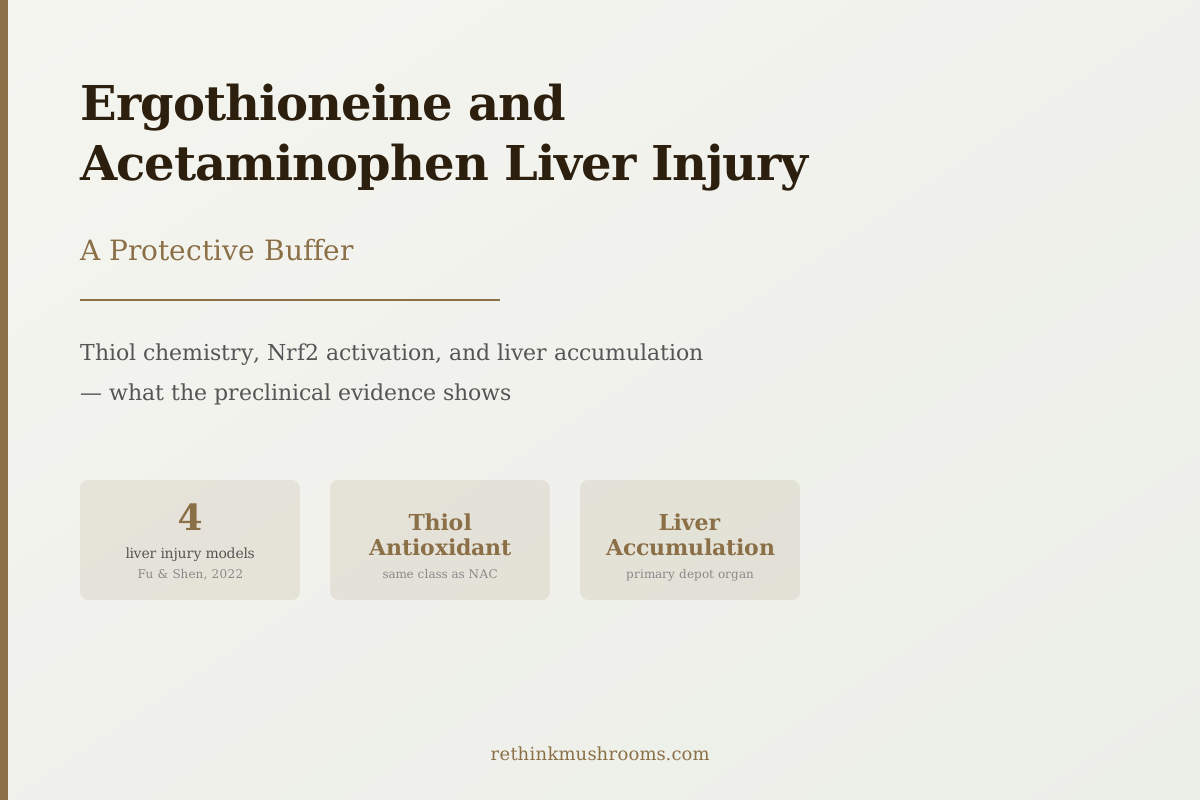
3 preclinical liver models
Ergothioneine has shown hepatoprotective effects across three distinct preclinical liver-injury models, but none has tested acetaminophen specifically.
Kawano 1983; Bedirli 2004
Thiol antioxidant
same chemistry class as NAC
Nrf2 activation
master antioxidant pathway
Liver accumulation
primary ergothioneine depot
Kawano 1983; Bedirli 2004
 View as image ↗
Acetaminophen is in almost every medicine cabinet in the country. It is also the leading cause of acute liver failure in the United States, responsible for more than 50,000 emergency room visits every year. The protective mechanism of existing treatments, primarily N-acetyl cysteine (NAC), involves restoring glutathione and scavenging toxic reactive oxygen species. Ergothioneine, a sulfur-containing amino acid found almost exclusively in mushrooms, works through the same fundamental chemistry. Whether it can buffer against acetaminophen-induced liver injury is an open question, but the mechanistic case is more coherent than most people realize.
This article explains the biology of acetaminophen toxicity, why ergothioneine's properties make it a mechanistically plausible protective agent, and what the actual research shows, including honest acknowledgment of what has not been studied yet. For a foundation on what ergothioneine is and why it has a dedicated human transporter, see What Is Ergothioneine?. For the broader hepatoprotective evidence base, see Ergothioneine and Liver Health: Hepatoprotective Research.
Key Takeaways
- Acetaminophen liver injury occurs when a toxic metabolite called NAPQI depletes glutathione and then binds to liver proteins, triggering cell death and inflammation
- Ergothioneine is a thiol antioxidant, carrying the same type of sulfur-hydrogen bond as glutathione that allows it to neutralize reactive oxygen species through identical chemistry
- Kawano and colleagues showed in 1983 that ergothioneine directly modulated the hepatic drug-metabolizing enzyme system and protected rat livers against experimentally induced hepatic injury
- Bedirli et al. (2004) found that ergothioneine pretreatment significantly reduced acute liver injury by upregulating heat shock protein 70, a cellular defense against protein damage
- Ergothioneine activates the Nrf2 pathway, which upregulates the cell's own glutathione synthesis, placing it functionally parallel to NAC in the same defense cascade
- The liver is a primary ergothioneine accumulation site, which puts this compound exactly where acetaminophen toxicity occurs; no human trial has yet tested it specifically against acetaminophen
Coherent mechanism, real gap
What the Acetaminophen Evidence Actually Shows
The mechanistic rationale is strong and the adjacent preclinical signal is consistent — but no study has tested ergothioneine against acetaminophen in any model. The three streams should be read in that order.
Shared mechanism vs. NAC
Strong rationaleSame thiol chemistry as the antidote
Chemistry
Thiol/thione antioxidant; scavenges ROS like NAC
Gene program
Activates Nrf2/ARE → glutathione synthesis, HO-1
Location
Concentrates in liver via the OCTN1 transporter
A coherent mechanistic case is not the same as a demonstrated clinical effect.
Preclinical liver protection
Consistent, indirect3 animal models, not acetaminophen
Drug-metabolizing injury
Kawano 1983: protected rat liver, modulated P450 system
Lipid peroxidation
Kawano 1983: inhibited hepatic lipid peroxide formation
Ischemia-reperfusion
Bedirli 2004: reduced injury via HSP70 induction
Different hepatotoxins and models; the 1983 work predates modern Nrf2 / OCTN1 understanding.
Acetaminophen-specific test
Not doneZero studies, any model
Animal
No acetaminophen dose-response study exists
Human
No trial; PK data only in healthy volunteers (Cheah 2017)
Nearest
ET vs. azathioprine in human HepaRG cells (2022) — different drug
Absence of evidence here is absence of experimental attention, not a negative result.
Sources: Cheah & Halliwell, 2021 (RTHM-01334); Kawano et al., 1983 (RTHM-00009, RTHM-00010); Bedirli et al., 2004 (RTHM-00128); Cheah et al., 2017 (RTHM-00856). No acetaminophen-specific study of ergothioneine exists.
How Acetaminophen Injures the Liver (And Why Glutathione Is the Key Variable)
At normal doses, the liver metabolizes acetaminophen through two main conjugation pathways, with a small fraction routed through cytochrome P450 enzymes. That minority route produces NAPQI, a highly reactive compound. Under normal conditions, the liver's glutathione stores bind NAPQI immediately and neutralize it before any damage occurs. At higher doses, or with chronic use in a nutritionally depleted system, NAPQI production outpaces glutathione availability. Unbound NAPQI then attaches directly to liver proteins, disrupts mitochondrial function, and triggers the inflammatory cascade that kills hepatocytes.
This is why the standard antidote works the way it does. N-acetyl cysteine provides cysteine as a building block to rapidly rebuild glutathione stores. It also carries its own thiol group, which scavenges reactive oxygen species directly. Given early, within eight to ten hours of ingestion, NAC is highly effective. Given late, when the damage cascade is already advanced, the clinical picture is much worse.
The key variable throughout this process is the ratio of NAPQI production to glutathione capacity. Anything that preserves glutathione, scavenges reactive oxygen species upstream of glutathione depletion, or activates the cell's own antioxidant gene programs shifts that ratio toward survival. That is the mechanistic frame for evaluating ergothioneine's potential relevance here.
Lipid peroxidation is an important secondary mechanism. After the initial NAPQI-mediated injury, reactive oxygen species propagate damage through cell membranes via chain reactions that destroy lipids and extend the zone of injury. Blocking lipid peroxidation reduces secondary damage even after the primary toxic hit has occurred.
Ergothioneine's Chemistry: A More Stable Version of the Same Thiol Defense
Glutathione is a tripeptide with a thiol group, the sulfur-hydrogen bond that is the reactive site for neutralizing oxidants. Ergothioneine also carries a sulfur group, but its molecular structure is different in one critical way. The sulfur sits inside a histidine-derived ring structure (technically called a thione tautomer), which stabilizes it against spontaneous oxidation in water. This makes ergothioneine substantially more stable than free glutathione or NAC in biological fluids.
Cheah and Halliwell described this stability in their comprehensive 2021 review as central to ergothioneine's biological role.[1] Unlike most antioxidants that are irreversibly oxidized and eliminated after reacting with a single reactive species, ergothioneine cycles between reduced and oxidized forms, meaning the same molecule can neutralize multiple reactive species over time. This cycling without destruction gives ergothioneine unusual durability as a tissue-resident antioxidant.
The liver accumulates ergothioneine to concentrations substantially higher than those found in the blood, because it is both the primary site of ergothioneine absorption after ingestion and the organ most continuously exposed to metabolic byproducts of drug processing. This anatomical specificity is not incidental. The liver is where acetaminophen metabolism occurs, where NAPQI is produced, and where oxidative damage plays out. Having an antioxidant that selectively concentrates in this tissue rather than distributing uniformly across all body compartments is a meaningful pharmacological property.
Ergothioneine also engages the cell's own antioxidant gene programs. Cheah and Halliwell describe ergothioneine raising endogenous antioxidant defenses through the Nrf2/ARE pathway.[1] Nrf2 is the transcription factor often called the master regulator of cellular antioxidant defense. When it is activated, it triggers expression of a suite of protective genes including glutamate-cysteine ligase, which synthesizes glutathione, and heme oxygenase-1, which neutralizes reactive iron. The 2022 review by Fu and Shen in Frontiers in Pharmacology catalogued ergothioneine's protective effects in liver contexts including non-alcoholic fatty liver disease and hepatic ischemia-reperfusion injury, attributing them to mechanisms such as iron chelation, heat shock protein induction, and suppression of lipid peroxidation.[5] The result is that ergothioneine does not just neutralize individual reactive molecules; it boosts the cell's capacity to produce its own defensive compounds.
This is the functional parallel to NAC. NAC provides cysteine to rebuild glutathione directly. Ergothioneine activates the gene program that makes glutathione. They act at different points in the same pathway.
The Kawano 1983 Studies: The Oldest and Most Direct Evidence
The closest direct test of ergothioneine against drug-induced liver injury comes from Kawano and colleagues, working in Japan in 1983, in a two-part series. The first study demonstrated that ergothioneine directly modulated the hepatic drug-metabolizing enzyme system and protected rats against experimentally induced hepatic injury, establishing a principle that had not previously been tested.[2]
The significance of that finding is that ergothioneine appeared to interact with the enzymatic machinery that processes hepatotoxic compounds, not merely neutralize downstream reactive oxygen species after damage was already underway. That is a more upstream intervention point, and it is mechanistically relevant to acetaminophen because cytochrome P450 enzyme activity is what produces NAPQI in the first place.
The second Kawano study in the same series showed that ergothioneine inhibited lipid peroxide formation in mouse liver.[3] Lipid peroxidation is a major component of acetaminophen-induced secondary damage; once hepatocytes are injured by NAPQI, reactive oxygen species propagate membrane damage through chain reactions that spread the zone of injury. Stopping lipid peroxide propagation limits that secondary spread even after the primary toxic hit.
The limitations of this evidence are real. The Kawano studies are over four decades old, conducted before the detailed understanding of Nrf2 signaling, the OCTN1 transporter, or modern pharmacokinetics. The animal models used may not map directly to human acetaminophen metabolism. These caveats matter and should not be minimized.
What the studies establish is the principle that ergothioneine can interact with the hepatic drug-processing system and suppress lipid oxidation in liver tissue under toxic challenge. That foundation has not been overturned by subsequent research.
Acute Injury Protection: What the Ischemia-Reperfusion Model Shows
Hepatic ischemia-reperfusion injury provides a controlled model for testing protective compounds against acute oxidative liver damage. In this model, blood supply to the liver is briefly interrupted and then restored. The restored blood flow delivers a burst of reactive oxygen species that can trigger widespread hepatocyte death, a scenario analogous in its oxidative intensity to the acute phase of acetaminophen toxicity.
Bedirli and colleagues published a 2004 study testing ergothioneine pretreatment in this model.[4] Animals pretreated with ergothioneine showed significantly reduced liver injury, and the mechanism they identified was upregulation of heat shock protein 70 (HSP70) in the liver. HSP70 is a cellular defense protein that helps prevent misfolded proteins from aggregating and assists damaged cells in recovering from acute stress. Its induction represents a protective response distinct from direct antioxidant chemistry.
This is mechanistically relevant to acetaminophen toxicity because NAPQI causes protein adducts: it binds to proteins and deforms them, in addition to driving oxidative damage. A compound that both scavenges reactive oxygen species and induces HSP70 addresses two separate injury mechanisms rather than one.
The Lam-Sidun 2021 review synthesizing all preclinical evidence for ergothioneine's cardiometabolic and hepatic effects identified consistent reduction in hepatic oxidative stress, lipid accumulation, and inflammatory signaling across animal models, and named ergothioneine as the most promising mushroom-derived compound for metabolic liver health.[6] The mechanisms described in that synthesis (antioxidant enzyme upregulation, lipid peroxidation inhibition, suppression of pro-inflammatory cytokines) are the same mechanisms relevant to limiting acetaminophen-induced damage.
Ergothioneine vs. NAC: Two Thiol Antioxidants, Different Properties
NAC is the standard medical intervention for acetaminophen overdose in emergency settings. Given intravenously within the therapeutic window, it is highly effective and well-tolerated. No one is suggesting ergothioneine should replace it in an acute overdose context, and that comparison is not the point of this article.
The comparison is useful for understanding the mechanism. Both NAC and ergothioneine are thiol antioxidants. Both scavenge reactive oxygen species. Both support glutathione-dependent pathways in the liver. That shared chemistry is why ergothioneine is mechanistically relevant to acetaminophen toxicity in a way that a non-thiol antioxidant like vitamin C or beta-carotene is not.
Three properties distinguish ergothioneine from NAC in ways that are scientifically interesting rather than clinically actionable right now.
First, stability. NAC in plasma is rapidly oxidized and eliminated. Its half-life is measured in hours. Ergothioneine's thione structure resists oxidation in biological environments, giving it substantially longer persistence in tissue. A compound that remains active in liver tissue longer has more opportunity to intercept reactive species.
Second, tissue selectivity. NAC distributes broadly after administration. Ergothioneine selectively accumulates in the liver, kidney, bone marrow, and eye lens, at concentrations well above plasma levels. When an antioxidant's protective effect depends on local tissue concentration, this selectivity is meaningful. The liver accumulates ergothioneine through the OCTN1 transporter specifically because the liver operates under high oxidative load chronically.
Third, mechanism of entry. NAC is administered therapeutically because the body does not make it and does not selectively accumulate it. Ergothioneine enters the body through diet, primarily from mushrooms. The question its preclinical data raises is whether maintaining adequate dietary ergothioneine levels shifts baseline liver resilience, making the organ less vulnerable to acute toxic insults. That is a different question than "can ergothioneine treat an overdose?"
For the dietary source question, Why Only Fungi Make Ergothioneine explains the biosynthetic reason mushrooms are essentially the sole dietary source and which varieties have the highest concentrations.
What the Evidence Does Not Show
No study has tested ergothioneine specifically against acetaminophen-induced liver injury in any model, animal or human. The Kawano 1983 study used a different experimental hepatotoxin. Bedirli 2004 used ischemia-reperfusion. The Fu and Shen 2022 review covers fatty-liver and ischemia-reperfusion contexts rather than acetaminophen, and no review of ergothioneine's liver effects includes an acetaminophen-specific dataset.
There is emerging evidence in adjacent territory. A 2022 study in the International Journal of Health Sciences tested ergothioneine against azathioprine-induced liver toxicity in HepaRG cells, a human hepatocyte cell model, finding protective effects. Azathioprine hepatotoxicity involves a different metabolic pathway than acetaminophen, but the shared feature is drug-induced oxidative stress in human liver cells. That work has not yet been incorporated into systematic reviews of the field.
Human pharmacokinetic data exists for ergothioneine supplementation from work by Cheah and colleagues, who administered pure ergothioneine to healthy volunteers and tracked its uptake and effects on oxidative-damage biomarkers, but those subjects had normal liver function and were not under toxic challenge.[7] Healthy liver function does not provide data about ergothioneine's effects under toxic challenge.
The honest summary: the mechanism is coherent, the preclinical signal is consistent, and the gap in acetaminophen-specific evidence is real. This is a research question that has not been specifically asked about ergothioneine, not a question that has been asked and answered negatively. The absence of evidence here is an absence of experimental attention, not an absence of plausibility.
What would change this picture? A controlled preclinical study using an acetaminophen dose-response model in rodents, with and without ergothioneine pretreatment or co-administration, measuring NAPQI adducts, glutathione levels, ALT/AST, and liver histology. That study does not appear to exist yet.
The Bottom Line
Ergothioneine shares core thiol chemistry with NAC, the established acetaminophen antidote, and accumulates selectively in the liver where acetaminophen toxicity occurs. Preclinical studies from 1983 showed direct interaction with the hepatic drug-metabolizing enzyme system and inhibition of lipid peroxidation; a 2004 study showed significant reduction in acute liver injury via HSP70 induction. The 2022 Fu and Shen review catalogued ergothioneine's protective effects in fatty-liver and ischemia-reperfusion contexts, and its Nrf2-activating antioxidant chemistry is well described in the broader ergothioneine literature. No acetaminophen-specific trial exists for ergothioneine in any model. The mechanistic case is coherent and the research gap is real.
Frequently Asked Questions
Sources & References
- 1RTHM-00678·Cheah, Irwin K et al. (2021). “Ergothioneine, recent developments..” Redox biology.Study breakdown →PubMed →↩
- 2RTHM-00009·Kawano, H et al. (1983). “Studies on ergothioneine. X. Effects of ergothioneine on the hepatic drug metabolizing enzyme system and on experimental hepatic injury in rats..” Chemical & pharmaceutical bulletin.Study breakdown →PubMed →↩
- 3RTHM-00010·Kawano, H et al. (1983). “Studies on ergothioneine. XI. Inhibitory effect on lipid peroxide formation in mouse liver..” Chemical & pharmaceutical bulletin.Study breakdown →PubMed →↩
- 4RTHM-00128·Bedirli, Abdulkadir et al. (2004). “Ergothioneine pretreatment protects the liver from ischemia-reperfusion injury caused by increasing hepatic heat shock protein 70..” The Journal of surgical research.Study breakdown →PubMed →↩
- 5RTHM-01517·Fu, Tong-Tong et al. (2022). “Ergothioneine as a Natural Antioxidant Against Oxidative Stress-Related Diseases..” Frontiers in pharmacology.Study breakdown →PubMed →↩
- 6RTHM-00696·Lam-Sidun, Daniel et al. (2021). “Mushroom-Derived Medicine? Preclinical Studies Suggest Potential Benefits of Ergothioneine for Cardiometabolic Health..” International journal of molecular sciences.Study breakdown →PubMed →↩
- 7RTHM-00856·Cheah, Irwin K et al. (2017). “Administration of Pure Ergothioneine to Healthy Human Subjects: Uptake, Metabolism, and Effects on Biomarkers of Oxidative Damage and Inflammation..” Antioxidants & redox signaling.Study breakdown →PubMed →↩