Ergothioneine & Liver Health
10 healthy subjects
The first human ergothioneine supplementation study confirmed safe tissue uptake and reduced oxidative damage biomarkers, with liver function tests unchanged in healthy participants, establishing the safety baseline.
Cheah et al., Antioxid Redox Signal, 2017
OCTN1 upregulates
liver actively recruits under stress
RUNX1 transcription
stress-response import mechanism
Primary depot organ
liver concentrates ergothioneine above plasma
Cheah et al., Antioxid Redox Signal, 2017
 View as image ↗
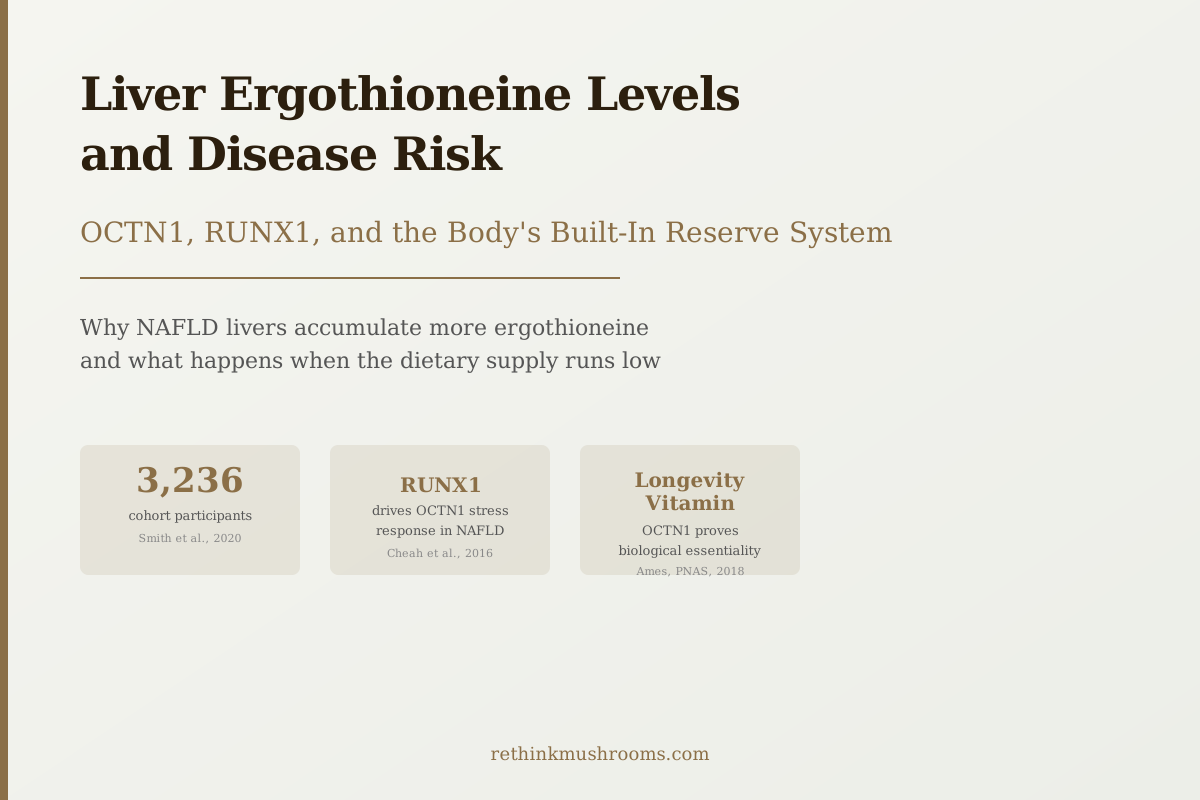
Here is a finding that initially looks like a contradiction: people with fatty liver disease have higher ergothioneine concentrations in their livers than people with healthy livers. Cheah and colleagues documented this in 2016 in a guinea pig NAFLD model, and it reframes how you should think about ergothioneine's relationship to liver disease.[1] The diseased liver was not running low on ergothioneine. It was working overtime to accumulate more of it, via a specific stress-response mechanism, because it needed more protection.
Understanding liver ergothioneine levels means understanding that the liver is not a passive recipient of this compound. It actively regulates its own ergothioneine supply using a dedicated import protein. When that supply is adequate, the liver maintains its baseline defense. When the liver comes under metabolic attack, it turns up the import. And when the dietary supply is chronically low, that defense mechanism operates from a depleted reserve.
For an introduction to ergothioneine's biology and why it has a dedicated transporter at all, see What Is Ergothioneine?. For the full hepatoprotective research base, see Ergothioneine and Liver Health: Hepatoprotective Research.
Key Takeaways
- NAFLD livers accumulate significantly more ergothioneine than healthy livers via RUNX1-mediated upregulation of the OCTN1 transporter, a stress response that correlates with disease severity (Cheah et al., 2016)
- Bruce Ames (2018) classified ergothioneine as a longevity vitamin, arguing that its evolutionarily conserved dedicated transporter proves biological essentiality, and that deficiency accelerates age-related metabolic damage
- Halliwell et al. (2023) argued ergothioneine is uniquely capable among dietary antioxidants of reaching the liver at therapeutically relevant concentrations, which distinguishes it from vitamin C, polyphenols, and other commonly used dietary antioxidants
- In 3,236 prospectively followed participants, ergothioneine was the single metabolite most strongly associated with lower all-cause mortality and reduced cardiovascular and metabolic disease risk (Smith et al., 2020)
- The first human supplementation study (Cheah et al., 2017) confirmed that oral ergothioneine reaches the liver safely, with oxidative damage biomarkers reduced and no adverse liver function changes in healthy subjects
- Blood ergothioneine levels can be measured but are not yet a standard clinical test; they reflect dietary intake rather than tissue stores, since most ergothioneine is concentrated inside cells
NAFLD Livers Have More Ergothioneine: Here Is Why That Matters
In the Cheah 2016 study, guinea pigs were fed a high-fat diet to induce NAFLD, and their liver ergothioneine concentrations were compared against healthy control animals.[1] The NAFLD livers contained significantly more ergothioneine. The researchers identified the mechanism: the transcription factor RUNX1, normally associated with blood cell development, was upregulated in the stressed liver and was driving increased expression of the OCTN1 transporter. More OCTN1 on the cell surface means more ergothioneine imported per unit time from the bloodstream.
The accumulation correlated with cholesterol levels and disease severity. The sicker the liver, the more OCTN1 it expressed, and the more ergothioneine it retained.
Two interpretations of this finding deserve attention.
The first interpretation: this is a compensatory defense response. The liver, under oxidative and metabolic stress, recognizes that it needs more ergothioneine and actively acquires it. The presence of elevated ergothioneine in NAFLD livers is not a sign that ergothioneine is causing the problem — it is the liver trying to solve the problem. This is analogous to how the liver produces more albumin under inflammatory stress; the upregulation signals the need, not the cause.
The second interpretation: if the dietary supply of ergothioneine is chronically low, which it will be in people who rarely eat mushrooms, the liver's ability to execute this compensatory response is limited. A liver trying to upregulate OCTN1 import cannot compensate if there is little ergothioneine in circulation to import. The protective mechanism fails not because of biological dysfunction but because of dietary insufficiency.
For a deeper look at how these ergothioneine levels relate to NAFLD outcomes specifically, see Ergothioneine and NAFLD: Fatty Liver Protection. The OCTN1 transporter biology is explored in detail in OCTN1: The Dedicated Transporter That Proves Ergothioneine Matters.
Why Evolution Preserved This System
Bruce Ames, the biochemist who developed the Ames test for carcinogens, published a 2018 paper in PNAS classifying ergothioneine among what he called longevity vitamins: compounds whose dedicated biological handling machinery suggests they are essential for healthspan even if not strictly required for immediate survival.[3]
His argument focused on OCTN1. Maintaining a dedicated, high-affinity transporter for a dietary compound is metabolically expensive. Evolution removes metabolic expenses that do not confer survival advantages. The fact that OCTN1 has been conserved across vertebrate evolution, and that it upregulates specifically under disease conditions, is strong circumstantial evidence that ergothioneine serves functions the body cannot perform without it.
Ames argued that deficiency in longevity vitamins does not cause immediate clinical disease (unlike scurvy from vitamin C deficiency) but instead accelerates age-related damage, particularly in metabolically active organs like the liver. On this framing, chronic low ergothioneine intake does not produce a specific ergothioneine deficiency syndrome; it contributes to the background rate of oxidative damage that drives metabolic disease, neurodegeneration, and other chronic conditions over time.
The dietary implication is direct. Ergothioneine enters the human body almost entirely through mushrooms. Populations that eat mushrooms regularly maintain higher plasma ergothioneine levels than populations that do not. The American diet is characteristically low in mushroom consumption. If Ames's longevity vitamin framework is correct, this dietary gap has metabolic consequences, with the liver being one of the primary affected organs.
Why Ergothioneine Reaches the Liver When Other Antioxidants Don't
Halliwell and colleagues made a pointed argument in their 2023 Annual Review of Food Science and Technology paper: ergothioneine is uniquely capable among dietary antioxidants of reaching target tissues at therapeutically relevant concentrations.[4]
Most dietary antioxidants fail at delivery. Polyphenols (resveratrol, quercetin) are rapidly metabolized and excreted, reaching tissues at concentrations many orders of magnitude below what produces effects in cell culture. Vitamin C is hydrophilic and does not penetrate cell membranes without transporters; plasma concentrations reach a ceiling with supplementation. Vitamin E distributes broadly but slowly. Few reach liver cells at concentrations that the preclinical literature suggests are necessary for biological effect.
Ergothioneine's pharmacokinetics are different in three ways. First, OCTN1 actively concentrates it into cells, producing intracellular concentrations well above plasma levels. Second, its thione structure resists oxidation in aqueous environments, meaning it is not consumed in circulation before reaching its target. Third, it accumulates preferentially in the tissues that face the highest oxidative burden, including the liver, where OCTN1 expression is highest.
The result, Halliwell argued, is that ergothioneine may be the only commonly consumed dietary antioxidant that actually reaches the liver at concentrations sufficient to do the things it demonstrably does in isolated liver cells and animal models. This is not a minor pharmacological distinction. It is the reason the preclinical evidence for ergothioneine is mechanistically coherent while the evidence for most dietary antioxidants in liver disease is equivocal.
What Human Pharmacokinetics Show
Cheah and colleagues published in 2017 the first controlled human supplementation study for ergothioneine.[5] Ten healthy volunteers received pure ergothioneine at doses comparable to moderate dietary mushroom intake. The compound was well absorbed and reached stable plasma levels within days. Oxidative damage biomarkers (measures of oxidized lipids and proteins in circulation) were reduced. Liver function tests, including ALT and AST, were unchanged in healthy subjects, which confirmed the compound's safety at supplementation doses.
The unchanged liver enzymes in healthy subjects should not be interpreted as a null result for liver health. Healthy subjects have normal liver function tests to begin with; these enzymes only elevate when hepatocytes are being damaged. The trial showed that ergothioneine does not harm the liver (confirming safety) and reduces systemic oxidative damage markers (consistent with biological activity). Testing whether ergothioneine improves liver function in people with already-elevated enzymes requires a disease population, which was not this study's design.
The 2021 review by Cheah and Halliwell summarized the pharmacokinetic picture from this and related data: the liver is confirmed as a primary ergothioneine accumulation organ in humans, and oral supplementation successfully increases tissue levels.[6]
What Low Ergothioneine Levels Mean at Population Scale
Smith and colleagues published in 2020 the largest population-level study connecting ergothioneine status to health outcomes.[2] In 3,236 participants followed prospectively, non-targeted metabolomics (measuring hundreds of compounds without preselecting them) identified ergothioneine as the single metabolite most strongly associated with lower all-cause mortality and reduced cardiovascular disease risk, independent of other dietary factors.
The independence from other dietary factors is the key statistical observation. Ergothioneine did not track mortality risk because it was correlated with a generally healthy diet. When other dietary markers were controlled for, ergothioneine's association with lower mortality remained. This suggests ergothioneine is doing something specific rather than acting as a proxy for diet quality overall.
The connection to liver health is inferential but coherent. Cardiovascular disease and NAFLD share the same metabolic risk factors; both involve dyslipidemia, insulin resistance, and chronic oxidative stress. Lower ergothioneine status may reflect low mushroom intake, higher systemic oxidative burden, or impaired tissue antioxidant capacity, all of which would converge on worse liver outcomes. The Smith data does not allow separation of these explanations, but it provides population-level signal consistent with the mechanistic direction.
Tian and colleagues argued in 2023 in the British Journal of Nutrition that blood ergothioneine levels decline with age, which they proposed as one mechanism linking mushroom consumption to longevity.[7] They also highlighted the ErgMS trial, targeting metabolic syndrome with liver function outcomes among primary endpoints, as the study that would provide the first rigorous human data on ergothioneine levels and liver disease specifically.
When the Compensatory Mechanism Fails
The Cheah 2016 OCTN1 upregulation finding has an implicit corollary: the compensatory mechanism has a ceiling. A liver experiencing metabolic stress upregulates OCTN1 to import more ergothioneine. But if plasma ergothioneine is low because dietary mushroom intake is low, more transporter expression cannot compensate. The liver is asking for more ergothioneine from a depleted supply.
The consequence would be a liver facing elevated oxidative stress without adequate antioxidant buffering. The Nrf2 pathway cannot be fully activated without sufficient ergothioneine to trigger it. Autophagy, which the Lv 2024 study showed ergothioneine promotes to clear the hepatic fat that drives steatotic liver disease, is not reinforced.[9] The TGF-beta/Smads fibrosis pathway, which the Mao 2025 study showed ergothioneine suppresses, continues unchecked.[10] The Fu and Shen 2022 review, which covers all four hepatoprotective contexts for ergothioneine, would predict that deficiency across all four contexts simultaneously impairs the liver's capacity to manage metabolic stress.[8]
None of this constitutes proof that low ergothioneine causes NAFLD or its progression. It constitutes a mechanistically coherent explanation of why dietary ergothioneine may matter to liver health and why population-level data links ergothioneine status to disease burden.
How to Increase Liver Ergothioneine Levels
The most direct way to increase liver ergothioneine levels is to eat more mushrooms. Ergothioneine is not synthesized by animals or plants; only fungi and certain bacteria produce it. Of commonly available mushrooms, oyster mushrooms and king oyster (Pleurotus eryngii) have among the highest concentrations, with shiitake and porcini also being meaningful sources. Cooking does not substantially degrade ergothioneine because its stable thione structure resists heat.
Supplemental ergothioneine is available and achieves measurable plasma levels at doses used in studies, as confirmed by the Cheah 2017 pharmacokinetic trial. Whether supplemental forms produce equivalent liver tissue accumulation to dietary mushroom consumption has not been directly compared.
The Cheah 2021 review noted that blood ergothioneine can be measured using high-performance liquid chromatography techniques, though this is not a standard clinical test and is primarily available through research laboratories and select specialist providers. Plasma ergothioneine reflects recent dietary intake rather than tissue stores; because OCTN1 actively concentrates ergothioneine inside cells, the majority of the body's ergothioneine is intracellular and not visible in plasma measurements.
For why dietary sources matter and which mushroom species are richest, see Why Only Fungi Make Ergothioneine. For how this connects to the full anti-inflammatory picture in liver disease, see Ergothioneine and Drug-Induced Liver Injury and Ergothioneine and Acetaminophen Liver Injury.
The Bottom Line
The liver maintains one of the highest ergothioneine concentrations in the body under normal conditions and actively upregulates this concentration via RUNX1-mediated OCTN1 expression when under metabolic stress. The Ames longevity vitamin framework, the Halliwell bioavailability argument, and the Smith 2020 mortality data all converge on the same conclusion: ergothioneine levels matter for long-term metabolic health, and the primary dietary source is mushroom consumption. Human pharmacokinetic data confirms that oral ergothioneine reaches tissues safely; disease-population RCT data is still emerging.
Frequently Asked Questions
Sources & References
- 1RTHM-00771·Cheah, Irwin K et al. (2016). “Liver ergothioneine accumulation in a guinea pig model of non-alcoholic fatty liver disease. A possible mechanism of defence?.” Free radical research.Study breakdown →PubMed →↩
- 2RTHM-00655·Smith, Einar et al. (2020). “Ergothioneine is associated with reduced mortality and decreased risk of cardiovascular disease..” Heart (British Cardiac Society).Study breakdown →PubMed →↩
- 3RTHM-00936·Ames, Bruce N (2018). “Prolonging healthy aging: Longevity vitamins and proteins..” Proceedings of the National Academy of Sciences of the United States of America.Study breakdown →PubMed →↩
- 4RTHM-01705·Halliwell, Barry et al. (2023). “Diet-Derived Antioxidants: The Special Case of Ergothioneine..” Annual review of food science and technology.Study breakdown →PubMed →↩
- 5RTHM-00856·Cheah, Irwin K et al. (2017). “Administration of Pure Ergothioneine to Healthy Human Subjects: Uptake, Metabolism, and Effects on Biomarkers of Oxidative Damage and Inflammation..” Antioxidants & redox signaling.Study breakdown →PubMed →↩
- 6RTHM-00678·Cheah, Irwin K et al. (2021). “Ergothioneine, recent developments..” Redox biology.Study breakdown →PubMed →↩
- 7RTHM-01805·Tian, Xiaoying et al. (2023). “Ergothioneine: an underrecognised dietary micronutrient required for healthy ageing?.” The British journal of nutrition.Study breakdown →PubMed →↩
- 8RTHM-01517·Fu, Tong-Tong et al. (2022). “Ergothioneine as a Natural Antioxidant Against Oxidative Stress-Related Diseases..” Frontiers in pharmacology.Study breakdown →PubMed →↩
- 9RTHM-01942·Lv, Xiaoyu et al. (2024). “Ergothioneine ameliorates metabolic dysfunction-Associated Steatotic Liver Disease (MASLD) by enhancing autophagy, inhibiting oxidative damage and inflammation..” Lipids in health and disease.Study breakdown →PubMed →↩
- 10RTHM-02138·Mao, Yaping et al. (2025). “Ergothioneine Ameliorates Liver Fibrosis by Inhibiting Glycerophospholipids Metabolism and TGF-β/Smads Signaling Pathway: Based on Metabonomics and Network Pharmacology..” Journal of applied toxicology : JAT.Study breakdown →PubMed →↩