Ergothioneine & Liver Health
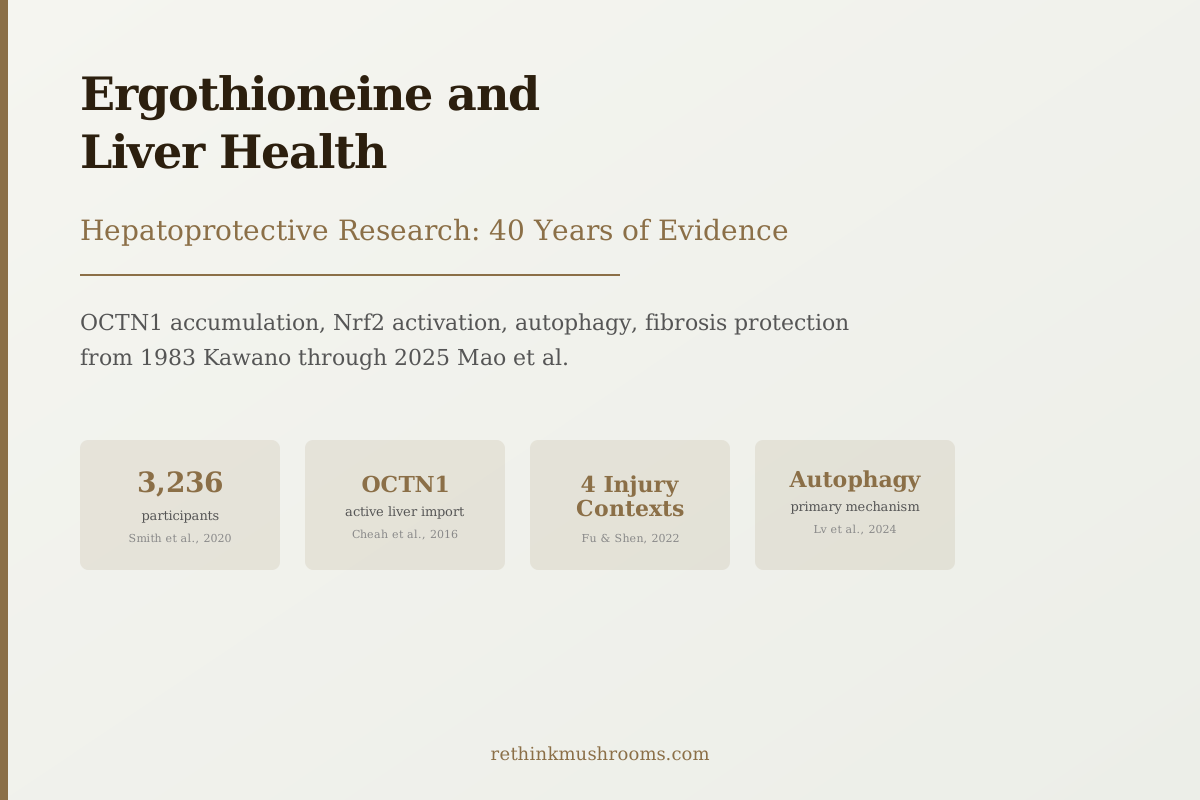
3,236 participants
In a prospective cohort study, ergothioneine was the single metabolite most strongly associated with lower all-cause mortality and reduced cardiovascular disease risk, independent of other dietary factors.
Smith et al., Heart, 2020
OCTN1 transporter
liver actively recruits ergothioneine
Nrf2 activation
unifying hepatoprotective mechanism
4 injury types
NAFLD, DILI, fibrosis, ischemia
Smith et al., Heart, 2020
 View as image ↗
Here is something counterintuitive about how the liver handles ergothioneine: when the liver is diseased, it accumulates more of it, not less. Cheah and colleagues documented this in 2016, finding that livers from guinea pigs with non-alcoholic fatty liver disease contained significantly more ergothioneine than healthy livers, and the mechanism was an active stress response. The liver had upregulated a specific transporter protein to import more ergothioneine precisely because it was under attack.[1]
That finding reframes the question of what ergothioneine does for the liver. It is not a compound that happens to pass through liver tissue. The liver treats it as a defense resource worth actively recruiting. The research base explaining why spans four decades and several distinct liver injury contexts, from lipid peroxidation studies in the 1980s through a 2025 fibrosis trial with molecular target identification.
Ergothioneine is a sulfur-containing amino acid found almost exclusively in mushrooms that accumulates preferentially in the liver. Research shows it protects against multiple forms of liver damage by neutralizing reactive oxygen species, activating the Nrf2 defense pathway, and inhibiting lipid peroxidation. For background on ergothioneine's biology and its unique dedicated transporter, see What Is Ergothioneine?.
Key Takeaways
- When the liver is stressed by NAFLD, it upregulates the OCTN1 transporter to actively import more ergothioneine, suggesting the compound serves as a built-in hepatic defense resource (Cheah et al., 2016)
- Ergothioneine has been studied against four distinct liver injury contexts: NAFLD/MASLD, drug-induced hepatotoxicity, liver fibrosis, and ischemia-reperfusion injury
- Kawano et al. (1983) showed ergothioneine both modulated hepatic drug-metabolizing enzymes and inhibited lipid peroxide formation in liver tissue, establishing the foundational mechanism
- Lv et al. (2024) identified autophagy enhancement as the primary mechanism for NAFLD protection; blocking autophagy with an inhibitor abolished ergothioneine's benefit
- Mao et al. (2025) found ergothioneine reduced five liver injury and fibrosis biomarkers in a CCl4 model by inhibiting glycerophospholipid metabolism through PLA2G2A and blocking the TGF-beta/Smads pro-fibrotic cascade
- Halliwell et al. (2023) argued ergothioneine is uniquely capable among dietary antioxidants of reaching liver tissue at therapeutically meaningful concentrations, which distinguishes it from vitamin C and other commonly used antioxidants
The OCTN1 Story: Why the Liver Treats Ergothioneine as a Defense Resource
Under normal conditions, the body distributes ergothioneine from dietary intake into various tissues via the OCTN1 transporter (officially SLC22A4). The liver captures a substantial share because it is the first organ ergothioneine encounters after absorption from the gut. OCTN1 is expressed throughout the liver, and its activity under normal conditions gives the liver one of the highest ergothioneine concentrations in the body.
The Cheah 2016 study added something unexpected to this picture.[1] In guinea pigs fed a high-fat diet to induce NAFLD, the diseased livers accumulated significantly more ergothioneine than healthy livers. The mechanism was transcriptional: the liver had upregulated OCTN1 expression through a transcription factor called RUNX1, effectively turning up the import capacity specifically in response to metabolic stress. The accumulation correlated with cholesterol levels and disease severity, suggesting the liver's demand for ergothioneine increases as the damage intensifies.
This is not a passive observation. It indicates that ergothioneine occupies a defined role in the liver's stress response architecture, not merely as a bystander antioxidant. The liver has a regulated mechanism for acquiring more ergothioneine when it needs more protection. What happens when dietary ergothioneine is chronically low, and the liver cannot fill that demand, is a question the research on ergothioneine deficiency begins to address.
The 2021 review by Cheah and Halliwell confirmed the liver as a primary accumulation organ and described the OCTN1 stress-response upregulation as one of the most compelling pieces of evidence for ergothioneine's biological essentiality in metabolically active tissues.[10] A dedicated transporter, upregulated under disease conditions, is the hallmark of a compound the body considers indispensable in that context.
For a detailed analysis of how ergothioneine levels in the liver relate to disease risk across populations, see Liver Ergothioneine Levels and Disease Risk.
The Foundation: 1983 Kawano Studies
The oldest direct evidence for ergothioneine's hepatoprotective effects comes from a two-part series by Kawano and colleagues published in Chemical and Pharmaceutical Bulletin in 1983. These two papers together established the two most fundamental hepatoprotective mechanisms.
The first showed that ergothioneine inhibited lipid peroxide formation in mouse liver tissue.[2] Lipid peroxidation is the chain reaction through which reactive oxygen species damage cell membranes. Once initiated, it propagates through membrane lipids, spreading damage beyond the initial oxidative insult. Ergothioneine's ability to terminate this chain reaction in liver tissue was the first documented hepatoprotective mechanism for the compound.
The second paper demonstrated that ergothioneine directly modulated the hepatic drug-metabolizing enzyme system and protected rats against experimentally induced hepatic injury.[3] This finding placed ergothioneine in contact with the cytochrome P450 enzymatic machinery responsible for metabolizing both drugs and dietary compounds, and showed protection against acute toxic liver challenge. That these mechanisms were documented in 1983 and have been confirmed by every subsequent review is a mark of how robust the foundational signal was.
Acute Liver Injury: The 2004 Ischemia-Reperfusion Study
Bedirli and colleagues tested ergothioneine pretreatment in a hepatic ischemia-reperfusion model in 2004, finding that pretreatment significantly reduced liver injury by upregulating heat shock protein 70 (HSP70) in the liver.[4] Ischemia-reperfusion creates a controlled burst of acute oxidative injury, clinically relevant to liver transplantation and liver surgery.
HSP70 induction is a distinct mechanism from direct antioxidant chemistry. It activates a cellular stress response program that helps liver cells survive protein damage and misfolding, which occurs both in ischemia-reperfusion and during drug toxicity. Ergothioneine appears to protect through both chemical pathways (reactive oxygen species scavenging, lipid peroxide inhibition) and biological pathways (HSP70 induction, Nrf2 activation), giving it a multi-layer protection profile.
For the full analysis of ergothioneine in drug-induced liver injury contexts, see Ergothioneine and Drug-Induced Liver Injury.
Why Ergothioneine Reaches the Liver at Therapeutic Concentrations
Most dietary antioxidants have a fundamental pharmacokinetic problem: they are rapidly oxidized in circulation and never reach target tissues at concentrations sufficient to make a meaningful biological difference. The Halliwell 2023 Annual Review paper addressed this directly, arguing that ergothioneine is uniquely capable among dietary antioxidants of reaching tissues in therapeutically relevant concentrations.[5]
The reasons are structural. Ergothioneine's thione tautomer resists oxidation in aqueous biological environments, unlike most antioxidants that are irreversibly consumed after a single reactive event. And OCTN1 actively transports ergothioneine into high-priority tissues rather than relying on passive diffusion, creating tissue concentrations well above plasma levels. Halliwell, who has spent decades characterizing ergothioneine's biological role, argues this concentration-delivery combination is what distinguishes ergothioneine from vitamin C, polyphenols, and other commonly discussed dietary antioxidants.
For the liver specifically, this matters because liver tissue processes the highest continuous flux of reactive compounds of any organ in the body. An antioxidant that can maintain protective tissue concentrations despite this flux is qualitatively different from one that is quickly consumed.
The Lam-Sidun 2021 preclinical review reached the same conclusion from a different angle: across all mushroom-derived compounds studied in cardiometabolic and hepatic models, ergothioneine showed the most consistent and reproducible hepatoprotective profile.[11]
Four Injury Contexts, One Unifying Mechanism
The most comprehensive mapping of ergothioneine's hepatoprotective mechanisms came from Fu and Shen in a 2022 review in Frontiers in Pharmacology.[6] They examined four distinct liver injury contexts: NAFLD, drug-induced hepatotoxicity, hepatic ischemia-reperfusion, and hepatic stellate cell activation (which drives fibrosis). In all four, they identified Nrf2 activation as the unifying mechanism.
Nrf2 (nuclear factor erythroid 2-related factor 2) is the transcription factor that activates the cell's antioxidant response element. When Nrf2 is activated, the cell upregulates production of glutathione, superoxide dismutase, catalase, and heme oxygenase-1, among other protective molecules. Rather than just neutralizing individual reactive species, Nrf2 activation rebuilds the cell's capacity to protect itself.
Each of the four injury contexts they reviewed has its own dedicated cluster article: NAFLD is covered in Ergothioneine and NAFLD: Fatty Liver Protection, drug-induced hepatotoxicity in Ergothioneine and Drug-Induced Liver Injury, and acetaminophen-specific injury in Ergothioneine and Acetaminophen Liver Injury.
The 2024 MASLD Autophagy Breakthrough
Lv and colleagues published in 2024 the most mechanistically detailed animal study of ergothioneine in fatty liver disease to date.[7] In mice fed a high-fat diet to induce metabolic dysfunction-associated steatotic liver disease (the renamed NAFLD condition), ergothioneine treatment reduced body weight, body fat percentage, blood lipid levels, and improved insulin resistance. Liver-specific outcomes included reduced fat deposition and normalized glycogen storage.
The key mechanistic finding was autophagy. Ergothioneine increased autophagy flux in liver tissue. Autophagy is the process by which cells break down and recycle damaged components, including lipid droplets (the hallmark of fatty liver). When Lv's group blocked autophagy using the inhibitor 3-methyladenine, ergothioneine's benefits on hepatic fat, inflammation, and oxidative damage were abolished. This confirmed autophagy as the primary mechanistic driver of ergothioneine's NAFLD protection, not a secondary effect.
The autophagy finding matters because MASLD/NAFLD has no approved pharmaceutical treatment. Understanding that ergothioneine's benefit operates through a defined, testable, and regulatable cellular pathway provides the scientific foundation for designing a credible human intervention study.
The 2025 Fibrosis Study: Identifying the Molecular Target
Mao and colleagues published the most recent study in the cluster in 2025, testing ergothioneine in a CCl4-induced liver fibrosis model.[8] Carbon tetrachloride is a classic chemical hepatotoxin that reliably produces both acute oxidative liver injury and fibrosis with repeated dosing. Mice received ergothioneine at 5 or 10 mg per kilogram per day for six weeks.
The results covered both function and structure. Liver enzyme markers of cell death (ALT, AST) were reduced. Bilirubin was reduced. Fibrosis markers including alpha-smooth muscle actin, collagen I and III, laminin, and hydroxyproline were all reduced. The mechanistic analysis used metabolomics and network pharmacology to identify PLA2G2A (a phospholipase enzyme) as the molecular target. Ergothioneine inhibits glycerophospholipid metabolism through this enzyme, which blocks downstream activation of the TGF-beta/Smads signaling pathway, the primary driver of hepatic fibrosis.
The identification of PLA2G2A as a molecular target is clinically significant: it provides a specific, testable mechanism for how ergothioneine could prevent the progression from hepatitis to fibrosis to cirrhosis, which is the main long-term risk of untreated NAFLD.
Ergothioneine Levels and Long-Term Health Outcomes
Smith and colleagues published in 2020 the largest population-level study connecting ergothioneine status to health outcomes.[9] In 3,236 participants followed prospectively, ergothioneine was the single metabolite most strongly associated with lower all-cause mortality and reduced cardiovascular disease risk, independent of other dietary factors. This was a non-targeted metabolomics study, meaning researchers measured hundreds of compounds and ergothioneine emerged at the top without being selected in advance.
The connection to liver health is indirect but important. Cardiovascular disease and liver disease share metabolic risk factors. Low ergothioneine status, in the context of Smith's data, likely reflects low mushroom intake, poor metabolic health, or high oxidative burden. Whether the liver's ergothioneine content specifically mediates some of this mortality risk is not directly answerable from this study. What it does is provide population-level signal consistent with the mechanistic picture: higher ergothioneine status, lower disease burden.
The Tian 2023 review in the British Journal of Nutrition synthesized this population evidence and argued ergothioneine should be reclassified as an essential dietary micronutrient, citing declining blood levels with age and association with cardiometabolic disease including NAFLD.[12] They also noted the ErgMS trial as the first human intervention study targeting metabolic syndrome with liver function among the primary endpoints, though full results have not yet been published.
What Human Evidence Exists
The most specific human supplementation data comes from a clinical study reported by GeneIII, a company developing an ergothioneine product, involving 30 subjects with abnormal liver function given 30 mg of ergothioneine per day for 30 days. Their reported results included significant reductions in AST, ALT, and GGT (gamma-glutamyltransferase, another liver enzyme). This is a preprint/company-reported finding and has not yet entered the peer-reviewed literature, so it should be considered preliminary. It is the closest available human signal for ergothioneine's direct effects on liver enzymes in people who actually have abnormal liver function, rather than healthy subjects.
The preclinical evidence across the studies reviewed here is consistent and mechanistically specific. The gap is controlled human trial data in disease populations. The GeneIII finding, if replicated in a peer-reviewed trial, would substantially strengthen the clinical case. The ErgMS trial, when published, will provide the most rigorous evidence to date.
Dietary ergothioneine comes almost entirely from mushrooms. Why Only Fungi Make Ergothioneine explains why no plant foods contain meaningful amounts and which species have the highest concentrations. The connection between ergothioneine's anti-inflammatory mechanisms and liver health is explored in Ergothioneine and Inflammation: Anti-Inflammatory Research.
The Bottom Line
Ergothioneine is the only dietary compound known to be actively upregulated in the liver under disease conditions, via RUNX1-mediated OCTN1 transporter expression. Four decades of preclinical research have shown protection against lipid peroxidation (Kawano 1983), acute oxidative injury (Bedirli 2004), NAFLD/MASLD via autophagy (Lv 2024), and fibrosis via PLA2G2A-TGF-beta inhibition (Mao 2025). The unifying mechanism across all contexts is Nrf2 activation. Human evidence is emerging but not yet fully peer-reviewed; the mechanistic case for ergothioneine's hepatoprotective role is the most coherent in the dietary mushroom compound literature.
Frequently Asked Questions
Sources & References
- 1RTHM-00771·Cheah, Irwin K et al. (2016). “Liver ergothioneine accumulation in a guinea pig model of non-alcoholic fatty liver disease. A possible mechanism of defence?.” Free radical research.Study breakdown →PubMed →↩
- 2RTHM-00010·Kawano, H et al. (1983). “Studies on ergothioneine. XI. Inhibitory effect on lipid peroxide formation in mouse liver..” Chemical & pharmaceutical bulletin.Study breakdown →PubMed →↩
- 3RTHM-00009·Kawano, H et al. (1983). “Studies on ergothioneine. X. Effects of ergothioneine on the hepatic drug metabolizing enzyme system and on experimental hepatic injury in rats..” Chemical & pharmaceutical bulletin.Study breakdown →PubMed →↩
- 4RTHM-00128·Bedirli, Abdulkadir et al. (2004). “Ergothioneine pretreatment protects the liver from ischemia-reperfusion injury caused by increasing hepatic heat shock protein 70..” The Journal of surgical research.Study breakdown →PubMed →↩
- 5RTHM-01705·Halliwell, Barry et al. (2023). “Diet-Derived Antioxidants: The Special Case of Ergothioneine..” Annual review of food science and technology.Study breakdown →PubMed →↩
- 6RTHM-01517·Fu, Tong-Tong et al. (2022). “Ergothioneine as a Natural Antioxidant Against Oxidative Stress-Related Diseases..” Frontiers in pharmacology.Study breakdown →PubMed →↩
- 7RTHM-01942·Lv, Xiaoyu et al. (2024). “Ergothioneine ameliorates metabolic dysfunction-Associated Steatotic Liver Disease (MASLD) by enhancing autophagy, inhibiting oxidative damage and inflammation..” Lipids in health and disease.Study breakdown →PubMed →↩
- 8RTHM-02138·Mao, Yaping et al. (2025). “Ergothioneine Ameliorates Liver Fibrosis by Inhibiting Glycerophospholipids Metabolism and TGF-β/Smads Signaling Pathway: Based on Metabonomics and Network Pharmacology..” Journal of applied toxicology : JAT.Study breakdown →PubMed →↩
- 9RTHM-00655·Smith, Einar et al. (2020). “Ergothioneine is associated with reduced mortality and decreased risk of cardiovascular disease..” Heart (British Cardiac Society).Study breakdown →PubMed →↩
- 10RTHM-00678·Cheah, Irwin K et al. (2021). “Ergothioneine, recent developments..” Redox biology.Study breakdown →PubMed →↩
- 11RTHM-00696·Lam-Sidun, Daniel et al. (2021). “Mushroom-Derived Medicine? Preclinical Studies Suggest Potential Benefits of Ergothioneine for Cardiometabolic Health..” International journal of molecular sciences.Study breakdown →PubMed →↩
- 12RTHM-01805·Tian, Xiaoying et al. (2023). “Ergothioneine: an underrecognised dietary micronutrient required for healthy ageing?.” The British journal of nutrition.Study breakdown →PubMed →↩