Antrodia Liver Health
4 biomarkers improved
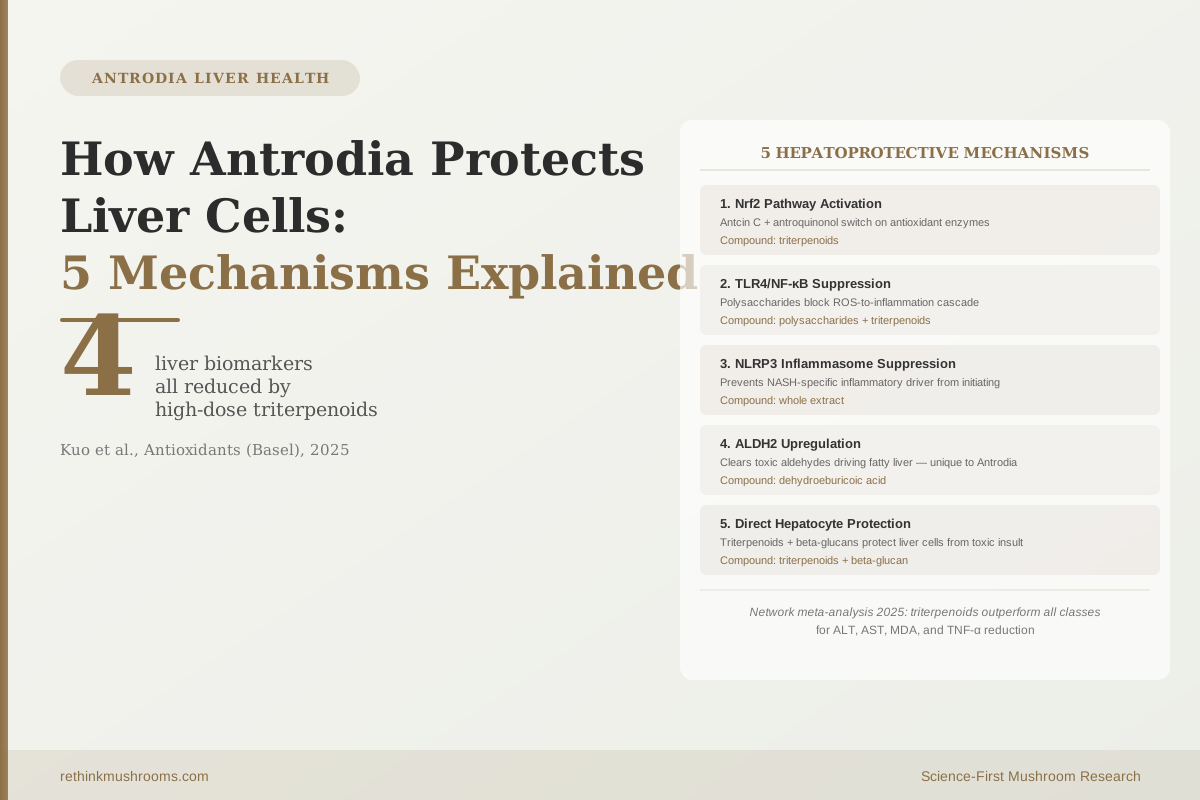
A 2025 network meta-analysis found high-dose Antrodia triterpenoids most effective for reducing all four key liver biomarkers (ALT, AST, MDA, and TNF-α), outperforming polysaccharides and ubiquinone derivatives.
Kuo et al., Antioxidants (Basel), 2025
5 pathways
Nrf2, TLR4/NF-κB, NLRP3, ALDH2, and direct hepatocyte protection
Nrf2 + TLR4
two independent antioxidant-inflammatory circuits activated simultaneously
ALDH2
unique aldehyde-clearing mechanism not documented in other medicinal mushrooms
Kuo et al., Antioxidants (Basel), 2025
 View as image ↗
Antrodia camphorata contains over 200 identified bioactive compounds. That number alone explains little. The more useful question is: which compounds protect liver cells, and through which molecular mechanisms?
A 2025 network meta-analysis by Kuo and colleagues compared the efficacy of three Antrodia compound classes (triterpenoids, polysaccharides, and ubiquinone derivatives) across animal studies measuring key liver biomarkers. High-dose triterpenoids outperformed the other classes on all four biomarkers: ALT, AST (the two liver enzymes used clinically to assess liver damage), malondialdehyde (a marker of oxidative stress), and TNF-α (a key inflammatory signal).[1] Polysaccharides showed effective antioxidant activity across doses but ranked lower for liver enzyme reduction.
This compound hierarchy matters practically. A supplement standardized only for polysaccharides, or one that uses myceliated grain where polysaccharides dominate, provides a different hepatoprotective profile than a dual-extracted or triterpenoid-standardized product.
Understanding how Antrodia protects liver cells requires looking at five distinct mechanisms that operate in parallel across different cell compartments and signaling cascades.
For the broader overview of Antrodia's liver effects across conditions, see the cluster overview at Antrodia for liver health: Taiwan's most-studied hepatoprotective mushroom. For the complete profile of Antrodia's bioactive compounds, see Antrodia bioactive compounds: antcins, triterpenoids, and polysaccharides.
Key Takeaways
- A 2025 network meta-analysis found high-dose triterpenoids most effective for reducing ALT, AST, MDA, and TNF-α across Antrodia studies; polysaccharides effective for oxidative stress across doses (Kuo et al., Antioxidants, 2025)
- Antcin C activates the Nrf2 pathway (the cell's master antioxidant switch) to protect liver cells from free radical damage in both cell culture and animal models (Gokila Vani et al., EBCAM, 2013)
- Antrodia polysaccharides block the ROS-driven TLR4-NF-κB inflammatory cascade in liver injury, a mechanism distinct from the triterpenoid Nrf2 pathway, meaning the two compound classes protect through different but complementary circuits (Yang et al., JCMM, 2022)
- Antrodia and its compound dehydroeburicoic acid upregulate ALDH2 activity (an aldehyde-clearing enzyme) as a distinct NAFLD protection mechanism not documented in other medicinal mushrooms (Cao et al., JEthnopharmacol, 2022)
- Antrodia suppresses NLRP3 inflammasome activation in vitro and in vivo; NLRP3 is the key inflammatory driver of NASH progression and is distinct from the NF-κB cascade (Yen et al., AJCM, 2020)
- Triterpenoids from Antrodia significantly reduced CCl4-induced liver injury, with isolated triterpenoids identified as the primary hepatoprotective compound class over whole extract (Li et al., JEthnopharmacol, 2017)
The Five Mechanisms: An Overview
Antrodia protects liver cells through at least five distinct signaling pathways:
- Nrf2 pathway activation: triterpenoids (antcin C, antroquinonol) switch on the cell's own antioxidant enzyme production
- TLR4/NF-κB suppression: polysaccharides block the ROS-to-inflammation cascade that amplifies liver injury
- NLRP3 inflammasome suppression: reduces the specific inflammatory driver behind NASH progression
- ALDH2 upregulation: dehydroeburicoic acid enhances aldehyde-clearing enzyme activity, removing a key NAFLD trigger
- Direct hepatocyte protection: triterpenoids and beta-glucans protect liver cells from toxic insult through complementary membrane and intracellular mechanisms
These pathways are not redundant. They target different threats at different points in the chain of liver damage. The Nrf2 mechanism handles the initial oxidative stress. The TLR4 and NLRP3 mechanisms handle the secondary inflammatory amplification. The ALDH2 mechanism handles aldehyde accumulation that drives fat deposition. The direct hepatocyte mechanisms protect cell viability once damage has begun.
Nrf2 Activation: How Antrodia Switches On the Cell's Own Antioxidant System
The liver is the body's primary detoxification organ and is continuously exposed to oxidative stressors from metabolism, alcohol, drugs, and environmental toxins. Cells have an internal defense: the Nrf2 pathway, a transcription factor that, when activated, switches on a battery of antioxidant enzymes including superoxide dismutase, catalase, heme oxygenase-1, and glutathione-S-transferase.
Two Antrodia compounds have been documented to activate this pathway specifically in liver cells.
Gokila Vani and colleagues demonstrated in 2013 that antcin C protected liver cells from free radical damage through a Nrf2-dependent mechanism, confirmed in both in vitro human hepatocyte cultures and in vivo rodent models.[2] The Nrf2 dependence was established by blocking the pathway pharmacologically: when Nrf2 was inhibited, antcin C's protective effect was substantially reduced. This placed Nrf2 activation as a primary, not coincidental, mechanism.
Antroquinonol, a structurally distinct Antrodia compound in the ubiquinone class, also activates Nrf2 signaling. A 2011 study by Tsai and colleagues found that antroquinonol reduced oxidative stress and inflammation through Nrf2 upregulation, with downstream suppression of inflammatory markers.[3]
The Nrf2 mechanism is significant because it is amplifying: a single activation event switches on multiple antioxidant genes simultaneously, producing a sustained defense response rather than a single chemical neutralization. Two independent Antrodia compounds activating this same pathway through different structural chemistry suggests it is a primary hepatoprotective mechanism for the species.
For more on antioxidant mechanisms across Antrodia compounds, see the companion article on Antrodia and antioxidant activity: free radical protection.
TLR4/NF-κB Suppression: How Two Compound Classes Cut the Inflammatory Amplifier
Liver injury from any cause (alcohol, fat accumulation, toxins) triggers a secondary inflammatory amplification that can be more damaging than the initial insult. This amplification runs through the TLR4 receptor, which detects damage-associated signals and activates NF-κB, a master transcription factor that drives production of inflammatory cytokines including TNF-α, IL-6, and IL-1β.
Antrodia polysaccharides act specifically on this cascade. A 2022 study by Yang and colleagues demonstrated that Antrodia camphorata polysaccharide blocked the ROS-driven TLR4-NF-κB inflammatory pathway in liver injury models. The polysaccharide reduced reactive oxygen species (ROS), which in turn reduced TLR4 signaling, which reduced NF-κB activation, which reduced cytokine production.[4]
A 2020 study by Liu and colleagues showed Antrodia triterpenoids suppressing acute alcohol-induced liver inflammation through a different but parallel anti-inflammatory circuit: the Akt/p70S6K and Wnt/β-catenin signaling pathways, inhibiting pro-inflammatory cytokine production downstream of ethanol exposure.[5]
The key insight here: triterpenoids and polysaccharides suppress inflammation through different upstream entry points. This is not redundancy: it is complementary coverage of the inflammatory cascade. If one pathway is saturated or bypassed, the other continues operating.
Li and colleagues confirmed in 2017 that Antrodia triterpenoids significantly reduced CCl4-induced liver injury in mice. CCl4 (carbon tetrachloride) is a hepatotoxin that produces severe oxidative and inflammatory liver damage, making it a stringent test of hepatoprotective potency. Both whole extract and isolated triterpenoids performed significantly better than controls, with isolated triterpenoids identified as the primary active class.[10]
For more on the anti-inflammatory mechanisms of Antrodia triterpenoids across organ systems, see the companion article on Antrodia and inflammation: anti-inflammatory triterpenoid research.
NLRP3 and ALDH2: Two Pathways Specific to Fatty Liver Protection
Non-alcoholic steatohepatitis (NASH) and non-alcoholic fatty liver disease (NAFLD) involve a distinct set of inflammatory and metabolic processes beyond simple oxidative damage. Antrodia addresses both through mechanisms not found in most other medicinal mushrooms.
The NLRP3 inflammasome is a multi-protein complex inside immune cells that, when activated, triggers a highly inflammatory form of cell death called pyroptosis. NLRP3 activation is a recognized driver of NASH progression from simple fat accumulation to active liver inflammation and scarring. A 2020 study by Yen and colleagues demonstrated that Antrodia cinnamomea suppressed NLRP3 inflammasome activation in both hepatocyte cultures and animal models of NASH.[6] The NLRP3 mechanism is distinct from NF-κB suppression; it operates upstream, preventing the inflammatory cascade from initiating rather than suppressing it once running.
ALDH2 (aldehyde dehydrogenase 2) is an enzyme responsible for clearing toxic aldehydes that accumulate during fat metabolism and alcohol breakdown. When ALDH2 activity is insufficient, aldehydes build up in liver cells, triggering mitochondrial dysfunction and inflammatory signaling that drives NAFLD progression. A 2022 study by Cao and colleagues found that Antrodia cinnamomea and its compound dehydroeburicoic acid attenuated NAFLD specifically by upregulating ALDH2 activity.[7]
The ALDH2 mechanism is particularly notable because it represents a genuinely distinct mode of liver protection, not simply antioxidant or anti-inflammatory, but metabolic enzyme augmentation. This mechanism has not been documented in other commonly studied medicinal mushrooms including reishi, turkey tail, or lion's mane.
For the clinical evidence on Antrodia specifically in NAFLD and NASH patients, see the companion article on Antrodia camphorata and NAFLD: fatty liver protection.
Direct Hepatocyte Protection: Triterpenoids and Beta-Glucans at the Cell Level
Beyond pathway-level signaling, Antrodia compounds also protect liver cells through more direct mechanisms at the cellular level.
Eburicoic acid and dehydroeburicoic acid, two specific Antrodia triterpenoids, were tested in a 2013 study by Huang and colleagues in an acute liver injury model. Both compounds produced significant hepatoprotective effects, with reductions in liver enzyme markers and histological improvement in liver tissue damage.[8] The acute injury model is useful for isolating direct cellular protection from the upstream pathway effects, since the timeline is too short for full Nrf2-mediated enzyme induction.
Antrodia's beta-glucan fraction also has a direct role. A 2017 study by Chen and colleagues tested Antrodia beta-glucan directly in human hepatocyte cell lines exposed to lipopolysaccharide (LPS), a bacterial toxin that triggers liver inflammation. The beta-glucan reduced LPS-induced inflammation and ROS production in the human liver cells.[9] This was done in human hepatocytes, one of the more clinically relevant in vitro test systems, as it avoids the species-translation uncertainty of rodent models.
The beta-glucan mechanism differs structurally from the triterpenoid mechanisms. Beta-glucan binds to pattern recognition receptors on immune cells and modulates their response to inflammatory signals, while triterpenoids act intracellularly on transcription factors. The two compound classes address the same threat through different cellular entry points.
How the Five Mechanisms Work Together
The hepatoprotective architecture of Antrodia can be understood as three temporal layers of defense.
The first layer, operating continuously, is the Nrf2-mediated antioxidant defense. Antcin C and antroquinonol keep basal antioxidant enzyme levels elevated. This provides a standing buffer against the oxidative stress that liver cells encounter during normal metabolic function.
The second layer, activated by injury signals, is the anti-inflammatory cascade suppression. TLR4/NF-κB blockade by polysaccharides and Akt/p70S6K inhibition by triterpenoids both limit the inflammatory amplification that converts local liver damage into systemic inflammatory disease. NLRP3 suppression specifically addresses the NASH-specific inflammatory driver.
The third layer, specific to fatty liver conditions, is the metabolic correction. ALDH2 upregulation by dehydroeburicoic acid clears aldehyde accumulation, removing a primary trigger of fat-associated liver injury before it propagates.
These mechanisms are not activated by a single Antrodia compound. They emerge from the interaction of multiple compound classes present in a properly extracted whole-mushroom preparation. This is why the 2025 network meta-analysis finding matters: triterpenoids led for enzyme markers, but polysaccharides remained effective for oxidative stress; neither fraction alone replicates the full mechanistic profile of a well-made dual extract.
The Bottom Line
Antrodia protects liver cells through at least five distinct mechanisms: Nrf2-mediated antioxidant enzyme activation (antcin C, antroquinonol), TLR4/NF-κB inflammatory cascade suppression (polysaccharides and triterpenoids through separate upstream entry points), NLRP3 inflammasome suppression specific to NASH, ALDH2 upregulation for aldehyde clearance, and direct hepatocyte protection from triterpenoids and beta-glucan. A 2025 network meta-analysis ranked high-dose triterpenoids most effective for ALT, AST, MDA, and TNF-α reduction, while polysaccharides provided effective antioxidant coverage. These mechanisms are complementary rather than redundant, with each addressing a different phase or type of liver injury.
Frequently Asked Questions
Sources & References
- 1. Source details for this reference are not yet available.
- 2. Source details for this reference are not yet available.
- 3. Source details for this reference are not yet available.
- 4. Source details for this reference are not yet available.
- 5. Source details for this reference are not yet available.
- 6. Source details for this reference are not yet available.
- 7. Source details for this reference are not yet available.
- 8. Source details for this reference are not yet available.
- 9. Source details for this reference are not yet available.
- 10. Source details for this reference are not yet available.