Antrodia (Antrodia camphorata / cinnamomea)
3 Human Trials Completed
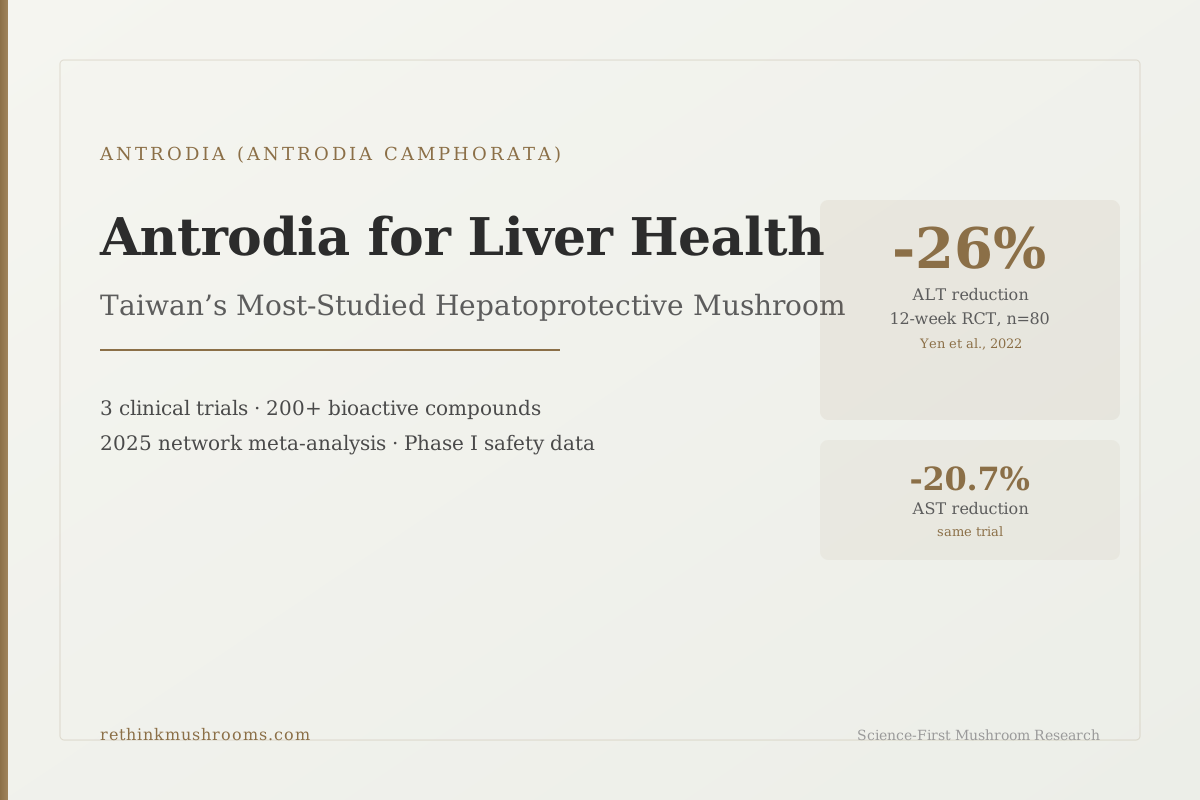
Antrodia cinnamomea has been tested in three small human trials — a 28-participant NASH RCT, a 44-participant subhealth-adults RCT, and a Phase I safety study — alongside a 2025 network meta-analysis of mouse and rat data ranking high-dose triterpenoids first for liver-injury markers.
Kuo et al., Antioxidants, 2025
78+ bioactive compounds
identified in A. cinnamomea (Ganesan minireview, 2019)
Triterpenoids ranked first
in animal models for ALT, AST, malondialdehyde, and TNF-α (Kuo network meta-analysis, 2025)
Phase I safety
first-in-human dose escalation up to 2,988 mg/day of LEAC-102 (Liao, 2023)
Kuo et al., Antioxidants, 2025
 View as image ↗
A 2025 network meta-analysis pooled the available preclinical Antrodia liver studies and found something specific: among the three major compound classes in this mushroom, high-dose triterpenoids reduced liver injury markers more consistently than both polysaccharides and ubiquinone derivatives.[1] Triterpenoids ranked first across four endpoints: ALT and AST (the liver enzymes that rise when liver cells are damaged), malondialdehyde (a marker of oxidative damage in liver tissue), and TNF-α (a cytokine that drives chronic liver inflammation). That distinction matters because it moves the conversation from "Antrodia helps the liver" to "here is which fraction of Antrodia carries the strongest preclinical signal." The meta-analysis is built entirely on mouse and rat data, however — the human evidence is much smaller.
Antrodia cinnamomea (also called Antrodia camphorata) is a medicinal fungus endemic to Taiwan. It grows on the inner heartwood of the Taiwan sassafras tree (Cinnamomum kanehirae) and has a long history of traditional use for liver conditions. The scientific literature on its liver effects is substantial: a 2019 minireview by Ganesan and colleagues catalogued more than 78 identified compounds in A. cinnamomea,[5] and a 2012 review by Liu and colleagues had already characterized hepatoprotective activity across antioxidant, anti-inflammatory, and anti-fibrotic mechanisms in animal and cell models.[6]
For an introduction to what Antrodia cinnamomea is and where it comes from, see What Is Antrodia camphorata? Taiwan's National Treasure Mushroom. This article covers what the liver research actually shows, which compound classes carry the evidence, and where the human trials are still small.
Key Takeaways
- A 2025 network meta-analysis of mouse and rat studies found that high-dose triterpenoids outperformed polysaccharides and ubiquinone derivatives for ALT, AST, malondialdehyde, and TNF-α reduction. The authors explicitly note the human translation gap (Kuo et al., Antioxidants, 2025)
- A small randomized, double-blind, placebo-controlled trial (n = 28) in patients with nonalcoholic steatohepatitis (NASH) found that 420 mg/day of Antrodia cinnamomea mycelium extract for 6 months reduced SteatoTest values from 0.66 to 0.49 and ActiTest values from 0.46 to 0.30, with no participants experiencing adverse events (Chiou et al., Journal of the American College of Nutrition, 2021)
- A randomized, double-blind, placebo-controlled trial (n = 44) of 250 mg/day Antrodia cinnamomea mycelia extract for 12 weeks in subhealth Japanese adults with mildly elevated ALT did NOT show significant ALT or AST changes in the main per-protocol analysis. A subgroup of regular drinkers (more than twice per week) showed improved ALT compared with placebo (Ho et al., Journal of Dietary Supplements, 2023)
- A first-in-human Phase I study (n = 18) of LEAC-102, a regulatory-grade Antrodia cinnamomea botanical drug extract, used dose escalation from 597.6 to 2,988 mg/day with no serious adverse events; the maximum tolerated dose was 2,988 mg/day after one urticaria event (Liao et al., Journal of the American Nutrition Association, 2023)
- A 2019 minireview catalogued more than 78 bioactive compounds in A. cinnamomea, primarily triterpenoids (antcins, eburicoic acid), beta-glucan polysaccharides, and the ubiquinone derivative antroquinonol (Ganesan et al., Journal of Food Biochemistry, 2019)
- A 2012 review summarized the preclinical evidence for Antrodia cinnamomea against liver injury across antioxidant, anti-inflammatory, and anti-fibrotic pathways (Liu et al., 2012)
Why Antrodia Has More Liver Research Than Most Functional Mushrooms
The density of Antrodia liver research is not an accident. In Taiwan, alcohol-related and hepatitis-B-related liver disease has historically been a major cause of death, and Antrodia cinnamomea was a traditional medicine for liver conditions long before the modern literature caught up.
That traditional use prompted systematic pharmacological investigation starting in the early 2000s. By 2012, a review by Liu and colleagues had already mapped hepatoprotective activity across multiple experimental models — antioxidant, anti-inflammatory, and anti-fibrotic mechanisms together.[6] By 2019, the Ganesan minireview catalogued more than 78 identified compounds, with terpenoids (antcins) as the dominant class.[5]
The compound-level explanation for that breadth is real: Antrodia produces multiple distinct hepatoprotective chemistries — triterpenoids, polysaccharides, and ubiquinone derivatives — each acting through a different mechanism. The 2025 network meta-analysis was the first attempt to compare these classes head-to-head in a quantitative synthesis.
For a detailed breakdown of the bioactive compounds, see Antrodia Bioactive Compounds: Antcins, Triterpenoids, and Polysaccharides.
The 2025 Meta-Analysis: Which Compound Class Works Best in Animal Models
Until 2025, there was no formal head-to-head comparison between Antrodia's compound classes. Studies used different extracts, doses, injury models, and outcome measures. The 2025 network meta-analysis by Kuo and colleagues, published in Antioxidants, was the first synthesis to compare them quantitatively.[1]
The analysis pooled animal studies (mice and rats) and compared three compound classes — triterpenoids, polysaccharides, and ubiquinone derivatives (primarily antroquinonol) — across the four most commonly tracked liver-health biomarkers: ALT (most sensitive to liver-cell damage), AST (broader injury marker), malondialdehyde (oxidative damage), and TNF-α (chronic inflammation).
The result was that high-dose triterpenoids ranked first across all four endpoints. Polysaccharides showed the most reliable signal for malondialdehyde (oxidative stress) across all dose ranges, suggesting they have a more dose-flexible antioxidant effect. Ubiquinone derivatives performed meaningfully but ranked third on most endpoints.
This ranking has practical implications. Triterpenoids are fat-soluble and require alcohol extraction; hot-water extraction alone leaves much of them behind. A product that uses only hot-water processing will be high in polysaccharides but low in triterpenoids. The meta-analysis suggests such a product is missing a substantial fraction of the compound profile the preclinical evidence is built around.
The authors are explicit about the translational caveat: this is mouse and rat evidence, not human evidence. It informs which fraction is most worth carrying forward into clinical work, not what dose or form is established for human use.
The Human Trials: Three Small Studies, Mixed Results
The human evidence base for Antrodia and the liver consists of three published randomized trials, all small.
Chiou 2021 — NASH, n = 28
A randomized, double-blind, placebo-controlled trial enrolled 28 patients with nonalcoholic steatohepatitis (NASH), the inflammatory form of fatty liver disease.[2] Participants received either 420 mg per day of Antrodia cinnamomea mycelium (ACM) or 420 mg of starch placebo for 6 months.
The primary readouts used the FibroMax panel of biomarker tests — composite blood-based measures of liver fat, inflammation, and fibrosis. The treatment group's SteatoTest values declined from 0.66 to 0.49 (lower fat infiltration), and ActiTest values declined from 0.46 to 0.30 (lower inflammatory activity). No participants experienced adverse events.
Two limitations matter: the sample is small (n = 28 across both arms), and the readouts are biomarker indices rather than direct biopsy or imaging endpoints. The 6-month duration is the longest of the three trials, however, and the design (randomized, double-blind, placebo-controlled) is appropriate for an early-phase efficacy signal.
Ho 2023 — Subhealth Japanese adults, n = 44
A second randomized, double-blind, placebo-controlled trial enrolled 44 Japanese adults with marginally elevated liver enzymes (ALT 31–50 U/L, AST ≤ 50 U/L) — a "subhealth" population, not active liver disease.[3] Participants took 250 mg per day of A. cinnamomea mycelia extract (ACME) or placebo for 12 weeks.
In the main per-protocol analysis, there were no significant changes in ALT or AST levels within or between groups. A subgroup analysis identified one positive: among regular drinkers (alcohol consumption more than twice per week), the ACME group showed a significant ALT improvement compared with placebo. No treatment-related adverse effects were reported.
This is a more honest read of the supplement-grade evidence than the headline-friendly framing some marketing copy uses. A primarily null trial with a single positive subgroup signal in regular drinkers is not the same as an across-the-board liver-enzyme benefit.
Liao 2023 — Phase I safety, n = 18
A first-in-human Phase I dose-escalation study enrolled 18 healthy volunteers and tested LEAC-102, a regulatory-grade botanical drug extract from A. cinnamomea.[4] The 3+3 dose-escalation protocol covered 597.6, 1,195.2, 1,792.8, 2,390.4, and 2,988 mg/day for one month plus a 7-day safety follow-up.
No serious adverse events were observed across the cohort. The maximum tolerated dose was set at 2,988 mg/day after a single participant developed urticaria. Clinical biochemistry profiles stayed in the normal range. The study also reported dose-dependent increases in natural killer cells, NKT cells, dendritic cells, and effector T-cell activation.
This is the only Antrodia trial conducted to regulatory standards. It establishes a safety floor at substantially higher doses than the supplement trials used (250 mg in Ho 2023, 420 mg in Chiou 2021), but it does not by itself establish efficacy for liver disease.
For more on the alcohol-related liver evidence, see Antrodia and Alcohol-Related Liver Damage: Research Review. For the fatty liver mechanism story, see Antrodia camphorata and NAFLD: Fatty Liver Protection.
What the Compound Profile Looks Like
The 2019 Ganesan minireview and the 2012 Liu review together provide the cleanest summary of the hepatoprotective chemistry, with more than 78 identified compounds in A. cinnamomea grouped into a few major classes.[5][6]
Triterpenoids (antcins, eburicoic acid, dehydroeburicoic acid): The most pharmacologically active class for liver protection in animal models, and the class that ranked first in the 2025 meta-analysis.[1] Antcins are steroid-like triterpenoids unique to Antrodia and have shown anti-inflammatory and antioxidant activity in cellular assays. The fraction is fat-soluble, which means hot-water extracts capture relatively little of it.
Beta-glucan polysaccharides: Water-soluble, easy to extract, and responsible for separate anti-inflammatory and antioxidant activity in cellular and animal models. The 2025 meta-analysis showed polysaccharides have the most reliable malondialdehyde (oxidative stress) signal across dose ranges, even when triterpenoids ranked higher overall.
Antroquinonol (ubiquinone derivative): A ubiquinone-like compound structurally related to coenzyme Q10. It is the marker compound the Liao 2023 LEAC-102 program is built around and is found exclusively in Antrodia among medicinal mushrooms.
For a fuller mechanistic breakdown, see How Antrodia Protects Liver Cells: Mechanisms of Hepatoprotection.
Safety: What the Phase I Data Establish
The Liao 2023 Phase I trial is the most rigorous safety document in the Antrodia literature. The dose-escalation design covered 597.6 to 2,988 mg/day, with clinical biochemistry monitoring at each cohort. The maximum tolerated dose was set at 2,988 mg/day after a single urticaria event. No serious adverse effects appeared at any dose.[4]
The two supplement-grade efficacy trials reinforce this safety read at much lower doses: Chiou 2021 reported no adverse events at 420 mg/day for 6 months,[2] and Ho 2023 reported no treatment-related adverse effects at 250 mg/day for 12 weeks.[3]
Two caveats are worth noting. First, all three human trials were conducted in Asian populations (Taiwanese and Japanese); broader demographic safety characterization is not yet established. Second, the LEAC-102 extract used in Liao 2023 is a defined botanical drug product, while supplement-grade ACM and ACME are different preparations — safety data on one preparation does not automatically transfer to the others.
For readers comparing Antrodia to other functional mushrooms with liver research, see Reishi for Liver Health: Hepatoprotective Research; the two species share some overlapping mechanisms (antioxidant polysaccharides, triterpenoid activity) but differ on compound profile and human-trial breadth.
Where the Evidence Currently Stands
Antrodia cinnamomea has the largest preclinical liver-research base of any functional mushroom. Three randomized, double-blind, placebo-controlled human trials and a 2025 network meta-analysis of animal data give it more clinical-and-quantitative scaffolding than is typical for the category.
The limitations are equally real. The human trials together total 90 participants. The longest is 6 months. The 12-week supplement trial in subhealth adults was primarily null on its main ALT/AST endpoints. The clearest positive — the Chiou 2021 NASH biomarker improvement — comes from a 28-participant study using composite biomarker indices rather than biopsy or imaging. The 2025 meta-analysis, while methodologically sound, is built on mouse and rat data and the authors explicitly flag the human-translation gap.
What the evidence supports: there is preclinical reason to expect Antrodia (and especially its triterpenoid fraction) to reduce markers of liver injury and oxidative stress. There is one positive small NASH trial, one regulatory-grade safety study, and one mostly-null subhealth trial. That is a more cautious read than headline-style "Antrodia reduces liver enzymes" framing supports.
The dose and form most directly tied to a positive human signal are 420 mg/day ACM mycelium for 6 months in NASH (Chiou 2021); whether this translates to raw powder, tea, or different mushroom preparations is not directly established by the clinical evidence.
For the anti-inflammatory mechanisms that overlap with hepatoprotection, see Antrodia and Inflammation: Anti-Inflammatory Triterpenoid Research.
The Bottom Line
Antrodia cinnamomea has more preclinical liver research than any other functional mushroom and a 2025 network meta-analysis ranking high-dose triterpenoids first across mouse-and-rat liver-injury markers. The human evidence is much smaller: a 28-participant NASH RCT showed FibroMax biomarker improvement at 420 mg/day for 6 months (Chiou 2021), a 44-participant subhealth-adults RCT was primarily null on ALT/AST at 250 mg/day for 12 weeks with a positive subgroup in regular drinkers (Ho 2023), and a Phase I dose-escalation study established safety up to 2,988 mg/day (Liao 2023). The clinical evidence supports cautious further study, not headline-style "Antrodia reduces liver enzymes" claims.
Frequently Asked Questions
Sources & References
- 1RTHM-02118·Kuo, Chien-Liang et al. (2025). “Comparative Efficacy of Antrodia cinnamomea on Liver Function Biomarkers in Mice and Rats: A Network Meta-Analysis..” Antioxidants (Basel.Study breakdown →PubMed →↩
- 2RTHM-00681·Chiou, Ya-Ling et al. (2021). “Hepatoprotective Effect of Antrodia cinnamomea Mycelium in Patients with Nonalcoholic Steatohepatitis: A Randomized, Double-Blind, Placebo-Controlled Trial..” Journal of the American College of Nutrition.Study breakdown →PubMed →↩
- 3. Source details for this reference are not yet available.
- 4RTHM-00839·Liao, Yu-Tso et al. (2023). “A Botanical Drug Extracted From Antrodia cinnamomea: A First-in-human Phase I Study in Healthy Volunteers..” Journal of the American Nutrition Association.Study breakdown →PubMed →↩
- 5RTHM-00555·Ganesan, Nagarajan et al. (2019). “Antrodia cinnamomea-An updated minireview of its bioactive components and biological activity..” Journal of food biochemistry.Study breakdown →PubMed →↩
- 6RTHM-00255·Liu, Yen-Wenn et al. (2012). “Protective effects of Antrodia cinnamomea against liver injury..” Journal of traditional and complementary medicine.Study breakdown →PubMed →↩