Mushroom Supplement Regulation
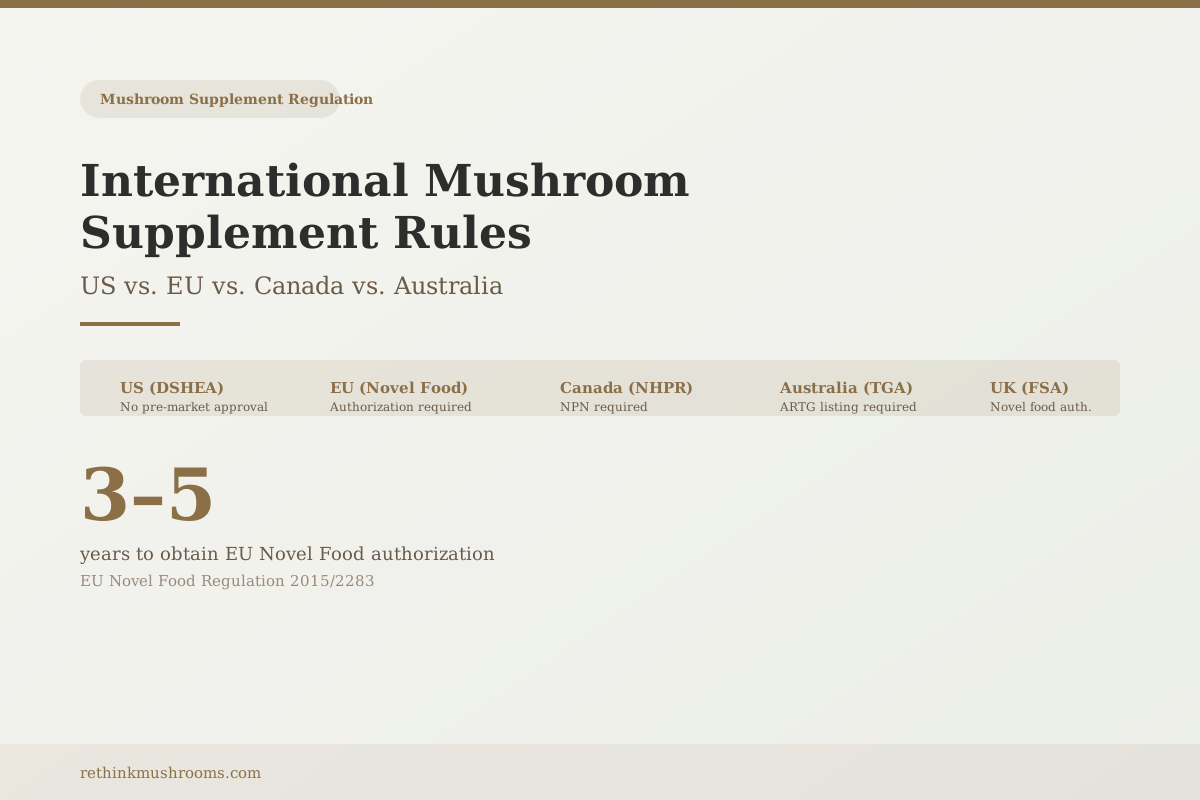
0 pre-market approvals needed in US
Under US DSHEA (1994), mushroom supplement manufacturers bear their own safety responsibility with no pre-market regulatory review — the world's most permissive major-market framework for dietary supplements.
DSHEA, US Congress, 1994
2.56 yrs
average EU novel food application-to-authorisation time, across 292 applications (2018–2024)
NPN
eight-digit Natural Product Number — required before any mushroom supplement sale in Canada
May 1997
EU threshold: foods not consumed significantly before this date require pre-market authorization
DSHEA, US Congress, 1994
 View as image ↗
The same Lion's Mane extract that requires no pre-market approval to sell in the United States may need EU novel food authorization or Canadian pre-market licensing before it can reach shelves in Europe or Canada. Mushroom supplement regulations vary dramatically across major markets. Understanding these differences explains why some products are available in certain countries but not others — and why navigating multiple jurisdictions is a meaningful quality signal for any brand willing to do it.
But the differences are more specific than "stricter" and "looser," and the popular shorthand gets them wrong in both directions. Three of these markets are routinely described as requiring pre-market approval. Each of them gates a different thing: Canada reviews the product, the EU reviews only what is legally novel, and Australia reviews the ingredient list while leaving the product itself to the manufacturer's own certification. Knowing which gate a product actually passed through is the difference between a real quality signal and a meaningless one.
This article compares five major markets: the United States, the European Union, Canada, Australia, and the United Kingdom. All information is drawn from the official regulatory frameworks of each jurisdiction; specific regulatory determinations for individual products and species should always be verified against current official sources, as these frameworks are updated regularly.
The US FDA regulatory framework for mushroom supplements is the baseline most supplement buyers are familiar with. This article places that baseline in international context.
Key Takeaways
- The US operates under DSHEA (1994), which requires no pre-market approval for mushroom supplements — the most permissive framework among major markets, governing a category that has grown from roughly 4,000 products in 1994 to more than 80,000 today (Wallace & Koturbash 2025)
- The EU's Novel Food Regulation (2015/2283) requires authorization only for ingredients not consumed in significant quantities in Europe before May 15, 1997 — so a traditional reishi fruiting-body extract may need no EU authorization at all, while the same species as a mycelium powder does
- EU novel food status attaches to the form, not the species: for lion's mane and reishi, the fruiting body and aqueous extract are treated as non-novel while dehydrated mycelium powder is novel
- Canada is the only one of these markets that reviews every product: Health Canada must issue an eight-digit Natural Product Number (NPN) before any natural health product can be sold
- Australia's ARTG gate sits on the ingredient list, not the product. Standard AUST L listings are granted on the sponsor's own certification with no individual TGA evaluation; only the rarer AUST L(A) pathway involves a TGA pre-market assessment of efficacy evidence
- Post-Brexit, Great Britain (England, Wales, Scotland) runs its own novel food process through the Food Standards Agency, while Northern Ireland continues to follow EU rules under the Windsor Framework
- A Canadian NPN or an Australian AUST L(A) marker reflects genuine product-level review. An AUST L number or EU market presence alone does not — and the difference matters when using regulatory status as a quality proxy
The Regulatory Landscape at a Glance
The five markets differ most significantly on one dimension: what, if anything, is reviewed before a product reaches consumers. The critical detail is that "pre-market approval" describes at least three different mechanisms across these jurisdictions.
Not all “pre-market approval” is the same
Where the Regulatory Gate Actually Sits in Each Market
Four of these five markets are commonly described as requiring pre-market approval for mushroom supplements. They gate very different things — a product, a novelty question, or only an ingredient list — and only one of them reviews every product that reaches a shelf.
United States
No gate
Where the gate sits
Nowhere — market entry is the default
Who reviews before sale
No one. The manufacturer self-determines safety
Does every product get reviewed?
No — zero products are reviewed pre-market
What the consumer can verify
Nothing. No registration number exists to look up
Australia
Ingredient-level gate
Where the gate sits
On the ingredient list, not the product
Who reviews before sale
TGA pre-approves permitted ingredients; the sponsor self-certifies the product
Does every product get reviewed?
No — standard AUST L listings are not individually evaluated
What the consumer can verify
AUST L number on the ARTG; AUST L(A) means efficacy was assessed
EU / United Kingdom
Novelty-triggered gate
Where the gate sits
On novelty — only if not consumed significantly before 15 May 1997
Who reviews before sale
EFSA (EU) or the FSA (GB), but only for novel forms
Does every product get reviewed?
No — non-novel fruiting bodies need no authorisation at all
What the consumer can verify
Union list / GB novel food register entry, for novel items only
Canada
Product-level gate
Where the gate sits
On every individual product, without exception
Who reviews before sale
Health Canada reviews the product licence application
Does every product get reviewed?
Yes — no NHP may be sold without an issued NPN
What the consumer can verify
Eight-digit NPN on the label, searchable in the LNHPD
The common shorthand that non-US markets are “stricter” hides the important detail: a traditional reishi fruiting-body extract can enter the EU with no authorisation whatsoever, while the same product cannot be sold in Canada without an issued NPN.
Frameworks per DSHEA 1994; Regulation (EU) 2015/2283; the Natural Health Products Regulations (Canada); the Therapeutic Goods (Permissible Ingredients) Determination and Therapeutic Goods Act 1989 (Australia); and retained EU law as administered by the Food Standards Agency (Great Britain).
| Jurisdiction | Pre-market gate | Regulatory body | Claims standard |
|---|---|---|---|
| United States | None (manufacturer responsibility) | FDA (reactive enforcement) | Structure/function with disclaimer; disease claims prohibited |
| European Union | Only for novel foods (many mycelium forms) | EC / EFSA safety assessment | Pre-approved claims list only |
| Canada | NPN required for every product | Health Canada | Claims must match approved monograph |
| Australia | Ingredient-level; product self-certified (AUST L) | TGA | Low-level indications from a closed list |
| United Kingdom | Only for novel foods (Great Britain) | Food Standards Agency | Mirrors retained EU framework |
The US framework assumes market entry is permitted unless a product is shown to be unsafe. The Canadian framework assumes market entry requires a prior product-level determination. The EU and UK frameworks sit in between, applying a rigorous authorization process to a defined subset of ingredients and none at all to the rest. Australia applies a strict filter to what may go into a product and a light one to the product itself.
The United States: No Pre-Market Approval Required
The US Dietary Supplement Health and Education Act of 1994 (DSHEA) established the regulatory category of dietary supplements and set the terms under which they can be sold. Under DSHEA, dietary supplements — including mushroom supplement capsules, powders, and extracts — do not require pre-market review or approval by the FDA. A manufacturer can bring a new mushroom product to market without any regulatory authorization, provided they comply with current Good Manufacturing Practice (cGMP) regulations and do not make drug claims.
Thirty years on, the scale of what that framework governs has changed beyond recognition. The category has grown from approximately 4,000 products at DSHEA's passage in 1994 to more than 80,000 today, representing a roughly $60 billion domestic market, and roughly three-quarters of US consumers report using dietary supplements. Scientists, public health officials, regulators, and consumer advocacy organizations have all called for reform of what has been widely described as outdated regulation.[1]
The manufacturer bears responsibility for ensuring the product is safe and that any claims made are truthful and not misleading. Structure/function claims — statements about what a supplement does for normal body functions, like "supports immune health" or "promotes mental clarity" — are permitted with a standard disclaimer: "This statement has not been evaluated by the Food and Drug Administration. This product is not intended to diagnose, treat, cure, or prevent any disease."
Disease claims — statements that a supplement treats or cures a specific medical condition — are prohibited. The legal limits on health claims for mushroom supplements covers this in detail.
FDA enforcement is reactive: the agency investigates problems after they occur, rather than reviewing products before they reach market. Its principal post-market instrument for labeling and claims violations is the warning letter, issued after a product is already in commerce.[2] The practical implication for consumers is that any mushroom supplement product, regardless of quality, can legally reach a US consumer's doorstep without any independent review.
What that permits shows up clearly in the two published analyses of US reishi products. Wu and colleagues evaluated 19 batches of Ganoderma lucidum supplements bought in the United States against their label ingredients, using chromatographic methods and saccharide mapping to measure triterpenes and polysaccharides. Only five of the 19 (26.3%) matched their labels — meaning roughly three-quarters showed a mismatch between measured and declared content.[3] A separate DNA-based analysis found a different problem in the same market.[4]
Loyd, Richter, Jusino, Truong, Smith, Blanchette & Smith (2018) · Frontiers in Microbiology
- Population
- 20 commercially manufactured reishi products (pills, tablets, teas) and 17 grow-your-own kits, all labeled as containing Ganoderma lucidum
- Intervention
- DNA extraction and sequencing of the ITS region and translation elongation factor 1-alpha, plus Illumina MiSeq sequencing of ITS1 to detect multiple species
- Finding
- 93% of the manufactured products were identified as Ganoderma lingzhi, not G. lucidum. None of the manufactured products contained G. lucidum sensu stricto; it was detected in only one grow-your-own kit. Other Ganoderma species, including G. applanatum, were also present.
narrow-scope A 20-product sample from one market at one point in time, and the finding reflects a genuine taxonomic problem as much as a commercial one: G. lingzhi is the taxon actually cultivated and studied for medicinal use, while the name G. lucidum has been applied loosely to most shiny Ganoderma species. It documents label-species mismatch, not that the products were inert or unsafe.
Loyd et al., Frontiers in Microbiology, 2018 (PMID 30061872)
Both findings are small samples from a single market, and neither should be read as a census of every US mushroom supplement. What they do show is that the failures are the kind a pre-market review would be positioned to catch, and that in the US no such review exists.
The European Union: Pre-Market Authorization for Anything Novel
The EU operates a fundamentally different philosophy — but it applies to a narrower target than most summaries suggest. Under the EU Novel Food Regulation (EU) 2015/2283, any food ingredient not consumed in the EU in "significant quantities" before May 15, 1997 is classified as a novel food and requires pre-market authorization before it can be sold. An ingredient that clears that threshold requires no novel food authorization at all.
For mushroom supplements, this creates an analysis that turns on the part of the organism and the food category, not on whether a species sounds exotic.
Novel food status follows the form, not the species
Same Mushroom, Two Different Answers in the EU
For several of the best-selling functional mushrooms, the fruiting body carries a documented history of European consumption and the mycelium does not. That single distinction decides whether a product needs pre-market authorisation.
Species
Fruiting body / aqueous extract
Mycelium powder
Lion's Mane
Hericium erinaceus
Fruiting body and aqueous extract powder
Dehydrated mycelium powder requires authorisation
Reishi
Ganoderma lucidum
Fruiting body and aqueous extract powder
Dehydrated mycelium powder requires authorisation
Chaga
Inonotus obliquus
Non-novel in food supplements only
Novel outside the food supplement category
Cordyceps
Cordyceps militaris
Novel in both forms — unlike C. sinensis
Novel in both forms — unlike C. sinensis
Turkey Tail
Trametes versicolor
Novel for any food application
Novel for any food application
Cordyceps is the clearest trap: C. sinensis is treated as non-novel in food supplements, while C. militaris — the species almost every commercial cordyceps product actually contains — is novel in both forms.
Status per the EU Novel Food status Catalogue under Regulation (EU) 2015/2283. The Catalogue is non-exhaustive and non-binding, entries are revised as Member States reach new views, and proving pre-1997 consumption remains the operator's responsibility. Verify current status before relying on any entry.
Traditional culinary mushrooms — shiitake, oyster mushrooms, and other fungi consumed regularly in European food before 1997 — are generally not considered novel foods in whole or conventional forms.
Fruiting bodies of several functional species are also treated as non-novel despite their more recent commercial popularity, because a documented European consumption history exists. Lion's mane and reishi fruiting bodies and their aqueous extract powders fall here.
Mycelium powders and biomass are where most functional mushroom products run into the regulation. Dehydrated mycelium of lion's mane and reishi is treated as novel even though the fruiting body of the same species is not. Some species are novel in every form: Trametes versicolor (turkey tail) requires authorization for any food use, and Cordyceps militaris — the species in most commercial cordyceps products — is novel as both mycelium and fruiting body, while Cordyceps sinensis is treated as non-novel in food supplements.
The European Commission maintains an EU Novel Food status Catalogue documenting Member State views on specific ingredients. It is a useful orientation tool and the first place to look, but it is explicitly non-exhaustive and non-binding: it records the views of Member State authorities rather than making authorization decisions, entries are revised over time, and a non-novel entry does not guarantee a product is permitted in every Member State, since national rules may add restrictions.
Authorized novel foods relevant to this category include vitamin D2 mushroom powder, produced by exposing Agaricus bisporus to UV light. It is worth being precise about its history, because it is often cited as a recent first. It was originally authorized in August 2020 by Commission Implementing Regulation (EU) 2020/1163, on an application from Oakshire Naturals. A second authorization followed in April 2025 under Commission Implementing Regulation (EU) 2025/691, on an application from Luxidum GmbH, which carries five years of data protection from April 30, 2025 based on the applicant's proprietary production and stability data.
The Luxidum file is also a useful measure of what the pathway costs in time. The application was submitted on December 14, 2020; EFSA adopted its scientific opinion on April 30, 2024; the Commission authorized it on April 9, 2025 — around four years and four months end to end.
That is slower than typical. An analysis of 292 novel food applications submitted to EFSA between 2018 and 2024 found an average duration from submission to publication of 2.56 years, with a standard deviation of 1.19 years, with delays driven largely by suitability checks and requests for additional data (Le Bloch et al., npj Science of Food, 2025; the authors are employed by a regulatory consultancy that manages ingredient authorizations commercially, which is worth noting when reading their framing of the delays). Widely repeated figures of three to five years and €500,000 to €2 million per application circulate in industry commentary, but they are consultancy estimates rather than published measurements, and the measured average duration is meaningfully shorter than the lower end of that time range. What is not in dispute is that the process demands substantial scientific dossiers and is out of reach for most small brands.
Two EFSA opinions show what that scrutiny looks like for fungal ingredients specifically. In assessing freeze-dried mycelia of Antrodia camphorata as a novel food, the EFSA Panel reviewed composition, genotoxicity, a 90-day repeated-dose toxicity study and a prenatal developmental toxicity study, derived a safe level of 16.5 mg per kg body weight per day, and concluded the ingredient was safe at the proposed maximum use level of 990 mg per day for people aged 14 and over.[5] A comparable assessment of synthetic l-ergothioneine, a compound strongly associated with mushrooms, extended the exposure and safety assessment specifically to infants, young children, and pregnant and breastfeeding women.[6] This is the level of evidence the novel pathway requires — and precisely what a non-novel fruiting-body product never has to produce.
For the species-by-species EU status list, see EU Novel Food Regulations and Mushroom Supplements: What's Approved and What Isn't. The framework itself is detailed in EU Novel Food Regulations and Mushroom Supplements.
Regulatory quality signals
Myth vs. evidence
The claim
“If a mushroom supplement is sold legally in the EU, it has passed a European safety review.”
The EU's novel food regime is genuinely rigorous, and coverage of it rarely mentions that it applies to only a subset of ingredients.
What research shows
MisleadingEU authorization is triggered by novelty, not by being a supplement. A reishi or lion's mane fruiting-body extract with a documented pre-1997 European consumption history can be sold in the EU without any novel food authorization, EFSA assessment, or Commission decision.
The inference does hold in the narrower case: if a product contains an ingredient that IS on the Union list of authorized novel foods, that ingredient has been through an EFSA safety assessment. The error is generalizing from 'sold in the EU' to 'reviewed in the EU'.
Regulation (EU) 2015/2283; EU Novel Food status Catalogue; Commission Implementing Regulations (EU) 2020/1163 and (EU) 2025/691
Canada: The Natural Product Number System
Canada operates the most consistently applied gate of the five. Under the Natural Health Products Regulations, administered by Health Canada, any natural health product — including mushroom supplements — must hold a Natural Product Number (NPN) before it can be sold in Canada. An NPN is an eight-digit number assigned by Health Canada after a product-level pre-market review. There is no novelty threshold and no self-certification route: every product goes through the process.
The review uses a monograph system. Health Canada has developed product monographs for many common natural health product ingredients, including several medicinal mushrooms. A monograph specifies the permitted claims, doses, conditions of use, and safety considerations for a specific ingredient. A product application that matches an existing monograph is reviewed more quickly than one requiring a novel application.
For common medicinal mushrooms — reishi (Ganoderma lucidum), shiitake (Lentinula edodes), and some Cordyceps products — Health Canada monographs exist, and NPN applications for products matching these monographs are relatively straightforward. For less-studied species or unusual extract forms, a full safety dossier may be required.
The consumer implication is unusually clean: any mushroom supplement legally sold in Canada has been through a defined pre-market review. The NPN is visible on the product label — it appears as "NPN" followed by the eight digits — and is searchable in Health Canada's Licensed Natural Health Products Database. Of the verification tools available across these five markets, it is the most reliable.
Australia: Complementary Medicines and the TGA
Australia classifies mushroom supplements as complementary medicines, regulated by the Therapeutic Goods Administration (TGA). Before a product can be sold, it must be included in the Australian Register of Therapeutic Goods (ARTG). This is frequently described as a pre-market approval, and that description is misleading in an important way.
What an AUST L number does and does not mean
Australia's Three Pathways — and the One Almost Every Mushroom Supplement Uses
An ARTG number is often read as proof the TGA examined the product. On the standard listed pathway it is not: the TGA pre-approves the ingredients a sponsor may use, then the sponsor certifies the rest and the listing is granted automatically.
Listed
AUST L — self-certified
TGA review before market
None on the product. Ingredients are pre-approved, the product is not
What the sponsor certifies
Safety, quality and efficacy — all by the sponsor
Level of indications allowed
Low-level only, chosen from the Permissible Indications Determination
Label marker
AUST L
Where mushroom supplements sit
Effectively all of them
Assessed Listed
AUST L(A) — efficacy assessed
TGA review before market
Yes — the TGA assesses the efficacy evidence pre-market
What the sponsor certifies
Safety and quality; efficacy is reviewed by the TGA
Level of indications allowed
Intermediate-level indications above what AUST L permits
Label marker
AUST L(A), and may carry a "TGA assessed" claim
Where mushroom supplements sit
Rare
Registered
AUST R — fully evaluated
TGA review before market
Yes — full evaluation of safety, quality and efficacy
What the sponsor certifies
Submits a full dossier for TGA evaluation
Level of indications allowed
Higher-level indications, including some disease claims
Label marker
AUST R
Where mushroom supplements sit
Essentially none
The meaningful Australian quality signal is not AUST L. It is the rarer AUST L(A) marker, which is the only listing tier where the TGA looked at the evidence behind the product's claims before it went on sale.
Pathways per the Therapeutic Goods Act 1989, the Therapeutic Goods (Permissible Ingredients) Determination and the Therapeutic Goods (Permissible Indications) Determination, as administered by the Therapeutic Goods Administration.
For standard listed medicines — the AUST L pathway, which covers effectively every mushroom supplement on the Australian market — the TGA does not individually evaluate the product before it goes on sale. The sponsor completes an online application and certifies that the product meets Australian requirements for safety, quality and efficacy, and the product is then included in the ARTG automatically. The TGA's pre-market control operates one level up, on the ingredients: listed medicines may contain only ingredients in the Therapeutic Goods (Permissible Ingredients) Determination, whose quality and safety for this use have been evaluated in advance. The TGA may audit any listed product at any time and requires sponsors to hold evidence supporting their claims, but that review is post-market.
A second pathway, the assessed listed medicine (AUST L(A)), does involve genuine pre-market scrutiny of the product's claims: the sponsor still self-certifies safety and quality, but the TGA assesses the efficacy evidence before listing, permits intermediate-level indications in return, and allows the product to carry a "TGA assessed" claim. It is used far less often, which is exactly what makes it informative when it appears.
Claims are also more tightly bounded than the standard framing suggests. Listed medicines may use only low-level indications selected from the Therapeutic Goods (Permissible Indications) Determination — a closed list — and each indication must be supported either by scientific evidence or by evidence of traditional use held by the sponsor. This is a different kind of constraint from the US system rather than simply a looser or tighter one: US structure/function claims are free-text and need no pre-approval, while Australian indications must be chosen from a fixed menu. The Australian route does formally accommodate traditional-use indications, which have no direct US equivalent, but it does not permit the higher-level claims available on the assessed or registered pathways.
The ARTG number appears on product labels as "AUST L" (or "AUST L(A)") followed by the number, and is searchable on the TGA website.
The United Kingdom: Post-Brexit Novel Food Authorization
Following the UK's departure from the EU, Great Britain runs its own novel food authorization system. Applications for England, Wales and Scotland are coordinated and assessed by the Food Standards Agency, working alongside Food Standards Scotland, with authorization decisions taken by the appropriate ministers. The FSA maintains the GB register of authorized novel foods. The framework broadly mirrors the EU approach, with the May 15, 1997 threshold retained.
Northern Ireland is the part most summaries get wrong. It does not sit inside the GB regime. Under the Northern Ireland Protocol and the Windsor Framework, EU novel food law continues to apply in Northern Ireland, and businesses placing novel foods on the NI market follow the European Commission's authorization process. The Windsor Framework adds one significant carve-out: since autumn 2023, pre-packed retail goods moving from Great Britain to Northern Ireland through the Northern Ireland Retail Movement Scheme may meet GB public health requirements, including for novel foods, rather than EU ones.
Novel foods authorized by the European Commission before January 1, 2021 remain valid in Great Britain, having been carried across as retained EU law. New authorizations require a separate GB application evaluated by the FSA rather than EFSA.
For practical purposes, a mushroom supplement brand selling across the EU, Great Britain and Northern Ireland post-2021 may need to navigate two separate authorization pathways for anything novel, with Northern Ireland following the EU side of that split. The administrative separation creates compliance complexity for smaller brands attempting multi-jurisdiction market entry.
What This Means for Supplement Buyers
The useful question is not whether a product comes from a "strict" market, but which specific gate it passed through.
A Canadian NPN is the strongest single indicator available. It applies to every product without exception, it reflects a Health Canada review, and it is verifiable in a public database. An Australian AUST L(A) marker is similarly meaningful, because the TGA assessed the evidence behind the product's claims. Presence on the EU Union list of authorized novel foods is meaningful for that ingredient specifically, since it reflects a completed EFSA safety assessment.
Weaker signals are more common. A plain AUST L number confirms the product uses TGA-permitted ingredients and that the sponsor certified compliance — not that the TGA examined the product. EU market presence alone may mean nothing more than that the ingredient was never novel to begin with.
Interpreting regulatory status
ModerateRegulatory clearance is a safety and quality gate, not evidence that a product works
Concern
Pre-market authorization frameworks assess whether an ingredient is safe under proposed conditions of use, and whether a product's composition and manufacturing meet standards. With the narrow exception of Australia's assessed listed pathway and Canada's monograph-matched claims, they do not certify that a mushroom supplement produces the health effects a buyer is hoping for.
What the research says
Read a registration number as evidence about identity, safety and manufacturing oversight. Evaluate efficacy separately, on the clinical evidence for the specific species, form and dose.
Particularly relevant for: Anyone using NPN, ARTG or EU novel food status as a proxy for whether a supplement is effective
What to do
Verify the number in the issuing regulator's database — Health Canada's LNHPD or the TGA's ARTG search — and confirm the product's species, form and dose match the evidence you are relying on.
Natural Health Products Regulations (Canada); Therapeutic Goods Act 1989 (Australia); Regulation (EU) 2015/2283
None of this means US products are necessarily lower quality. Some US manufacturers pursue Canadian NPN registration or Australian ARTG listing voluntarily, even for products not sold in those markets, as a way of validating their products against external standards. Conversely, the absence of any non-US regulatory clearance says nothing specific about quality on its own — it indicates only that the company has not pursued multi-jurisdiction validation.
The broadest practical implication holds, with the correction applied: the US framework's permissiveness creates the conditions for the quality failures documented in the reishi analyses above, and the Canadian and EU frameworks create stronger baseline incentives where their gates actually apply. A brand that has cleared a product-level review in another jurisdiction has invested in quality infrastructure that a US-only brand may not have. The point is to check which review it cleared.
This article describes regulatory frameworks, not medical guidance, and is not a substitute for advice from a qualified healthcare professional. Regulatory status is also not static: consult current official sources before relying on any determination described here.
GRAS Status for Mushroom Ingredients: What It Means covers the US Generally Recognized as Safe designation, which is the closest US equivalent to EU novel food authorization for food ingredients. For the downstream quality and adulteration implications of these regulatory gaps, Selling Mushroom Supplements Globally: Regulatory Challenges covers the brand-facing dimension.
The Bottom Line
Five major markets regulate mushroom supplements under fundamentally different frameworks, and the differences are structural rather than a simple strict-to-lax ranking. The US (DSHEA 1994) requires no pre-market approval. The EU (Regulation 2015/2283) requires authorization only for ingredients that are legally novel, which for functional mushrooms usually means mycelium forms rather than fruiting bodies. Canada (NHPR) reviews every product and issues an eight-digit NPN. Australia (TGA) pre-approves ingredients but grants standard AUST L listings on the sponsor's own certification, with genuine pre-market efficacy assessment reserved for the rarer AUST L(A) pathway. Great Britain runs its own post-Brexit novel food process while Northern Ireland stays aligned to EU rules. For buyers using regulation as a quality proxy, a Canadian NPN and an Australian AUST L(A) marker are the signals that reliably reflect product-level review.
Frequently Asked Questions
Sources & References
- 1RTHM-02200·Wallace, Taylor C et al. (2025). “DSHEA 1994 - Celebrating 30 Years of Dietary Supplement Regulation in the United States..” Journal of dietary supplements.Study breakdown →PubMed →↩
- 2RTHM-00765·Brody, Tom (2016). “Food and Dietary Supplement Package Labeling-Guidance from FDA's Warning Letters and Title 21 of the Code of Federal Regulations..” Comprehensive reviews in food science and food safety.Study breakdown →PubMed →↩
- 3RTHM-00499·Wu, Ding-Tao et al. (2017). “Evaluation on quality consistency of Ganoderma lucidum dietary supplements collected in the United States..” Scientific reports.Study breakdown →PubMed →↩
- 4RTHM-00981·Loyd, Andrew L et al. (2018). “Identifying the "Mushroom of Immortality": Assessing the Ganoderma Species Composition in Commercial Reishi Products..” Frontiers in microbiology.Study breakdown →PubMed →↩
- 5RTHM-00799·Turck, Dominique et al. (2022). “Safety of freeze-dried mycelia of Antrodia camphorata as a novel food pursuant to regulation (EU) 2015/2283..” EFSA journal. European Food Safety Authority.Study breakdown →PubMed →↩
- 6RTHM-00920·Turck, Dominique et al. (2017). “Statement on the safety of synthetic l-ergothioneine as a novel food - supplementary dietary exposure and safety assessment for infants and young children, pregnant and breastfeeding women..” EFSA journal. European Food Safety Authority.Study breakdown →PubMed →↩