Mushroom Biology: Life Cycle, Reproduction & Ecology
2 nuclei per cell
Most mushroom mycelium exists in a 'dikaryotic' state: two genetically distinct nuclei sharing one cell, neither fused, a reproductive arrangement unique to basidiomycetes that persists through the entire vegetative growth phase before nuclear fusion occurs only at spore formation.
Liu et al., Archives of Microbiology, 2025
3 routes
of genetic diversification: sexual reproduction, asexual propagation, and horizontal gene transfer
arthrospores
the asexual spore form Antrodia camphorata produces in liquid submerged culture (Geng 2013)
HGT
horizontal gene transfer: how psilocybin biosynthesis genes spread between unrelated mushroom genera
Liu et al., Archives of Microbiology, 2025
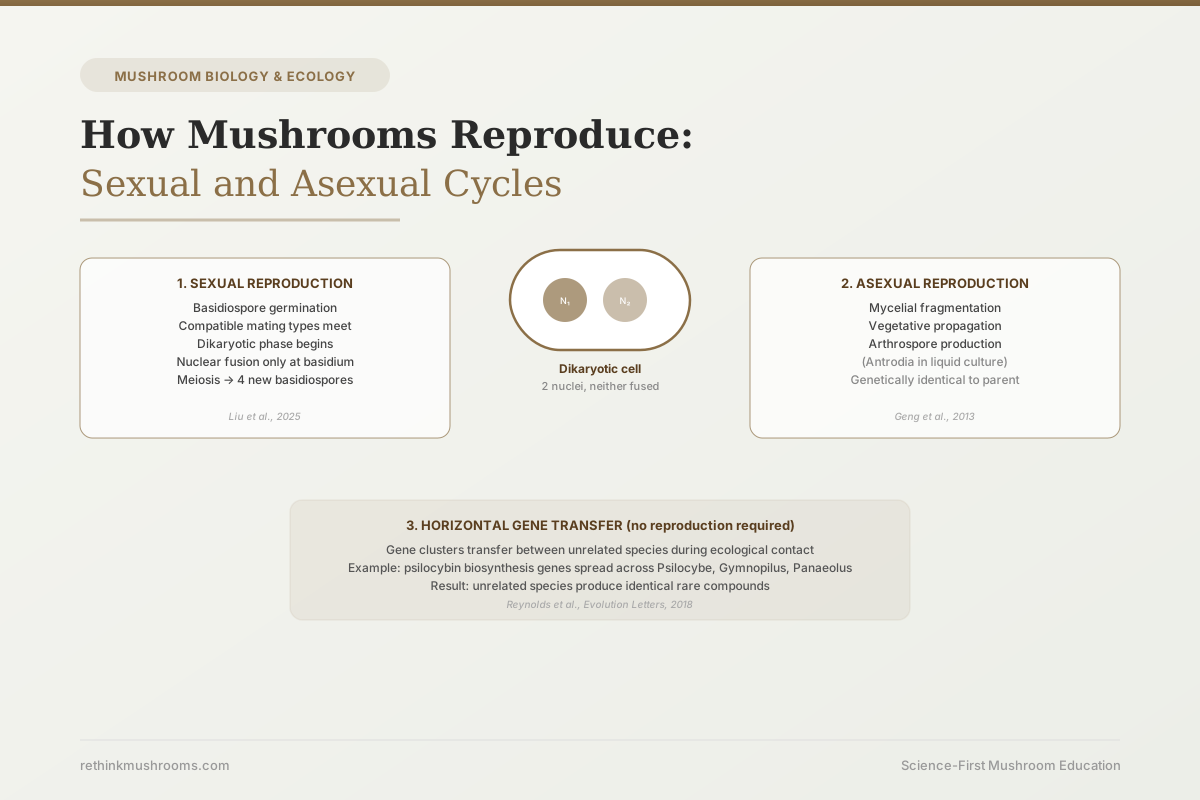 View as image ↗
Ask most people how mushrooms reproduce and they say "by spores." That is correct but incomplete to the point of missing what is genuinely fascinating about fungal reproduction. Fungi have evolved reproductive strategies that no other organisms use. Most mushroom mycelium contains two genetically different nuclei per cell, neither of them fused, coexisting through the entire vegetative growth phase in an arrangement called the dikaryotic state. Some species have not two but tens of thousands of genetically compatible mating types. And a subset of mushrooms can transfer genes sideways between unrelated lineages without any form of reproduction at all. The "mushrooms reproduce by spores" answer leaves all of this out.
This article covers the three main mechanisms fungi use for reproduction and genetic diversification, what makes the sexual cycle in basidiomycetes biologically unusual, the practical implications of asexual reproduction in supplement production, and what horizontal gene transfer adds to the picture. For the consumer-facing implications of this biology, see Fruiting Body vs. Mycelium: The Great Mushroom Supplement Debate.
Key Takeaways
- Most mushrooms are basidiomycetes that reproduce primarily through sexual basidiospores, but the sexual cycle includes an unusual intermediate: the dikaryotic phase, where mycelium contains two genetically distinct nuclei per cell that never fuse until spore formation
- The dikaryotic state (dikaryon) is unique to fungi: most organisms are either haploid (one set of chromosomes) or diploid (two matched sets); mushroom mycelium is neither, containing two unmatched haploid nuclei in each cell
- Mating in basidiomycetes requires compatible mating types, not simply "male" and "female"; some species have thousands of distinct mating types, maximizing the probability that any two randomly encountered spores are compatible
- Liu and colleagues' 2025 review documented that sexual spores (basidiospores) carry their own distinct bioactive compound profile, different from both mycelium and fruiting body; the compound category changes across reproductive stages
- Asexual reproduction in mushrooms occurs through mycelial fragmentation, vegetative propagation, and in some species, the production of asexual spores; Geng and colleagues (2013) found Antrodia camphorata produces arthrospores in submerged liquid culture, a reproductive form not seen in natural growth
- Reynolds and colleagues (2018) showed that psilocybin biosynthetic genes spread between distantly related fungal genera through horizontal gene transfer, a genetic exchange that occurs without any form of reproduction, representing a third mechanism for acquiring novel chemistry
The Sexual Cycle: Basidiospores and the Path to New Mycelium
The mushroom cap most people recognize is not the organism. It is the fruiting body: the reproductive structure that exists briefly to disperse spores. The organism itself is the mycelium growing invisibly through substrate below or inside a log, sometimes for decades, sometimes covering areas measured in hectares.
Sexual reproduction in basidiomycetes (the group that includes most culinary and medicinal mushrooms) begins when a mature fruiting body releases basidiospores from the gills, pores, or teeth beneath its cap. Each spore is haploid, carrying one copy of the fungus's genetic material. Upon landing in a suitable environment, a spore germinates into a network of hyphae, the thread-like filaments that collectively form mycelium.
A 2025 review by Liu and colleagues in Archives of Microbiology documented the molecular and environmental triggers that govern sexual spore formation: temperature, light intensity, CO2 concentration, and nutrient availability all serve as signals that flip the fungus from vegetative to reproductive mode.[1] The review also catalogued the bioactive compounds found specifically in basidiospores, which differ meaningfully from the compound profiles of mycelium and fruiting bodies. Spores are not just smaller versions of the fruiting body; they are a distinct biochemical state with their own compound signatures.
The Dikaryotic Stage: Two Nuclei, One Cell, Neither Fused
The most biologically unusual aspect of mushroom reproduction is what happens after a spore germinates but before it can undergo sexual reproduction. This stage does not exist in animals or plants in the same form.
When a basidiospore germinates, it produces what is called a primary mycelium, or monokaryon: haploid hyphae with one nucleus per cell. This mycelium can grow and colonize substrate, but it cannot form a fruiting body. For reproduction, it needs to encounter compatible mycelium from a spore with a different mating type.
Mating in basidiomycetes is not as simple as male meets female. Compatibility is determined by genes at one or more mating type loci, and a species can have many distinct allele combinations at these loci. Whether two mycelia are compatible depends entirely on whether they have different alleles at the mating type genes. In the most extreme case documented in fungi, the species Schizophyllum commune has been estimated to have over 23,000 distinct mating types, meaning almost any two randomly encountered spores are sexually compatible. This is not exceptional in the fungal kingdom; it is a common solution to the problem of finding a mate when you cannot move.
When two compatible primary mycelia do meet, they fuse their hyphae in a process called plasmogamy. But here is where the biology diverges from most other organisms. The two nuclei do not fuse. Instead, both nuclei are retained in the same cell, and the mycelium now contains paired, genetically distinct nuclei in every cell it produces. This is the dikaryotic state, and the mycelium in this state is called a dikaryon.
The dikaryon grows, colonizes substrate, and develops through the entire vegetative phase of the life cycle. During this entire period (which can last for years or decades in long-lived species) the two nuclear lineages remain separate. Nuclear fusion (karyogamy) occurs only at one point: when the fruiting body forms basidia, the spore-bearing cells. In the basidium, the two nuclei finally fuse to form a diploid nucleus, which immediately undergoes meiosis to produce four haploid basidiospores. Each spore carries a new genetic combination from both parental lineages.
This means a mushroom is diploid for only a brief period, in a small number of specialized cells, right before spore formation. For most of its existence, it is a dikaryon: two haploid nuclei, cohabiting but separate. This arrangement is found in no other kingdom of life.
Asexual Reproduction: When Spores Are Not Available
Not all fungal reproduction is sexual. Basidiomycetes can also propagate asexually through several mechanisms that do not involve spore-mediated sexual recombination.
The simplest is vegetative fragmentation. If a piece of mycelium breaks off and lands in a new substrate, it can colonize independently. Mushroom cultivators exploit this deliberately when they use mycelium from an established culture to inoculate new substrate blocks. This is vegetative propagation, genetically identical to the parent.
Some species produce asexual spores, a capability more commonly associated with ascomycetes (the other major fungal phylum) but documented in certain basidiomycetes as well. Geng and colleagues demonstrated this specifically in Antrodia camphorata, a medicinally important mushroom native to Taiwan, in 2013.[2] Under submerged liquid culture conditions (the type of fermentation used to produce mycelium supplements), Antrodia camphorata produced arthrospores, a type of asexual spore formed by the fragmentation of hyphae into individual spore-like cells. This form of reproduction does not occur in the mushroom's natural growth on its host wood.
The Geng finding has a practical implication. Submerged fermentation, which is how most mycelium-based supplements are produced, exposes fungi to growth conditions radically different from their natural environment. Under these conditions, some species enter reproductive states that do not exist in wild or wood-grown fruiting bodies. The mycelium in a supplement capsule may be biologically different from the same species grown on its natural substrate, not just in the quantities of compounds it contains, but in the reproductive and metabolic state it occupies.
For more on how the mycelium in supplements compares to wild mycelium and fruiting bodies, see What Is Mycelium? The Hidden Network Beneath the Mushroom and Are Mushroom Spores Bioactive? Research Review.
Horizontal Gene Transfer: A Third Mechanism for Acquiring New Chemistry
Sexual and asexual reproduction account for most fungal genetic diversification. But a 2018 analysis by Reynolds and colleagues revealed a third mechanism that had been operating for tens of millions of years: horizontal gene transfer, where an entire functional gene cluster moved between unrelated fungal lineages without any sexual or reproductive event.[3]
The specific case involved the psilocybin biosynthetic gene cluster, the four genes that encode the enzymes needed to convert tryptophan into psilocybin. Reynolds found that this cluster appeared in distantly related genera (Psilocybe, Gymnopilus, Panaeolus) with DNA sequences too similar to have evolved independently. The sequences looked like copies of a shared original, not like independent evolutionary inventions. The most parsimonious explanation: the cluster transferred as a unit between fungal lineages, most likely through direct hyphal contact when organisms sharing the same ecological niche grew into each other.
Horizontal gene transfer in fungi differs fundamentally from sexual reproduction. No spores are involved. No mating types need to be compatible. No dikaryotic phase occurs. One organism simply acquires the functional genes of another, without the parental lineages merging or exchanging gametes. The transferred genes are incorporated into the recipient genome and can immediately begin producing novel compounds.
This mechanism explains a puzzle that traditional reproductive biology could not: why do mushrooms with no shared ancestry, separated by hundreds of millions of years of divergent evolution, produce the exact same biosynthetically complex compound through the same enzymes? Not because they inherited the pathway from a common ancestor, but because the genes traveled.
The implication for understanding mushroom chemistry more broadly: a species' compound profile is not fully predictable from its evolutionary lineage. Genes for novel chemistry can arrive through transfer events, potentially conferring capabilities that phylogeny would not predict.
For the full story of how psilocybin gene transfer explains the distribution of psychedelic mushrooms, see Horizontal Gene Transfer and the Psilocybin Gene Cluster.
What Reproduction Stage Tells Us About Spore Bioactives
The connection between reproductive stage and bioactive compound content is not just theoretical. Liu and colleagues' 2025 review systematically catalogued the bioactive compounds found specifically in sexual spores (basidiospores) and found profiles distinct from both vegetative mycelium and fruiting body tissue.[1]
Spores are chemically specialized for dispersal and survival under harsh conditions. They are protected by a thick cell wall containing sporopollenin-like compounds and accumulate reserves needed for germination in nutrient-poor environments. The ergosterol, polysaccharide, and secondary metabolite profiles of spores do not match the profiles of the mycelium that produced them or the fruiting body that housed them.
This matters practically for readers evaluating spore-based mushroom products, particularly reishi spore oil and spore powder products. The compound profile in a spore is genuinely different from the compound profile in a fruiting body extract. Whether the spore-specific compounds are more or less therapeutically relevant than fruiting body compounds depends on the intended application and the specific compound being measured.
For more on what those differences mean for specific medicinal mushroom species, see Do Fruiting Bodies Have More Bioactive Compounds Than Mycelium? and Mushroom Ecology: Decomposers, Parasites, and Mutualists.
The Bottom Line
Mushroom reproduction is more diverse and biologically unusual than the simple "reproduction by spores" summary suggests. The basidiomycete sexual cycle includes a prolonged dikaryotic phase where two genetically distinct nuclei cohabit each cell without fusing; nuclear fusion occurs only at spore formation. Compatible mating types rather than male/female sex determine sexual compatibility, with some species having thousands of distinct mating types. Asexual reproduction occurs through fragmentation and, in submerged culture conditions, through asexual spore forms like the arthrospores documented in Antrodia camphorata. Horizontal gene transfer represents a third mechanism for acquiring new chemistry, as shown by the psilocybin gene cluster's spread between unrelated genera. Sexual spores carry distinct bioactive profiles from vegetative mycelium and fruiting bodies, with compounds optimized for dispersal and germination rather than defense or nutrition.
Frequently Asked Questions
Sources & References
- 1RTHM-00938·Liu, Dongmei et al. (2025). “Sexual spores in mushrooms: bioactive compounds, factors and molecular mechanisms of spore formation..” Archives of microbiology.Study breakdown →PubMed →↩
- 2RTHM-00285·Geng, Yan et al. (2013). “Antrodia camphorata ATCC 200183 sporulates asexually in submerged culture..” Applied microbiology and biotechnology.Study breakdown →PubMed →↩
- 3RTHM-01000·Reynolds, Hannah T et al. (2018). “Horizontal gene cluster transfer increased hallucinogenic mushroom diversity..” Evolution letters.Study breakdown →PubMed →↩