Mushroom Biology
4 ecological strategies
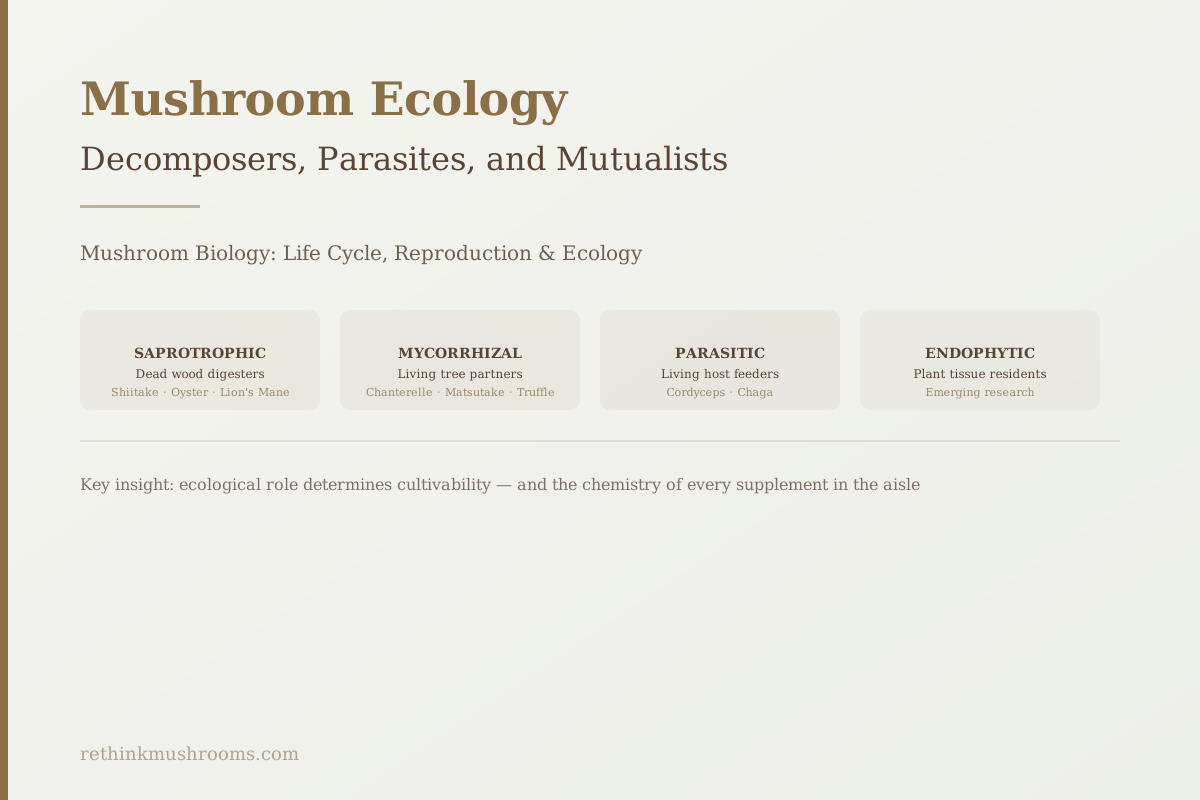
Saprotrophic, mycorrhizal, parasitic, and endophytic: a mushroom's ecological role determines whether it can be commercially cultivated and what bioactive compounds it accumulates in fruiting bodies.
Song et al., Applied Microbiology and Biotechnology, 2025
Can farm
saprotrophic species (shiitake, oyster, lion's mane, reishi) because they digest dead wood substrate
Cannot farm
mycorrhizal species (chanterelle, matsutake, truffle) because they require a living tree partner
Gene transfer
psilocybin biosynthesis genes jumped horizontally between distantly related mushroom lineages (Reynolds 2018)
Song et al., Applied Microbiology and Biotechnology, 2025
 View as image ↗
You can buy shiitake, lion's mane, and reishi supplements anywhere. You cannot buy chanterelle or matsutake supplements at any price. The reason isn't demand or market economics. It's mushroom ecology.
The ecological role a fungus evolved to fill determines how it feeds, what substrate it colonizes, which organisms it depends on, and whether it can survive in cultivation. Most of the medicinal mushrooms available as supplements share a particular ecological strategy that makes cultivation possible. The most celebrated culinary mushrooms in the world share a different strategy that makes cultivation biologically impossible. Understanding mushroom ecology is understanding why the supplement aisle looks the way it does. It also unlocks something more fundamental: how ecological pressures shaped the very bioactive compounds that make medicinal mushrooms worth studying. For the consumer-facing implications of mushroom biology, see fruiting body vs. mycelium: the great mushroom supplement debate.
Key Takeaways
- Fungi use four main ecological strategies: saprotrophic (digesting dead matter), mycorrhizal (partnering with tree roots), parasitic (feeding on living hosts), and endophytic (living inside plant tissue)
- Saprotrophic mushrooms, which evolved to digest dead wood, are the species that can be commercially cultivated on hardwood substrate: shiitake, oyster, lion's mane, reishi, turkey tail
- Mycorrhizal mushrooms require a living tree partner and cannot complete their life cycle in cultivation, which is why chanterelle, matsutake, truffle, and porcini do not appear as supplement ingredients
- Parasitic Cordyceps fungi evolved to infect and kill insects; wild Cordyceps sinensis requires a specific ghost moth larva host at high Himalayan altitude, making it biologically distinct from commercially cultivated Cordyceps militaris
- The ecological substrate the mycelium colonizes directly determines what compounds accumulate in the fruiting body, including both beneficial nutrients and potentially harmful heavy metals (Ziemlewska 2021)
- Psilocybin biosynthesis genes were transferred horizontally between distantly related mushroom lineages, showing that ecological selection pressure can drive rapid chemical change through gene acquisition rather than gradual evolution (Reynolds 2018)
Why Mushroom Ecology Matters: The Supplement Aisle as an Ecological Filter
Mushroom ecology is not a topic that appears on supplement labels. But it explains almost everything about which supplements exist, which ones don't, and why the compounds found in commercial products differ from those in wild-harvested specimens.
Fungi evolved four main strategies for obtaining the nutrients they need:
| Ecological role | How it feeds | Medicinal examples | Commercially cultivated? |
|---|---|---|---|
| Saprotrophic | Digests dead organic matter (wood, leaf litter) | Shiitake, oyster, lion's mane, reishi, turkey tail | Yes, on hardwood substrate |
| Mycorrhizal | Exchanges nutrients with living tree roots | Chanterelle, matsutake, truffle, porcini | Not commercially viable |
| Parasitic | Obtains nutrients from a living host (insects, trees) | Cordyceps (insect host), chaga (birch), honey fungus | Partially (Cordyceps militaris on grain) |
| Endophytic | Lives inside plant tissue without visible disease | Various species; research emerging | Rarely |
This table is effectively a map of the medicinal mushroom supplement industry. Every major commercially available medicinal mushroom species falls in the saprotrophic row. The mycorrhizal row contains some of the most expensive and sought-after fungi in the world, all unavailable as cultivated supplements. The parasitic row contains Cordyceps, where wild and cultivated versions are biologically different enough to be classified as different species.
The connection between mushroom ecology and medicinal compounds runs deeper still. The chemical profile a mushroom produces is inseparable from the ecological niche it evolved to fill. The same evolutionary pressures that made one fungus a wood digester and another an insect killer also shaped their secondary metabolite chemistry, including the compounds humans now study for medicinal applications.
For how ecological taxonomy is formally structured, see mushroom taxonomy 101: how scientists classify medicinal fungi.
Saprotrophic Fungi: The Dead-Wood Digesters That Stock the Supplement Aisle
Saprotrophic fungi obtain nutrients by secreting enzymes that break down dead or decaying organic matter. The primary substrate for most medicinal saprotrophic species is wood: the lignin and cellulose in dead trees, fallen logs, and woody debris.
To digest wood, these fungi evolved a remarkable enzymatic toolkit. White-rot fungi (which include shiitake, oyster, lion's mane, and reishi) produce lignin peroxidases, manganese peroxidases, and laccases, enzymes capable of breaking down lignin, one of the most chemically resistant organic polymers on earth. Brown-rot fungi (like turkey tail) preferentially degrade cellulose while leaving modified lignin behind.
This enzymatic capacity is directly related to why these species can be cultivated. Commercial shiitake production on hardwood logs or supplemented sawdust works because shiitake evolved to colonize hardwood substrate. Give a saprotrophic mushroom its preferred dead substrate, and it will grow. Song and colleagues' 2025 comprehensive review of shiitake cultivation biology confirmed that the full life cycle from spore to fruiting body can be completed on artificial hardwood substrate, provided the right environmental cues are supplied at each transition point: temperature, humidity, CO2 levels, and light exposure trigger the shift from vegetative growth to fruiting.[1]
The substrate matters beyond just supporting growth. The species of wood, the stage of decomposition, and the mineral content of the growing medium all influence what compounds accumulate in the fruiting body. A shiitake grown on oak logs in outdoor conditions differs chemically from one grown on supplemented sawdust in a controlled indoor facility. The ecological substrate the mycelium colonizes is not neutral; it is an active variable in the chemistry of the final product. This is explored in depth in how growing substrate affects mushroom bioactive content.
The list of cultivated saprotrophic medicinal species includes nearly everything in the supplement aisle: shiitake, oyster mushroom (Pleurotus ostreatus), lion's mane (Hericium erinaceus), reishi (Ganoderma lucidum), turkey tail (Trametes versicolor), and maitake (Grifola frondosa). Their commercial availability is not coincidental. They share the ecological strategy that makes cultivation feasible.
Mycorrhizal Fungi: The Tree Partners That Cannot Be Farmed
Mycorrhizal fungi do not digest dead matter. They form living partnerships with the roots of trees and other plants in an exchange the ecologist calls mutualism: both organisms benefit. The fungus extends its hyphal network deep into soil, dramatically expanding the effective root surface area of the tree and acquiring phosphorus, water, and trace minerals from a much larger soil volume than roots could reach alone. In return, the tree supplies the fungus with sugars produced by photosynthesis, which the fungus cannot make for itself.
This partnership creates the cultivability problem. Mycorrhizal fungi require their tree host to complete their life cycle. They are metabolically dependent on the sugars that only a living photosynthesizing tree can supply. Remove the tree, and the fungus cannot grow. Grow the fungus in a laboratory dish or a substrate bag, and it has no sugar source.
Chanterelle, matsutake, truffle, porcini, and porcini are all mycorrhizal. These are among the most culinarily prized and economically valuable fungi on earth, selling for hundreds or thousands of dollars per kilogram in wild-harvested form. All of them are absent from the supplement market because commercial cultivation in any meaningful scale is biologically impossible. Researchers have produced small quantities of truffles in controlled mycorrhizal orchards, planting trees inoculated with Tuber spores and waiting years for fruiting. Nothing comparable to the consistent high-yield cultivation possible for saprotrophic species.
This ecological difference is also why wild-harvested chanterelles or porcini cannot simply be scaled up to meet demand. The fruiting body is produced by the relationship between fungus and tree, not by the fungus alone. Harvest pressure affects the forest ecosystem, not just the fungal population.
The full ecological story of why matsutake specifically resists all cultivation attempts is told in why matsutake can't be cultivated: the mycorrhizal mystery.
Parasitic Fungi: Cordyceps and the Insect Hunters
Parasitic fungi obtain their nutrients from living hosts, either slowly draining a tree's resources or, in the case of entomopathogenic fungi, infecting, consuming, and killing an insect host.
Cordyceps is the most famous entomopathogenic medicinal mushroom genus. The classic image of wild Cordyceps sinensis shows a mummified ghost moth larva with a slender fruiting body erupting from its head. This is not a metaphor or an exaggeration. The fungus infects the larval stage of the ghost moth (Thitarodes species) at high elevation in the Tibetan plateau, colonizes and consumes the larva's internal tissues while keeping it alive long enough for the mycelium to fully saturate the body, and then sends up a fruiting body from the dead larva's head to release spores.
Wild Cordyceps sinensis is produced entirely by this biological process: one fungus, one larva, one fruiting body, at elevations between 3,500 and 5,000 meters. It cannot be replicated in cultivation because the ghost moth larva is not a controllable substrate. Wild C. sinensis costs several thousand dollars per kilogram.
What is sold as "cordyceps" in most supplements is Cordyceps militaris, a related but distinct species. C. militaris is also entomopathogenic in nature, but it is flexible enough in its substrate requirements to grow on a grain medium in laboratory conditions without an insect host. The compounds in cultivated C. militaris are different in profile from wild C. sinensis. Both are real; they are not the same organism producing the same chemistry.
Chaga (Inonotus obliquus) occupies an adjacent ecological position. It grows as a parasitic canker on living birch trees, slowly decomposing the tree's sapwood over years. The black exterior mass is largely composed of melanin, and the medicinal compounds concentrated in chaga reflect both its fungal metabolism and its long residence on the birch host. Wild-harvested chaga comes with the ecological complication that harvesting kills the tree, and sustainable harvest requires leaving enough viable birch for the forest ecosystem.
Honey fungus (Armillaria species) rounds out the parasitic category as one of the world's largest known organisms: a single Armillaria individual in Oregon's Malheur National Forest covers an estimated 965 hectares and may be thousands of years old. It is primarily a forest pathogen rather than a medicinal species.
Endophytic Fungi: The Understudied Ecological Category
Endophytic fungi live inside the living tissue of plants without causing obvious disease or providing an obvious benefit. They are neither parasites (not visibly harming the plant) nor mutualists (not providing measurable benefit in most documented cases), or rather, the exchange is subtle enough that researchers are still characterizing it.
Many fungal species are endophytic during part of their life cycle and saprophytic or otherwise ecological at other stages. Some produce bioactive compounds inside plant tissue that may protect the host from pathogens or herbivores. The mechanisms and ecological logic are an active research area.
Endophytic fungi are not currently represented as a meaningful category in the medicinal mushroom supplement market, though researchers are beginning to document bioactive secondary metabolites from endophytes that overlap with compounds found in more familiar medicinal species. This category may become commercially relevant as the diversity of fungal bioactivity becomes better characterized.
How Ecology Shapes Medicinal Chemistry: Two Findings That Change the Picture
The connection between a mushroom's ecology and its medicinal chemistry runs deeper than which substrate it grows on. Two pieces of research illustrate how ecological pressures actively shape the compounds that researchers study.
The first is the substrate accumulation question. Ziemlewska and colleagues published a 2021 review documenting that the substrate the mycelium colonizes determines both the nutrient and toxin accumulation profile in the fruiting body.[2] Mushrooms are efficient bioaccumulators: they concentrate whatever is in their substrate, both the desirable compounds (bioactive polysaccharides, ergothioneine, beta-glucans) and the undesirable ones (heavy metals like cadmium, lead, and arsenic if present in the growing medium or soil). A shiitake grown on clean hardwood substrate and a wild mushroom harvested from roadside soil have the same species name but potentially very different chemical profiles because of their differing ecological contexts.
This is the ecology-to-supplement-quality chain in its most direct form: the substrate the mycelium evolved to colonize is not just a feeding preference. It is the determinant of what ends up in the product. The practical implications for substrate standardization in supplement production are significant. This substrate-quality relationship is examined in detail in do fruiting bodies have more bioactive compounds than mycelium?.
The second finding is more unexpected. Reynolds and colleagues published a 2018 study in Evolution Letters documenting that the psilocybin biosynthesis gene cluster, which contains the four enzymes responsible for synthesizing psilocybin from tryptophan, is found in phylogenetically unrelated mushroom lineages.[3] Psilocybe, Gymnopilus, Pluteus, and Inocybe are distantly related mushroom genera that share psilocybin synthesis despite diverging from a common ancestor long before psilocybin chemistry appeared. The most parsimonious explanation is horizontal gene cluster transfer: the gene cluster was acquired from another fungus through mechanisms that don't require sexual reproduction.
The ecological driver proposed by Reynolds and colleagues is selection pressure from insects and other invertebrates. Psilocybin appears to deter grazing: insects avoid consuming psilocybin-containing fruiting bodies, providing a survival advantage that made the gene cluster worth acquiring and keeping. Each lineage that encountered this chemical defense was under pressure to acquire it, explaining the independent appearances across unrelated families.
This finding illuminates something important about medicinal mushroom chemistry generally: the compounds we study did not evolve for human benefit. They evolved in response to ecological pressures: competitors, predators, and environmental stressors. The selection pressure that produced psilocybin is the same category of pressure that produced the beta-glucans that stimulate human immune responses (which originally defend fungal cell walls from pathogen attack) and the triterpenes in reishi (which deter insects and microbial pathogens). Ecology is not background context for medicinal mushroom research. It is the origin story of the compounds themselves.
The Bottom Line
The four ecological strategies of fungi, saprotrophic, mycorrhizal, parasitic, and endophytic, determine cultivability, substrate choice, and the bioactive chemistry of the resulting fruiting bodies. The supplement market is essentially a saprotrophic ecology catalog: the species that can be commercially cultivated are those that evolved to digest dead wood substrate. Mycorrhizal species like chanterelle and matsutake cannot be farmed because they require a living tree partner. Parasitic species like Cordyceps exist in wild and cultivated forms that are biologically distinct. The substrate a mushroom colonizes determines both its nutrient accumulation and its toxin exposure. And the ecological selection pressures that drove fungi to evolve psilocybin, beta-glucans, and triterpenes are the same pressures that make these compounds biologically active in human physiology.
Frequently Asked Questions
Sources & References
- 1RTHM-02183·Song, Xiaoxia et al. (2025). “Cultivation methods and biology of Lentinula edodes..” Applied microbiology and biotechnology.Study breakdown →PubMed →↩
- 2. Source details for this reference are not yet available.
- 3RTHM-01000·Reynolds, Hannah T et al. (2018). “Horizontal gene cluster transfer increased hallucinogenic mushroom diversity..” Evolution letters.Study breakdown →PubMed →↩