Mushroom Industry Standards
73.7% failure rate
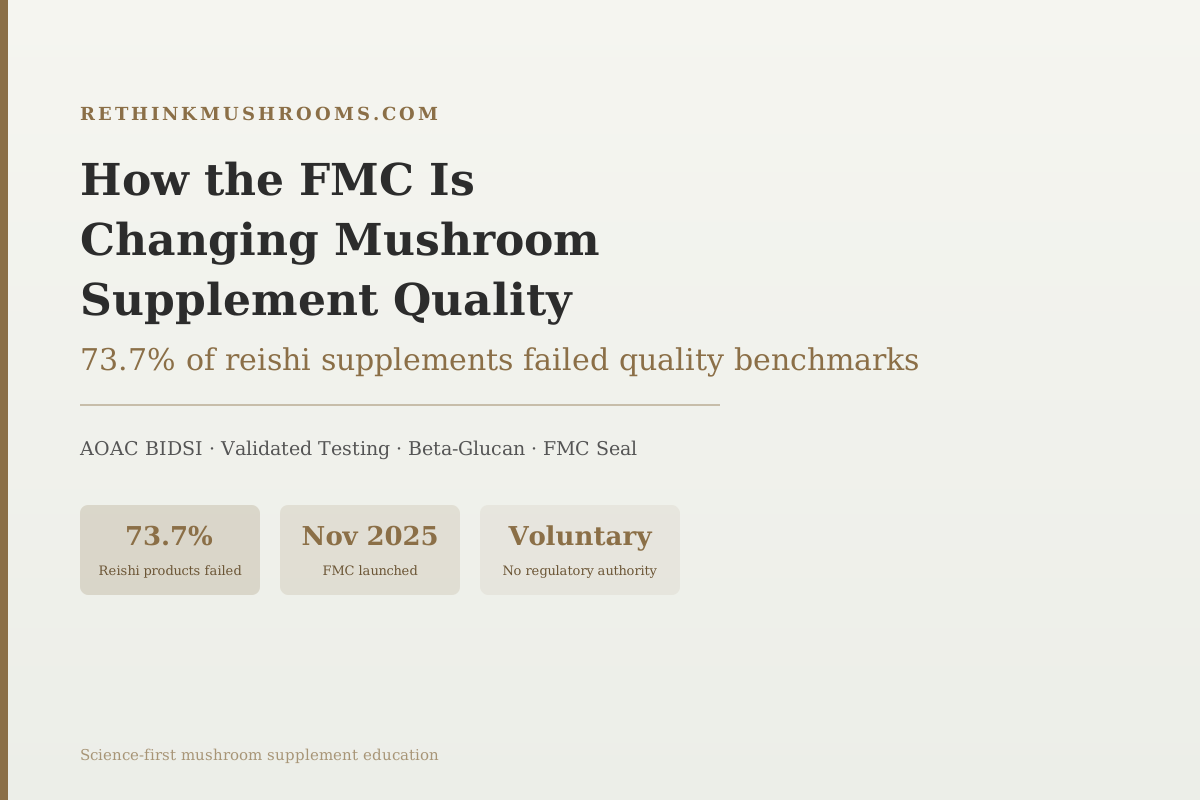
Just 5 of 19 US reishi supplements matched their own labels in a 2017 peer-reviewed analysis. That 73.7% shortfall is the kind of quality failure a dedicated industry standards council was eventually built to address.
Wu et al., Scientific Reports, 2017
AOAC BIDSI
AOAC International's Botanical Ingredients and Dietary Supplement Integrity program, which the Functional Mushroom Council is working with to validate mushroom testing methods, beginning with lion's mane and then reishi
October 2025
when the Functional Mushroom Council debuted at SupplySide Global, with founding members Fungi Perfecti (Paul Stamets), M2 Ingredients, Monterey Mushrooms, Aloha Medicinals, Mycopia, and Far West Fungi
Voluntary only
the regulatory status of all FMC standards and seals; participation is voluntary, and the FMC has no authority to remove products from market or compel compliance
Wu et al., Scientific Reports, 2017
 View as image ↗
In 2017, researchers bought 19 batches of reishi (Ganoderma lucidum) supplements sold in the United States and measured their triterpene and polysaccharide content against what the labels claimed. Only 5 of the 19 — 26.3% — had measured ingredients that were in accordance with their labels. The authors concluded that quality consistency in the US reishi market was poor.[1] Nineteen products is a small survey, not a census of the market. But it was a systematic one, and it landed in a segment where quality standards already existed on paper: reishi had a USP monograph. The market ignored it anyway.
The Functional Mushroom Council (FMC) is the industry's attempt to close that gap. It debuted at the SupplySide Global trade show in late October 2025, with its formal launch announcements following in November, and is a nonprofit trade organization working on validated testing methods and a seal program for mushroom supplements. What the FMC is doing, and what it is honestly limited by, is the subject of this article.
For the broader market context, see the functional mushroom market: size, growth, and projections. For the founding story and member list, see the Functional Mushroom Council: setting industry standards.
Key Takeaways
- Only 5 of 19 US reishi supplements (26.3%) had measured triterpene and polysaccharide content in accordance with their labels, despite reishi having an existing USP monograph (Wu et al., 2017)
- The Functional Mushroom Council debuted at SupplySide Global in October 2025, with a planned voluntary seal and a collaboration with AOAC International's Botanical Ingredients and Dietary Supplement Integrity (BIDSI) program
- Windsor et al. (2025) used six complementary analytical techniques to separate wildcrafted Chaga canker from fermented-grain products, which were starch-rich and lacked Chaga's triterpenoid and melanin markers; this kind of multi-method fingerprinting is what the FMC wants standardized
- Paul Stamets co-founded the FMC alongside fruiting-body advocates, having published peer-reviewed research showing turkey tail mycelium and its fermented substrate each activate immune cells in vitro (Benson, Stamets et al., 2019); a testing-first approach is the common ground that framing allows
- FMC standards are voluntary; the organization has no regulatory authority to remove products from market, mandate testing, or penalize non-compliant brands
- A 2024 review of label-compliance testing found that functional mushrooms sit among the top-selling botanicals most exposed to adulteration and inaccurate labeling, and surveyed the chromatographic, spectroscopic, and DNA methods used to verify ingredient claims (You et al., 2024)
Why a 73.7% Label-Mismatch Rate Put Quality on the Agenda
The reishi finding from Wu and colleagues is the origin document for understanding why the FMC exists.[1] The researchers weren't hunting for outliers. They bought what was on the shelf and measured it. Fourteen of nineteen products did not match their own labels — in a segment where quality standards already existed on paper.
Ganoderma lucidum has a monograph in the USP (United States Pharmacopeia) and the National Formulary. This defines what authentic reishi should contain: ganoderic acid triterpenoids, specific polysaccharide profiles, acceptable moisture ranges. Manufacturers can reference this monograph and test their products against it. Many don't, and nothing requires them to.
This is the structural problem. A review by Sarma and colleagues, co-authored by USP scientists, explains the framework: pharmacopeial monographs set quality benchmarks but have no mandatory enforcement mechanism under DSHEA, the US dietary supplement law. Supplements are classified as food, not drugs, and are presumed safe unless the FDA proves otherwise after market entry.[2] No pre-market testing is required. A company can skip the USP Ganoderma monograph entirely and no one stops them.
A 2024 review of label compliance and ingredient verification named functional mushrooms, alongside elderberry and turmeric, as top-selling botanical categories that "succumb to adulteration with inaccurate labeling" through the addition of lower-grade ingredients, non-target plants, and synthetic compounds. The review catalogued the analytical options available for verifying ingredient claims — chromatography, spectroscopy, and DNA-based approaches — and the US regulatory requirements they sit inside.[3] The methods exist. What has been missing for mushrooms specifically is agreement on which method to use for which species, and validation of those methods to a standard labs and regulators will recognize. That is the gap the FMC-AOAC BIDSI collaboration is aimed at.
What FMC Is and What It Has Actually Committed To
The Functional Mushroom Council is a nonprofit trade organization. It debuted at the SupplySide Global trade show in late October 2025. Founding members include Fungi Perfecti (Paul Stamets), M2 Ingredients, Monterey Mushrooms, Aloha Medicinals, Mycopia, and Far West Fungi. Dr. Julie Daoust, chief science officer at M2 Ingredients, chairs the council; Amir Karian of Monterey Nutra is vice-chair. These are producers and brands, not regulators.
Four concrete commitments have been announced:
AOAC BIDSI collaboration. The FMC is working with AOAC International's Botanical Ingredients and Dietary Supplement Integrity (BIDSI) program to develop and validate testing methods for mushroom ingredients specifically. AOAC is the internationally recognized body for analytical chemistry standards, the same organization whose methods underpin USP monographs. Method development is starting with lion's mane — covering both mycelium and fruiting body material — with reishi named as the next target. This is the most substantive technical commitment the FMC has made.
FMC seal program. A seal designating North American-grown ingredients in finished products is planned. The sourcing restriction applies to the on-package logo rather than to membership: brands can join the council regardless of where they source, but only products made with North American-grown material would be able to carry the mark. That reflects the founding members' supply-chain geography as much as any quality finding.
A marketplace quality survey. The FMC has a quality-and-consistency survey of products already on the market underway, including products sold on Amazon, with findings expected in March 2026 to coincide with Natural Products Expo West.
A multi-year research program. Beyond the marketplace survey, the council has a longer research agenda covering quality standards, bioactive compound profiles, and health effects across the full mushroom life cycle. It is being run with AOAC alongside third-party laboratories and industry scientists. The council has stated up front that it expects this research to show North American-grown mushrooms delivering more consistent benefits than imported material — a hypothesis its founding members have a commercial interest in confirming, and worth reading with that in mind.
Note what is not on this list. The FMC has not committed to publishing standardized legal definitions of "fruiting body," "mycelium," or "full-spectrum." Its stated posture is close to the opposite: rather than adjudicating "which is better, a mycelium product or a fruiting-body product," it favors methods broad enough to cover the diversity of products actually on the market. The council's own framing, per M2's chief science officer, is that it is "not a marketing seal but a working industry body" — a claim the next 12 to 24 months of output will test.
The Analytical Toolkit: How HPTLC and NMR Expose Grain Fillers in Chaga
The Windsor 2025 study on Chaga supplements illustrates the analytical rigor the FMC is working toward.[4]
Windsor and colleagues applied six complementary analytical approaches to Chaga materials ranging from wildcrafted canker to mycelium-fermented grain products: high-performance thin-layer chromatography (HPTLC), liquid chromatography with evaporative light scattering or photodiode-array detection (LC-ELSD, LC-PDA/DAD), liquid chromatography with quadrupole time-of-flight mass spectrometry (LC-QToF-MS), nuclear magnetic resonance (NMR) spectroscopy, UV-Vis spectrophotometry, and iodine-starch assays.
The separation was clean. Whole Chaga canker contained the triterpenoids inotodiol and trametenolic acid plus phenolics such as osmundacetone, and its melanin absorbance at 500 nm distinguished it from the fermented-grain products. The grain products, in turn, were starch-rich on iodine-starch testing, while authentic canker was not. NMR fingerprinting and LC-QToF-MS metabolomics showed what the authors called stark compositional deviations between wildcrafted canker, I. obliquus mycelium, and fermented grain.[4]
Worth stating precisely: the finding is that fermented-grain products lack Chaga canker's characteristic triterpenoid and melanin markers and carry a starch signature instead. That is not the same as saying they contain no beta-glucan at all. Grain and fungal biomass both contain glucans, which is exactly why a total-polysaccharide number on a label can look respectable while the material behind it is mostly rice.
Six Techniques, One Answer
How Analytical Convergence Separates Chaga From Grain
No single assay settled it. Windsor et al. (2025) ran six orthogonal techniques against wildcrafted Chaga canker, I. obliquus mycelium, and mycelium-fermented grain products. Each one answers a different question, and a product would have to defeat all six to pass as something it is not.
- HPTLCHigh-performance thin-layer chromatographyA visual chromatographic fingerprint of the compound profile.
- LC-ELSD / PDALiquid chromatography with light-scattering or diode-array detectionSeparates and quantifies compound classes across the extract.
- LC-QToF-MSLiquid chromatography, quadrupole time-of-flight mass spectrometryMetabolomic comparison; identified marker compounds by exact mass.
- NMRNuclear magnetic resonance spectroscopyStructural fingerprinting; showed stark compositional deviation between canker, mycelium, and grain.
- UV-VisUV-visible spectrophotometryMelanin absorbance at 500 nm separated whole canker from fermented grain.
- Iodine-starchIodine-starch assayConfirmed starch-rich composition in fermented grain, absent in authentic canker.
The convergent result: whole canker carried triterpenoids (inotodiol, trametenolic acid) and phenolics such as osmundacetone, plus a melanin signal. Fermented grain carried starch and lacked those markers.
Read carefully: the finding is that fermented-grain products lack Chaga’s triterpenoid and melanin markers and are starch-rich — not that they contain no glucan at all. Grain contains glucans too, which is precisely why a total-polysaccharide number on a label can look respectable while the material behind it is mostly rice.
Source: Windsor et al. (2025), International Journal of Molecular Sciences 26(7):2970 [ref 4].
This is what "validated testing methods" means in practice: not one assay, but a fingerprint where several orthogonal techniques have to agree. HPTLC gives a visual chromatographic fingerprint. NMR provides structural confirmation at the molecular level. Mass spectrometry identifies marker compounds by exact mass. Enzymatic beta-glucan assays quantify the bioactive fraction rather than total carbohydrate. Together they are hard to fool.
The FMC's AOAC collaboration is working to standardize this kind of multi-method approach, though on a narrower front than the Chaga paper covers: lion's mane first, reishi next. Chaga, turkey tail, and cordyceps have not been announced as validated-method targets. For consumers, the practical implication is that the FMC seal, if and when it arrives, would be backed by methods at this level of rigor rather than single-assay self-reporting — for the species that have actually been through the process.
For more on how these testing methods work from a consumer-facing perspective, see DNA testing for mushroom supplements: verifying species identity.
The Stamets Tension: Quality Standards and the Mycelium Defender
Paul Stamets co-founded the FMC. He also founded Fungi Perfecti, whose Host Defense line is among the most prominent mycelium-based supplement brands in North America. These two facts exist in apparent tension: why would the main commercial defender of mycelium products help build an industry council that originated partly from criticisms of mycelium quality?
The answer lies in what Stamets actually published. In 2019, Benson, Stamets, and colleagues published a peer-reviewed study in BMC Complementary and Alternative Medicine testing turkey tail mycelium against the fermented rice-flour substrate it grew on, with the un-inoculated substrate as a control.[5] Both mycelium fractions triggered robust induction of CD69, an early activation marker, on lymphocytes and monocytes. The fermented substrate drove large dose-dependent increases in cytokines including IL-2, IL-6, IFN-gamma, IL-10 and G-CSF, while the starting substrate did little or nothing. The paper's actual argument is subtler than "mycelium works": it is that the fermentation transforms the grain into something bioactive that was not bioactive before.
That distinction matters for the labeling fight. It is the strongest available scientific case that mycelium-on-grain is not simply filler — and it is a case made in a peer-reviewed journal rather than a press release. It is also an in vitro study of immune-cell activation, which is a long way from a clinical outcome in a person.
A 2022 study by Jędrejko and colleagues measured Cordyceps militaris fruiting bodies (both commercial and self-cultivated), mycelium, and two commercial supplements, and found that substrate composition and cultivation method shaped the results. The highest cordycepin and lovastatin content actually came from the commercial supplements, while after simulated digestion the fruiting bodies released the most cordycepin.[6] The takeaway is that compound content tracks how the material was grown and processed, not simply which anatomical part it came from.
These findings point toward a more nuanced position than the binary "fruiting body good, mycelium bad" framing that dominates consumer content. The FMC's approach reflects this: rather than banning mycelium products, they are building testing methods that verify quality regardless of ingredient source. A mycelium product from properly grown, tested, grain-separated production could in principle meet FMC standards. A fruiting body product from poor-quality raw material might not.
The regulatory backdrop explains why. On June 7, 2023, the ingredient supplier Nammex filed a citizen petition asking the FDA to clarify that labeling of fungal ingredients should identify which part of the organism the ingredient came from — fruiting body, mycelium, or spore — arguing that using "mushroom" for all parts had opened the door to deceptive marketing. Fungi Perfecti responded within weeks with an open letter, co-signed by M2 Ingredients, Gourmet Mushrooms, and Monterey Mushrooms, calling the petition a source of "public confusion... about widely accepted and settled terminology" and arguing that "mushroom" properly names the whole organism while "mycelium" and "fruit body" name its parts.
The FDA did not resolve it. In a November 30, 2023 letter, Cara Welch, director of the agency's Office of Dietary Supplement Programs, told Nammex the FDA had not reached a decision within the statutory 180 days because of competing agency priorities — an interim response deferring the question rather than denying the petition. It remains unresolved.
Now look at who signed that open letter: Fungi Perfecti, M2 Ingredients, Gourmet Mushrooms, and Monterey Mushrooms. Three of those four are FMC founding members, and Gourmet Mushrooms is the parent of founding member Mycopia. The FMC's founding coalition is, to a substantial degree, the coalition that formed to oppose the Nammex petition. That is the most useful single fact for calibrating what the council is: a testing-standards approach is not a neutral choice arrived at from nowhere, it is the common ground available to a group that had already rejected part-based labeling mandates. Verified content is something they can all agree to measure. Anatomical disclosure was not.
Where the Coalition Came From
The Petition Fight That Preceded the Council
Two years before the FMC existed, four companies publicly opposed a petition to require part-based labeling of fungal ingredients. All four are now inside the council’s founding membership.
7 June 2023
Nammex petitions the FDA
Asks the agency to clarify that labels for fungal ingredients identify the part used — fruiting body, mycelium, or spore — arguing that calling every part “mushroom” enables deceptive marketing.
June 2023
Four companies publish an open letter against it
Fungi Perfecti, co-signed by M2 Ingredients, Gourmet Mushrooms, and Monterey Mushrooms, calls the petition a source of public confusion about settled terminology, arguing “mushroom” names the whole organism.
30 Nov 2023
The FDA defers
An interim response from the Office of Dietary Supplement Programs states no decision was reached within the statutory 180 days, citing competing agency priorities. The question is left open.
Oct–Nov 2025
The Functional Mushroom Council debuts
Founding members: Fungi Perfecti, M2 Ingredients, Monterey Mushrooms, Aloha Medicinals, Mycopia, Far West Fungi. Its instrument is analytical testing, not part-based labeling.
The overlap
- Fungi PerfectiSigned the letter · FMC founding member
- M2 IngredientsSigned the letter · FMC founding member, chairs the council
- Monterey MushroomsSigned the letter · FMC founding member
- Gourmet MushroomsSigned the letter · parent of founding member Mycopia
This does not make the council’s testing work illegitimate — validated methods are useful regardless of who funds them. It does explain the choice of instrument. Verified content is something this particular group can agree to measure. Anatomical disclosure was not.
Sources: Nammex citizen petition, FDA docket FDA-2023-P-2340 (7 June 2023); Fungi Perfecti open letter (June 2023); FDA Office of Dietary Supplement Programs interim response (30 November 2023); FMC launch announcements (October–November 2025).
For the full analysis of this debate and its consumer implications, see the mycelium vs. fruiting body debate: an industry perspective. For consumer-focused guidance, see fruiting body vs. mycelium on grain: the consumer guide.
What FMC Can and Cannot Change
Being honest about the FMC's limits matters as much as describing its goals.
Authority Boundary
What a Voluntary Council Can and Cannot Do
Everything on the left is something the FMC can do without asking anyone’s permission. Everything on the right requires federal regulatory authority the council does not have and cannot acquire.
Can do — no permission needed
Develop validated testing methods
With AOAC International’s BIDSI program — lion’s mane first, reishi named next.
Publish marketplace research
A quality-and-consistency survey of products already on sale, findings expected March 2026.
Operate a voluntary seal
A planned on-package mark for North American-grown ingredients that brands may choose to earn.
Shift the industry default
Once a method is AOAC-validated, it becomes the reference labs and buyers can point to.
Cannot do — needs FDA authority
Remove a product from the market
Only the FDA can act against a marketed supplement.
Require any brand to test
Non-members are unaffected. Members opt in.
Compel disclosure of COAs or methods
No mechanism exists to force a company to show its analytical data.
Fine or penalize non-compliance
A trade association has no enforcement powers.
This is not a criticism unique to the FMC. USP Verified and NSF International operate on the same voluntary footing: reputable brands opt in, others do not, and the pressure to comply is competitive rather than legal.
Sources: FMC launch announcements (October–November 2025); Sarma et al. (2023), Journal of Dietary Supplements 20(3):485–504 [ref 2] on the DSHEA framework that leaves enforcement post-market and discretionary.
What the FMC can do: Establish validated testing methods through the AOAC BIDSI collaboration, giving labs and brands a standardized reference for mushroom ingredient verification. Create a seal program that lets quality-committed brands differentiate their products. Publish marketplace research that raises the evidentiary baseline for what "quality" means. Make particular methods the expected default, so that a brand declining to run them becomes conspicuous.
What the FMC cannot do: Remove non-compliant products from market. Mandate testing for any brand that chooses not to join. Require any company to disclose their testing methodology or COAs. Issue fines or penalties. These powers require federal regulatory authority the FMC does not have and cannot acquire.
The FMC is working within the same structural limitation that produced the Wu 2017 reishi failure: participation is voluntary. A brand with a poor-quality product has no legal obligation to seek FMC certification, and the FMC has no mechanism to compel them. Quality improvement under this model relies on consumer preference for certified products creating market incentives for adoption.
This is not a criticism specific to the FMC. It is the same dynamic for every industry self-regulatory body in the supplement space. The NSF International and USP Verified programs operate identically: reputable brands adopt them, less reputable brands don't, and enforcement relies on brand competition rather than regulatory teeth.
For the broader regulatory framework, see industry self-regulation in the mushroom space and GMP standards for mushroom supplement manufacturing.
What the FMC Seal Means When You See It
The FMC seal remains in development as of mid-2026 and has not appeared on consumer products. The description below is therefore what the council has described as its intent, not a specification you can hold it to yet.
As announced, a product carrying the seal would represent testing against AOAC-validated methods for the specific species claimed, verification of beta-glucan content by the species-appropriate enzymatic assay rather than a total-polysaccharide number, identity confirmation capable of ruling out grain-starch adulteration in mycelium-based products, and North American-grown sourcing.
Two limits are worth stating now. First, the sourcing requirement is a geographic criterion, not a quality measurement — a North American-grown product is not automatically better than an imported one, and the council's own research intended to demonstrate that advantage has not been published yet. Second, the seal would verify composition, not effect. It cannot tell you that what is in the bottle matches a clinically studied dose, and compositional consistency is not the same thing as a clinical outcome. The seal verifies what is in the bottle. It does not make efficacy claims.
For the USP monograph framework that provides the scientific background for these quality benchmarks, see USP monographs for mushrooms: the push for industry-wide quality standards.
The Bottom Line
The Functional Mushroom Council debuted in October 2025 against a documented record of market quality failure — most notably the finding that only 5 of 19 US reishi supplements matched their own labels (Wu et al., 2017). Its primary technical work is developing validated testing methods with AOAC's BIDSI program, starting with lion's mane and then reishi, and building toward a seal that would mark North American-grown ingredients. Its founding coalition is largely the same group that opposed the 2023 Nammex petition to require part-based labeling, which makes a testing-standards approach the natural common ground rather than a neutral first principle. The FMC is voluntary: no regulatory authority compels participation, its research is not yet published, and any quality improvement depends on market incentives for brand adoption.
Frequently Asked Questions
Sources & References
- 1RTHM-00499·Wu, Ding-Tao et al. (2017). “Evaluation on quality consistency of Ganoderma lucidum dietary supplements collected in the United States..” Scientific reports.Study breakdown →PubMed →↩
- 2RTHM-01782·Sarma, Nandakumara et al. (2023). “Pharmacopeial Standards for the Quality Control of Botanical Dietary Supplements in the United States..” Journal of dietary supplements.Study breakdown →PubMed →↩
- 3RTHM-02031·You, Hong et al. (2024). “Label compliance for ingredient verification: regulations, approaches, and trends for testing botanical products marketed for "immune health" in the United States..” Critical reviews in food science and nutrition.Study breakdown →PubMed →↩
- 4RTHM-02209·Windsor, Coleton et al. (2025). “What This 2025 Chaga Supplement Authentication Study Actually Found.” International journal of molecular sciences.Study breakdown →PubMed →↩
- 5RTHM-01034·Benson, Kathleen F et al. (2019). “The mycelium of the Trametes versicolor (Turkey tail) mushroom and its fermented substrate each show potent and complementary immune activating properties in vitro..” BMC complementary and alternative medicine.Study breakdown →PubMed →↩
- 6RTHM-01545·Jędrejko, Karol et al. (2022). “Cordyceps militaris-Fruiting Bodies, Mycelium, and Supplements: Valuable Component of Daily Diet..” Antioxidants (Basel.Study breakdown →PubMed →↩