Mushroom Supplement Manufacturing & GMP Standards
26.3% matched their label claims
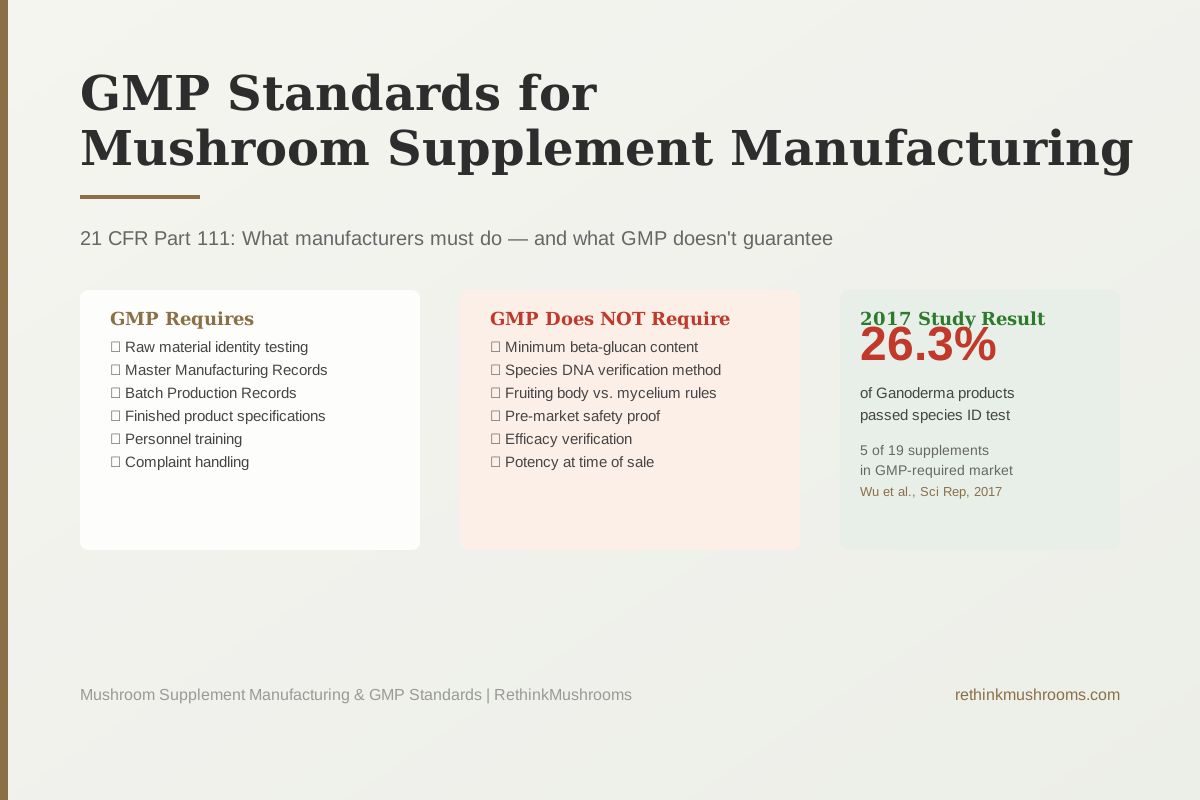
Only 5 of 19 commercially available Ganoderma supplements tested in the US had measured ingredients that matched their printed label, in a market where GMP compliance is legally required.
Wu et al., Scientific Reports, 2017
21 CFR Part 111
the FDA regulation that defines current Good Manufacturing Practice for dietary supplements
1994
year the Dietary Supplement Health and Education Act (DSHEA) passed, establishing the supplement framework
19 products
Ganoderma supplements tested in Wu 2017; only 5 had measured ingredients matching their labels
Wu et al., Scientific Reports, 2017
 View as image ↗
In 2017, researchers collected 19 commercially available Ganoderma (reishi mushroom) supplements sold in the United States and chemically tested each one against its label. Only 5 of them, 26.3%, had measured ingredients (triterpenes and polysaccharides) that were in accordance with what the label claimed.[4] This was not a fringe sample from discount retailers. These were products available in the same market where Good Manufacturing Practice (GMP) compliance is required by federal law.
That gap, between the legal requirement and the measurable outcome, is what this article explains. GMP is a meaningful regulation. It imposes real obligations on supplement manufacturers. It also has documented gaps, and understanding those gaps is more useful to anyone evaluating a mushroom supplement than simply knowing whether a GMP logo appears on the label.
For the broader regulatory framework governing what supplement companies can legally claim, see How the FDA Regulates Mushroom Supplements: The DSHEA Framework.
Key Takeaways
- FDA's Good Manufacturing Practice regulation for dietary supplements is 21 CFR Part 111 (current GMP, or cGMP), enacted fully in 2010 after phased implementation from 2007
- GMP requires identity testing of raw materials, batch production records for every manufacturing run, and finished product testing for identity, purity, strength, and composition
- GMP does not require minimum potency standards for mushroom-specific compounds (no minimum beta-glucan content is mandated) and does not verify efficacy
- Despite GMP being the legal requirement, only 26.3% of Ganoderma supplements tested in a 2017 US study had measured ingredients that matched their label claims (Wu et al., 2017)
- Third-party certifications from NSF International, USP, and the Natural Products Association go beyond FDA GMP by auditing facilities and testing actual product content
- FDA's inspection and pre-market review capacity is limited relative to the sheer number of supplement products and manufacturing facilities, constraining consistent oversight (Dwyer et al., 2018; Bailey et al., 2020)
How DSHEA Created the GMP Framework: The Law That Started Everything
The modern US supplement regulatory environment traces directly to the Dietary Supplement Health and Education Act of 1994 (DSHEA). Before DSHEA, dietary supplements were regulated more like foods, with some limited FDA oversight. DSHEA changed the framework in a fundamental way: it classified dietary supplements as a distinct category with specific rules that notably excluded the requirement for pre-market safety and efficacy proof.
Under DSHEA, a supplement manufacturer does not need to demonstrate to the FDA that a product is safe and effective before selling it. The FDA can only take action after a product is on the market and harm has been documented. This is the opposite of the drug approval pathway, where clinical evidence must be submitted and approved before a drug can be sold.[2]
The manufacturing quality standards under DSHEA took more than a decade to develop fully. The current GMP rules (21 CFR Part 111) were finalized in 2007 with a phased implementation that was complete by 2010, giving small manufacturers time to come into compliance. Since then, all US dietary supplement manufacturers have been legally required to follow these manufacturing standards.
The regulatory landscape for supplements is comprehensive but notably different from drug manufacturing in its oversight model: requirements are real, but enforcement is reactive rather than proactive.[1]
What 21 CFR Part 111 Actually Requires
The FDA's current GMP regulation for dietary supplements runs to dozens of pages of technical requirements. The core obligations that every supplement manufacturer must meet fall into several categories:
Raw material identity testing. Before any ingredient can be used in manufacturing, the facility must verify that it is the ingredient it claims to be. This means testing incoming raw material against reference standards to confirm identity. The standard does not specify which testing method must be used (chromatography, spectroscopy, DNA barcoding are all options), only that testing must be done and documented.
Master Manufacturing Records (MMR). For each product, manufacturers must maintain a written formula specifying every ingredient and quantity, plus instructions for every step of the manufacturing process. This is the template document against which every actual production run is measured.
Batch Production Records (BPR). Each time a product is manufactured, a batch record must document that the run followed the MMR. This includes personnel performing each step, equipment used, actual measurements taken, in-process testing results, and any deviations. Batch records must be reviewed before a product is released for sale.
Finished product specifications. Each product must have documented specifications for identity, purity, strength, and composition. The product must be tested against these specifications before release.
Personnel training. Everyone who works with supplements or manufacturing equipment must receive documented training appropriate to their role.
Facility and equipment standards. Manufacturing facilities must be designed and maintained to prevent contamination. Equipment must be cleaned and calibrated on documented schedules.
Complaint handling. Consumer complaints must be documented and investigated.
Adverse event reporting. Serious adverse events must be reported to the FDA.
These requirements are substantial and enforceable. They are also focused on process controls: the regulation specifies that a process must exist and be documented, and that documentation must be maintained. The regulation does not set specific potency thresholds for any ingredient, including beta-glucans in mushroom supplements.
GMP vs. cGMP: A Distinction That Matters in Principle
The "c" in cGMP stands for "current." FDA's regulation is officially titled the Current Good Manufacturing Practice regulation, and the distinction is meaningful in principle: manufacturers must follow practices that reflect the current state of science and technology, not just the practices that were standard when the rules were written.
In practical terms for supplement manufacturers, GMP and cGMP are used interchangeably and refer to the same 21 CFR Part 111 requirements. The dynamic obligation implied by "current" means that if testing technology advances, manufacturers may be expected to adopt improved methods even without a regulation change. DNA species verification, for example, has become a more accepted standard for botanical identity testing as the technology has improved.
The distinction between supplement cGMP (21 CFR Part 111) and pharmaceutical GMP (21 CFR Parts 210 and 211) is more significant. Drug GMP requirements are substantially more stringent: pharmaceutical manufacturers must validate manufacturing processes, use tighter contamination controls, and maintain higher levels of analytical verification. Supplement GMP is a different regulatory tier, appropriate for a category of products that does not require pre-market approval.
Who Must Comply: Every Link in the Supply Chain
Any company that manufactures, packages, labels, or holds dietary supplements for sale in the United States must comply with 21 CFR Part 111. This includes:
- Ingredient manufacturers who produce raw materials sold to supplement companies
- Contract manufacturers who make finished products for brands that outsource production
- Supplement companies that manage their own manufacturing
- Distributors and repackagers who handle finished products
- Foreign manufacturers who export supplements to US consumers
This broad scope means that even a supplement company that outsources all manufacturing to a contract facility bears responsibility for ensuring its supplier is GMP compliant. The brand name on the label is responsible for what goes into the product.
The enforcement of this broad requirement is where the documented gap appears. The FDA has limited inspection resources relative to the size of the supplement industry, which has grown substantially since DSHEA was enacted. Research documented that FDA's capacity for pre-market review and ongoing manufacturing inspections does not match the scale of the industry it oversees, an oversight gap driven by the sheer number of products and manufacturing facilities in the marketplace.[3]
Who Certifies GMP? Third-Party Programs Fill the Gap
FDA does not operate a GMP "certification" program. The agency inspects manufacturers and issues Warning Letters when violations are found, but there is no FDA certificate that a facility displays to prove ongoing compliance. Third-party organizations have developed certification programs to fill this gap.
NSF International. NSF/ANSI 173 is a dietary supplement-specific certification program that audits manufacturing facilities against GMP requirements. NSF certification means a facility was audited and found compliant at the time of the audit; it does not mean the facility's products have been tested for potency or label accuracy.
USP (United States Pharmacopeia). USP offers both facility GMP certification and a separate Dietary Supplement Verification Program. USP Verified is more stringent than NSF/ANSI 173 because it includes testing of the actual product to verify that it contains what the label claims. USP Verified products are tested for identity, potency, purity, and disintegration.
NPA (Natural Products Association). NPA's TruLabel certification is another third-party GMP audit program for supplement manufacturers.
NSF facility certification and NPA certification verify that manufacturing processes meet GMP standards. USP Dietary Supplement Verification is the strongest publicly available certification because it adds product testing to the facility audit. From a consumer perspective, a USP Verified mark means the product's contents were tested, not just the facility where it was made.
What GMP Does Not Guarantee: The Potency Gap
The Wu 2017 finding that only 26.3% of Ganoderma supplements had measured ingredients matching their label claims reveals the most important limitation of GMP as currently structured: it requires testing, but does not specify what passing looks like for mushroom-specific quality markers.[4]
Required vs. Verified
The Gap Between Legal Compliance and Actual Label Accuracy
Good Manufacturing Practice under 21 CFR Part 111 is mandatory for every US dietary-supplement manufacturer — a universal legal floor. But when Wu et al. (2017) chemically tested 19 US-market Ganoderma lucidum (reishi) supplements against their labels, most products did not match what they claimed.
Legally required to follow GMP (21 CFR Part 111)
100% · entire marketManufacturers, packagers, labelers, holders, and foreign exporters all fall under the requirement.
Actually matched their label when tested (Wu 2017)
5 of 19 · 26.3%The other 14 of 19 (73.7%) carried measured ingredients that did not match their printed label — in a market where GMP compliance is universally required.
GMP mandates that testing happen and be documented; it does not set a minimum beta-glucan content or a required species-verification method. The legal floor covers 100% of the market, yet fewer than one in four tested products matched its own label.
Sources: 21 CFR Part 111 (FDA cGMP for dietary supplements); Wu et al. (2017), Scientific Reports 7:7792 [ref 4].
Mushroom supplements have several quality dimensions that GMP does not specifically mandate:
Beta-glucan content. Beta-glucans are the polysaccharide compounds most associated with the immune-health effects attributed to mushrooms. GMP does not require any minimum beta-glucan percentage. A product can have all its GMP documentation in order and contain almost no beta-glucans.
Fruiting body vs. mycelium on grain. The substrate on which a mushroom grows, and whether a product is made from the mature fruiting body or from grain-colonized mycelium, has significant effects on beta-glucan content and alpha-glucan (starch) content. GMP does not address this distinction.
Species verification method. While GMP requires raw material identity testing, it does not specify that DNA barcoding must be used. A manufacturer using less precise methods may meet the documentation requirement while producing inaccurate results.
Potency at time of sale. GMP tests that the product met specifications at time of manufacture, not that it will maintain those specifications through its shelf life.
These gaps explain why GMP compliance and product quality are related but not equivalent. GMP is the floor of the manufacturing quality framework, not the ceiling. The Wu 2017 data demonstrates that the current floor permits a market where a majority of tested products did not match their own label claims.
For a consumer-facing explanation of how to evaluate product quality beyond GMP, see Mushroom Supplement Adulteration: How Widespread Is the Problem? and Starch Filler in Mushroom Supplements: The Dirty Secret. For how FDA's overall regulatory approach shapes what companies can claim, see FDA and Mushroom Supplements: How DSHEA Shapes What Companies Can (and Can't) Say.
What a GMP Audit Actually Looks Like
Whether conducted by FDA inspectors or third-party auditors, a GMP audit covers several consistent areas:
Document review. Auditors examine written procedures (Standard Operating Procedures), Master Manufacturing Records, batch production records, raw material testing records, employee training logs, and complaint files. A facility with well-maintained documentation is demonstrating GMP compliance regardless of what is happening on the production floor; a facility with poor records cannot demonstrate compliance even if its actual processes are sound.
Facility walkthrough. Physical inspection of the manufacturing area: cleanliness, pest control evidence, equipment calibration tags, temperature monitoring logs, and separation of manufacturing areas from office space. Cross-contamination risks are a particular focus.
Personnel observation. Auditors may watch manufacturing processes and ask workers questions about their training and the procedures they follow.
Laboratory review. The in-house testing laboratory (if the facility has one) receives specific attention: instrument calibration records, reference standard management, testing procedure documentation, and how out-of-specification results are handled.
Corrective Action review. How the facility has responded to past problems, whether internal discoveries or external complaints, is reviewed to assess whether the quality system is functioning properly.
FDA Warning Letters resulting from GMP inspections are public record and provide a reliable picture of what failure looks like. Common Warning Letter violations include: missing or inadequate identity testing procedures, batch records with missing or incomplete entries, specifications that do not cover all required quality attributes, and failure to investigate consumer complaints.
For the specific manufacturing and testing steps in supplement production, see cGMP Compliance for Mushroom Products: What Manufacturers Must Do and Quality Assurance in Mushroom Manufacturing: Best Practices.
The Bottom Line
GMP (Good Manufacturing Practice) for dietary supplements is defined by 21 CFR Part 111 and requires raw material identity testing, complete batch production records, finished product testing, and documented quality systems across personnel, facilities, and equipment. All US supplement manufacturers are legally required to comply. The regulation is meaningful but has specific gaps: it does not mandate minimum beta-glucan content, does not specify species verification methods precisely, and enforcement is constrained by FDA's limited inspection resources. The Wu 2017 finding that only 26.3% of tested Ganoderma supplements had measured ingredients matching their label claims demonstrates that GMP compliance does not guarantee product accuracy. Third-party certifications from NSF, USP, and NPA provide additional assurance, with USP Dietary Supplement Verification being the most comprehensive because it includes actual product testing.
Frequently Asked Questions
Sources & References
- 1RTHM-01165·Bailey, Regan L (2020). “Current regulatory guidelines and resources to support research of dietary supplements in the United States..” Critical reviews in food science and nutrition.Study breakdown →PubMed →↩
- 2RTHM-00735·Starr, Ranjani R (2015). “Too little, too late: ineffective regulation of dietary supplements in the United States..” American journal of public health.Study breakdown →PubMed →↩
- 3RTHM-00954·Dwyer, Johanna T et al. (2018). “Dietary Supplements: Regulatory Challenges and Research Resources..” Nutrients.Study breakdown →PubMed →↩
- 4RTHM-00499·Wu, Ding-Tao et al. (2017). “Evaluation on quality consistency of Ganoderma lucidum dietary supplements collected in the United States..” Scientific reports.Study breakdown →PubMed →↩