Mushroom Supplement Quality
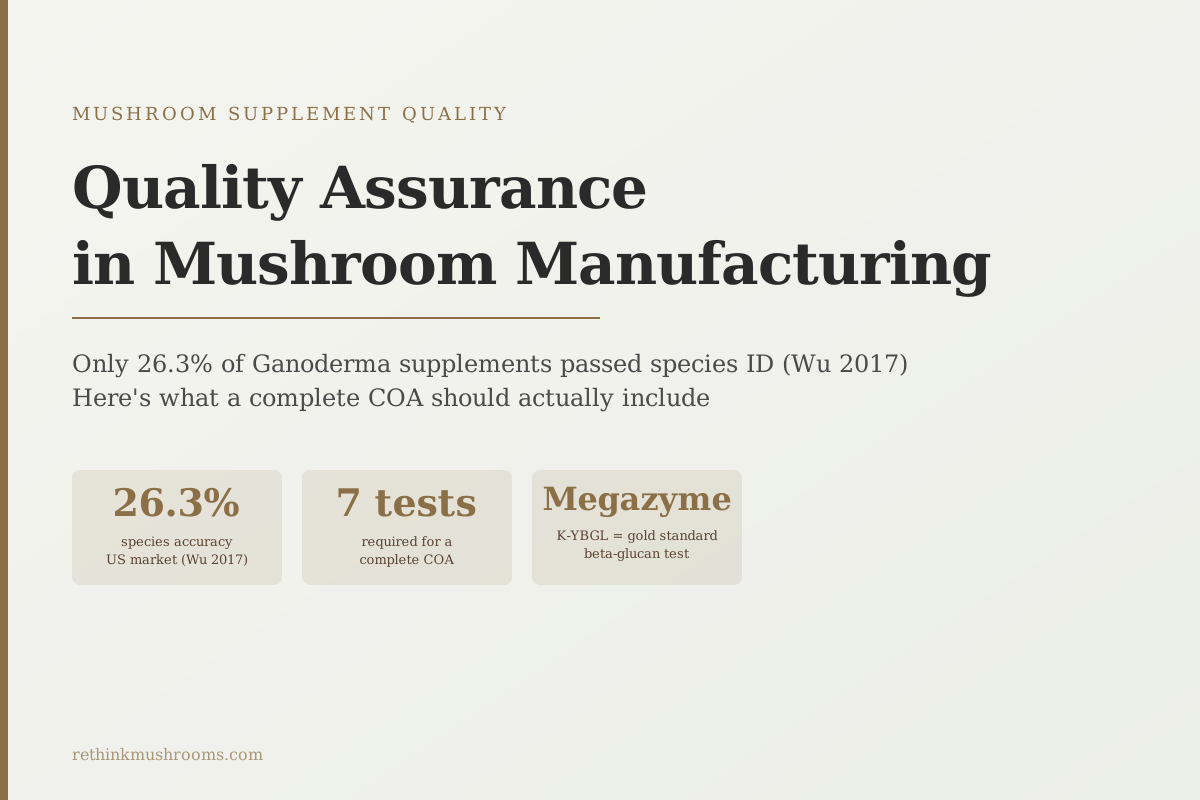
26.3% species accuracy rate
Only 5 of 19 commercially available Ganoderma supplements purchased in the United States contained the species indicated on the label — a 26.3% pass rate for the most fundamental quality test a supplement can face.
Wu et al., Sci Rep, 2017
7 tests
a complete mushroom supplement COA should cover: species ID, beta-glucan, alpha-glucan (starch), heavy metals, microbial, pesticides, water activity
Megazyme
standardized K-YBGL beta-glucan test method for mushrooms — used by NSF and USP-certified labs as the benchmark
≥20%
beta-glucan content minimum associated with meaningful immune support — products below this may not deliver effective doses
Wu et al., Sci Rep, 2017
 View as image ↗
When Wu and colleagues purchased 19 Ganoderma lucidum (reishi) supplements from US retailers in 2017 and tested them for basic species identity, only 5 passed — a 26.3% accuracy rate.[1] The other 14 products did not contain what their labels said they contained. Most contained different mushroom species or mycelium grown on grain substrate rather than actual fruiting bodies.
This is not a problem unique to reishi or to the United States. A 2023 analysis of the Italian mushroom supplement market documented the same pattern: widespread label inaccuracies, undisclosed ingredients, and quality claims unsupported by the product contents.[2]
The FDA's regulatory framework for dietary supplements — established under the Dietary Supplement Health and Education Act (DSHEA) and codified in the Current Good Manufacturing Practice regulations — requires manufacturers to verify ingredient identity, purity, and strength. Quality assurance programs translate those regulatory requirements into operational testing systems. The gap between what is required and what actually happens in the market is large enough that consumer verification of quality has become necessary, not optional.
This article explains what quality assurance in mushroom manufacturing looks like when done correctly, what tests should appear on a Certificate of Analysis, and how to interpret the results. For the broader regulatory context, see how the FDA regulates mushroom supplements: the DSHEA framework. For the full scope of quality failures in the mushroom supplement market, see the mushroom supplement quality crisis: why most products fail.
Key Takeaways
- Only 26.3% of commercially purchased Ganoderma supplements in the US passed species identity verification in a 2017 study — 14 of 19 products did not contain what the label claimed (Wu et al., Sci Rep, 2017)
- A 2023 Italian market analysis found the same pattern: widespread label inaccuracies, undisclosed additives, and unsubstantiated quality claims in mushroom supplements (Risoli et al., Nutrients, 2023)
- A complete mushroom supplement quality program requires seven test categories: species identity verification, beta-glucan content, alpha-glucan content (starch indicator), heavy metals, microbial contamination, pesticide residues, and water activity
- The standard beta-glucan test for mushrooms is the Megazyme K-YBGL enzymatic method — it distinguishes mushroom beta-glucans from starch, making it the only validated assay for quantifying active mushroom compounds (You et al., Crit Rev Food Sci Nutr, 2024)
- FDA's GMP regulations (21 CFR Part 111) require these testing systems but enforcement is reactive rather than pre-market — products can reach consumers before quality failures are caught (Bailey, Crit Rev Food Sci Nutr, 2020)
- Third-party certifications (NSF/ANSI 173, USP Verified) require product testing as well as facility audits, making them a more reliable quality signal than GMP certification alone
The Problem the Data Shows: Why QA Failures Persist Despite Regulations
The mushroom supplement market operates under a set of regulations that, on paper, should prevent most quality failures. The FDA's Current Good Manufacturing Practice regulations under 21 CFR Part 111 require manufacturers to establish written procedures for testing each batch of raw material before use, test or examine finished products against established specifications, and maintain records proving these steps were completed.
Despite these requirements, the failure rate documented in published research is striking. Wu and colleagues' 2017 analysis of Ganoderma supplements found that the majority of products on US retail shelves were misidentified at the species level — the most fundamental quality check possible.[1] Risoli and colleagues' 2023 analysis of the Italian market found similar patterns: products making quality claims that the actual contents couldn't support, additives not disclosed on labels, and dosing that wouldn't produce the effects described.[2]
A 2020 regulatory mapping study by Bailey in Critical Reviews in Food Science and Nutrition documented the structural reason this persists: the FDA's supplement enforcement model is post-market and reactive.[4] Supplements do not require pre-market review. The FDA can only take action after a product is already in distribution. With tens of thousands of supplement products on the market and limited FDA inspection resources, systematic enforcement of GMP requirements is not achievable at scale.
The result: manufacturers who cut corners on quality testing face low probability of detection, while consumers bear the risk of products that don't contain what's labeled. Quality assurance programs — and the Certificates of Analysis they produce — exist to fill that gap.
What a Quality Assurance System Actually Requires
Quality assurance in mushroom supplement manufacturing is not a single test. It is a system of controls applied at multiple stages of production, generating documented evidence at each step.
A complete QA system operates across three phases:
Raw material verification. Before any mushroom material enters the manufacturing process, it must be tested for species identity, contamination, and potency markers. Raw material testing is the first line of defense against quality failure. A shipment of dried mushroom powder that passes species verification and contamination screening before blending prevents problems that would be invisible in finished product testing alone.
In-process controls. During manufacturing, QA monitors critical parameters: extraction time and temperature, solvent concentrations, spray-drying conditions, encapsulation weight consistency. Deviations from validated parameters get documented, investigated, and resolved before the batch proceeds. This is where most of the contamination prevention work happens.
Finished product release testing. Before a batch ships, it must pass all release specifications. This is what appears on a Certificate of Analysis.
A Certificate of Analysis (COA) is a document listing the test results for a specific batch of product — the written record that a batch met its specifications before release. Every reputable mushroom supplement should have a COA available for every batch, ideally from an independent third-party laboratory rather than only the manufacturer's in-house lab.
The Seven Tests That Belong on Every Mushroom Supplement COA
A 2024 systematic review by You and colleagues in Critical Reviews in Food Science and Nutrition mapped the analytical methods validated for ingredient verification in immune-health botanical products — including mushroom supplements — and documented which tests detect which quality failures.[3] Based on this literature, seven categories of testing are necessary for a complete mushroom supplement QA program.
1. Species Identity Verification
The Wu 2017 data makes this the most consequential test for mushrooms. Species identity testing confirms that what's in the capsule matches the label. The two main methods are:
- DNA barcoding — a genetic identification technique that extracts DNA from the supplement and matches it against reference databases to confirm species. DNA barcoding is highly specific and can detect species substitution even when the material has been dried or extracted.
- Microscopy — physical examination of cell morphology. Useful as a complementary method but less specific than DNA for highly processed extracts where cell structures are damaged.
For extracted products, DNA barcoding may produce degraded results because extraction processing damages DNA. In these cases, chemical fingerprinting methods (such as HPLC chromatography, which measures the pattern of chemical compounds in the extract) can confirm species identity indirectly.
For a deeper look at DNA-based species verification specifically, see DNA testing for mushroom supplements: verifying species identity.
2. Beta-Glucan Content
Beta-glucans are the polysaccharide compounds in mushrooms that drive immune-supporting effects. Beta-glucan percentage is the primary potency marker for mushroom supplements. A supplement can pass species identity testing but contain very little active compound if it was processed from young, immature fruiting bodies or from grain-grown mycelium with low beta-glucan density.
The standard validated method is the Megazyme K-YBGL enzymatic assay. Megazyme is a food science testing company whose beta-glucan assay was specifically designed to measure (1,3)/(1,6)-β-glucans in mushrooms and distinguish them from starch. The K-YBGL method uses specific enzymes to break down only mushroom beta-glucans, not starch, then measures the resulting glucose by spectrophotometry.
Products labeled for immune support typically should have beta-glucan content of 20% or higher by dry weight to deliver meaningful doses at label serving sizes. This is not an FDA-mandated standard — it is a benchmark derived from clinical trial dosing. Products significantly below 20% beta-glucan may not provide effective amounts of the active compounds.
3. Alpha-Glucan Content (Starch Indicator)
Alpha-glucan is a form of starch. In a pure mushroom fruiting body product, alpha-glucan content should be minimal. High alpha-glucan levels indicate that the product contains significant grain substrate — the growing medium — rather than pure mushroom tissue.
This test is the chemical indicator for the problem documented in the Wu 2017 study: mycelium products grown on grain substrate (oats, rice, or corn) that incorporate the grain into the final product. The grain starch shows up as alpha-glucan. A high alpha-glucan, low beta-glucan ratio is a direct quality flag.
For a full explanation of this issue, see starch filler in mushroom supplements: the dirty secret.
4. Heavy Metals Panel
Mushrooms are bioaccumulators — they absorb metals from their growing substrate and environment. A comprehensive heavy metals test must cover at minimum:
- Lead (Pb) — target: less than 0.1 ppm (parts per million) per serving
- Cadmium (Cd) — target: less than 0.1 ppm per serving
- Arsenic (As) — total arsenic below 1.0 ppm; organic arsenic requires separate measurement
- Mercury (Hg) — target: less than 0.1 ppm per serving
These targets align with California Proposition 65 limits and NSF/ANSI 173 standards. Products sourced from unpolluted substrates with good agricultural practice compliance typically pass comfortably. Products sourced from low-quality suppliers in industrial growing regions may not.
5. Microbial Contamination
Mushroom products must test clean for:
- Total aerobic plate count (total bacterial load)
- E. coli and Salmonella (absence required in finished product)
- Total yeast and mold count
- Staphylococcus aureus
Inadequate drying — a risk in humid growing facilities or during transportation — allows mold to develop and potentially produce mycotoxins (toxic compounds that molds generate). Water activity measurement (a value from 0 to 1 indicating how much free water is available to support microbial growth) accompanies microbial testing: a water activity below 0.60 prevents mold growth in dried products.
6. Pesticide Residues
Conventional mushroom cultivation may use pesticides on the grain substrate or growing area. A standard pesticide panel covering the most common agricultural chemicals — organophosphates, pyrethroids, organochlorines — should confirm residues are below established safety thresholds. Certified organic products carry additional assurance but still require testing, as contamination can occur through substrate, water, or air exposure.
7. Potency and Label Claim Verification
For standardized extracts claiming specific compound percentages — polysaccharide percentage, triterpene percentage, specific compound content — the COA should include the test result for each labeled specification. HPLC (high-performance liquid chromatography) is the primary analytical method for quantifying triterpenes in reishi and other compounds with specific extraction profiles.
How to Read a Certificate of Analysis: What Good Results Look Like
A COA from a reputable manufacturer will include:
- Product name and batch/lot number — every batch should have its own COA
- Test method for each result — the Megazyme K-YBGL method for beta-glucan, specific ICP-MS or ICP-OES methods for heavy metals, PCR or DNA barcoding method for species identity
- Third-party lab name and accreditation — an ISO 17025-accredited laboratory provides independently verified results; manufacturer-only COAs carry less assurance
- Results with units and limits — each result should show the measured value, the acceptance limit, and whether the batch passed or failed
Red flags on a COA:
- No method cited (just a number with no analytical method listed)
- Results from an in-house lab only with no third-party verification
- Beta-glucan listed as "total polysaccharides" — this inflates the number by including starch
- Missing tests (no heavy metals, no species verification, no microbial data)
- Batch number that doesn't match the product bottle
Third-Party Certifications: What They Actually Verify
Third-party certifications add an independent layer beyond a manufacturer's own COA.
NSF/ANSI 173 is the primary US standard for dietary supplements. NSF certification involves an annual facility audit plus testing of certified products against their label claims. NSF can be searched by product at NSF.org; if a specific product batch is NSF-certified, it has passed both facility and product verification.
USP Verified applies similar standards: the product must match label claims for identity, potency, and purity, and manufacturing must follow USP quality standards. USP verification is product-specific, not just facility-wide.
ConsumerLab is an independent testing organization that purchases products retail and tests them without manufacturer involvement. ConsumerLab membership provides access to pass/fail records for hundreds of specific products. A ConsumerLab pass is one of the strongest independent quality signals available.
GMP certification alone — the FDA's minimum requirement — certifies that the facility has processes in place. It does not certify that the specific product meets its label claims. The Wu 2017 data makes this distinction essential: products from GMP-compliant facilities still failed basic species identity testing. The gap between facility certification and product verification is where quality failures live.
For a full breakdown of the difference between GMP and these third-party programs, see cGMP for mushroom supplements: manufacturing standards that separate quality from junk. For the full scope of adulteration in the supplement market, see mushroom supplement adulteration: how widespread is the problem?.
The Bottom Line
Only 26.3% of Ganoderma supplements purchased from US retailers passed basic species identity verification in published research, and the pattern holds internationally. A complete mushroom supplement quality assurance program requires seven test categories: species identity (DNA barcoding), beta-glucan content (Megazyme K-YBGL method), alpha-glucan content (starch indicator), heavy metals, microbial testing, pesticide residues, and potency verification. A Certificate of Analysis should include results from each category with methods cited and ideally from an accredited third-party laboratory. Third-party certifications like NSF/ANSI 173 and USP Verified add independent product testing that GMP facility certification alone does not provide.
Frequently Asked Questions
Sources & References
- 1. Source details for this reference are not yet available.
- 2. Source details for this reference are not yet available.
- 3. Source details for this reference are not yet available.
- 4. Source details for this reference are not yet available.