Mushroom Supplement Regulation
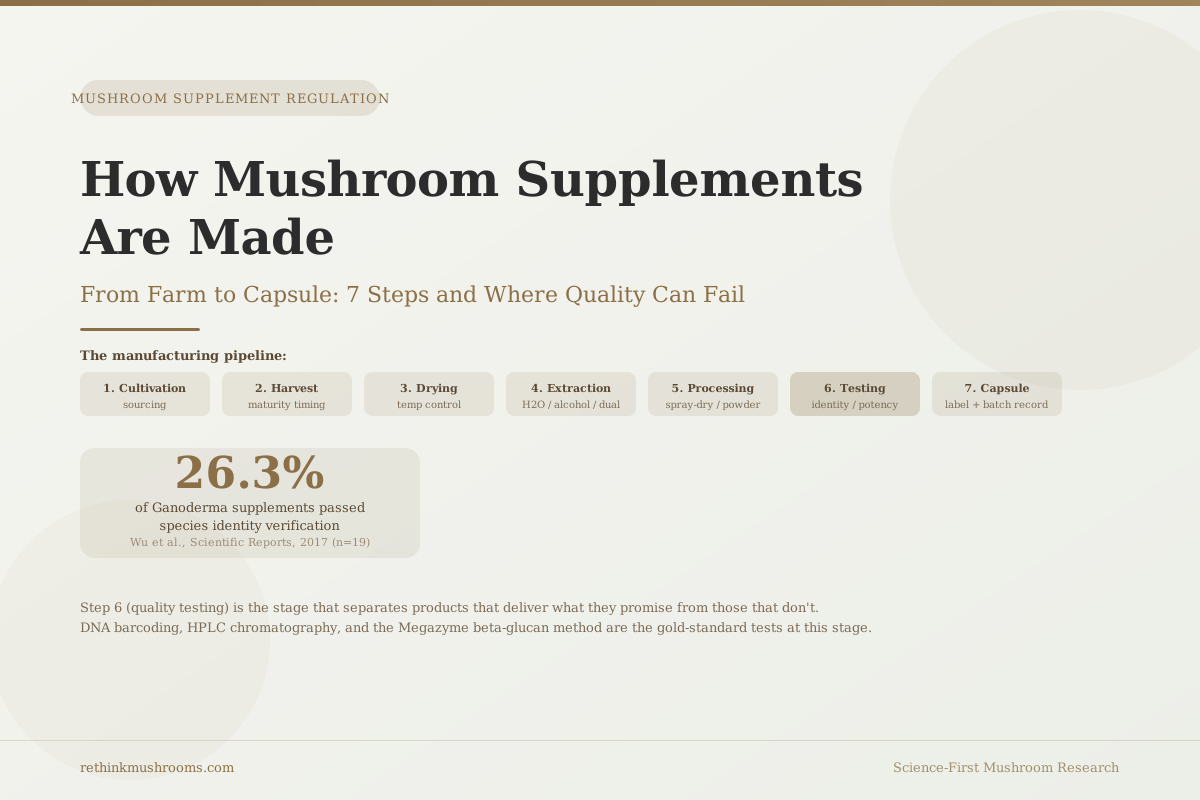
26.3% passed species verification
Only 5 of 19 commercially available Ganoderma supplements collected in the US contained the species listed on the label in a 2017 market study. The manufacturing process and testing decisions made upstream determine which products reach that bar.
Wu et al., Scientific Reports, 2017
7 steps
from cultivation to finished capsule
Hot water
standard extraction method for beta-glucans and polysaccharides
DNA barcoding
most definitive analytical method for species identity verification (You 2024)
Wu et al., Scientific Reports, 2017
 View as image ↗
Most people buying a mushroom supplement think of it as a simple product: mushrooms, dried, put in a capsule. The actual manufacturing process has seven distinct stages, and each one is a decision point where quality either gets built in or lost. Understanding how mushroom supplements are made is the foundation for understanding why two products with identical labels and similar prices can contain completely different amounts of the compounds they claim to provide. For the regulatory context around why this matters, see our overview of how the FDA regulates mushroom supplements.
Key Takeaways
- Mushroom supplements pass through at least seven manufacturing stages: cultivation/sourcing, harvest, drying, extraction, spray-drying or powder processing, quality testing, and encapsulation
- The most consequential early decision is starting material: whole fruiting bodies vs. mycelium grown on grain substrate; grain-substrate mycelium produces starch-heavy powder with low beta-glucan content
- Hot water extraction concentrates polysaccharides and beta-glucans; alcohol extraction captures triterpenes (reishi ganoderic acids); dual extraction uses both methods sequentially
- Unextracted powders and extracts are not equivalent: a "10:1 extract" label means little without beta-glucan percentage from a verified test
- Wu et al. (2017) tested 19 commercially available Ganoderma supplements and found only 26.3% contained the species indicated on the label, demonstrating that manufacturing failure rates are high even in a regulated market
- You et al. (2024) identified DNA barcoding, HPLC-based chromatography, and spectroscopy as the primary analytical methods for verifying species identity in mushroom products, which GMP-compliant manufacturers are expected to use
The 7 Steps From Cultivation to Capsule
The manufacturing pipeline for a mushroom supplement follows a consistent sequence regardless of species or brand. Each step has a quality-control role, and the absence of proper controls at any stage creates failure modes that downstream testing may or may not catch.
1. Cultivation or wild sourcing 2. Harvest at appropriate maturity 3. Drying under controlled temperature 4. Extraction (hot water, alcohol, or dual) 5. Spray-drying or powder processing 6. Quality testing (identity, potency, contaminants) 7. Encapsulation, labeling, and batch record completion
The steps in the middle determine the bioactive profile. The steps at the end determine whether that profile is accurately measured and reported.
Step 1: Cultivation and Sourcing: The Starting Material Decision
The most consequential quality decision in mushroom supplement manufacturing is made before any processing begins: what starting material goes into the supply chain.
Fruiting bodies vs. mycelium on grain
Reishi, lion's mane, chaga, and most medicinal mushrooms can be produced two ways: as mature fruiting bodies (the recognizable mushroom structure) or as mycelium grown on grain substrates (typically oats or brown rice). These are pharmacologically different materials, and they produce different supplement profiles.
Fruiting body material is what traditional medicine systems have used for centuries and what most clinical research has used. It contains the beta-glucans, triterpenes, and other compounds attributed to medicinal mushrooms.
Mycelium grown on grain is faster and cheaper to produce than fruiting bodies but comes with a built-in quality problem: the mycelium and its grain substrate are often processed together. The grain contributes starch (specifically alpha-glucans) to the finished product. Alpha-glucans inflate the apparent "total polysaccharide" reading that brands often report, while providing none of the immunological activity associated with beta-glucans.
For a detailed examination of the fruiting body vs. mycelium quality debate, see our article on fruiting body vs. mycelium on grain.
Geographic sourcing
Most commercial mushroom cultivation occurs in China and other parts of East Asia, where the industry has decades of established infrastructure. Some brands source from North American or European cultivation operations, often at higher cost and sometimes with different quality profiles. Substrate type and growing conditions vary by supplier.
Step 2: Harvest and Drying: The Window That Affects Compound Content
For cultivated fruiting bodies, harvest timing affects which bioactive compounds are present at peak concentration. For reishi specifically, different ganoderic acids peak at different developmental stages, and the cap (pileus) contains substantially more ganoderic acid per gram than the stem. These decisions are made at the cultivation site before any processing begins.
After harvest, drying is the first critical processing step. Most industrial mushroom drying uses hot-air convection dryers operating in the 50-80°C range. Freeze drying, which is more expensive and produces better compound retention for heat-sensitive bioactives like certain triterpenoids, is less commonly used at industrial scale.
Temperature matters because reishi's triterpenes and certain polysaccharide structures are thermally sensitive; they begin degrading at temperatures above roughly 60°C. The drying temperature used by a supplier is rarely disclosed in a finished supplement's labeling.
Step 3: Extraction: Hot Water, Alcohol, and Dual Methods
Raw dried mushroom material has limited bioavailability in whole-powder form because the bioactive compounds are locked inside fungal cell walls made of chitin, an indigestible structural material. Extraction breaks down the cell walls and dissolves the target compounds into a solvent, concentrating them for use in supplements.
Hot water extraction
Hot water extraction (also called aqueous extraction or "decoction") is the standard method for concentrating polysaccharides, including the beta-glucans primarily responsible for mushrooms' documented immune effects. Hot water dissolves polysaccharides from the mushroom material over several hours at temperatures typically above 80°C. The resulting liquid is then concentrated and spray-dried into powder.
Hot water extraction does NOT effectively capture triterpenes, which are fat-soluble compounds that require an organic solvent to dissolve.
Alcohol extraction
Alcohol extraction (ethanol) is used to capture fat-soluble compounds including triterpenes. For reishi, this captures ganoderic acids and other triterpene compounds associated with liver-protective and anti-inflammatory activity. Alcohol extraction does not efficiently capture polysaccharides.
Dual extraction
Dual extraction combines both methods, performing hot water extraction and alcohol extraction sequentially. This produces a finished extract with both polysaccharide and triterpene fractions. It is the method most commonly recommended for comprehensive reishi products because reishi contains meaningful amounts of both compound classes.
Unextracted powders
Some products on the market are simply dried, ground mushroom material without extraction. These are labeled as "mushroom powder" or sometimes just "mushroom" rather than "mushroom extract." They are not inherently inferior: if made from high-quality fruiting body material, they contain the full range of compounds present in the mushroom. But they typically provide lower concentrations of bioactives per gram than extracts, and they include the chitin-bound portion that may be less bioavailable.
The problem occurs when grain-substrate mycelium is used: a mycelium powder may contain more starch than any meaningful mushroom bioactive. A hot water extract of fruiting body material and a spray-dried mycelium powder look identical in a capsule. For more on this specific problem, see our article on starch filler in mushroom supplements.
Step 4: Spray-Drying and Powder Processing
After liquid extraction, the concentrated extract must be converted back into powder for encapsulation. The standard method is spray-drying: the liquid extract is atomized through a nozzle into a heated chamber, where moisture evaporates almost instantly and leaves behind fine dried particles.
Spray-drying typically requires a carrier material to help the extract powder flow and maintain stability. Common carriers include maltodextrin (a starch derivative) and silicon dioxide. Carrier materials are legitimate excipients at appropriate levels, but they also add non-mushroom content to the final powder, affecting the beta-glucan percentage per gram of finished product.
At this stage, some manufacturers perform standardization: adjusting the extract concentration to hit a target beta-glucan percentage (for example, 30% or 40%) by blending batches of different potency. Standardized extracts offer more consistent dosing across production batches.
Step 5: Quality Testing: What Reputable Manufacturers Actually Measure
Quality testing is the stage where manufacturing quality becomes visible. A complete quality testing program for a mushroom supplement covers several distinct areas.
Species identity verification
The most fundamental test asks: does this product contain the mushroom species stated on the label? You et al.'s 2024 systematic review in Critical Reviews in Food Science and Nutrition identified three primary analytical methods for species identity verification in mushroom products: DNA barcoding (which identifies species from genetic markers), HPLC-based chromatography (which identifies characteristic chemical fingerprints specific to certain species), and spectroscopy-based methods.[1]
DNA barcoding is considered the most definitive method for species identification because it directly reads genetic material unique to each species. The significance of this testing category is illustrated by Wu et al.'s 2017 study in Scientific Reports, which tested 19 commercially available Ganoderma (reishi) supplements collected from US markets.[2] Only 5 of 19 (26.3%) contained the species indicated on the label. Most contained different Ganoderma species or admixtures; several showed no detectable Ganoderma DNA at all.
Beta-glucan content
After species identity, the most important potency test for immune-active mushroom supplements is beta-glucan quantification. The Megazyme K-YBGL method (also called the Mixed-Linkage Beta-Glucan Assay) is the industry-recognized standard for measuring beta-glucan content and distinguishing it from alpha-glucans (starch). A product reporting "polysaccharide content" without specifying beta-glucan percentage using this method is not providing the relevant number.
Contaminant testing
A complete contaminant panel covers: heavy metals (lead, cadmium, arsenic, mercury), microbial content (including pathogens like Salmonella and E. coli and total mold/yeast counts), pesticide residues, and aflatoxins. Mushrooms are effective bioaccumulators and can concentrate heavy metals from their growing substrate, making heavy metal testing particularly relevant for wild-harvested or substrate-grown material.
What happens without this testing
For a full picture of the quality gap in the mushroom supplement market, see our article on cGMP for mushroom supplements: manufacturing standards that separate quality from junk.
Step 6: Encapsulation, Labeling, and Batch Records
Finished extract powder is blended with any additional excipients (anti-caking agents, flow aids) and filled into capsule shells, pressed into tablets, or processed into other delivery formats.
Capsule shells are typically either gelatin (animal-derived) or hydroxypropyl methylcellulose (plant-based, suitable for vegan products). The capsule shell material is usually disclosed on the label.
Under FDA's 21 CFR Part 111 cGMP requirements, manufacturers must create a Batch Production Record for each production batch. This document traces the entire manufacturing process: raw material lot numbers, in-process weights and measurements, equipment used, personnel involved, and quality control test results. The Certificate of Analysis (COA) issued to buyers summarizes the testing results for that specific batch.
A COA from a reputable manufacturer should include: species identity confirmation, beta-glucan percentage by the Megazyme method, heavy metals results with numerical values (not just "pass"), microbial results, and information about which third-party laboratory performed the testing.
For a guide to what a complete COA should contain, see our article on cGMP compliance for mushroom products.
The Gap Between Process and Outcome
Walking through these seven steps, a well-designed mushroom supplement manufacturing process clearly provides many points at which quality can be ensured. The Wu 2017 data shows what happens when it isn't: in a market where cGMP compliance is required by law, nearly three-quarters of tested Ganoderma products failed basic species verification.
The manufacturing process described above, done correctly, produces a mushroom supplement with verified species identity, measured beta-glucan content, clean contaminant results, and documented batch history. Done with shortcuts at any step (wrong substrate, incomplete extraction, absent testing, or species substitution), it produces a product that looks identical in its capsule and label but contains something different.
This gap between manufacturer process claims and verified product quality is why third-party product certification programs (NSF International's NSF/ANSI 173 and USP Verified) exist as a layer beyond GMP compliance. They audit not just the facility process but the actual finished product content.
For the broader context on mushroom supplement regulation and what the FDA does and doesn't require manufacturers to prove before products reach market, see our article on FDA and mushroom supplements under DSHEA.
The Bottom Line
Mushroom supplements pass through cultivation, harvest, drying, extraction, powder processing, quality testing, and encapsulation before reaching consumers. The starting material decision (fruiting body vs. mycelium on grain) and extraction method (hot water for beta-glucans, alcohol for triterpenes, dual for both) have the largest impact on bioactive content. Wu et al. (2017) found that only 26.3% of commercially tested Ganoderma supplements contained the labeled species, demonstrating that regulatory compliance does not guarantee product accuracy. You et al. (2024) identified DNA barcoding and HPLC chromatography as the primary tools for verifying species identity. A complete quality testing program covers species identity, beta-glucan content by the Megazyme method, heavy metals, and microbial contaminants.
Frequently Asked Questions
Sources & References
- 1. Source details for this reference are not yet available.
- 2. Source details for this reference are not yet available.