Indoor vs. Outdoor Mushroom Growing
2× bioactives in antler-form reishi
Under controlled ventilation, reishi grown into the antler form carried roughly twice the bioactive compounds of the flat conk form grown under the same conditions. Growing environment does not just affect yield; it shapes what you harvest.
Sudheer et al., LWT, 2018
log-grown
shiitake had higher bioactive content and antioxidant capacity than sawdust-grown (Nam 2021)
blue light
increased ergothioneine content in shiitake fruiting bodies (Kim 2024)
cold shock
supports beta-glucan-rich fruiting in Ganoderma (Cortina-Escribano 2020)
Sudheer et al., LWT, 2018
 View as image ↗
Every article about growing mushrooms at home eventually comes down to two decisions: indoor or outdoor, and which species to try first. Most guides treat these as separate questions. They're not.
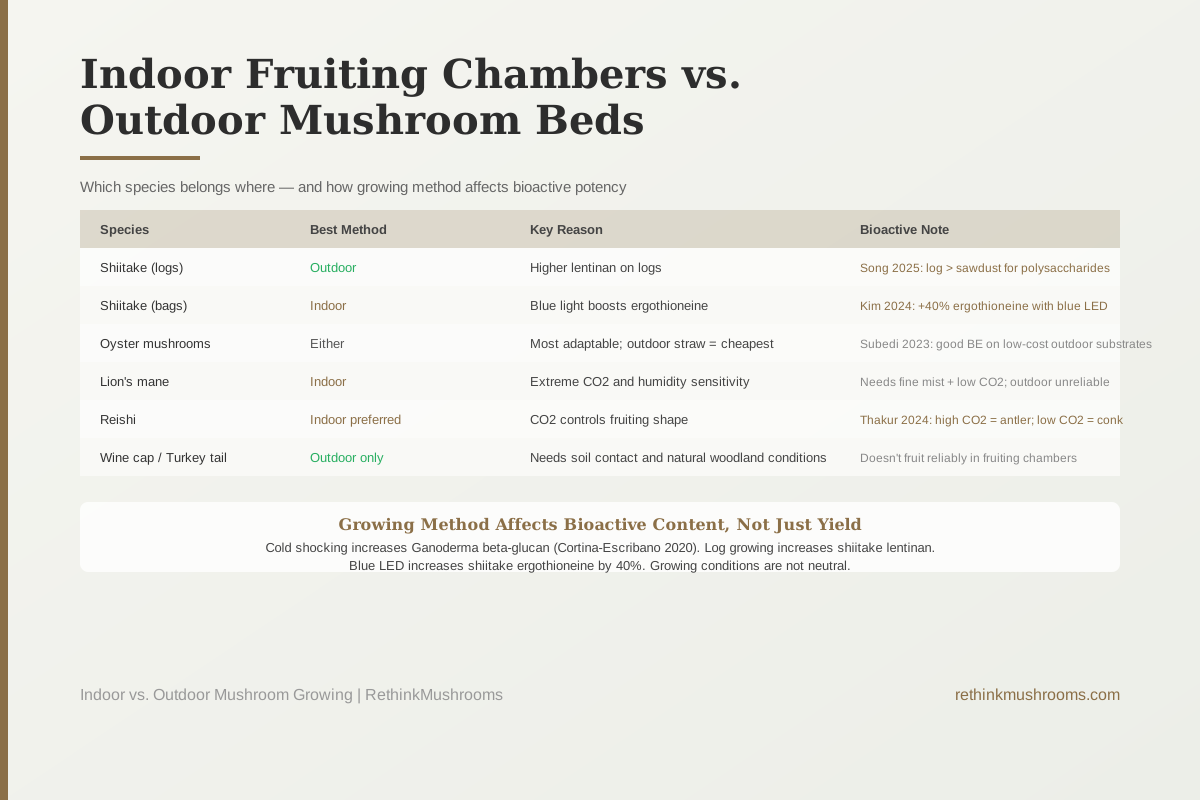
The best growing environment for a given mushroom species is partly practical (does it tolerate outdoor temperature swings?) and partly about compound quality (does the growing method affect the health compounds you harvest?). A 2021 study found that log-cultivated shiitake had higher concentrations of bioactive compounds and stronger antioxidant capacity than sawdust-grown shiitake, even though sawdust cultivation grows faster.[1] A 2024 study found that blue light during fruiting increased the ergothioneine content of shiitake mushrooms.[2] Growing conditions are not just about convenience. They affect what you harvest.
This guide covers which species belong in fruiting chambers, which belong in outdoor beds, and what the research shows about how each environment shapes compound quality.
For the full beginner context, see How to Grow Mushrooms at Home: A Complete Beginner's Guide.
Key Takeaways
- A fruiting chamber is an enclosed space (box, tent, or chamber) where temperature, humidity, CO2, and lighting are controlled; outdoor beds are unenclosed growing areas where seasonal conditions do the environmental work
- Log-cultivated shiitake had higher concentrations of bioactive compounds and stronger antioxidant capacity than sawdust-cultivated shiitake, while sawdust-grown material was higher in primary metabolites and grew faster (Nam et al., Biomolecules, 2021)
- Blue light during shiitake fruiting increased ergothioneine content compared with standard white light, making indoor growing with controlled LED lighting a bioactive quality advantage (Kim et al., Mycobiology, 2024)
- Reishi fruiting form is shaped by ventilation and the CO2 it controls: restricted airflow (high CO2) drives the elongated antler form, which carried roughly twice the bioactive compounds of the flat conk form grown under identical conditions (Sudheer et al., LWT, 2018)
- Wine cap (King Stropharia) and turkey tail grow best in outdoor beds with soil contact and natural woodland conditions; neither thrives in standard indoor fruiting chambers
- Lion's mane is essentially an indoor species due to its extreme sensitivity to CO2 buildup and dryness; outdoor growing is possible in high-humidity climates but not reliable
What Is a Fruiting Chamber?
A fruiting chamber is an enclosed environment where the grower controls the conditions that trigger and support mushroom fruiting: temperature, relative humidity, CO2 levels, and light. The enclosure can range from a clear plastic storage tub with holes drilled in the sides (the cheapest option, often called a "shotgun fruiting chamber") to a grow tent with automated misting, fans, and an environmental controller.
The point of a fruiting chamber is precision. You control when fruiting happens, how much moisture is available, and how much fresh air circulates. For species with specific environmental requirements or for year-round growing in climates that don't cooperate seasonally, this control is necessary.
For a deep dive into year-round indoor climate control parameters by species, see Year-Round Indoor Mushroom Growing: Climate Control Tips.
Species Guide: Indoor Fruiting Chamber vs. Outdoor Bed
| Species | Best Method | Why | Bioactive Note |
|---|---|---|---|
| Oyster mushrooms | Either | Tolerant and adaptable | Ergothioneine; outdoor straw beds are the lowest-cost option |
| Shiitake (logs) | Outdoor | Higher bioactive content on logs | Higher bioactive compounds and antioxidant capacity than sawdust (Nam 2021) |
| Shiitake (bags) | Indoor | Consistent year-round yield | Blue light increases ergothioneine content (Kim 2024) |
| Lion's mane | Indoor | Extreme CO2/humidity sensitivity | Needs fine mist, not spray; very low CO2 tolerance |
| Reishi | Indoor preferred | Ventilation/CO2 controls fruiting form | High CO2 = antler (≈2× bioactives); low CO2 = flat conk (Sudheer 2018) |
| Wine cap (King Stropharia) | Outdoor only | Needs soil contact, cool woodland conditions | Beta-glucans; natural stress likely beneficial |
| Turkey tail | Outdoor only | Grows on logs and stumps naturally | PSK/PSP content; logs are the natural substrate |
| Cordyceps militaris | Indoor only | Requires controlled light and temperature | Needs precise environmental control; not practical outdoors in most climates |
Outdoor-Only Species: When Soil and Woodland Conditions Matter
Two of the most interesting culinary-medicinal mushrooms essentially require outdoor growing: wine cap (Stropharia rugosoannulata) and turkey tail (Trametes versicolor).
Wine cap is the most beginner-friendly outdoor mushroom there is. It colonizes a thick layer of wood chips or straw spread on garden beds, fruits prolifically in cooler months (spring and fall), and can establish itself permanently in a woodland garden or shaded corner. It does not need a fruiting chamber, pasteurized substrate, or controlled environment. It needs moisture and a cool shaded spot. The spent substrate left behind also breaks down into the garden, which is why wine cap beds are a common companion to vegetable plots and wood-chip pathways.
Turkey tail grows on hardwood logs and stumps in a similar outdoor-preferred pattern. It is one of the most thoroughly researched medicinal mushrooms, with its PSK and PSP polysaccharide fractions studied extensively in Japan and Taiwan. It does not fruit easily in indoor fruiting chambers; it prefers the natural decomposition cycle of outdoor logs and the seasonal conditions that come with them.
For setting up outdoor beds, see Setting Up an Outdoor Mushroom Bed: A Beginner's Guide.
Species for Either Method: Shiitake and Oyster Mushrooms
Shiitake and oyster mushrooms both grow successfully indoors and outdoors, but the method you choose affects the result in different ways.
Shiitake: The Log vs. Sawdust Trade-off
Traditional log cultivation takes 18 to 24 months before first fruiting, while sawdust bag cultivation fruits in 3 to 6 months. That patience gap has a compound-quality payoff. Nam and colleagues compared the metabolic profile, bioactive compounds, and antioxidant capacity of shiitake grown on logs versus sawdust and found that log-cultivated mushrooms had higher concentrations of bioactive compounds and stronger antioxidant capacity, more closely resembling wild mushrooms. Sawdust-grown shiitake, by contrast, was higher in primary metabolites such as amino acids and grew faster.[1]
The longer colonization period on a real hardwood log appears to shift the mushroom toward a richer bioactive profile at the expense of raw growth rate. Sawdust blocks produce mushrooms faster and with consistent yield, but the balance tips toward primary metabolites rather than the antioxidant-active fraction.
Patience vs. Volume
Shiitake: Log vs. Sawdust Cultivation
Sawdust grows more mushroom, faster. Logs grow material with more bioactive compounds and stronger antioxidant capacity. Bars show which substrate runs higher for each attribute (directional, from Nam 2021).
Neither substrate is simply “better.” Sawdust bags win on speed and total volume; logs win on the medicinally interesting fraction. Choose by what you are growing for.
Source: Nam et al. (2021), Biomolecules (RTHM-01411). Log-cultivated shiitake showed higher bioactive-compound content and antioxidant capacity; sawdust-cultivated shiitake showed higher primary metabolites and faster growth. Bars are directional, not measured coordinates.
For outdoor log growers, the patience investment has a health-compound return. For indoor growers who want to strengthen the bioactive side of sawdust cultivation, Kim and colleagues found that growing shiitake under blue-spectrum LED lighting increased ergothioneine content compared to standard white lighting, with the highest ergothioneine levels (about 2.8 mg/g in the L808 cultivar) occurring under blue light.[2] Ergothioneine is the powerful antioxidant amino acid found almost exclusively in mushrooms. Indoor growers using blue LED supplement lighting can meaningfully boost one of shiitake's key health compounds.
For full log cultivation guidance, see Mushroom Log Cultivation in Your Backyard.
Oyster Mushrooms: Outdoor Straw Beds as the Cheapest Entry Point
Oyster mushrooms are the most versatile cultivated species, and outdoor straw beds are the most affordable growing method available to home growers. Subedi and colleagues confirmed in a 2023 study that oyster mushrooms perform strongly on paddy (rice) straw and other low-cost agricultural materials common in outdoor settings, with growth and yield parameters varying significantly by substrate mixture; rice straw alone gave the fastest colonization and cropping in their trial.[5]
Outdoor straw beds require no fruiting chamber, no humidity tent, and minimal equipment. The straw is pasteurized (a large pot of boiling water works), inoculated with grain spawn, and laid in a shaded outdoor area. Mushrooms fruit when temperature and humidity align, typically in spring and fall in most temperate climates.
For year-round production, indoor growing on straw in 5-gallon buckets or grow bags produces consistent harvests regardless of season. See How to Grow Oyster Mushrooms at Home: The Easiest Beginner Mushroom.
Indoor-Preferred Species: Lion's Mane and Reishi
Two of the most medicinally studied mushroom species are almost impossible to grow reliably outdoors in most climates: lion's mane and reishi.
Lion's Mane: CO2 and Humidity Make Outdoor Growing Unreliable
Lion's mane fruiting bodies are extraordinarily sensitive to CO2 buildup and to moisture loss. In an open outdoor environment, maintaining the 85 to 95% relative humidity required for proper fruiting while also ensuring enough airflow to prevent CO2 accumulation is practically very difficult outside of consistently humid climates (coastal regions, forests, etc.).
In a fruiting chamber, fine misting (not heavy spraying) and regular air exchanges manage this balance. The characteristic white pom-pom shape only develops when CO2 is kept low and humidity is maintained; outdoor growers in dry or variable climates will get irregular and often poor results.
Reishi: CO2 Determines the Shape of the Mushroom
Reishi (Ganoderma lucidum) gives indoor growers an extraordinary level of control: you can determine the shape of your harvest by controlling ventilation, and with it the CO2 that accumulates around the developing fruiting body.
Sudheer and colleagues investigated how ventilation and light drive the development of antler-type reishi. When primordia bags were kept under restricted ventilation, the CO2 the mushrooms produced through respiration built up and pushed development toward the elongated antler form; better fresh-air exchange favors the flat, disc-shaped conk form associated with traditional use. Critically, the difference is not only cosmetic: the antler-form fruiting bodies carried a roughly two-fold increase in bioactive compounds (phenolics, flavonoids, water-soluble polysaccharides, and ganoderic acid) compared with the conk form grown under the same conditions.[3]
Same Grow, Twice the Actives
Antler vs. Conk: Bioactive Content Compared
Under identical controlled conditions, antler-form reishi carried roughly a two-fold increase in every measured compound class. Bars are indexed to conk form (baseline = 1×); the ≈ 2× magnitude is what the study reports.
The trade-off the bars do not show: antler form yields less fresh-weight material per flush. Growers choosing antler are optimizing for concentration per gram, not total volume.
Source: Sudheer et al. (2018), Fungal Biology (RTHM-01011). All four compound classes showed a reported two-fold increase in antler vs. conk form; the shared ≈ 2× index reflects that single finding and does not imply per-class precision.
This makes fruiting-form control a genuine potency lever, not just an aesthetic one. Traditional herbalism describes the flat conk as the standard medicinal form, but the antler form concentrates more measured actives per gram. Whether you want conks for traditional use or antlers for maximum bioactive density, indoor ventilation control is the mechanism.
Outdoors, air is freely exchanged and reishi typically develops into the conk form, but control over temperature, humidity, and contamination risk remains a challenge.
How Growing Method Affects Bioactive Potency
The research on growing conditions and bioactive content is still developing, but several findings are already actionable.
Cold shocking helps drive beta-glucan-rich fruiting. Cortina-Escribano and colleagues cultivated Ganoderma lucidum on boreal wood residues and used cold shock treatments to trigger fruiting body formation, which simulates the seasonal temperature drop outdoor logs experience naturally. Beta-glucan content in the fruiting bodies varied with strain and wood substrate (highest on a Populus tremula-based substrate), and a 5 degrees C cold treatment was recommended to induce primordia and raise fruiting probability.[4] Indoor growers can replicate the cold trigger by chilling fruiting blocks before each cycle. Outdoor growers get it naturally in spring and fall.
Blue light boosts ergothioneine. Kim and colleagues found that blue-spectrum LED lighting during shiitake fruiting increased ergothioneine content relative to standard white light.[2] Outdoor natural light contains blue wavelengths that indoor standard incandescent or warm LED lighting lacks. Adding a blue-spectrum component to an indoor grow setup is a practical, research-supported intervention.
Log substrate raises bioactive content. Nam 2021 found that the patience of log cultivation produces shiitake with higher bioactive-compound content and stronger antioxidant capacity than faster sawdust cultivation.[1] This may reflect the more complex carbohydrate and phenolic environment of real wood versus prepared sawdust.
For the deeper science behind why growing conditions affect compound content, see Stress and Bioactive Production: How Challenging Conditions Make Stronger Mushrooms and Growing Mushrooms for Maximum Bioactive Content.
What Is the Cheapest Way to Grow Mushrooms at Home?
An outdoor straw bed for oyster mushrooms requires almost no equipment beyond a pot, some straw, and grain spawn (typically $5 to $15 per batch). The mushrooms fruit naturally when conditions align.
A basic indoor fruiting chamber can be built from a large clear plastic storage container, a small fan, and a cheap digital hygrometer for $20 to $50. For species that need more control (lion's mane, reishi), a grow tent with a fogger and environmental controller runs $200 to $400 and enables year-round production of the most demanding species.
Free substrate options make outdoor growing nearly free at steady state. See Free Mushroom Substrates: Coffee Grounds, Straw, and Cardboard.
The Bottom Line
Indoor fruiting chambers and outdoor mushroom beds suit different species and growing goals. Log-cultivated shiitake carries higher bioactive-compound content and antioxidant capacity than sawdust-bag cultivation, while sawdust grows faster (Nam 2021). Blue LED lighting increases shiitake ergothioneine content (Kim 2024). Ventilation and the CO2 it controls shape reishi fruiting form, with the high-CO2 antler form carrying roughly twice the bioactive compounds of the flat conk form (Sudheer 2018). Wine cap, turkey tail, and similar species require outdoor conditions. Lion's mane and reishi need indoor environmental control for reliable results. Oyster mushrooms grow well in both formats, with outdoor straw beds being the lowest-cost entry point.
Frequently Asked Questions
Sources & References
- 1RTHM-01411·Nam, Miso et al. (2021). “Metabolic Profiles, Bioactive Compounds, and Antioxidant Capacity in Lentinula edodes Cultivated on Log versus Sawdust Substrates..” Biomolecules.Study breakdown →PubMed →↩
- 2RTHM-01915·Kim, Min-Jun et al. (2024). “Effects of Blue Light on Fruiting Body Production and Ergothioneine Content During Sawdust Cultivation of Shiitake (Lentinula edodes)..” Mycobiology.Study breakdown →PubMed →↩
- 3RTHM-01011·Sudheer, Surya et al. (2018). “Development of antler-type fruiting bodies of Ganoderma lucidum and determination of its biochemical properties..” Fungal biology.Study breakdown →PubMed →↩
- 4RTHM-01183·Cortina-Escribano, Marta et al. (2020). “Effect of Strain, Wood Substrate and Cold Treatment on the Yield and β-Glucan Content of Ganoderma lucidum Fruiting Bodies..” Molecules (Basel.Study breakdown →PubMed →↩
- 5RTHM-01794·Subedi, Sobita et al. (2023). “Performance of oyster mushroom (Pleurotus ostreatus) on paddy straw, water hyacinth and their combinations..” Heliyon.Study breakdown →PubMed →↩