Growing Mushrooms at Home
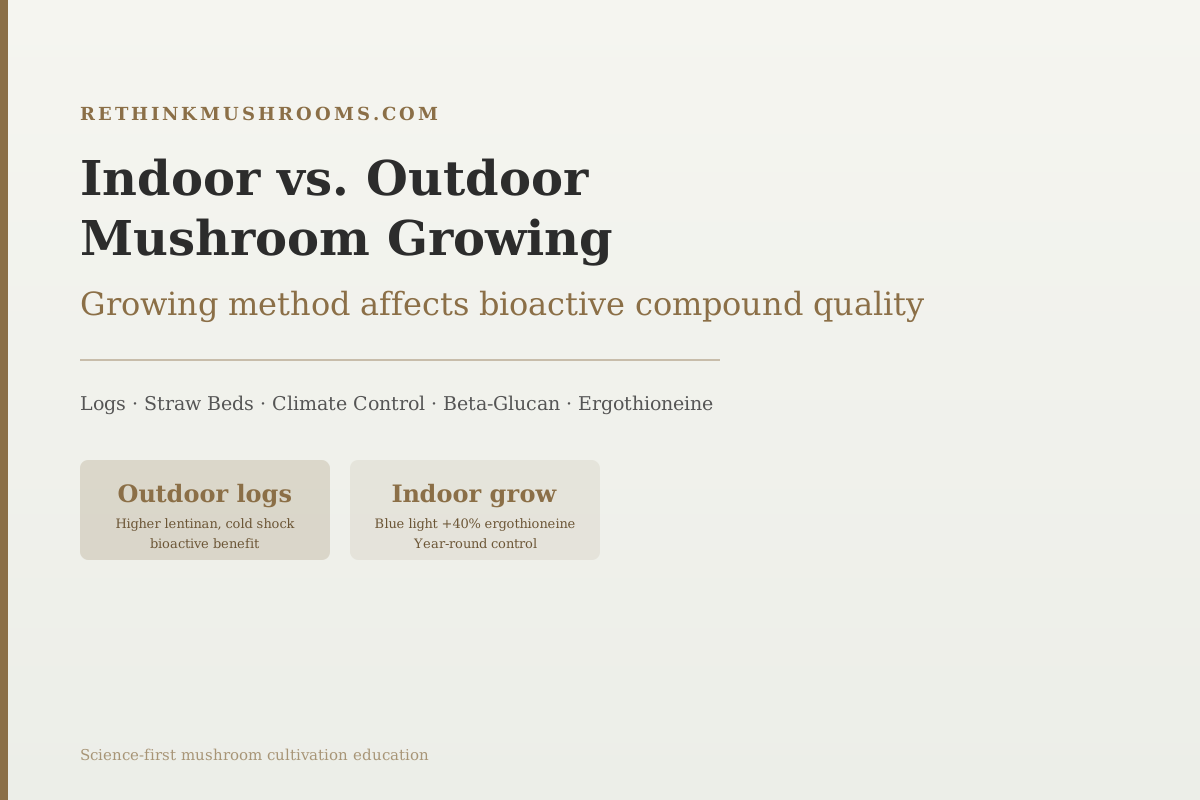
40% more ergothioneine
Blue light exposure during shiitake fruiting increased ergothioneine content by approximately 40% compared to standard lighting, suggesting that light management in indoor growing is a health compound optimization tool, not just a fruiting trigger.
Kim et al., Mycobiology, 2024
18-24 months
the incubation time for shiitake on hardwood logs, which a 2025 cultivation review found produces higher lentinan and beta-glucan content than faster sawdust block methods (Song et al., 2025)
Cold shocking
submerging logs in cold water for 24-48 hours before desired fruiting, shown to significantly increase both yield AND beta-glucan content in Ganoderma lucidum (Cortina-Escribano et al., 2020)
Spent substrate
the mushroom-colonized material left after harvest, which retains lignocellulosic enzymes and can be composted to significantly improve garden soil structure and microbial activity (Phan et al., 2012)
Kim et al., Mycobiology, 2024
 View as image ↗
Most comparison guides for indoor versus outdoor mushroom growing answer one question: which produces more mushrooms faster? That framing misses something important for anyone growing mushrooms for health benefits. The conditions a mushroom experiences during growth directly affect its bioactive compound profile. Temperature swings, substrate type, light exposure, and stress conditions influence not just fruiting success but how much beta-glucan, ergothioneine, and other active compounds end up in the mushroom you eventually eat.
This article covers both dimensions: the practical comparison (cost, effort, equipment, contamination risk, year-round capability) and the health compound quality dimension that no other growing guide addresses.
For the complete beginner introduction to home mushroom growing, see how to grow mushrooms at home: a complete beginner's guide.
Key Takeaways
- Outdoor growing creates natural stress conditions (temperature fluctuations, seasonal light cycles, substrate variation) that research suggests can increase bioactive compound production in some species
- Blue light exposure during shiitake fruiting increased ergothioneine content by approximately 40% compared to standard lighting, meaning indoor growers can actively optimize health compound levels through lighting choices (Kim et al., 2024)
- Log-cultivated shiitake has higher lentinan and beta-glucan content than faster sawdust block methods according to a 2025 cultivation review, giving the slower outdoor method a health-compound justification (Song et al., 2025)
- Cold shocking (submerging logs in cold water for 24-48 hours before fruiting) significantly increased both yield and beta-glucan content in Ganoderma lucidum, demonstrating that stress-response mechanisms improve compound quality, not just yield (Cortina-Escribano et al., 2020)
- Oyster mushrooms are the best species for beginner outdoor straw beds, with good biological efficiency on multiple low-cost substrates (Subedi et al., 2023)
- Spent outdoor mushroom substrate improves garden soil structure and microbial diversity; outdoor mushroom beds integrated with vegetable gardens provide a dual-use benefit (Phan et al., 2012)
The Question Competitors Miss: Which Growing Method Produces More Bioactive Compounds?
The standard comparison framework treats mushroom growing as a yield optimization problem. Indoor growing wins on control and consistency. Outdoor growing wins on simplicity and scale for some species. Neither framing asks what a health-focused grower actually cares about: which approach grows a more medicinal mushroom?
Recent research suggests the answer is more nuanced than either approach's proponents typically claim.
Outdoor growing exposes mushrooms to conditions that trigger stress responses: temperature swings from day to night, seasonal humidity variation, natural light spectrums including UV, and the physical characteristics of natural substrate like oak wood or straw. Stress conditions in biological systems often upregulate defensive compound production. The same logic applies to mushrooms: stress during development can push the organism to produce higher concentrations of the protective compounds that humans seek when eating them.
Indoor growing gives you control. But control means you can also engineer the stress conditions that matter. Blue light, cold shocking, and substrate selection can be deliberately applied indoors to replicate and sometimes exceed the bioactive benefits of outdoor stress conditions. The research base for doing this deliberately is new, and no competitor grows guide covers it.
For the scientific foundation of why stress conditions increase bioactive compound production, see stress and bioactive production: how challenging conditions make stronger mushrooms.
The Practical Comparison: Cost, Equipment, and What Can Go Wrong
| Factor | Indoor Growing | Outdoor Growing |
|---|---|---|
| Startup cost | $50-500+ (substrate, bags, misting, climate control) | $20-100 (spawn, logs or straw, basic tools) |
| Year-round capability | Yes, with climate control | Seasonal (spring/fall for most species) |
| Contamination risk | Higher (sterile technique required) | Lower (natural competition limits pathogen pressure) |
| Effort | High initial setup; moderate ongoing | Low setup; minimal maintenance |
| Species range | Broader (lion's mane, cordyceps, reishi antler form) | Narrower (oyster, shiitake, turkey tail, wine cap) |
| Space required | Small (closet, spare room, tent) | Garden space or log storage area |
| Harvest predictability | High (controlled environment) | Lower (weather-dependent) |
| Bioactive optimization | Possible with deliberate engineering | Partially automatic via natural conditions |
Indoor growing has a higher contamination risk because you are working in controlled-air environments where competitor molds (Trichoderma, Neurospora) can establish quickly if sterilization isn't thorough. Outdoor growing is more forgiving: the complex outdoor microbiome provides competitive pressure that reduces any single pathogen's ability to dominate.
Why Cold, Seasonal Stress May Produce More Medicinal Mushrooms Outdoors
The most significant research finding connecting outdoor growing conditions to bioactive compound quality is Cortina-Escribano et al.'s 2020 study on cold treatment in Ganoderma lucidum cultivation.[2] The study found that cold treatment (submerging logs in cold water for a shock period before fruiting) significantly increased both fruiting yield and beta-glucan content in the resulting mushrooms. Growing on oak versus beech substrate also significantly affected beta-glucan concentration.
Cold shocking is a practice traditional outdoor log cultivators have used for generations to trigger fruiting. The research now explains why it works: the temperature stress activates the same biological stress-response pathways that upregulate polysaccharide production. The cold is not just a fruiting trigger. It is a bioactive quality signal.
For outdoor growers using logs, this practice is easy to integrate: submerge the log in cold water for 24-48 hours when you want to trigger a flush, particularly after a dry period. For indoor growers, the cold shock technique can be replicated by moving blocks to a refrigerator overnight or using cold water soaks.
A 2025 systematic review of shiitake cultivation methods found that log cultivation produced higher lentinan and beta-glucan concentrations than sawdust block cultivation, despite the faster turnaround of the indoor method.[1] The 18-24 month patience investment for outdoor log shiitake produces a more potent mushroom than the 3-6 month indoor sawdust block. This doesn't make indoor growing wrong; it means the choice between methods has health compound implications worth knowing.
For more on how substrate choice affects health compounds, see how substrate composition affects mushroom health compounds.
What Blue Light Does to Shiitake's Health Compounds
The most actionable finding for indoor growers comes from Kim and colleagues' 2024 study on light effects during shiitake fruiting.[3] The study found that blue light exposure during the fruiting stage significantly increased ergothioneine content by approximately 40% compared to standard lighting, while also affecting the physical development of fruiting bodies.
Ergothioneine is a sulfur-containing antioxidant amino acid that mushrooms are among the only organisms that can synthesize in significant quantities. It accumulates in human tissues and has been associated with reduced oxidative stress and potential neuroprotective effects. Shiitake is one of the better dietary sources.
The practical implication: if you grow shiitake indoors, adding blue-spectrum LED light during the fruiting period could increase the ergothioneine content of your harvest by roughly 40%. This requires nothing more than swapping a standard white LED for a blue-weighted or full-spectrum LED that includes blue wavelengths (approximately 450-470nm).
Outdoor shiitake grown in partial shade with natural light gets some blue-wavelength exposure, but the spectrum is less optimizable than deliberate indoor blue light. This is a case where indoor growing may exceed the outdoor equivalent when the grower specifically optimizes for health compound content rather than just fruiting success.
Species Decision Guide: Who Goes Outdoors and Who Stays In
Not all species suit both environments equally. The choice of growing method should start with the species.
Oyster mushrooms (Pleurotus ostreatus): Excellent for outdoor straw beds. Subedi and colleagues found good biological efficiency on paddy straw, water hyacinth, and combinations, confirming multiple low-cost outdoor substrates work well.[4] Oyster mushrooms also grow well indoors on straw-filled buckets or grow bags. They are the best entry species for either method. See how to grow oyster mushrooms at home: the easiest beginner mushroom.
Shiitake (Lentinula edodes): Grows well outdoors on hardwood logs (highest bioactive content, slower) or indoors on sawdust blocks (faster, lower bioactive yield per the Song 2025 review). For health-focused growers, outdoor log cultivation is the stronger choice if you can wait. Indoor growing with blue light optimization and cold shocking can close some of the gap.
Lion's mane (Hericium erinaceus): Strongly favors indoor growing. Lion's mane is sensitive to CO2 buildup and low humidity, and outdoor conditions often provide the wrong combination of both. It needs fine misting (not spray) and high fresh air exchange. The fruiting bodies are fragile and weather-exposed. See growing lion's mane at home: from spawn to harvest in 3 weeks.
Reishi (Ganoderma lucidum): Can be grown either way, but indoor growing allows CO2 management that determines fruiting form. High CO2 (above 5,000 ppm) produces the dramatic antler form; lower CO2 produces the flat conk. Outdoor reishi on logs produces the natural flat form. Both contain similar compounds.
Wine cap / King Stropharia (Stropharia rugosoannulata): Almost exclusively outdoor. Needs soil contact and cool, moist conditions that outdoor beds naturally provide. One of the easiest species to establish in a garden bed.
Turkey tail (Trametes versicolor): Outdoor only, on natural hardwood logs or stumps. Produces reliably in woodland conditions but is not suitable for indoor fruiting chambers.
The Sustainability Bonus: What Outdoor Growing Does for Your Garden Soil
One advantage of outdoor mushroom growing that no competitor guide addresses is the effect on garden soil.
Phan and colleagues' analysis of spent mushroom substrate found it retains significant lignocellulosic enzymes after the fruiting cycle, including laccases, peroxidases, and cellulases that continue breaking down organic matter.[5] When incorporated into garden soil, spent mushroom substrate improves aeration, moisture retention, and microbial diversity. The fungal mycelium that colonized the substrate continues forming beneficial relationships with plant roots.
For home growers with a vegetable garden, an outdoor mushroom bed positioned near the garden provides dual use: mushroom harvests in spring and fall, followed by spent substrate that improves the soil for summer vegetables. Wine cap mushroom beds established between garden rows are a particularly efficient integrated system.
This sustainability dimension makes outdoor growing more appealing even for growers who might prefer indoor methods otherwise. The spent material doesn't go to waste.
The Bottom Line
Indoor and outdoor mushroom growing each have practical advantages, but the decision also affects bioactive compound quality. Outdoor log cultivation produces higher lentinan and beta-glucan in shiitake than indoor sawdust methods (Song et al., 2025), and cold shocking improves beta-glucan in Ganoderma (Cortina-Escribano et al., 2020). Indoor growing allows deliberate optimization: blue light increases shiitake ergothioneine by 40% (Kim et al., 2024). Species selection matters: oyster mushrooms suit both environments, lion's mane is strongly indoor, wine cap and turkey tail are outdoor only. Spent outdoor substrate improves garden soil.
Frequently Asked Questions
Sources & References
- 1RTHM-02183·Song, Xiaoxia et al. (2025). “Cultivation methods and biology of Lentinula edodes..” Applied microbiology and biotechnology.Study breakdown →PubMed →↩
- 2RTHM-01183·Cortina-Escribano, Marta et al. (2020). “Effect of Strain, Wood Substrate and Cold Treatment on the Yield and β-Glucan Content of Ganoderma lucidum Fruiting Bodies..” Molecules (Basel.Study breakdown →PubMed →↩
- 3RTHM-01915·Kim, Min-Jun et al. (2024). “Effects of Blue Light on Fruiting Body Production and Ergothioneine Content During Sawdust Cultivation of Shiitake (Lentinula edodes)..” Mycobiology.Study breakdown →PubMed →↩
- 4RTHM-01794·Subedi, Sobita et al. (2023). “Performance of oyster mushroom (Pleurotus ostreatus) on paddy straw, water hyacinth and their combinations..” Heliyon.Study breakdown →PubMed →↩
- 5RTHM-00260·Phan, Chia-Wei et al. (2012). “Potential uses of spent mushroom substrate and its associated lignocellulosic enzymes..” Applied microbiology and biotechnology.Study breakdown →PubMed →↩