Chaga Anti-Inflammatory Mechanisms
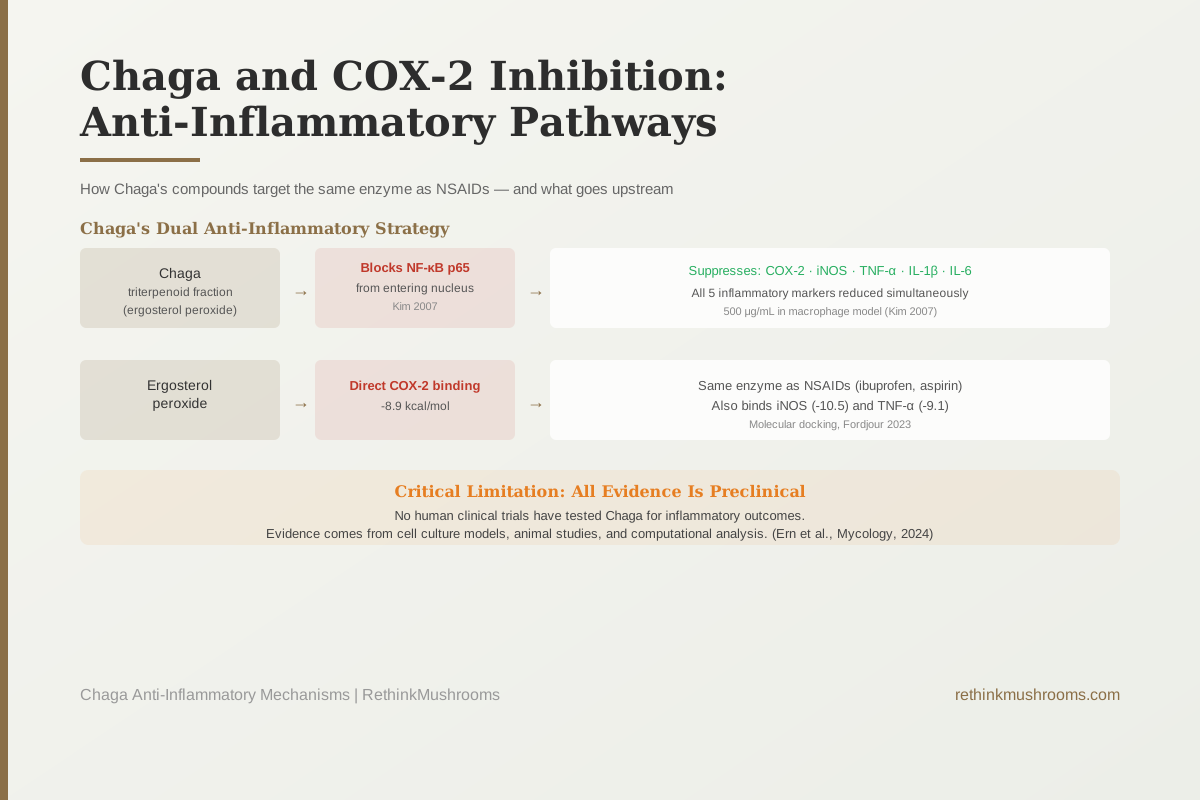
-8.9 kcal/mol ergosterol peroxide binding to COX-2
Molecular docking analysis found ergosterol peroxide from Chaga binds COX-2 at -8.9 kcal/mol binding energy. This is the same enzyme that ibuprofen and aspirin target, through a different chemical route.
Fordjour et al., Frontiers in Pharmacology, 2023
NF-κB p65
blocked from cell nucleus by Chaga ethanol extract (Kim 2007)
5 markers
simultaneously suppressed by Chaga extract in macrophages (Kim 2007)
preclinical only
no human clinical trials on Chaga for inflammation (Ern 2024)
Fordjour et al., Frontiers in Pharmacology, 2023
 View as image ↗
Ibuprofen, aspirin, and naproxen all work by blocking the same enzyme: cyclooxygenase-2 (COX-2). This enzyme produces prostaglandins, chemical signals that cause the pain and swelling associated with inflammation. COX-2 inhibition is one of the most validated anti-inflammatory mechanisms in pharmacology.
Chaga (Inonotus obliquus) inhibits COX-2. The mechanism involves a compound called ergosterol peroxide, which molecular docking analysis found binds to the COX-2 enzyme at a binding energy of -8.9 kcal/mol, indicating strong molecular affinity.[4] But Chaga's anti-inflammatory mechanism does not stop at COX-2. It also blocks NF-κB, the upstream molecular switch that turns on COX-2 and dozens of other inflammatory genes simultaneously.
Understanding the distinction between these two targets explains both why Chaga has attracted serious research attention and why none of the research has produced a clinical trial in humans.
For a broader overview of Chaga, see What Is Chaga Mushroom? The King of Medicinal Mushrooms.
Key Takeaways
- Chaga inhibits COX-2 (cyclooxygenase-2) through ergosterol peroxide, which molecular docking found binds COX-2 at -8.9 kcal/mol binding energy; COX-2 is the enzyme targeted by NSAIDs including ibuprofen and aspirin (Fordjour et al., Frontiers in Pharmacology, 2023)
- A 2007 foundational study (Kim et al., Journal of Medicinal Food) found Chaga ethanol extract simultaneously suppressed five inflammatory markers in macrophages (NO, PGE2, TNF-α, IL-1β, IL-6) by blocking NF-κB p65 from entering cell nuclei
- Inotodiol, a lanostane-type triterpene unique to Chaga, demonstrated anti-inflammatory efficacy in animal models at acceptable toxicity levels (Nguyen et al., Molecules, 2022)
- Maza and colleagues (Frontiers in Immunology, 2021) found inotodiol modulates dendritic cells in an atypical pattern, activating some maturation markers while suppressing inflammatory cytokine output, suggesting it shifts immune responses toward tolerance
- Ern and colleagues (Mycology, 2024), the most current comprehensive Chaga review, confirmed the anti-inflammatory mechanisms via NF-κB, COX-2, and iNOS inhibition while noting that essentially all evidence is preclinical; no human clinical trials on Chaga anti-inflammatory effects have been completed
- Chaga inhibits COX-2 through a different chemical route than NSAIDs and cannot replace them for acute pain management; the preclinical evidence supports a role in chronic inflammatory pathway modulation, not acute symptom relief
What COX-2 Is and Why It Matters
COX-2 (cyclooxygenase-2) is an enzyme that converts arachidonic acid (a fat in cell membranes) into prostaglandins, a family of chemical signals that cause pain, swelling, and fever at sites of inflammation or injury. When your ankle swells after a sprain, prostaglandins produced by COX-2 are a major reason.
Non-steroidal anti-inflammatory drugs (NSAIDs), the family that includes ibuprofen, aspirin, and naproxen, work by blocking COX-2. This reduces prostaglandin production and relieves pain and swelling. COX-2 inhibition is one of the most extensively studied anti-inflammatory mechanisms in medicine, with clinical evidence from thousands of trials.
COX-2 does not act independently. Its expression is controlled upstream by a protein complex called NF-κB (nuclear factor kappa B). When NF-κB is activated inside a cell, it migrates into the cell's nucleus and turns on the genes for COX-2, for nitric oxide synthase (iNOS), and for inflammatory cytokines including TNF-α, IL-1β, and IL-6. NF-κB is, in effect, the master switch that turns on multiple inflammatory processes including COX-2 expression.
The reason this structure matters: blocking only COX-2 (the NSAID approach) addresses one branch of the inflammatory cascade. Blocking NF-κB upstream addresses the entire cascade simultaneously. This is the distinction between NSAIDs and corticosteroids, which act upstream of NF-κB.
Chaga operates at both levels.
How Chaga Inhibits COX-2: Ergosterol Peroxide
The compound primarily responsible for Chaga's COX-2 inhibition is ergosterol peroxide, a modified form of ergosterol (the fungal equivalent of cholesterol found in mushroom cell membranes).
Fordjour and colleagues, publishing a comprehensive Chaga review in Frontiers in Pharmacology in 2023, included molecular docking analysis mapping Chaga compounds to their inflammatory enzyme targets.[4] Molecular docking is a computational method that predicts how well a molecule fits into the active site of an enzyme, estimating how strongly they interact. A more negative binding energy value indicates a stronger predicted interaction.
For ergosterol peroxide at COX-2, the binding energy was -8.9 kcal/mol. For comparison, the same analysis found ergosterol peroxide binding iNOS (the enzyme that produces nitric oxide) at -10.5 kcal/mol and TNF-α at -9.1 kcal/mol. All three represent strong molecular interactions.
These binding energy values are computational predictions, not direct measurements of inhibition in a living system. But they provide a mechanistic rationale for why ergosterol peroxide appears consistently in the list of Chaga's anti-inflammatory compounds in in vitro studies.
The Upstream Block: NF-κB Inhibition
The most mechanistically important study of Chaga's anti-inflammatory action is Kim and colleagues, published in the Journal of Medicinal Food in 2007.[1]
Kim's team exposed RAW 264.7 macrophages (immune cells commonly used in inflammation research) to LPS, a bacterial component that reliably triggers strong inflammation. They then added Chaga ethanol extract at various concentrations and measured multiple inflammatory markers.
At 500 micrograms per milliliter, the extract significantly suppressed:
- Nitric oxide (NO) production
- PGE2 (a prostaglandin produced by COX-2)
- TNF-α (a cytokine that drives inflammation)
- IL-1β (a cytokine involved in fever and acute inflammation)
- IL-6 (a cytokine that coordinates immune responses)
They also found that COX-2 protein expression was significantly reduced at this concentration, and that iNOS (the enzyme producing nitric oxide) was suppressed.
The mechanistic finding was that Chaga extract blocked NF-κB p65, the active subunit of the NF-κB complex, from entering the cell nucleus. This upstream block is what explains the simultaneous reduction in multiple inflammatory markers. When NF-κB p65 cannot enter the nucleus, it cannot switch on the genes for COX-2, iNOS, TNF-α, IL-1β, or IL-6.
The triterpenoid fraction of Chaga was identified as the key active component. This aligns with the later molecular docking evidence pointing to ergosterol peroxide as the specific compound interacting with COX-2 and related targets.
Inotodiol: Chaga's Second Anti-Inflammatory Compound
Inotodiol is a lanostane-type triterpenoid found specifically in Chaga. It is distinct from ergosterol peroxide and has been studied separately for its anti-inflammatory properties.
Nguyen and colleagues published an animal model study in Molecules in 2022 evaluating inotodiol as an anti-inflammatory agent.[2] They found inotodiol produced anti-inflammatory efficacy in the animal model with an acceptable toxicity profile, establishing it as a viable candidate for further research.
Maza and colleagues published a mechanistically detailed study in Frontiers in Immunology in 2021, examining how inotodiol affects dendritic cells, which are immune cells that serve as bridges between the innate and adaptive immune systems.[3] They found inotodiol causes what they describe as "atypical maturation" of dendritic cells: it activates some maturation surface markers while simultaneously suppressing the inflammatory cytokine output that normally accompanies full dendritic cell activation.
This unusual pattern suggests inotodiol may shift dendritic cell behavior toward immune tolerance rather than immune activation. Inflammatory diseases involve excessive immune activation; a compound that shifts dendritic cells toward tolerance without simply suppressing all immune activity could be useful in chronic inflammatory conditions where the immune system is overreacting to stimuli that should not provoke a strong response.
For more on inotodiol specifically, see Inotodiol: Chaga's Other Important Bioactive Compound.
What Chaga's Full Anti-Inflammatory Mechanism Looks Like
Taken together, the research paints a multi-target picture:
- Ergosterol peroxide acts on COX-2 and iNOS (the enzymes producing prostaglandins and nitric oxide)
- NF-κB inhibition (via the Chaga triterpenoid fraction broadly) blocks the upstream transcription of COX-2, iNOS, and multiple cytokines simultaneously
- Inotodiol modulates dendritic cell behavior toward tolerance, affecting the adaptive immune component of inflammation
- Polysaccharide fractions of Chaga also reduce cytokine activity, through mechanisms that appear distinct from the triterpenoid pathways
The 2023 Fordjour review in Frontiers in Pharmacology explicitly maps these pathways, noting that Chaga's anti-inflammatory action spans the NF-κB, MAPK, and Nrf2 signaling pathways, with different compounds primarily responsible for each.[4]
This multi-target pattern is different from NSAIDs, which primarily block COX-2 specifically. It is more comparable to corticosteroids in breadth of target, though the mechanism is entirely different and the potency is not comparable.
The Honest Limitation: No Human Clinical Trials
Ern and colleagues published the most current comprehensive review of Chaga's therapeutic properties in Mycology in 2024.[5] They confirmed the anti-inflammatory mechanisms across NF-κB, COX-2, and iNOS inhibition, and they noted a critical gap: essentially all Chaga anti-inflammatory evidence is preclinical.
No human clinical trials have been completed testing Chaga for inflammatory outcomes. The evidence comes from:
- Cell culture studies (macrophages treated with LPS, a bacterial mimic)
- Animal models (mouse colitis, mouse inflammation models)
- Computational analysis (molecular docking)
This is a large gap between mechanism and clinical application. The preclinical evidence is consistent and mechanistically plausible. But we do not know at what doses the mechanisms operate in humans, whether orally consumed Chaga produces the relevant compounds at the right concentrations in vivo, or whether the effects observed in isolated cells replicate in the complex environment of human physiology.
Can Chaga Replace Ibuprofen for Inflammation?
No.
Ibuprofen's anti-inflammatory and analgesic effects are established in dozens of human clinical trials across millions of patients. The mechanism is well-understood and the dose-response is predictable.
Chaga's COX-2 inhibition is demonstrated in cell culture and computational analysis. The effective concentration in those cell studies (500 μg/mL for Kim 2007) is a laboratory parameter, not a clinical dose. We do not know how much Chaga tea or extract a person would need to consume to achieve comparable COX-2 inhibition in inflamed tissue, or whether it would be sufficient for acute pain relief.
The more reasonable framing for Chaga, based on available evidence: it contains compounds that modulate inflammatory pathways through mechanisms that are well-characterized in vitro. This makes it an interesting candidate for research into chronic inflammation, where the goal is long-term pathway modulation rather than acute symptom suppression. For acute pain from an injury, the evidence supports NSAIDs, not Chaga.
For the broader evidence on Chaga for chronic inflammation, see Chaga for Chronic Inflammation: What the Studies Show. For the NF-κB mechanism in more depth, see Chaga and Inflammation: NF-kB Inhibition Research. For Chaga's IBD-related preclinical evidence, see Chaga and Inflammatory Bowel Disease: Preclinical Evidence.
The Bottom Line
Chaga inhibits COX-2, the enzyme targeted by NSAIDs, via ergosterol peroxide at a molecular docking binding energy of -8.9 kcal/mol (Fordjour 2023). It also blocks NF-κB p65 upstream, which suppresses COX-2 expression along with iNOS, TNF-α, IL-1β, and IL-6 simultaneously in macrophage models (Kim 2007). Inotodiol, a Chaga-specific triterpenoid, modulates dendritic cell behavior toward immune tolerance (Maza 2021). All evidence is preclinical; no human trials on Chaga for inflammation exist. Chaga cannot replace NSAIDs for acute pain, but the mechanistic case for investigating its role in chronic inflammatory pathway modulation is substantive.
Frequently Asked Questions
Sources & References
- 1RTHM-00117·Kim, Ho-Gyoung et al. (2007). “Ethanol extract of Inonotus obliquus inhibits lipopolysaccharide-induced inflammation in RAW 264.7 macrophage cells..” Journal of medicinal food.Study breakdown →PubMed →↩
- 2RTHM-01592·Nguyen, Thi Minh Nguyet et al. (2022). “Evaluation of Toxicity and Efficacy of Inotodiol as an Anti-Inflammatory Agent Using Animal Model..” Molecules (Basel.Study breakdown →PubMed →↩
- 3RTHM-01402·Maza, Perry Ayn Mayson A et al. (2021). “Inotodiol From Inonotus obliquus Chaga Mushroom Induces Atypical Maturation in Dendritic Cells..” Frontiers in immunology.Study breakdown →PubMed →↩
- 4RTHM-01694·Fordjour, Eric et al. (2023). “Chaga mushroom: a super-fungus with countless facets and untapped potential..” Frontiers in pharmacology.Study breakdown →PubMed →↩
- 5RTHM-01886·Ern, Phoebe Tee Yon et al. (2024). “Chaga Therapeutic Properties: What This 2024 Review Actually Shows.” Mycology.Study breakdown →PubMed →↩