Regulatory notice: Psilocybin is classified as a Schedule I controlled substance in the United States under federal law. Oregon and Colorado have created state-licensed supervised-use frameworks that operate under state law only. Federal law applies regardless of state or local regulations. This article discusses regulatory policy and research findings. Nothing here constitutes legal advice or encouragement to obtain or use controlled substances.
Oregon Psilocybin Services
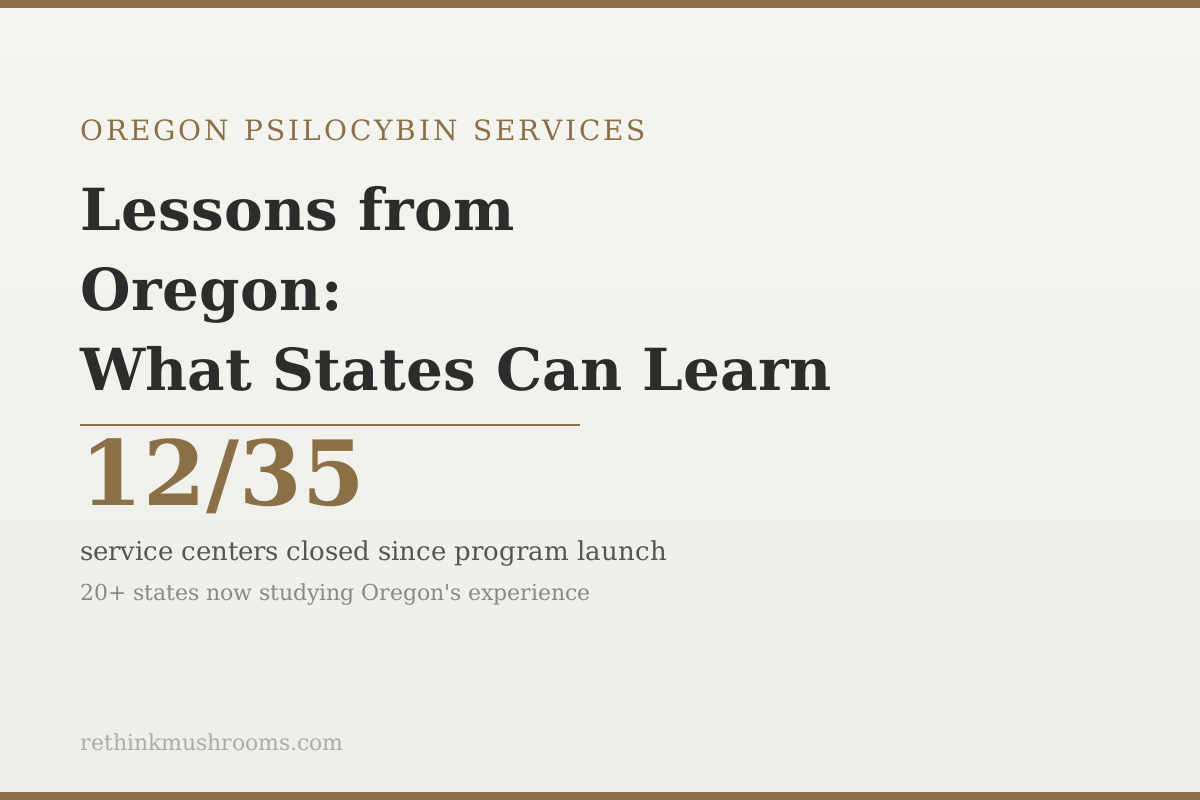
12 of 35 Oregon psilocybin service centers have closed since the program launched
Oregon became the first jurisdiction to create a licensed supervised psilocybin services program. The closures, cost barriers, and awareness gap that emerged in the first two years are now the primary data points other states are studying before designing their own programs.
Oregon Health Authority Program Data
$2,500
average cost of an Oregon psilocybin session, excluding preparation and integration support, creating a significant access barrier that Colorado's regulatory design explicitly attempted to address
20+
US states with active psilocybin legislation moving through their legislatures as of 2024, each studying Oregon's first-mover experience to inform their own frameworks (Siegel et al., 2023)
Decriminalization gap
cities like Denver and Oakland that decriminalized psilocybin without regulation created very different outcomes than Oregon's licensed service model, with lower safety infrastructure (Bhave et al., 2025)
Oregon Health Authority Program Data
 View as image ↗
Oregon had no model to follow. When Measure 109 passed in November 2020, it created the world's first licensed supervised psilocybin services program, requiring the Oregon Health Authority to build licensing infrastructure, facilitator training requirements, and service center regulations from scratch. No other jurisdiction had done this. Every decision was an experiment.
Two years after the program launched in 2023, the lessons from Oregon are now the most concrete guidance available for the more than 20 states studying their own psilocybin legislation. The primary lessons are not about safety. Oregon's safety record has been strong. The lessons are about economics, access, and awareness. For broader policy context, see psilocybin's Schedule I status: history and controversy.
Key Takeaways
- Oregon Measure 109 created the world's first licensed supervised psilocybin services program, launching in 2023 with state-certified facilitators, licensed service centers, and a structured three-phase session model
- Twelve of 35 licensed Oregon service centers have closed since the program launched, primarily due to the $10,000 annual license fee combined with operational costs; the closures concentrated among rural and lower-income-area providers
- Session costs averaging $2,500 have made the program largely inaccessible to low-income and uninsured Oregonians, with no insurance coverage pathway established in the first two years
- Fewer than 1 in 5 Oregonians with conditions that might benefit from psilocybin services are aware the program exists; Oregon's Measure 109 included no public education mandate
- Colorado's Proposition 122 (passed November 2022) directly addressed Oregon's cost and access challenges by allowing licensed clinicians to integrate psilocybin into their existing practice rather than requiring standalone service centers
- Siegel et al. (2023) mapped the legislative reform landscape in JAMA Psychiatry, identifying the specific structural features that distinguish high-access from low-access regulatory models; the cost and awareness gaps Oregon created are the primary variables subsequent legislation is designed to solve
What Oregon Got Right: Safety Infrastructure That Actually Worked
The safety-first design of Oregon's program has produced the result it was designed to produce: no serious adverse events attributable to the program's sessions since launch.
Oregon required facilitators to complete at least 160 hours of Oregon Health Authority-approved training covering screening, preparation, session facilitation, and integration support. The three-phase structure (preparation, session, integration) is mandatory. Psilocybin can only be administered in licensed service centers with a trained facilitator present. There is no take-home option, no mail-order pathway, and no online sessions.
This structure was deliberate. The Oregon model's design philosophy was safety first: get the infrastructure right before worrying about cost and access. The early program data supports the safety case. Screens for contraindicated medications and psychiatric conditions are applied before every session. The structured three-phase approach reduces the rate of difficult psychological experiences and ensures that challenging experiences occur within a supported container.
The safety record matters for other states because it establishes that licensed supervised psilocybin services can operate without the adverse outcomes that opponents predicted. That evidentiary foundation strengthens legislative arguments in states that are still debating whether to create programs at all.
The Cost Barrier: $2,500 for an Experience Most People Cannot Afford
Safety works. Cost does not.
The average Oregon psilocybin session costs approximately $2,500. This covers the session itself: the facilitator's time, the service center fee, and the psilocybin preparation. It does not include the preparation sessions (typically two to three separate meetings) or integration support (recommended follow-up meetings), which can add $500 to $1,500 to the total.
For a treatment intended to address mental health conditions, this price point creates a demographic filter. Oregon's program has been used primarily by people with disposable income and the ability to take time off work for multi-day preparation and recovery. Uninsured and low-income Oregonians, who carry the highest burden of untreated depression and PTSD, have the least access to the program.
Insurance does not cover Oregon psilocybin services. Psilocybin remains a Schedule I controlled substance under federal law, which prevents insurance reimbursement through any federally regulated pathway. Oregon created no state-funded sliding-scale subsidy in the initial program design. Some service centers developed scholarship programs on their own, but these are individual provider decisions, not systematic access solutions.
The cost problem is directly connected to the center closure problem: service centers cannot reduce session prices without reducing facilitator compensation or absorbing operating losses, and the $10,000 annual license fee plus commercial space costs make the margin math difficult for low-volume providers.
Service Center Closures: The Licensing Fee Created a Viability Problem
Twelve of the 35 licensed Oregon service centers have closed since the program launched. The closures disproportionately affected rural providers and centers serving lower-income populations, compressing service availability toward urban areas and providers serving clients who can pay full price.
The primary structural factor is the $10,000 annual Oregon Health Authority license fee, combined with commercial space requirements and the cost of maintaining a roster of trained facilitators. A service center that conducts 100 sessions per year at $2,500 each generates $250,000 gross revenue. After facilitator pay (typically 50-70% of session revenue), facility costs, and the license fee, the economic model is viable only for centers with consistent volume. Centers serving rural areas or lower-income communities often cannot achieve that volume.
This is the sharpest concrete lesson from Oregon for other states: the license fee structure determines provider viability. A $10,000 annual fee with no volume threshold treats a center conducting 300 sessions per year identically to one conducting 30. States designing programs after Oregon have the option to use tiered licensing fees, waive fees for providers demonstrating community access commitments, or subsidize rural providers from program revenue.
The closures also create a compounding access problem. When a rural center closes, people in that area who were aware of the program lose their local access point. This concentrates the remaining program into urban centers, worsening the geographic access gap that the closures created.
Colorado's Different Architecture: What Oregon's Neighbor Chose Instead
Colorado's Proposition 122, passed in November 2022, represents a direct legislative response to Oregon's design choices. Colorado's architects explicitly studied the Oregon model and built a different regulatory framework.
The most significant architectural difference: Colorado allows licensed healthcare providers (therapists, counselors, physicians) to integrate psilocybin services into their existing clinical licenses rather than requiring standalone service centers. A therapist who already sees clients in an established practice can add psilocybin facilitation to their services, eliminating the need for a separate service center license.
This single structural choice addresses multiple Oregon problems at once. Therapists with established client relationships can apply their existing knowledge of a client's mental health history to preparation and screening. The overhead of a standalone facility is replaced by the existing clinical space. Clients who already have a therapeutic relationship with a provider can move into psilocybin services without building a new treatment relationship from scratch.
Siegel and colleagues' 2023 analysis in JAMA Psychiatry mapped the legislative reform landscape across US states and identified the structural variables that distinguish different regulatory models.[1] The clinician-integration approach that Colorado adopted is one of the key structural variables the analysis identifies as having the potential to reduce cost and increase access by lowering the overhead burden on providers.
For a detailed comparison of what these differences look like in practice, see how Colorado's psychedelic law differs from Oregon.
The Awareness Gap: Most Eligible Oregonians Don't Know the Program Exists
Oregon's Measure 109 created a legal framework and a licensing system. It did not include a public education mandate.
The result: fewer than 1 in 5 Oregonians with conditions that would qualify them for psilocybin services are aware the program exists. Depression, PTSD, and end-of-life anxiety are the primary documented indications for psilocybin from clinical trials. Oregon has hundreds of thousands of residents with these diagnoses. Most have never heard of Oregon Psilocybin Services.
This is the lesson that receives the least attention in consumer journalism. Policy coverage focuses on whether programs get approved. It rarely examines whether people who could benefit from approved programs know they exist. Oregon created a program for a population that doesn't know it's available.
The awareness gap is fixable. States designing programs after Oregon can include public health communication budgets in their program design, require licensed centers to publish their services through state mental health referral networks, and work with psychiatrists and primary care physicians to make provider referrals to the program a standard pathway rather than a patient-initiated discovery.
Decriminalization Without Regulation: A Different Set of Problems
Oregon's Measure 109 (supervised services) passed on the same ballot as Measure 110 (drug decriminalization). Both passed. These are two different policy approaches with different outcomes.
Cities that decriminalized psilocybin without creating regulatory infrastructure (Denver in 2019, Oakland in 2019) created a third model: psilocybin use deprioritized for prosecution, but no licensed facilitators, no service centers, no screening requirements, and no safety infrastructure.
Bhave and colleagues (2025) examined the effects of psilocybin decriminalization in cities that had taken the deprioritization approach, tracking outcomes including emergency department visits, poisoning rates from misidentified mushrooms, and patterns of use.[2] The decriminalization cities showed different risk patterns than Oregon's licensed program: lower barriers to access, but also lower screening for contraindications, higher rates of unsupervised high-dose use, and the persistent identification risk (wild-harvested mushrooms misidentified as psilocybe species account for poisoning events that the Oregon licensed program, which uses laboratory-cultivated preparations, eliminates).
The comparison between Oregon's regulated model and Denver/Oakland's decriminalization model is the clearest data for states debating whether to create licensed frameworks or pursue simpler decriminalization. Regulation adds cost and complexity. It also adds safety infrastructure that decriminalization cannot provide. Other states can choose their position on this spectrum with two years of comparative real-world data now available.
What Other States Should Build Into Their Programs
The lessons from Oregon are concrete enough to become design principles for the states currently writing legislation.
Tiered license fees based on session volume. The $10,000 flat fee regardless of capacity is the primary driver of center closures. A sliding-scale fee structure protects rural and low-volume providers who serve underserved populations.
Clinician integration pathways. Colorado's decision to allow licensed therapists to integrate psilocybin into their existing practice reduces overhead and connects services to established mental health care. States can adopt this architecture, mandate it, or offer it as an optional pathway alongside Oregon-style standalone centers.
Mandatory awareness infrastructure. Including public health communication requirements in program design, and building referral pathways through existing mental health networks, addresses the awareness gap that Oregon left unresolved.
Sliding-scale subsidy programs. Using a portion of license fee revenue to fund access programs for uninsured and low-income individuals requires a policy mechanism at the program design stage. Oregon left this to individual service center discretion. The result was inconsistent and insufficient.
Siegel et al. (2023) identified these structural variables as the key policy levers in their legislative reform analysis, providing the academic framework to match what Oregon's operational data now demonstrates empirically.[1]
The Bottom Line
Oregon's psilocybin services program, the world's first, has produced a strong safety record and a clear set of structural limitations. Twelve of 35 service centers have closed primarily due to licensing costs; average session prices of $2,500 exclude the majority of people with relevant diagnoses; and fewer than 1 in 5 eligible Oregonians know the program exists. Colorado's clinician-integration regulatory architecture directly addresses the access and cost problems. Siegel et al.'s 2023 JAMA Psychiatry analysis maps the legislative variables; Bhave et al. (2025) provides comparison data between licensed service programs and simpler decriminalization approaches. The 20+ states with active legislation have two years of operational evidence to incorporate into program design.
Frequently Asked Questions
Sources & References
- 1RTHM-01791·Siegel, Joshua S et al. (2023). “Psychedelic Drug Legislative Reform and Legalization in the US..” JAMA psychiatry.Study breakdown →PubMed →↩
- 2RTHM-02058·Bhave, Ashutosh (2025). “Magic of the Mushrooms: Effects of Psilocybin Decriminalization..” Journal of psychoactive drugs.Study breakdown →PubMed →↩