Oregon Psilocybin Services
16,000+ clients served
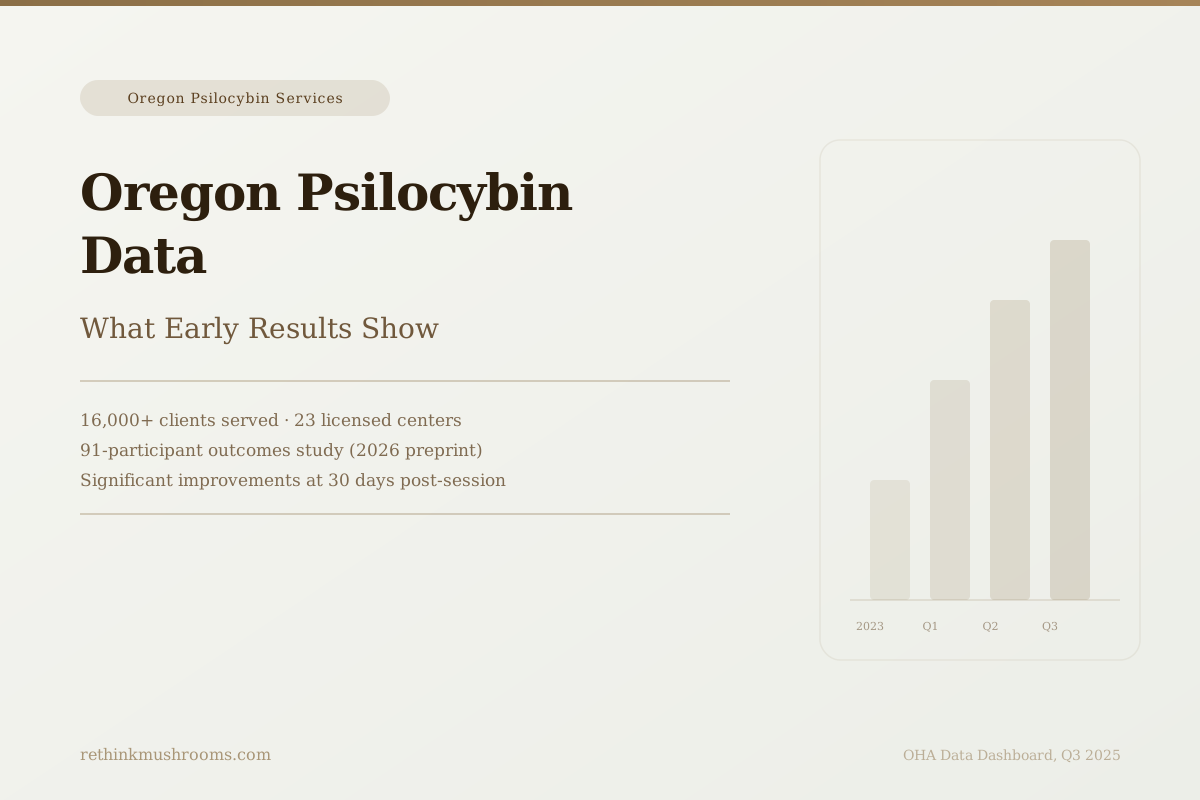
The world's first legal psilocybin program served more than 16,000 adults through 23 licensed service centers in Oregon. A 2026 outcomes preprint followed 91 of them and found significant improvements in depression, anxiety, and wellbeing at 30 days post-session.
Oregon Health Authority OPS Data Dashboard, Q3 2025
91
participants in the first Oregon program naturalistic outcomes preprint
93.2%
of study participants had low or very low wellbeing at baseline
24.44 mg
average psilocybin dose in Q1 2025, roughly half the 50mg permitted maximum
Oregon Health Authority OPS Data Dashboard, Q3 2025
 View as image ↗
Oregon's Measure 109 passed in November 2020 with 56% of the vote. It created a state-regulated psilocybin services program with no medical prescription required, the first of its kind in the world. After two years of rulemaking, the first licensed service centers opened in 2023. Three years into operation, the program has served more than 16,000 adults, generated over $1.7 million in tracked revenue, and produced the first naturalistic outcomes data from any legal psilocybin program.
That outcomes data is what this article covers. It also covers what the official program data shows about scale, demographics, and safety, and what the data cannot yet tell us, which is as important as what it can.
For context on how the program is structured, see Oregon Psilocybin Services: How the World's First Legal Program Works. For broader context on psilocybin law and policy, this article sits within the Psychedelic Law & Policy cluster.
Key Takeaways
- As of Q3 2025, Oregon's psilocybin program had served 16,000+ clients across 23 active service centers, with 366 licensed facilitators and $1.7 million in recorded revenue
- The average psilocybin dose in Q1 2025 was 24.44 mg (the permitted range is 5 mg to 50 mg), administered across a 6 to 8 hour session
- A February 2026 preprint study (91 participants, March 2024 to April 2025) found significant improvements in depression, anxiety, and wellbeing scores at 30 days post-session (p<0.001)
- At baseline, 69.2% of participants had mild-to-severe depression, 67% had anxiety, and 93.2% had low or very low wellbeing
- The preprint has not been peer-reviewed and has no control group, which limits what can be concluded from the positive outcomes
- Bellman (2024) documented that the Oregon program is being accessed by people with treatment-resistant depression, including cancer patients, bridging clinical evidence to real-world use
The Scale: 16,000 Clients, 23 Centers, and the First Real Numbers from a Legal Psilocybin Program
Three years of operation have produced concrete program data. According to Oregon Health Authority records through Q3 2025:
More than 16,000 clients have accessed licensed psilocybin services. Over 37,000 products have been sold. Total program revenue exceeds $1.7 million. Twenty-three of the 35 licensed service centers are actively operating (12 have closed, primarily due to the $10,000 annual license fee and operational costs at low initial volume). Three hundred sixty-six facilitators hold active licenses out of 572 who have applied.
The dosing data is specific: the average psilocybin dose administered in Q1 2025 was 24.44 mg, roughly half the 50 mg permitted maximum. The program permits doses from 5 mg to 50 mg psilocybin, with the specific dose determined through the preparation process between facilitator and client.
The awareness gap is striking. Fewer than one in five Oregonians who have a diagnosis relevant to psilocybin services know the program exists, according to OHA estimates. This means the 16,000+ clients served so far represent a subset of those who might benefit, drawn primarily from people who actively sought the program out.
These numbers establish the program's scope. Oregon created 35 licensed service centers, a new licensed profession (psilocybin facilitator), a formal training and licensing process, and an ongoing data reporting system. All from scratch, in a regulatory space where no precedent existed.
The First Outcomes Study: 91 Oregon Participants, Significant Improvements at 30 Days
The official OHA data tracks program operations, not clinical outcomes. A 2026 preprint posted to medRxiv provides the first prospective outcomes data from Oregon's actual licensed program.
The preprint describes a naturalistic study of 91 participants who received psilocybin sessions at Oregon service centers between March 2024 and April 2025. Participants completed validated mental health assessments at baseline, at 24 hours post-session, and at 30 days post-session. The measures included standardized depression, anxiety, and wellbeing scales.
The baseline numbers reflect the population seeking services: 69.2% of participants had mild-to-severe depression, 67% had mild-to-severe anxiety, and 93.2% had low or very low wellbeing. Nearly half (46.6%) were taking psychiatric medication at the time of their session. The median participant age was 43. Just over half (53.4%) were from Oregon.
At 30 days post-session, participants showed statistically significant improvements across all three outcome measures (p<0.001). Depression scores improved. Anxiety scores improved. Wellbeing scores improved. This was the first time these outcomes had been measured prospectively in Oregon's actual regulated program, as distinct from the controlled clinical trials that established psilocybin's therapeutic potential.
Two things are worth stating clearly here: this is a positive finding, and it comes with major limitations that must be understood before drawing conclusions.
Who Was Showing Up: The Demographics of Oregon's Early Program Users
The demographics of the 91-person study, and the broader OHA data, describe a particular population.
Sixty-four percent of study participants had prior psychedelic experience. They were not first-time users encountering psilocybin in a completely novel context. Most were college-educated adults in their 40s, predominantly from Oregon. Nearly half were on psychiatric medication.
This demographic skew reflects both the self-selection that shapes any voluntary program and the cost and accessibility constraints of Oregon's model. At $1,200 to $3,500 for a single session, the program is financially accessible primarily to people with significant discretionary income or a strong personal motivation to seek it out despite the cost.
The implication: the 16,000+ clients served so far and the 91-person study sample both overrepresent psychedelic-experienced, financially comfortable, health-engaged adults. They underrepresent people with lower incomes, people unfamiliar with psychedelics, and people from communities with less access to alternative health modalities.
Understanding who is using the program is as important as understanding what the program does for them. Both the positive outcomes and the service gaps deserve honest reporting.
What Naturalistic Studies Tell You and What They Don't
The 2026 preprint is a naturalistic study, not a randomized controlled trial. Understanding what this distinction means is essential to reading the outcomes data accurately.
In a randomized controlled trial, participants are randomly assigned to receive either the active treatment or a control condition (placebo, comparison treatment, or waitlist). Outcomes are compared across groups. This design rules out the possibility that improvements result from spontaneous recovery, expectation effects, or characteristics of the people who sought treatment rather than the treatment itself.
A naturalistic study follows people who received the treatment in real-world settings and measures their outcomes before and after. It can document that outcomes changed. It cannot establish that the treatment caused the change, because there is no comparison group.
The 93.2% of study participants with low or very low wellbeing at baseline, and the 46.6% on psychiatric medication, were adults who voluntarily paid $1,200 to $3,500 for a psilocybin session because they believed it might help them. They had high motivation, high expectation, and often prior positive experience with psychedelics. All of these factors could contribute to improvement independent of the pharmacological effects of psilocybin.
This is not a critique of the study. Naturalistic data from a real-world program is genuinely valuable and genuinely hard to obtain. The authors of the 2026 preprint are transparent about these limitations. The data point is: these people improved significantly at 30 days. The honest interpretation: psilocybin services as delivered in Oregon appear to be beneficial for the people who sought them out. The data cannot yet establish whether the psilocybin dose is the primary reason.
For the higher-quality controlled evidence on psilocybin's clinical effects, the clinical trial literature provides a different and complementary picture.
Cancer Patients and Treatment-Resistant Depression: One Population Getting Through
The Oregon program was not designed for a specific diagnosis. It is a wellness service, legally distinct from medical treatment. In practice, people are accessing it for specific mental health conditions, including some of the most treatment-resistant ones.
Bellman's 2024 review in Cancers specifically examined psilocybin use for depression in cancer patients under Oregon's program framework.[1] Cancer patients frequently experience depression that is poorly addressed by conventional antidepressants, both because the medications take weeks to work and because cancer-related depression has specific features that make standard antidepressant response less predictable.
The review documents that Oregon's program is being accessed by this population. The non-prescription, non-medical framing of Oregon's model removes barriers that clinical trial enrollment typically creates: patients don't need to be in a study, off their current medications, or within specific diagnostic criteria. They pay for a service.
This access pattern has practical implications. The clinical trial evidence for psilocybin in cancer-related depression, among the strongest in the entire psilocybin literature, represents one of the best-matched use cases for Oregon's program. The question of whether real-world Oregon sessions produce outcomes comparable to the clinical trial setting is exactly what future controlled outcomes research will need to test.
What Happened in Places That Decriminalized Without Building a Program
A useful point of comparison comes from examining what did and did not change in places that decriminalized psilocybin before Oregon created its full regulatory model.
Bhave's 2025 analysis in the Journal of Psychoactive Drugs examined the empirical effects of psilocybin decriminalization in cities and states that had removed criminal penalties before Oregon's model.[2] The central concern with decriminalization is whether removing criminal deterrents increases problematic use rates.
The evidence from Bhave's analysis: in studied contexts, decriminalization did not increase problematic psilocybin use. The population that was using psilocybin before decriminalization largely overlapped with the population that continued using it after, without a significant new wave of problematic use emerging. This provides some empirical support for the claim that psilocybin's relatively low abuse potential and naturally self-limiting effect profile (requiring days to weeks for tolerance to reset) makes it behaviorally different from substances where decriminalization has historically produced demand expansion.
This comparative context is relevant to assessing Oregon's program. If decriminalization without a program structure did not increase problematic use, the argument that Oregon's formal regulatory structure primarily serves public safety (rather than being primarily therapeutic) is worth examining. Oregon's model was built to prioritize safety and quality over access, and the 12 center closures and cost barriers reflect that prioritization.
For more on how Colorado took a different approach, see How Colorado's Psychedelic Law Differs from Oregon.
What the Program Still Can't Tell Us
What the OHA data and the 2026 preprint cannot answer, at this stage:
Are the improvements durable? The 2026 preprint measured outcomes at 30 days. Clinical trial data for psilocybin in conditions like treatment-resistant depression shows durability ranging from months to over a year in some studies. Whether Oregon's program produces durable improvements comparable to controlled trials is unknown.
How does Oregon's setting affect outcomes? Licensed facilitators in Oregon are explicitly not therapists. They are trained to provide a safe container, not psychological treatment. Clinical trials typically pair psilocybin with structured psychotherapy. Whether the non-therapy facilitation model produces comparable outcomes to the therapy-integrated clinical trial model is an open question with significant clinical and regulatory implications.
Who is not served? The program reaches psychedelic-experienced, high-income adults in Oregon who actively sought it out. The populations most likely to benefit from the clinical trial evidence (treatment-resistant depression, PTSD, end-of-life distress in cancer patients) are not necessarily the populations who can access Oregon's program at current costs.
What happens to the 46.6% on psychiatric medication? Nearly half the 2026 preprint participants were taking psychiatric medication during their session. The interactions between standard psychiatric medications and psilocybin are not well characterized. This is a data gap with direct clinical relevance.
These aren't reasons to dismiss Oregon's early data. They're the questions that honest coverage of a genuinely novel program should name clearly.
The Bottom Line
Oregon's psilocybin program had served more than 16,000 clients through 23 licensed centers by Q3 2025. A 2026 preprint naturalistic study of 91 participants found significant improvements in depression, anxiety, and wellbeing at 30 days post-session, though the absence of a control group limits causal conclusions. The program is being accessed by adults with serious mental health conditions, including cancer patients with treatment-resistant depression. Comparative evidence from places that decriminalized psilocybin without a formal program shows no increase in problematic use. Outstanding questions include outcome durability, how facilitation-only settings compare to therapy-integrated clinical trials, and who is not being reached at current cost levels.
Frequently Asked Questions
Sources & References
- 1RTHM-01858·Bellman, Val (2024). “Review of Psilocybin Use for Depression among Cancer Patients after Approval in Oregon..” Cancers.Study breakdown →PubMed →↩
- 2RTHM-02058·Bhave, Ashutosh (2025). “Magic of the Mushrooms: Effects of Psilocybin Decriminalization..” Journal of psychoactive drugs.Study breakdown →PubMed →↩