Oregon Psilocybin Services
$1,200–$3,500 per session
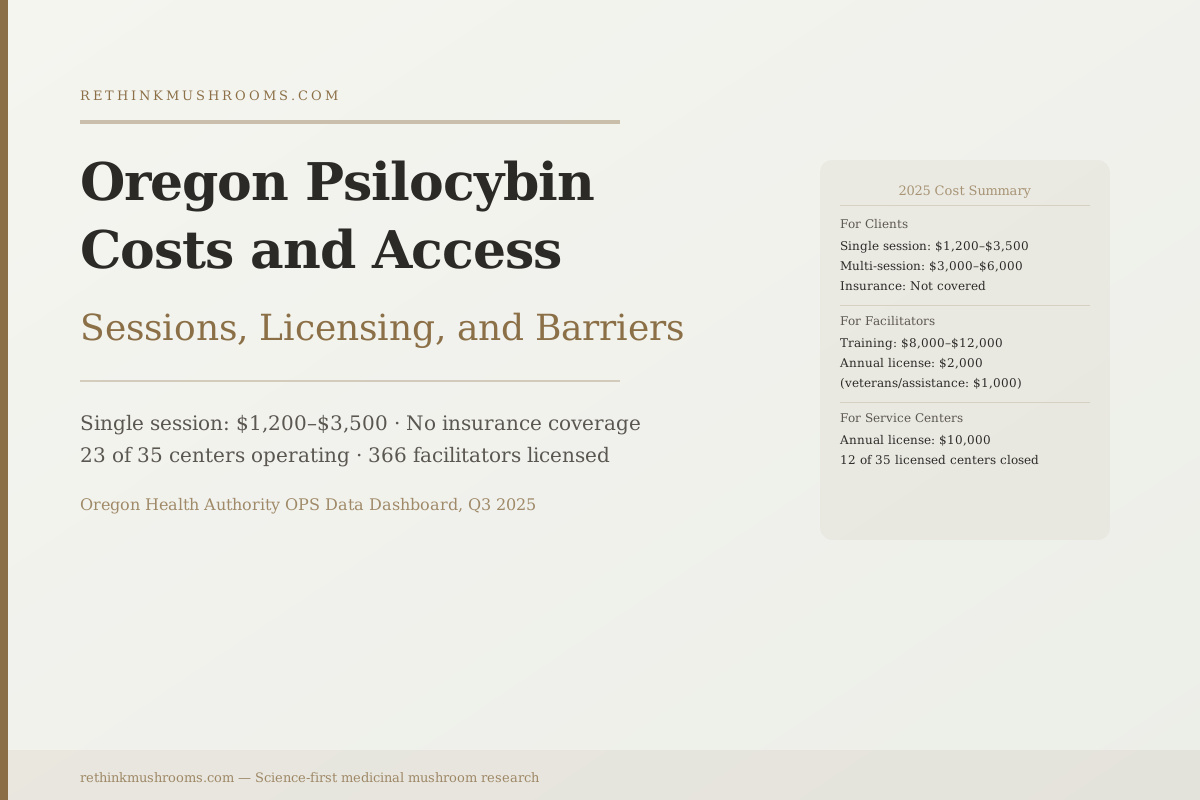
Oregon psilocybin sessions cost $1,200-$3,500 for a single administration session plus preparation and integration. No insurance covers the cost. Some centers offer sliding-scale pricing — but most do not.
Oregon Health Authority OPS Data Dashboard, Q3 2025
23 of 35
licensed service centers currently operating — 12 have closed, primarily due to $10,000/year license fees and operating costs
366 facilitators
trained and licensed as of Q3 2025, having served 16,000+ clients through the program
No insurance
coverage available for Oregon psilocybin sessions — the full cost is out of pocket for all participants
Oregon Health Authority OPS Data Dashboard, Q3 2025
 View as image ↗
The first question most people have about Oregon's psilocybin program is the same one: how much does it cost?
A single Oregon psilocybin session — meaning one administration session plus the required preparation and integration contacts — typically costs between $1,200 and $3,500. Multi-session programs, which some service centers offer, run $3,000-$6,000. No health insurance plan covers the cost. If a person can afford to participate in Oregon's program, they pay the full amount out of pocket.
That price point immediately creates an access question that the Oregon Health Authority (OHA), which regulates the program, has acknowledged openly. Fewer than one in five Oregonians who have a diagnosis relevant to psilocybin treatment know the program exists. Of those who do know, the cost eliminates many.
This article covers what Oregon psilocybin costs and why, how the facilitator licensing system works and what it costs on the provider side, and what accessibility accommodations currently exist. For the broader overview of how Oregon's program functions, see Oregon psilocybin services: how the world's first legal program works. For context on why psilocybin remains federally controlled despite state legalization, see the psilocybin Schedule I status guide.
Key Takeaways
- A single Oregon psilocybin session (preparation, administration, and integration contacts) costs $1,200-$3,500; multi-session programs run $3,000-$6,000; insurance does not cover any of it
- 12 of the 35 Oregon service centers that received licenses are no longer operating, primarily because the $10,000/year service center license fee and operating costs are unsustainable at current client volumes
- Facilitators must complete an OHA-approved training program (120+ curriculum hours, plus supervised practice) costing $8,000-$12,000, then pay a $2,000 annual license fee — reduced to $1,000 for veterans and public assistance recipients
- As of Q3 2025, 366 licensed facilitators and 23 active service centers had collectively served over 16,000 clients, with revenue across the program exceeding $1.7 million (Oregon Health Authority data)
- A workforce mismatch defines the program: far more trained facilitators exist than open service centers, making it difficult for facilitators to practice and limiting client access in most Oregon counties
- Legal and ethics analysis confirms Oregon's regulatory structure deliberately prioritizes safety and accountability over accessibility, which directly explains the cost structure (Schonholz et al., 2024)[1]
What a Session Costs — and What That Price Covers
The price of an Oregon psilocybin session covers more than the hours spent in the administration room. Oregon law requires a three-phase process, and the session fee typically covers all three phases.
The three phases are preparation, administration, and integration.
Preparation consists of one or more sessions (most centers use two) in which a client and facilitator review informed consent documents, discuss the client's intentions and mental health history, establish a safety plan, and agree on a dose. Preparation sessions may be conducted in person or virtually. They typically run one to two hours each. Their purpose, from a regulatory and legal standpoint, is to ensure clients understand what they are agreeing to and that facilitators have screened for contraindications (certain medications, particularly MAOIs, and certain mental health conditions warrant careful consideration).
Administration is the session itself. It takes place at a licensed service center — this is a non-negotiable regulatory requirement. The client consumes psilocybin (the dose range runs from a minimum of 1mg to a maximum of 50mg; the average dose in Q1 2025 OHA data was 24.44mg). A licensed facilitator is present throughout the session, which lasts 6-8 hours. Curated music is standard practice at most centers. The facilitator's role during the session is to provide a safe, supportive environment — not to provide psychotherapy, which Oregon's regulatory framework explicitly prohibits.
Integration refers to a follow-up contact, legally required within 72 hours after the administration session. This can be a phone call or in-person meeting. It covers how the client is processing their experience, any immediate concerns, and referrals to community mental health resources if appropriate.
When the full cost is understood as covering this entire arc — two preparation sessions, one 6-8 hour administration session, and integration follow-up — $1,200-$3,500 is less surprising than the headline number might initially suggest. It is still expensive by almost any standard. But it is not a single-hour appointment.
For a detailed walkthrough of what actually happens during each phase, see what happens at an Oregon psilocybin session: a guide.
Why Sessions Cost This Much: The Regulatory Economics
The price of an Oregon psilocybin session is largely a function of four factors: the service center operating costs, the facilitator time required, the lack of insurance reimbursement, and the current scale of the program.
Service center operating costs. Licensed service centers pay $10,000 per year for their OHA license. They must also maintain facilities that meet OHA regulatory standards — separate intake areas, administration rooms with appropriate furniture and sound equipment, storage compliant with controlled substance rules, and staff trained in safety protocols. In the Portland metropolitan area, where most centers are located, commercial real estate adds substantially to operating costs.
Facilitator time. A typical client engagement with a facilitator runs 10-14 hours of direct time: preparation sessions, the full administration session, and integration follow-up. At rates that allow facilitators to cover their own licensing and training costs, a single client engagement requires meaningful hourly compensation to be financially sustainable.
No insurance reimbursement. Because psilocybin remains a Schedule I controlled substance federally, no commercial insurance plan covers Oregon psilocybin services. This means every dollar of program revenue comes directly from clients. The absence of third-party payers removes the pricing support mechanism that exists for most healthcare services.
Small scale. With 16,000+ clients served over the program's first two-plus years of operation, and 23 active centers, the program is not operating at the volumes that typically allow cost reduction. There are no economies of scale yet. Each center is effectively a small operation.
Schonholz and colleagues (2024) analyzed the legal and ethics framework Oregon established and identified the deliberate regulatory choice underlying the cost structure.[1] Oregon's model prioritizes accountability, informed consent, and duty of care — the legal framework that ensures facilitators take responsibility for client safety — over accessibility and price competition. The compliance infrastructure required to maintain these standards adds operational cost to every session. Oregon made that tradeoff intentionally, reasoning that a safety-first model with higher costs was preferable to a lower-cost model with reduced oversight.
The result is that Oregon's program is simultaneously one of the most carefully regulated psilocybin access models in the world and one of the most expensive.
The Facilitator Side: What Training and Licensing Actually Cost
Understanding the client cost requires understanding the provider cost. Oregon created a new licensed profession — the psilocybin facilitator — that did not previously exist in any US state.
Training. Becoming a licensed Oregon psilocybin facilitator requires completing an OHA-approved training program. These programs cover psychology of psychedelic experience, facilitation skills, safety and risk management, legal and ethical requirements, cultural and historical context, and supervised practice hours. Most OHA-approved programs run more than 120 curriculum hours plus practicums. Training costs $8,000-$12,000 depending on the program.
As of Q3 2025, OHA had processed 572 facilitator applications and issued 366 licenses. A meaningful number of trained facilitators are not currently practicing.
Annual license fee. A licensed facilitator pays $2,000 per year to maintain their OHA license. OHA reduced this to $1,000 for veterans and recipients of public assistance — an explicit acknowledgment that the fee creates a financial barrier for some practitioners.
The workforce mismatch. Oregon's facilitator workforce has a structural problem: 366 licensed facilitators, but only 23 active service centers. The math does not work for everyone. To practice legally, a facilitator must either be employed by a service center or operate as an independent contractor with a center. With fewer centers than facilitators, many trained practitioners are sitting on active licenses they cannot use in practice.
This mismatch also affects clients. A trained facilitator in a rural county cannot legally offer sessions if no licensed service center exists in that county. Geographic concentration of service centers in Portland means that clients outside the metro area face travel costs on top of session costs.
For readers interested in what the facilitator training standards require and how they compare to psychedelic therapy certification in other contexts, see psychedelic therapist certification: training standards and ethical frameworks.
The Access Barriers Beyond the Price Tag
Cost is the most visible access barrier. It is not the only one.
Geographic. With 23 active service centers and most of them concentrated in the Portland area, Oregonians outside major population centers face real logistical challenges accessing the program. Some must travel hours for preparation and administration sessions.
Awareness. Oregon Health Authority data indicates that fewer than one in five Oregonians who have a diagnosis that psilocybin research suggests might benefit them — treatment-resistant depression, PTSD, alcohol use disorder, anxiety associated with terminal illness — know the program exists. A program that people don't know about cannot help them.
The prescription-free paradox. Oregon's program requires no prescription, no diagnosis, and no medical referral. This is a deliberate design choice: the program is not positioned as medical treatment but as a licensed psilocybin facilitation service for adults 21 and older. For some potential participants, this is liberating — no gatekeeping by a physician who may be skeptical of psychedelics. For others, the absence of medical integration creates a gap: they want their psychiatrist or therapist involved, and the regulatory structure makes that coordination informal rather than built-in.
Who is currently using the program. Data from a naturalistic observation study of 91 Oregon program participants (conducted March 2024 through April 2025) showed the median participant age was 43, 52% were male, 53.4% were from Oregon, and 64.8% were already psychedelic-experienced. Nearly half (46.6%) were on psychiatric medications at the time of their session. These demographics suggest the program is currently reaching a population that is more educated, more psychedelic-aware, and more financially resourced than the general population of Oregonians who might benefit.
For the early outcomes data from Oregon's program, including what the 30-day post-session results showed in that naturalistic study, see Oregon psilocybin data: early results from the first licensed centers.
What Affordable Options Exist — and What Doesn't Yet
The current landscape of cost-reduction options is thin but growing.
Sliding scale pricing. Some service centers offer income-based sliding scale pricing. These programs are not standardized across the industry and are not required by OHA. Availability and terms vary by center; prospective clients need to ask directly about this option when contacting centers.
Reduced facilitator license fees. OHA's $1,000 reduced fee for veterans and public assistance recipients is explicitly intended to increase facilitator diversity and make the profession more accessible to practitioners from lower-income backgrounds. Whether this successfully creates more diversity in the facilitator workforce is not yet measurable.
Research trials. For people whose interest in psilocybin is specifically therapeutic and who may qualify for clinical trials, research trials typically cover all costs including the psilocybin dose itself. Multiple psilocybin clinical trials are ongoing across the US. These offer supervised psilocybin access at no cost, with the tradeoff that participants may be randomized to a control group and face eligibility requirements.
Other legal access models. Oregon is not the only legal psilocybin access pathway in the United States. For readers for whom the $1,200-$3,500 cost range is prohibitive, a review of all current options — including expanded access programs, clinical trials, and retreat programs in jurisdictions where psilocybin is legal — is available at legal psilocybin access before FDA approval: all current options. Expanded access programs for psilocybin, which are distinct from Oregon's services model, are covered at expanded access programs for psilocybin: how they work.
The fundamental access problem Oregon faces is structural rather than administrative. The regulatory model that makes the program safe and accountable is also the model that makes it expensive. Other states watching Oregon's experience — including Colorado, which took a different regulatory approach that may create lower cost structures — are implicitly testing whether this tradeoff is unavoidable or addressable through different design choices. For that comparative analysis, see lessons from Oregon: what other states can learn.
The Bottom Line
Oregon psilocybin sessions cost $1,200-$3,500 for a single session and $3,000-$6,000 for multi-session programs, with no insurance coverage. The cost reflects regulatory compliance requirements, facilitator time across a three-phase process, small program scale, and the absence of third-party payer reimbursement. A workforce mismatch — 366 licensed facilitators but only 23 active service centers — limits both provider sustainability and client access, particularly outside the Portland metro area. An awareness gap (fewer than 1 in 5 Oregonians with relevant diagnoses know the program exists) adds to these barriers. Some sliding-scale options exist; research trials and expanded access programs offer alternative pathways for those who cannot afford Oregon's session costs.
Frequently Asked Questions
Sources & References
- 1RTHM-01983·Schonholz, Stephanie M et al. (2024). “Legal and Ethics Concerns of Psilocybin as Medicine..” The journal of the American Academy of Psychiatry and the Law.Study breakdown →PubMed →↩