Lion's Mane (Hericium erinaceus)
60 min after a single dose, one small RCT found lion's mane sped up Stroop task performance. A second acute trial found no overall effect.
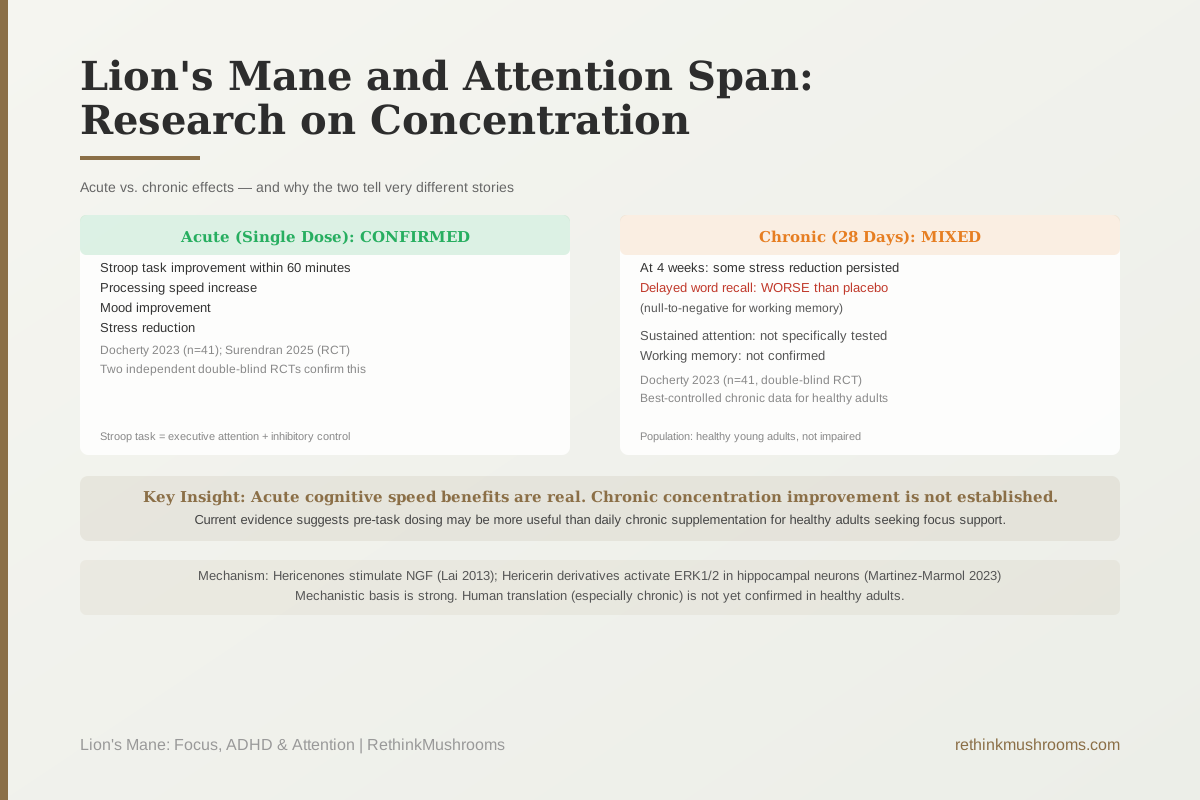
Docherty 2023 (n=41) found a single dose of lion's mane improved speed on the Stroop task, a test of executive attention, within 60 minutes. A second acute trial, Surendran 2025 (n=18), found no significant overall effect on cognition or mood. The acute attention story rests on one small positive pilot, not two independent confirmations.
Docherty et al., Nutrients, 2023; Surendran et al., Frontiers in Nutrition, 2025
Stroop task
the executive-attention test where the single positive acute finding was measured: interference control, not general focus
n=18, null
the second acute RCT (Surendran 2025) found no significant effect on overall cognition or mood
healthy young adults
both acute trials enrolled healthy participants without cognitive impairment or ADHD
Docherty et al., Nutrients, 2023; Surendran et al., Frontiers in Nutrition, 2025
 View as image ↗
"Lion's mane improves focus and concentration" is one of the most common claims in functional mushroom marketing. The research is more specific than that framing suggests, and the results are more mixed than any supplement label will tell you.
One small randomized controlled trial in healthy young adults found that a single dose of lion's mane extract sped up performance on a specific attention test within 60 minutes of taking it. That is a genuine, measurable acute signal. But a second acute trial testing similar questions found no significant overall effect on cognition or mood. And the same trial that produced the positive Stroop result also found participants recalled fewer words correctly right after dosing, and it found no chronic memory benefit after four weeks of daily use.
Understanding what the research actually tested, and what it means for the different aspects of attention and concentration, requires some specificity about how "attention" works.
For a broader overview of lion's mane and its cognitive effects, see What Is Lion's Mane Mushroom? A Science-Based Overview. For the working memory data specifically, see Lion's Mane and Working Memory: Research on Executive Function.
Key Takeaways
- Docherty and colleagues (Nutrients, 2023, n=41, randomized double-blind placebo-controlled) found that a single 1.8 g dose of lion's mane sped up Stroop task performance at 60 minutes post-dose (p=0.005): the clearest acute attention signal in healthy young adults
- The same Docherty trial found two cautionary results: participants recalled fewer correct words on an immediate recall test right after dosing (p=0.013), and after 28 days of daily use the placebo group improved on delayed recall while the lion's mane group did not
- Surendran and colleagues (Frontiers in Nutrition, 2025, n=18, crossover) found no significant effect of a single lion's mane dose on overall cognition or mood at 90 minutes; the only isolated improvement was on a pegboard test of manual dexterity, not the Stroop or general processing speed
- The Stroop task measures executive attention (suppressing an automatic response in favor of a correct but less natural one), which is related to but not the same as sustained attention or general focus
- Chronic cognitive benefits have been shown mainly in older or cognitively impaired adults: Saitsu 2019 (a 12-week RCT) found improved MMSE scores, and Mori 2009 (a 16-week RCT) improved cognitive scores in adults with mild cognitive impairment; neither enrolled healthy young adults seeking better focus
- Mechanistic support is real but preclinical: hericenones stimulate nerve growth factor synthesis in cells (Lai 2013), and hericene A activates an ERK1/2 neurotrophic pathway that enhanced hippocampal memory in mice (Martinez-Marmol 2023)
Acute Evidence · Head to Head
Two Acute RCTs, Two Different Answers
The acute attention story rests mainly on one small positive pilot. A second acute trial found no overall effect. This is a single suggestive signal, not an independently replicated result.
Docherty 2023
SignalNutrients · n=41 · parallel, double-blind
1.8 g H. erinaceus, single dose
Assessed 60 min post-dose
- Faster Stroop task speed (p = 0.005)
- Fewer correct immediate word recall (p = 0.013)
- 28-day: placebo gained on delayed recall, lion’s mane did not
- 28-day stress: non-significant trend only (p = 0.051)
Surendran 2025
Largely nullFrontiers in Nutrition · n=18 · crossover, double-blind
3 g of 10:1 fruiting-body extract, single dose
Assessed 90 min post-dose
- No significant effect on global cognition or mood
- No significant Stroop or overall processing-speed benefit
- One isolated gain: pegboard (manual dexterity) at 90 min
- Authors: any benefit may be task- or domain-specific
Types of Attention: Why "Focus" and "Concentration" Are Not One Thing
Attention is not a single cognitive process. Neuroscience and cognitive psychology distinguish several distinct types, each supported by different brain circuits and susceptible to different interventions.
Sustained attention is the ability to maintain focus on a task over time. It is what people mean when they say someone "has a short attention span": the capacity to stay engaged rather than becoming distracted. It depends heavily on the prefrontal cortex and dopamine systems.
Selective attention is the ability to focus on relevant stimuli while filtering out irrelevant ones. Reading in a noisy environment requires selective attention; filtering distractions is an active process.
Executive attention (also called attentional control or inhibitory control) is the ability to override a habitual or automatic response in favor of a less automatic one.
Processing speed is not technically attention but overlaps practically: faster cognitive processing means less time spent holding information in working memory while completing a task, which reduces cognitive load and feels like better concentration.
The one acute lion's mane finding that reached statistical significance was faster speed on the Stroop task. That is executive attention and processing speed, not sustained attention or selective attention. This distinction matters for calibrating what people might reasonably expect.
The Acute Results: What the Two RCTs Actually Found
Docherty and colleagues published a double-blind, randomized, placebo-controlled, parallel-groups trial in Nutrients in 2023, enrolling 41 healthy young adults aged 18 to 45.[2] The trial tested both acute (single 1.8 g dose) and chronic (28-day) effects. At 60 minutes after the single dose, participants in the lion's mane group performed significantly quicker on the Stroop task than those in the placebo group (p=0.005). That is the strongest acute attention signal in the literature for healthy young adults.
The same trial, however, is more nuanced than any marketing summary admits. In the same acute assessment, the lion's mane group recalled fewer correct responses on an immediate word recall test (p=0.013). And over the 28-day chronic phase, the placebo group improved on delayed word recall while the lion's mane group did not show comparable gains. The authors described the overall pattern as promising for speed and stress but noted "null and limited negative findings were also observed" in a small sample.
Surendran and colleagues published a second acute trial in Frontiers in Nutrition in 2025: a double-blind, randomized, placebo-controlled crossover study in 18 healthy adults aged 18 to 35, testing a single 3 g dose of a 10:1 fruiting-body extract assessed 90 minutes post-consumption.[1] The result: no significant effect of lion's mane on composite measures of global cognitive function or mood. The only isolated improvement was on a pegboard test of manual dexterity. The authors concluded that acute lion's mane "did not demonstrate a significant overall improvement in cognitive performance and mood" and that any benefit "may be task or domain specific."
This is the honest acute picture. It is not two independent RCTs confirming the same thing. It is one small pilot finding a specific speed effect, and a second small trial finding essentially nothing on overall cognition. A single suggestive signal in a small sample is a reason to run larger trials, not a reason to promise sharper focus.
Docherty et al. (2023) · Nutrients
- Population
- 41 healthy adults aged 18–45 (randomized, double-blind, placebo-controlled, parallel-groups)
- Intervention
- 1.8 g Hericium erinaceus — single acute dose and 28-day daily use
- Comparator
- Placebo
- Finding
- Faster Stroop task speed at 60 min post single dose (p=0.005). But fewer correct immediate word recalls at the same assessment (p=0.013), and no chronic delayed-recall gain over 28 days (placebo improved, lion's mane did not). Reduced subjective stress at 28 days was a non-significant trend (p=0.051).
mixed A real acute speed signal, but a small pilot (n=41) with simultaneous negative memory findings and no confirmed chronic benefit. Interpret as preliminary, not established.
Docherty et al. (2023), Nutrients
How Quickly Does Lion's Mane Work for Attention?
The one positive acute finding was measurable within 60 minutes of a single dose. That timing, if it holds up in larger trials, would suggest pre-task dosing is a more evidence-aligned use than building chronic daily use for long-term attention improvement.
But two cautions apply. First, "sped up Stroop performance in one small trial" and "improves general concentration and focus over days" are very different claims, and only the narrow first one has any acute human support. Second, even that support is inconsistent: the second acute trial (Surendran 2025) found no overall effect, and the same trial that produced the positive Stroop result also found a simultaneous drop in immediate recall accuracy.
The chronic evidence is clearest for older adults or those with existing cognitive impairment, not for healthy young adults. Saitsu and colleagues published a 12-week randomized, double-blind, placebo-controlled trial in 2019, testing a fruiting-body supplement; MMSE scores significantly improved in the lion's mane group.[3] This is a genuine RCT rather than a weak observational study, but MMSE is a coarse screening instrument and the population was not healthy young adults seeking better focus.
Mori and colleagues' 2009 double-blind, placebo-controlled RCT found that 16 weeks of lion's mane significantly improved cognitive scale scores in adults aged 50 to 80 diagnosed with mild cognitive impairment.[6] Notably, scores declined again after supplementation stopped, suggesting the effect required ongoing use. That population had measurable room to improve; healthy young adults at cognitive peak may respond differently.
For the timing question specifically, see How Long Does Lion's Mane Take to Improve Cognition?.
- Cell & Lab Studiescompleted
Hericenones stimulate NGF synthesis in neuronal cells in vitro (Lai 2013)
- Animal Studiescompleted
Hericene A activates an ERK1/2 neurotrophic pathway and enhanced hippocampal memory in mice (Martinez-Marmol 2023)
- Small Human Trialscurrent
One acute RCT (Docherty 2023, n=41) found faster Stroop speed; a second (Surendran 2025, n=18) found no overall effect. Chronic RCTs (Saitsu 2019, Mori 2009) show benefit mainly in older or impaired adults
- Large Confirmatory RCTsmissing
No large trial has confirmed an attention or concentration benefit in healthy young adults
- Meta-Analysismissing
No meta-analysis isolates acute attention outcomes in healthy adults
Mechanism is well supported preclinically. Human attention evidence in healthy young adults is a single small positive acute trial against one null acute trial. Chronic benefit is established only in older or cognitively impaired populations.
Lai 2013; Martinez-Marmol 2023; Docherty 2023; Surendran 2025; Saitsu 2019; Mori 2009
The Mechanism: Why Lion's Mane Might Affect Attention
The biological rationale for lion's mane affecting attention comes from two converging preclinical findings.
Lai and colleagues (2013) demonstrated that hericenones from the lion's mane fruiting body stimulate NGF synthesis in neuronal cells in vitro and that the mushroom's aqueous extract acts synergistically with exogenous NGF to promote neurite outgrowth in NG108-15 cells.[4] NGF (nerve growth factor) supports the survival and function of neurons in brain regions involved in attention and cognition, including the basal forebrain cholinergic neurons that modulate cortical attention circuits.
Martinez-Marmol and colleagues (2023) extended the mechanistic picture with a more specific finding: hericene A and a related isoindoline compound (NDPIH) promote extensive axon outgrowth and neurite branching in cultured hippocampal neurons, activating an ERK1/2 signaling cascade that is at least partly independent of the TrkB receptor.[5] Mice fed the crude extract plus hericene A showed increased neurotrophin signaling and significantly enhanced hippocampal memory. The hippocampus supports working memory and the processing of new information, both of which contribute to concentration during complex tasks.
The mechanistic story is coherent: lion's mane compounds support neurotrophic signaling in brain regions relevant to attention and memory. But the gap between "supports neurotrophic signaling in cells and mice" and "improves attention in healthy human adults over time" has not been bridged by the available clinical evidence.
Does Lion's Mane Help with Mental Fatigue?
Mental fatigue is a real and distinct phenomenon from poor sustained attention. It reflects the depletion of cognitive resources during sustained effortful work, and it impairs concentration even in people with normal baseline attention.
The Docherty 2023 trial measured subjective stress alongside cognitive outcomes. After 28 days, the lion's mane group showed a trend toward lower subjective stress, but this did not reach statistical significance (p=0.051).[2] That is a hint worth following up, not a confirmed effect. Stress and mental fatigue are related, and if a genuine stress reduction exists it could support sustained attention indirectly, but the data do not yet establish it.
Neither acute trial specifically tested sustained attention under fatiguing conditions (such as cognitive batteries that get harder over time). The mental fatigue angle is plausible from the mechanism and the stress trend, but it has not been directly demonstrated.
What the Evidence Does and Doesn't Show for Concentration
What the evidence shows:
- One small acute RCT (Docherty 2023, n=41) found a single lion's mane dose sped up Stroop task performance within 60 minutes (p=0.005) in healthy young adults
- Chronic RCTs in older or cognitively impaired adults (Saitsu 2019, Mori 2009) found cognitive improvements on screening measures such as the MMSE
- Cell and animal evidence provides a coherent mechanistic basis for neurotrophic effects in brain regions relevant to attention
What the evidence does not show:
- Independent acute replication: the second acute RCT (Surendran 2025) found no significant overall effect on cognition or mood
- Any chronic improvement in sustained attention or working memory in healthy young adults; the one 28-day endpoint showed no delayed-recall gain versus placebo
- A confirmed effect on mental fatigue under demanding conditions
- Any effect in people with ADHD (no ADHD-specific lion's mane trials exist)
Safety
LowThis is research context, not medical advice
Concern
Lion's mane is marketed for focus, but the human attention evidence in healthy adults is preliminary and mixed, and supplements are not standardized or regulated as drugs.
What the research says
Treat any acute focus benefit as unproven beyond one small trial. Do not use lion's mane to replace evaluation or treatment for a diagnosed attention condition.
Particularly relevant for: Anyone considering lion's mane for concentration, ADHD, or a suspected attention disorder
What to do
Talk to a qualified clinician before starting a supplement, especially if you take medication or have a medical condition.
Docherty 2023; Surendran 2025; RethinkMushrooms editorial standard
For the ADHD-specific evidence landscape, see Lion's Mane for ADHD: Can a Mushroom Improve Focus?. For where lion's mane fits among other evidence-based focus supplements, see Natural Focus Supplements: Where Lion's Mane Fits in the Research.
The Bottom Line
The claim that lion's mane sharpens focus rests on thinner evidence than marketing implies. One small acute RCT (Docherty 2023, n=41) found a single 1.8 g dose sped up Stroop task performance within 60 minutes (p=0.005), but the same trial found fewer correct immediate word recalls (p=0.013) and no chronic delayed-recall benefit over 28 days, with reduced stress only as a non-significant trend (p=0.051). A second acute RCT (Surendran 2025, n=18) found no significant overall effect on cognition or mood, with only an isolated pegboard (dexterity) improvement. Chronic cognitive benefits appear mainly in older or cognitively impaired adults (Saitsu 2019, a 12-week RCT; Mori 2009, a 16-week MCI RCT), not in healthy young adults. Mechanistic support is preclinical: NGF stimulation in cells (Lai 2013) and ERK1/2-mediated hippocampal memory gains in mice (Martinez-Marmol 2023). The acute Stroop-speed effect is a single suggestive signal; a reliable concentration benefit in healthy adults is not established.
Frequently Asked Questions
Sources & References
- 1RTHM-00952·Surendran, Geyan et al. (2025). “Acute effects of a standardised extract of Hericium erinaceus (Lion's Mane mushroom) on cognition and mood in healthy younger adults: a double-blind randomised placebo-controlled study..” Frontiers in nutrition.Study breakdown →PubMed →↩
- 2RTHM-00821·Docherty, Sarah et al. (2023). “The Acute and Chronic Effects of Lion's Mane Mushroom Supplementation on Cognitive Function, Stress and Mood in Young Adults: A Double-Blind, Parallel Groups, Pilot Study..” Nutrients.Study breakdown →PubMed →↩
- 3RTHM-00585·Saitsu, Yuusuke et al. (2019). “Improvement of cognitive functions by oral intake of Hericium erinaceus..” Biomedical research (Tokyo.Study breakdown →PubMed →↩
- 4RTHM-00295·Lai, Puei-Lene et al. (2013). “Neurotrophic properties of the Lion's mane medicinal mushroom, Hericium erinaceus (Higher Basidiomycetes) from Malaysia..” International journal of medicinal mushrooms.Study breakdown →PubMed →↩
- 5RTHM-01746·Martínez-Mármol, Ramón et al. (2023). “Hericerin derivatives activates a pan-neurotrophic pathway in central hippocampal neurons converging to ERK1/2 signaling enhancing spatial memory..” Journal of neurochemistry.Study breakdown →PubMed →↩
- 6RTHM-00165·Mori, Koichiro et al. (2009). “Improving effects of the mushroom Yamabushitake (Hericium erinaceus) on mild cognitive impairment: a double-blind placebo-controlled clinical trial..” Phytotherapy research : PTR.Study breakdown →PubMed →↩