Lion's Mane & Cognitive Function
ADHD trials: 0 for lion's mane (as of 2026)
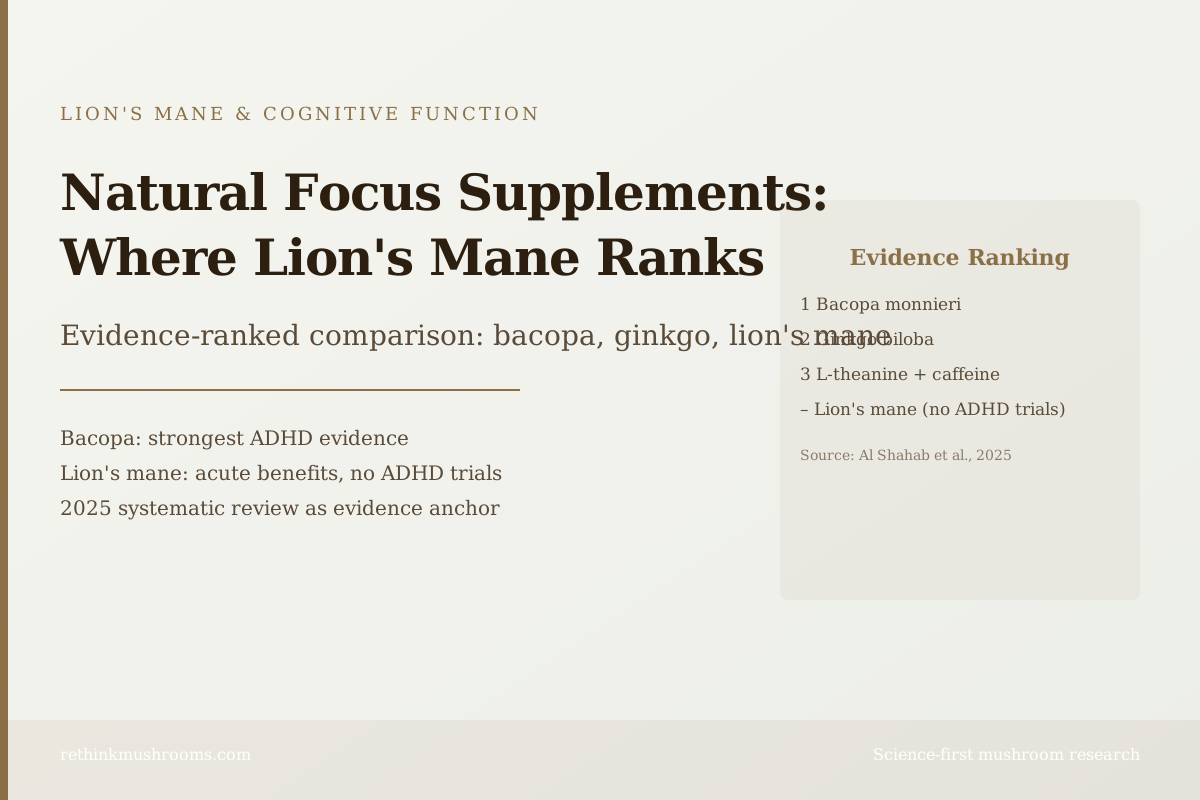
The most comprehensive 2025 systematic review of natural ADHD supplements does not include lion's mane, because no ADHD-specific trials have been published. Here's what the ranking actually looks like.
Al Shahab et al., Nutrients, 2025
Bacopa #1
most ADHD-specific evidence among natural supplements
2 RCTs
confirm acute cognitive speed improvements from lion's mane single doses (2023 + 2025)
Worse recall
lion's mane group scored lower than placebo on delayed word recall at 4 weeks (Docherty 2023)
Al Shahab et al., Nutrients, 2025
 View as image ↗
Every "best natural focus supplements" listicle ranks the same ingredients in roughly the same order, usually without citing a single controlled trial. The actual evidence picture is more specific, more interesting, and in one key area, more honest than what most sites report. A 2025 systematic review published in Nutrients (covering all natural supplements studied for ADHD symptoms) provides the most current and rigorous evidence map for natural focus supplements.[1] Where lion's mane fits into that landscape, specifically among natural focus supplements, is the subject of this article. For the broader picture of lion's mane's cognitive effects, the Lion's Mane mushroom overview covers the full evidence base.
Key Takeaways
- A 2025 systematic review of natural supplements for ADHD found bacopa monnieri has the strongest evidence: multiple trials showing significant improvements in inattention, hyperactivity, and cognitive function
- Lion's mane is absent from that ADHD review entirely, because no ADHD-specific clinical trials in humans have been published as of 2026
- Two 2023 and 2025 RCTs confirm that a single dose of lion's mane improves Stroop task performance (a measure of attention switching and cognitive speed) 60 minutes post-dose in healthy younger adults
- In the same 2023 trial, the lion's mane group performed worse on delayed word recall than the placebo group after 4 weeks of daily use, a finding absent from virtually all supplement marketing content
- A 2024 review found mushroom evidence for cognition is most consistent in older adults or those with existing cognitive impairment; evidence in healthy younger adults is weak
- In the 2009 Mori trial (the only completed RCT in people with mild cognitive impairment), 16 weeks of lion's mane produced significant cognitive improvements that reversed after stopping
Why Most "Best Focus Supplement" Articles Are Wrong About the Evidence
The typical natural focus supplement ranking works like this: the writer lists several ingredients with a paragraph of mechanism text for each, links to an affiliate store, and calls it evidence-based. Almost none of these articles distinguish between ADHD-specific trials (studying people with actual ADHD symptoms), general cognition trials (studying healthy adults), and preclinical data (studying cells or mice). These are not equivalent, and treating them as equivalent is how readers get misled.
The 2025 systematic review by Al Shahab and colleagues in Nutrients is the most rigorous available answer to the specific question: which natural supplements have controlled trial evidence for alleviating ADHD symptoms?[1] The researchers reviewed trials of bacopa, ginkgo biloba, L-theanine, caffeine, and other commonly used supplements, specifically in ADHD populations, and graded the evidence for each. This is the right framework for evaluating natural focus supplements: what does each one actually do, in people who actually have attention difficulties, confirmed by controlled studies?
The 2025 Evidence Ranking: Bacopa First, Ginkgo Second, Lion's Mane Not Listed
The Al Shahab systematic review ranked the natural ADHD supplement evidence as follows.[1]
| Supplement | ADHD Evidence Level | What It Improves | Limitations |
|---|---|---|---|
| Bacopa monnieri | Strongest | Inattention, hyperactivity, cognitive function | GI side effects; effects take weeks to months |
| Ginkgo biloba | Moderate | Inattention | Less effective than methylphenidate; bleeding risk |
| L-theanine | Limited | Sleep quality | Did not improve core ADHD symptoms in trials |
| Caffeine (alone) | Minimal | None in ADHD | Ineffective for ADHD in controlled trials |
| Caffeine + L-theanine | Low | Some attention benefit | Limited trial data |
| Lion's mane | Not included | No ADHD trials | N/A |
Lion's mane is absent because, as of 2026, no clinical trial has tested lion's mane specifically in people with ADHD. This absence is not evidence of ineffectiveness. It is a research gap. But it means the common framing ("lion's mane helps with focus and ADHD") is unsupported by the kind of evidence that the Al Shahab review was looking for.
Bacopa monnieri's position at the top is worth understanding. Multiple trials have found significant improvements in inattention and hyperactivity. Effects accumulate over weeks to months rather than appearing quickly. The mechanism involves acetylcholinesterase inhibition and antioxidant activity in neural tissue, a pathway distinct from both stimulant medications and lion's mane. Bacopa has GI side effects in some users and should not be combined with certain medications without medical guidance. But for someone specifically researching natural options for ADHD symptoms, bacopa has the most evidence among the supplements in this review.
The overall conclusion from the review is important for anyone expecting a natural replacement for stimulant ADHD medications: these supplements are at best complementary, not equivalent, to prescription treatment. Even bacopa, with the strongest evidence, performs more modestly than stimulants in direct comparisons.
Where Lion's Mane Actually Fits: Acute Speed, Chronic Uncertainty, and the Age Factor
Lion's mane's cognitive evidence exists, but it is more specific and more limited than most coverage suggests. Three findings define the current picture.
Acute effects in healthy young adults are real and replicated. In 2023, Docherty and colleagues published a double-blind RCT in Nutrients testing both single-dose and 4-week effects of lion's mane in healthy young adults.[3] The single-dose result: Stroop task performance improved significantly 60 minutes after taking lion's mane. The Stroop task measures the ability to suppress an automatic response in favor of a controlled one. This function, called inhibitory control, is relevant to attention switching and cognitive speed.
In 2025, Surendran and colleagues published a separate double-blind RCT in Frontiers in Nutrition testing acute effects of a standardized lion's mane extract in healthy younger adults.[4] The result confirmed the acute cognitive improvement, replicating the Docherty finding in a well-designed independent study. Two independent RCTs now support the conclusion that a single dose of lion's mane produces measurable improvements in cognitive speed measures in healthy young adults.
Chronic effects in healthy young adults are not confirmed, and in one trial went in the wrong direction. In the same Docherty 2023 trial, participants took lion's mane daily for four weeks. At the four-week mark, the lion's mane group performed worse on delayed word recall than the placebo group.[3] This is a null-to-negative result for the most commonly claimed benefit (memory enhancement) in the most relevant population (healthy younger adults). Virtually no competitor content reports this finding, which is why it stands as the single most important piece of information for healthy adults considering lion's mane for focus or memory.
The 2024 review by Cha and colleagues in Neuroscience and Biobehavioral Reviews, which examined mushroom evidence for mood and neurocognitive health across the lifespan, drew a similar conclusion: the cognitive enhancement narrative around lion's mane outpaces the evidence for healthy populations. Effects are more consistently demonstrated in older adults or those with existing cognitive impairment.[2]
The evidence is strongest for older adults with cognitive impairment. The Mori 2009 trial, published in Phytotherapy Research, is the single most robust human trial for lion's mane and cognition.[5] Fifty participants with mild cognitive impairment took 750mg lion's mane extract three times daily for sixteen weeks. Cognitive scores improved significantly compared to placebo during the treatment period. When supplementation stopped, the improvements reversed. This is meaningful evidence, but the population is very different from healthy adults or people with ADHD. Mild cognitive impairment is a distinct clinical condition.
Bacopa vs. Lion's Mane: Two Different Mechanisms, Two Different Use Cases
Comparing bacopa and lion's mane for focus reveals that they work through different mechanisms and, based on available evidence, are suited for different situations.
Bacopa monnieri works by inhibiting the enzyme that breaks down acetylcholine, effectively increasing acetylcholine signaling in the brain. It also has antioxidant and neuroprotective effects. Acetylcholine is involved in attention, learning, and memory formation; it is the same neurotransmitter that Alzheimer's drugs attempt to protect. The trials in the Al Shahab review found meaningful improvements in inattention and cognitive function across multiple controlled studies, primarily in ADHD populations. Effects build over weeks to months.[1]
Lion's mane works through an entirely different path: stimulating nerve growth factor (NGF) production, which supports the growth and maintenance of neurons, particularly in the hippocampus and cerebral cortex. The theory is that by supporting NGF, lion's mane enhances the structural health of neural circuits involved in cognition. This is a neuroplasticity mechanism, not a neurotransmitter mechanism. The timeline is different: NGF-driven changes unfold over weeks to months, not hours. Yet the acute cognitive data shows improvements within 60 minutes, which may involve a separate, more immediate mechanism not yet fully characterized.
The practical implication of this comparison: for someone with diagnosed ADHD seeking a natural supplement with controlled trial support, bacopa has more ADHD-specific evidence. For someone without ADHD wanting acute cognitive speed support before a specific task, lion's mane has the more compelling acute data. For an older adult concerned about cognitive decline, lion's mane has the strongest direct trial (Mori 2009). These are different use cases, and treating them as interchangeable produces poor recommendations.
For the ADHD-specific comparison, the article on Lion's Mane for ADHD covers that territory in depth. For the head-to-head comparison with stimulant medications, Lion's Mane vs. stimulant medications for focus addresses it directly.
Who Gets the Most From Lion's Mane, and Who Should Look Elsewhere
Based on current evidence, the population most likely to benefit from lion's mane for cognitive function is:
Older adults with early cognitive decline. The Mori 2009 MCI trial remains the single most convincing human data point. If cognitive function is visibly declining and the concern is preserving it, lion's mane has more direct trial support than for any healthy younger adult use case.
People seeking acute cognitive speed before demanding tasks. Two independent RCTs now confirm that a single dose improves attention-related processing speed 60 minutes post-dose in healthy younger adults. For someone wanting a non-stimulant option for a presentation, exam, or high-stakes task, the acute cognitive speed data supports this use with more rigor than most supplement marketing claims.
People who are not expecting a replacement for ADHD treatment. The entire ADHD supplement evidence base (including bacopa, the strongest option) points toward "complementary support, not replacement." For lion's mane, which has no ADHD trials at all, the expectation of replacing stimulant-level attention improvement is not supported by the data.
The evidence on which specific mushroom compounds drive cognitive effects, and which formulations provide them, is covered in Lion's Mane and cognitive function. For the question of timing (how long lion's mane takes to produce effects in different populations), how long does lion's mane take to improve cognition provides a timeline-focused breakdown. For the attention span and concentration-specific data, Lion's Mane and attention span covers the evidence on different cognitive tasks and domains. For working memory specifically, Lion's Mane and working memory addresses the hippocampal mechanism and the mixed human data.
The Bottom Line
Among natural focus supplements, bacopa monnieri has the strongest ADHD-specific evidence according to a 2025 systematic review; lion's mane is absent from that review because no ADHD-specific trials exist. Lion's mane shows consistent acute cognitive speed improvements in two independent RCTs, but chronic use in healthy young adults produced worse delayed word recall vs. placebo in one trial. The evidence is strongest for older adults with mild cognitive impairment. For natural focus support, lion's mane and bacopa address different mechanisms and different use cases; neither is a substitute for prescription ADHD treatment.
Frequently Asked Questions
Sources & References
- 1RTHM-02048·Al Shahab, Shatha et al. (2025). “Efficiency of Different Supplements in Alleviating Symptoms of ADHD with or Without the Use of Stimulants: A Systematic Review..” Nutrients.Study breakdown →PubMed →↩
- 2RTHM-00868·Cha, Sara et al. (2024). “A review of the effects of mushrooms on mood and neurocognitive health across the lifespan..” Neuroscience and biobehavioral reviews.Study breakdown →PubMed →↩
- 3RTHM-00821·Docherty, Sarah et al. (2023). “The Acute and Chronic Effects of Lion's Mane Mushroom Supplementation on Cognitive Function, Stress and Mood in Young Adults: A Double-Blind, Parallel Groups, Pilot Study..” Nutrients.Study breakdown →PubMed →↩
- 4RTHM-00952·Surendran, Geyan et al. (2025). “Acute effects of a standardised extract of Hericium erinaceus (Lion's Mane mushroom) on cognition and mood in healthy younger adults: a double-blind randomised placebo-controlled study..” Frontiers in nutrition.Study breakdown →PubMed →↩
- 5RTHM-00165·Mori, Koichiro et al. (2009). “Improving effects of the mushroom Yamabushitake (Hericium erinaceus) on mild cognitive impairment: a double-blind placebo-controlled clinical trial..” Phytotherapy research : PTR.Study breakdown →PubMed →↩