Lion's Mane (Hericium erinaceus)
NGF deficit is central to diabetic neuropathy pathology: hyperglycemia damages Schwann cells and depletes NGF signaling in peripheral nerves, the same deficit lion's mane compounds directly address
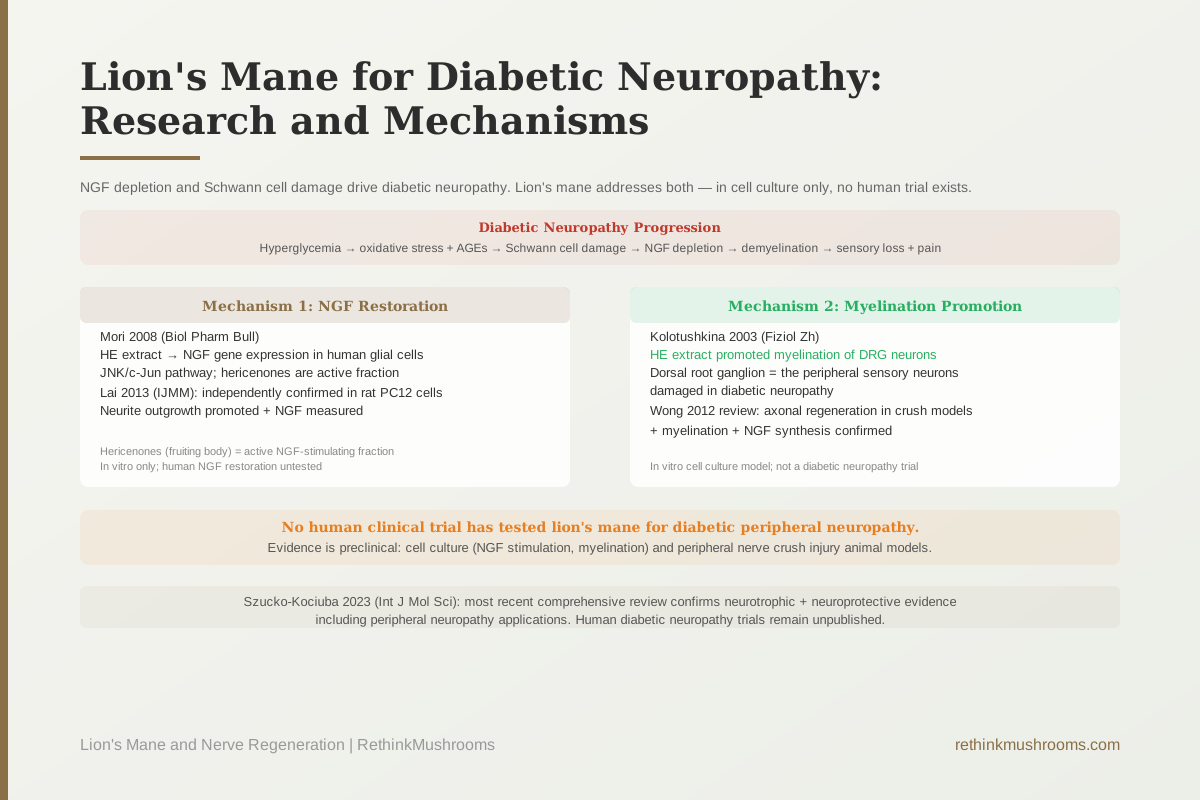
Diabetic peripheral neuropathy involves Schwann cell damage, NGF depletion, and progressive demyelination of peripheral nerves. Lion's mane hericenones stimulate NGF synthesis and promote myelination in cell models, addressing both central mechanisms of diabetic nerve damage.
Wong et al., International Journal of Medicinal Mushrooms, 2012
NGF stimulated
Mori 2008 and Lai 2013: hericenone compounds from lion's mane fruiting body stimulate NGF synthesis in human glial cells and rat neuronal cultures via JNK/c-Jun pathway
myelination promoted
Kolotushkina 2003: lion's mane extract promoted myelination of neurons in dorsal root ganglion cell cultures, directly relevant to the demyelination in diabetic neuropathy
no human trial
no published randomized controlled trial has tested lion's mane for diabetic peripheral neuropathy in human patients; all relevant evidence is from cell culture and animal models
Wong et al., International Journal of Medicinal Mushrooms, 2012
 View as image ↗
Diabetic peripheral neuropathy affects approximately 50% of people with diabetes over their lifetime. It is the most common and most debilitating complication of diabetes, producing pain, numbness, tingling, and weakness that typically starts in the feet and progresses upward. When it is severe, it leads to foot ulcers, infections, and amputation. Standard medical management addresses blood sugar control and symptom relief; no approved treatment reliably reverses the nerve damage once it has occurred.
The nerve damage in diabetic neuropathy is not random. It follows a specific biological pathway: prolonged exposure to elevated blood glucose damages the Schwann cells that wrap peripheral nerve fibers in myelin, disrupts the NGF (nerve growth factor) signaling that those Schwann cells require, and produces progressive demyelination and axonal loss. Understanding this mechanism is why lion's mane is scientifically interesting for this application: the mushroom's most studied biological activities directly address the molecular deficits that define diabetic nerve damage.
No randomized controlled trial has tested lion's mane for diabetic neuropathy in human patients. The evidence is mechanistic: cell culture and animal research showing that lion's mane compounds address the same pathological processes that drive diabetic neuropathy. This article explains the mechanism and the evidence honestly.
For the broader overview of lion's mane and peripheral nerve regeneration, see Lion's Mane for Neuropathy: Can It Regenerate Damaged Nerves? and What Is Lion's Mane Mushroom? The Brain Mushroom Explained.
Key Takeaways
- Diabetic neuropathy works through NGF depletion: prolonged hyperglycemia damages Schwann cells (the myelin-producing cells of peripheral nerves) and disrupts NGF signaling, producing demyelination, axonal damage, and progressive functional loss in peripheral nerves
- Mori and colleagues (Biological and Pharmaceutical Bulletin, 2008) identified that H. erinaceus extracts stimulate NGF synthesis in human astrocytoma cells via the JNK/c-Jun signaling pathway, with hericenones from the fruiting body identified as the active compounds; this is the molecular basis for why lion's mane is relevant to NGF-deficient conditions including diabetic neuropathy
- Lai and colleagues (International Journal of Medicinal Mushrooms, 2013) independently confirmed NGF stimulation and neurite outgrowth promotion in rat neuronal cell cultures using aqueous lion's mane extract, with hericenone compounds confirmed as responsible
- Kolotushkina and colleagues (Fiziol Zh, 2003) found that H. erinaceus extract promoted myelination of neurons in dorsal root ganglion cell cultures, which are peripheral sensory neurons: this myelination promotion is directly relevant to the demyelination pathology of diabetic neuropathy
- Wong and colleagues (International Journal of Medicinal Mushrooms, 2012) synthesized the full neuroregenerative potential in a canonical review: NGF stimulation by hericenones, erinacines crossing the blood-brain barrier, and axonal regeneration in crush injury models; all mechanisms relevant to the peripheral nerve damage in diabetes
- Szucko-Kociuba and colleagues (International Journal of Molecular Sciences, 2023) published the most recent comprehensive review of lion's mane's neurotrophic and neuroprotective evidence, confirming continued relevance across peripheral neuropathy applications including diabetic models
What Diabetic Neuropathy Does to Peripheral Nerves
The pathology of diabetic neuropathy starts at the level of Schwann cells, the specialized cells that wrap around peripheral nerve axons and produce the myelin sheath that enables rapid signal transmission. Myelin acts as electrical insulation around the nerve fiber: without it, signal conduction slows dramatically, and eventually stops.
Prolonged exposure to elevated blood glucose damages Schwann cells through several converging mechanisms: oxidative stress from glucose metabolism, accumulation of toxic metabolic byproducts (advanced glycation end products), and direct damage to mitochondrial function in Schwann cells. As Schwann cells are damaged, they lose the capacity to produce and maintain myelin.
NGF depletion is central to this damage. In healthy peripheral nerves, NGF produced by Schwann cells and target tissues supports the survival, maintenance, and repair capacity of peripheral sensory neurons. Diabetic conditions deplete this NGF supply: reduced Schwann cell function means less NGF produced, and the peripheral sensory neurons that depend on NGF for survival gradually lose support. This triggers the classic progression of diabetic neuropathy: first sensory symptoms (pain, tingling, numbness from damaged small fibers), then larger fiber loss (weakness, loss of vibration sense, balance problems), then autonomic nerve involvement.
The implication for lion's mane is direct. If the core deficit in diabetic neuropathy is NGF depletion and Schwann cell dysfunction, and if lion's mane compounds stimulate NGF production and promote myelination, the mechanism is specifically relevant rather than generically "good for nerves."
Mechanism Map
Where Lion’s Mane Meets the Diabetic Nerve-Damage Cascade
Diabetic neuropathy follows one specific chain, not random decay. Hyperglycemia injures Schwann cells, which depletes NGF, which drives demyelination and axonal loss. Lion’s mane’s two best-documented activities land on two nodes of that exact chain — NGF stimulation and myelination — which is why the interest is mechanistically specific. Every arrow below rests on cell or animal evidence only.
The cascade nodes are the established pathology of diabetic neuropathy; the two green intervention arrows are the points where documented lion’s mane activities align with that pathology — NGF stimulation [1][2][3] and myelination promotion [4]. Alignment of mechanism is not evidence of clinical benefit: no step in this figure has been demonstrated in human diabetic nerves.
Mechanism synthesis; nodes and arrows from refs [1][2][3][4]
Lion's Mane and NGF Restoration: The Cellular Evidence
The NGF stimulation evidence for lion's mane comes from two independent cell-based studies that established the mechanism.
Mori and colleagues published a 2008 study in Biological and Pharmaceutical Bulletin testing H. erinaceus extracts in 1321N1 human astrocytoma cells.[2] These cells are derived from human brain glial cells and serve as a validated model for NGF-producing cells in the nervous system. The extracts stimulated NGF synthesis through the JNK (c-Jun N-terminal kinase) signaling pathway: specifically, through phosphorylation of JNK and its substrate c-Jun, producing increased c-fos expression that drives NGF gene transcription. The hericenone compounds from the fruiting body were identified as the active fraction responsible for this NGF induction.
The JNK/c-Jun/AP-1 pathway is a known regulator of NGF gene expression. When lion's mane compounds activate this pathway, they are turning on the same molecular switch that normally regulates NGF production in response to neural injury and growth signals. In a state of NGF depletion (as occurs in diabetic neuropathy), this activation would partially compensate for the deficit.
Lai and colleagues published an independent 2013 study in the International Journal of Medicinal Mushrooms using PC12 rat neuronal cells, a different model system.[3] Aqueous lion's mane extract promoted neurite outgrowth in these cells, and NGF production was confirmed as the mechanism. The hericenone compounds were again identified as responsible. This independent confirmation using a different cell system and a different extraction method strengthens the mechanistic case for hericenone-mediated NGF stimulation.
Neurite outgrowth is the physical extension of nerve fiber processes that forms new synaptic connections. In the context of peripheral nerve damage from diabetes, the capacity for neurite regrowth is one of the limiting factors in recovery. An agent that promotes this regrowth through NGF stimulation is addressing the biological process that determines whether damaged peripheral nerve fibers can regenerate.
Wong and colleagues published the canonical neuroregenerative review in the International Journal of Medicinal Mushrooms in 2012, synthesizing the full evidence base at that time: NGF stimulation by hericenones from the fruiting body, erinacines from the mycelium crossing the blood-brain barrier and acting on central NGF pathways, axonal regeneration in crush injury animal models, and myelination promotion in vitro.[1] This review established the mechanistic framework that still anchors lion's mane nerve regeneration research.
Myelination Promotion: Addressing the Schwann Cell Failure
Kolotushkina and colleagues published a 2003 study in Fiziol Zh that is specifically relevant to the myelination component of diabetic neuropathy.[4]
The study tested H. erinaceus extract on dorsal root ganglion (DRG) cells in culture. Dorsal root ganglion neurons are the peripheral sensory neurons whose long processes run through peripheral nerves: they are specifically the cells damaged in sensory diabetic neuropathy. In the DRG cell culture system, lion's mane extract promoted myelination of the neurons.
In living nervous tissue, myelination of DRG neurons is performed by the surrounding Schwann cells. In cell culture, the myelination observed reflects the intrinsic capacity of the neurons and associated support cells to form myelin sheaths. The finding establishes that lion's mane compounds support the myelination process directly in peripheral sensory neurons.
The clinical relevance is straightforward: if diabetic neuropathy involves demyelination of DRG neurons and their peripheral processes, and if lion's mane promotes myelination in these same cells, the mechanism is specifically aligned with the pathology. Whether this in vitro finding translates to meaningful remyelination of damaged diabetic peripheral nerves in living patients has not been tested.
The 2023 Evidence Synthesis
Szucko-Kociuba and colleagues published a comprehensive 2023 review in the International Journal of Molecular Sciences synthesizing the full body of lion's mane neurotrophic and neuroprotective research.[5]
The review confirmed that lion's mane's neurotrophic activities (NGF stimulation, BDNF modulation, myelination promotion) are supported by consistent cell and animal evidence across multiple research groups and model systems. The review included coverage of peripheral neuropathy applications, confirming that the mechanistic case for diabetic neuropathy rests on the same NGF stimulation and myelination promotion data identified in the earlier studies.
The 2023 review also noted the key evidence gap that remains: the available research is predominantly cell culture and animal model data. Well-designed human clinical trials in peripheral neuropathy populations, including diabetic neuropathy, have not been published for lion's mane.
The Evidence Gap: What Has Not Been Tested
The mechanistic case for lion's mane in diabetic neuropathy is coherent and specific. It is not clinical evidence.
Evidence Ladder
How Far Up the Ladder the Evidence Actually Reaches
Reading the studies as a hierarchy shows the ceiling. Cell studies and reviews establish the mechanism; adjacent animal models show nerve regrowth after a different kind of injury. The top rung — a human trial in diabetic neuropathy patients — is empty. The mechanism is well-supported; the clinical claim has no rung to stand on.
Rungs 1 and 2 are solid and consistent across independent groups [1][2][3][4][5]; rung 3 is real but tests a different kind of nerve injury; rung 4 — the only rung that would support a clinical claim — is empty. This is why the honest framing is “mechanistically relevant,” not “treats diabetic neuropathy.”
Evidence-hierarchy synthesis; rungs from refs [1][2][3][4][5]
No randomized controlled trial has enrolled diabetic neuropathy patients, administered lion's mane supplementation, and measured nerve conduction velocity, pain scores, vibration threshold, or other validated neuropathy outcomes. The closest available evidence is the peripheral nerve crush injury animal research, which uses a different model of nerve damage (acute compression vs. chronic metabolic damage), and the cell culture myelination data, which cannot be directly translated to living patients.
This distinction matters practically. "Lion's mane addresses the molecular mechanisms of diabetic neuropathy" is a specific and defensible statement about preclinical evidence. "Lion's mane treats diabetic neuropathy" is a clinical claim that the evidence does not support.
For people with diabetic neuropathy who are exploring supplementation, the honest framing is: lion's mane's established biological activities are mechanistically relevant to the pathology of diabetic neuropathy; no human trial has tested this connection; the mechanism provides biological plausibility for future investigation, not a clinical recommendation.
This article is educational and is not medical advice. Diabetic neuropathy is a progressive condition that requires medical management, and no supplement is a substitute for glycemic control and clinician-directed care. Anyone considering lion's mane alongside diabetes treatment should discuss it with their physician or pharmacist first, and should monitor blood glucose, because some preclinical research has reported blood-glucose-lowering activity from lion's mane that could interact with diabetes medications.
What the Evidence Does and Doesn't Say
What the preclinical research establishes:
- Hericenone compounds from lion's mane fruiting body stimulate NGF synthesis in human glial cells via the JNK/c-Jun pathway (Mori 2008), independently confirmed in rat neuronal cultures (Lai 2013)
- Lion's mane extract promotes myelination in dorsal root ganglion cell cultures, the same peripheral sensory neurons damaged in diabetic neuropathy (Kolotushkina 2003)
- The mechanistic connection to diabetic neuropathy is specific: both the NGF deficit and the demyelination component of diabetic neuropathy are addressed by documented lion's mane activities
- Erinacines from the mycelium cross the blood-brain barrier and provide additional central NGF stimulation for any central components of neuropathic pain pathways (Wong 2012 review)
What the evidence does not establish:
- That lion's mane supplementation reduces diabetic neuropathy symptoms (pain, numbness, tingling, weakness) in human patients
- That lion's mane slows the progression of diabetic peripheral neuropathy
- Any comparison with approved treatments (glycemic control, pain medications, alpha-lipoic acid) for diabetic neuropathy
- The dose, form, or duration required to produce any nerve-protective effect in diabetic patients
For the related carpal tunnel nerve compression evidence, see Lion's Mane and Carpal Tunnel Syndrome: Nerve Compression Recovery Research. For the full peripheral nerve regeneration evidence, see Peripheral Nerve Regeneration and Lion's Mane: What Studies Show.
The Bottom Line
Diabetic neuropathy involves NGF depletion and Schwann cell damage producing peripheral demyelination. Lion's mane hericenones stimulate NGF synthesis in human glial cells via JNK/c-Jun pathway (Mori 2008, Lai 2013), and lion's mane extract promotes myelination in dorsal root ganglion cell cultures (Kolotushkina 2003). These are the specific mechanisms impaired in diabetic neuropathy. The 2012 Wong review and 2023 Szucko-Kociuba review synthesize the full neuroregenerative evidence base. No human clinical trial has tested lion's mane for diabetic peripheral neuropathy; the evidence is mechanistic and preclinical only.
Frequently Asked Questions
Sources & References
- 1RTHM-00500·Wong, Kah-Hui et al. (2012). “Neuroregenerative potential of lion's mane mushroom, Hericium erinaceus (Bull.: Fr.) Pers. (higher Basidiomycetes), in the treatment of peripheral nerve injury (review)..” International journal of medicinal mushrooms.Study breakdown →PubMed →↩
- 2RTHM-00268·Mori, Koichiro et al. (2008). “Nerve growth factor-inducing activity of Hericium erinaceus in 1321N1 human astrocytoma cells..” Biological & pharmaceutical bulletin.Study breakdown →PubMed →↩
- 3RTHM-00295·Lai, Puei-Lene et al. (2013). “Neurotrophic properties of the Lion's mane medicinal mushroom, Hericium erinaceus (Higher Basidiomycetes) from Malaysia..” International journal of medicinal mushrooms.Study breakdown →PubMed →↩
- 4RTHM-00058·Kolotushkina, E V et al. (2003). “The influence of Hericium erinaceus extract on myelination process in vitro..” Fiziolohichnyi zhurnal (Kiev.Study breakdown →PubMed →↩
- 5RTHM-01798·Szućko-Kociuba, Izabela et al. (2023). “Neurotrophic and Neuroprotective Effects of Hericium erinaceus..” International journal of molecular sciences.Study breakdown →PubMed →↩