Lion's Mane (Hericium erinaceus)
2003-2023: a 20-year research timeline from in vitro myelination to crush injury recovery to pan-neurotrophic discovery, all building the peripheral nerve regeneration evidence base
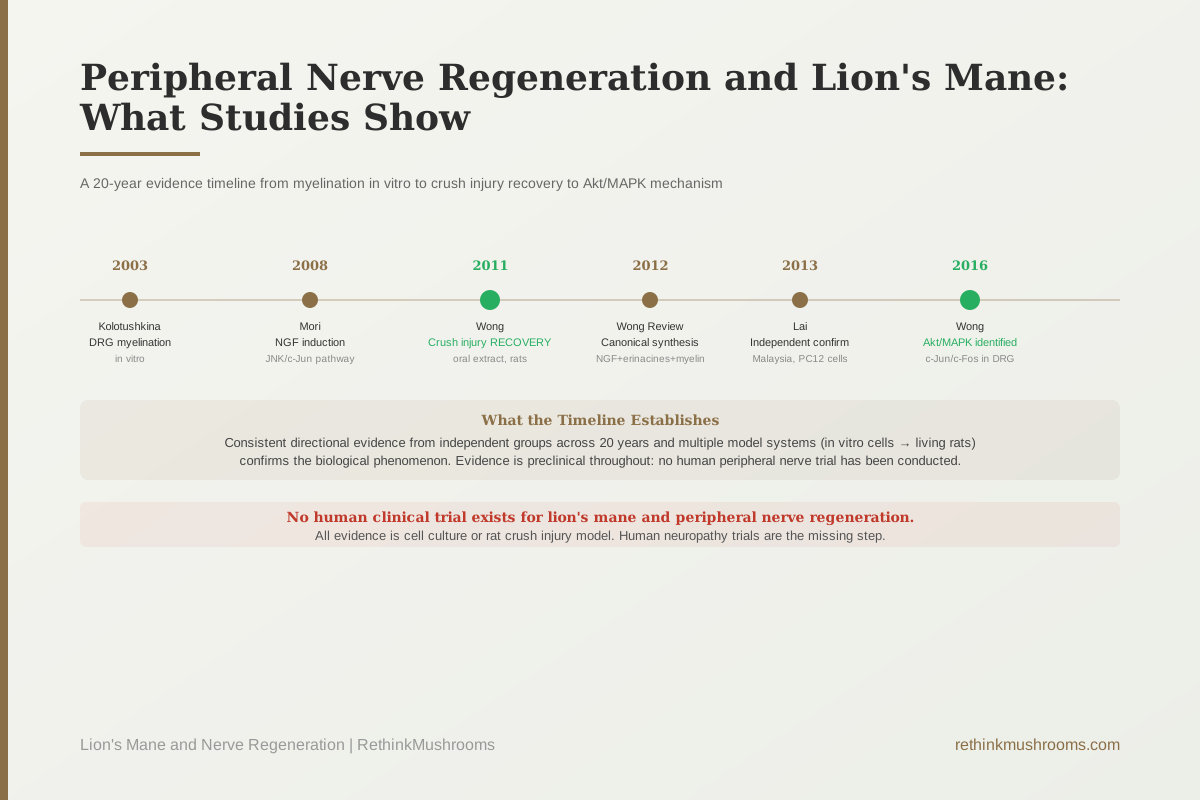
The peripheral nerve regeneration evidence for lion's mane developed over two decades: myelination in dorsal root ganglion cultures (2003), NGF induction in human glial cells (2008), peroneal nerve crush injury recovery in animals (2011), the Akt/MAPK mechanism (2016), and the pan-neurotrophic ERK1/2 discovery (2023).
Wong et al., International Journal of Medicinal Mushrooms, 2012 (canonical review)
2011 crush model
Wong 2011: the most directly relevant peripheral nerve animal model, showing functional recovery after oral lion's mane following peroneal nerve crush injury
2016 Akt/MAPK
Wong 2016: the intracellular signaling mechanism identified in dorsal root ganglia after lion's mane administration following nerve crush injury
no human trial
no human clinical trial has tested lion's mane for peripheral nerve regeneration from any cause; the evidence base is animal and cell culture only
Wong et al., International Journal of Medicinal Mushrooms, 2012 (canonical review)
 View as image ↗
The peripheral nerve regeneration evidence for lion's mane mushroom is not a single study. It is a 20-year accumulation of research building from a 2003 cell culture observation to a 2023 molecular discovery, with animal behavioral models and mechanistic studies in between. Understanding the full timeline shows both what the evidence actually demonstrates and why the lack of human clinical trials remains the most significant gap.
This article presents the peripheral nerve regeneration studies for lion's mane in the chronological order they were published, showing how each study built on or connected to what came before.
For the overview of how these mechanisms apply to specific conditions, see Lion's Mane for Neuropathy: Can It Regenerate Damaged Nerves?. For the diabetic neuropathy application, see Lion's Mane for Diabetic Neuropathy: Research and Mechanisms.
Key Takeaways
- Kolotushkina and colleagues (Fiziol Zh, 2003) published the earliest evidence: H. erinaceus extract promoted myelination of neurons in dorsal root ganglion cell cultures, establishing that lion's mane compounds support the myelination process in peripheral sensory neurons
- Mori and colleagues (Biological and Pharmaceutical Bulletin, 2008) identified the NGF induction mechanism in human astrocytoma cells: H. erinaceus stimulates NGF gene expression via JNK signaling, phosphorylation of c-Jun, and increased c-fos expression; hericenones from the fruiting body are the active compounds
- Wong and colleagues (International Journal of Medicinal Mushrooms, 2011) published the key animal model study: oral aqueous lion's mane extract promoted peripheral nerve regeneration and functional recovery after peroneal nerve crush injury in rats, providing the first direct evidence in an intact nervous system
- Wong and colleagues (International Journal of Medicinal Mushrooms, 2012) published the canonical neuroregenerative review synthesizing all prior evidence and establishing the foundational framework: NGF stimulation by hericenones, erinacines crossing the blood-brain barrier, axonal regeneration in crush models, and myelination promotion
- Lai and colleagues (International Journal of Medicinal Mushrooms, 2013) provided independent confirmation from a separate research group in Malaysia: aqueous lion's mane extract promoted neurite outgrowth in PC12 cells via NGF production, validating the hericenone-NGF mechanism
- Wong and colleagues (Chinese Journal of Integrative Medicine, 2016) identified the specific intracellular mechanism: Akt and MAPK signaling upregulated in dorsal root ganglia, c-Jun and c-Fos expression increased, and protein synthesis elevated in distal nerve segments after oral lion's mane following crush injury
2003: The First Evidence (Kolotushkina)
The first published evidence connecting lion's mane to peripheral nerve biology came from Kolotushkina and colleagues in 2003, published in Fiziol Zh (Physiological Journal), a Ukrainian scientific journal.[1]
The study used dorsal root ganglion (DRG) cell cultures: isolated peripheral sensory neurons from dorsal root ganglia, the clusters of nerve cell bodies that sit just outside the spinal cord and receive sensory signals from the body. DRG neurons send long axons out into peripheral nerves to innervate skin, muscles, and organs, and they are specifically the neurons damaged in sensory peripheral neuropathies.
H. erinaceus extract was applied to these DRG cultures, and the result: the extract promoted myelination of the neurons. In vitro myelination is a complex process reflecting the capacity of the neurons and associated support cells to form the myelin sheath. This earliest study established that lion's mane compounds support the myelination biology of peripheral sensory neurons.
The 2003 study was published in a journal with limited global reach and was not widely cited outside the specialty literature, but it established the biological phenomenon that later mechanistic studies would explain.
2008: The NGF Mechanism Identified (Mori)
Mori and colleagues published a 2008 study in Biological and Pharmaceutical Bulletin that identified the molecular mechanism behind lion's mane's neurotrophic effects in human cells.[2]
The study used 1321N1 human astrocytoma cells, a cell line derived from human brain glial cells that serve as a standard model for NGF production. Astrocytes and glial cells produce much of the NGF that neurons depend on. H. erinaceus extracts stimulated NGF synthesis in these cells, and the mechanism was traced to the JNK (c-Jun N-terminal kinase) signaling pathway:
- JNK was phosphorylated (activated) by lion's mane compounds
- The JNK substrate c-Jun was also phosphorylated
- c-fos expression increased
- Together, these activated the AP-1 transcription factor complex that drives NGF gene transcription
The hericenone compounds from the fruiting body were identified as the active fraction responsible for this NGF induction. This was the first mechanistic explanation for how lion's mane compounds promote NGF production: they activate a known gene regulatory pathway that switches on NGF synthesis.
2011: The Animal Model (Wong)
The most directly relevant peripheral nerve study for clinical translation came from Wong and colleagues in 2011, published in the International Journal of Medicinal Mushrooms.[3]
The researchers induced controlled crush injuries to the peroneal nerve in rats, then administered aqueous lion's mane extract orally. The peroneal nerve controls foot dorsiflexion; its crush produces a reproducible, measurable functional deficit that recovers as the nerve regenerates.
Animals receiving lion's mane extract showed significantly better peripheral nerve regeneration and functional recovery compared to untreated controls. Recovery was measured through behavioral tests (the ability to perform foot dorsiflexion) and electrophysiological measurements of nerve conduction.
This was the transition from cell culture to an intact living nervous system. The finding that oral administration of lion's mane produced measurable benefits in a peripheral nerve injury model confirmed that the bioactive compounds reach peripheral nerve tissue through systemic delivery after oral consumption.
2012: The Canonical Review (Wong)
Wong and colleagues published a review in 2012 in the International Journal of Medicinal Mushrooms that became the standard reference for lion's mane peripheral nerve research.[4]
The review synthesized all evidence available at that time into a coherent framework:
- NGF stimulation by hericenones: fruiting body compounds promote NGF synthesis in glial cells
- Erinacines crossing the blood-brain barrier: mycelium compounds that can reach central nervous system tissue
- Axonal regeneration in crush injury models: the 2011 animal evidence
- Myelination promotion: the 2003 cell culture evidence
This framework has remained the foundational reference for lion's mane peripheral nerve research for over a decade. It also identified the central gap that persists: human clinical trial evidence.
2013: Independent Confirmation (Lai)
Lai and colleagues published a 2013 study in the International Journal of Medicinal Mushrooms from a Malaysian research group, providing independent confirmation of the NGF mechanism using a different model system.[5]
Using PC12 cells (a rat adrenal cell line commonly used as a peripheral neuron model), the study showed that aqueous lion's mane extract promoted neurite outgrowth via NGF production. The hericenone compounds were again identified as responsible. This independent confirmation from a separate laboratory in a different country using a different cell system validated the hericenone-NGF mechanism established in the 2008 Mori study.
2016: The Intracellular Mechanism (Wong)
Wong and colleagues returned to the crush injury model in 2016 to identify what was happening at the molecular level inside the peripheral neurons during lion's mane-assisted recovery, publishing in the Chinese Journal of Integrative Medicine.[6]
After oral Hericium erinaceus administration to rats following peroneal nerve crush injury, the study measured gene expression and protein synthesis in dorsal root ganglia (the cell bodies of the injured neurons) and distal nerve segments (the damaged axonal portions).
The findings:
- Akt and MAPK signaling pathways were upregulated in dorsal root ganglia: both are cell survival and growth pathways; their activation in the context of nerve injury is consistent with a protective and regenerative response
- c-Jun and c-Fos gene expression increased in dorsal root ganglia: these are the same AP-1 transcription factor components identified in the 2008 mechanistic study
- Protein synthesis increased in distal nerve segments: the damaged portions of the nerve were producing more structural proteins, consistent with active regeneration
This mechanistic identification in living nerve tissue after oral administration was a critical step: it showed that the cell culture mechanism (JNK/c-Jun/AP-1) operates in living peripheral nerve tissue after oral delivery of lion's mane.
What the Timeline Shows
The 20-year evidence progression demonstrates consistent directional findings from independent research groups across multiple model systems:
- In vitro (DRG cultures, 2003): myelination promoted
- In vitro (human astrocytoma, 2008): NGF synthesis induced via JNK/c-Jun
- In vivo (rat crush model, 2011): functional nerve recovery with oral extract
- Review synthesis (2012): canonical neuroregenerative framework established
- In vitro (PC12 cells, 2013): independent NGF confirmation
- In vivo mechanism (2016): Akt/MAPK, c-Jun/c-Fos, increased protein synthesis in damaged nerve
No single study in this sequence is definitive. Each has limitations: cell cultures do not represent living organisms; crush injury models differ from chronic neuropathy; rat nerves differ from human nerves. But the consistency across model systems, research groups, and time periods strengthens the biological plausibility.
The human clinical gap: no study in this timeline involves human patients with peripheral nerve injury or neuropathy. The entire evidence base is preclinical.
The Bottom Line
The peripheral nerve regeneration evidence for lion's mane spans two decades: DRG myelination in vitro (Kolotushkina 2003), NGF induction via JNK/c-Jun in human glial cells (Mori 2008), peroneal nerve crush injury recovery with oral extract in rats (Wong 2011), the canonical neuroregenerative review (Wong 2012), independent NGF confirmation in PC12 cells (Lai 2013), and identification of Akt/MAPK/c-Jun/c-Fos mechanism in living nerve tissue (Wong 2016). All evidence is preclinical. No human peripheral nerve trial exists.
Frequently Asked Questions
Sources & References
- 1RTHM-00058·Kolotushkina, E V et al. (2003). “The influence of Hericium erinaceus extract on myelination process in vitro..” Fiziolohichnyi zhurnal (Kiev.Study breakdown →PubMed →↩
- 2RTHM-00268·Mori, Koichiro et al. (2008). “Nerve growth factor-inducing activity of Hericium erinaceus in 1321N1 human astrocytoma cells..” Biological & pharmaceutical bulletin.Study breakdown →PubMed →↩
- 3RTHM-00442·Wong, Kah-Hui et al. (2011). “Peripheral Nerve Regeneration Following Crush Injury to Rat Peroneal Nerve by Aqueous Extract of Medicinal Mushroom Hericium erinaceus (Bull.: Fr) Pers. (Aphyllophoromycetideae)..” Evidence-based complementary and alternative medicine : eCAM.Study breakdown →PubMed →↩
- 4RTHM-00500·Wong, Kah-Hui et al. (2012). “Neuroregenerative potential of lion's mane mushroom, Hericium erinaceus (Bull.: Fr.) Pers. (higher Basidiomycetes), in the treatment of peripheral nerve injury (review)..” International journal of medicinal mushrooms.Study breakdown →PubMed →↩
- 5RTHM-00295·Lai, Puei-Lene et al. (2013). “Neurotrophic properties of the Lion's mane medicinal mushroom, Hericium erinaceus (Higher Basidiomycetes) from Malaysia..” International journal of medicinal mushrooms.Study breakdown →PubMed →↩
- 6RTHM-00840·Wong, Kah-Hui et al. (2016). “Hericium erinaceus (Bull.: Fr.) Pers., a medicinal mushroom, activates peripheral nerve regeneration..” Chinese journal of integrative medicine.Study breakdown →PubMed →↩