Lion's Mane (Hericium erinaceus)
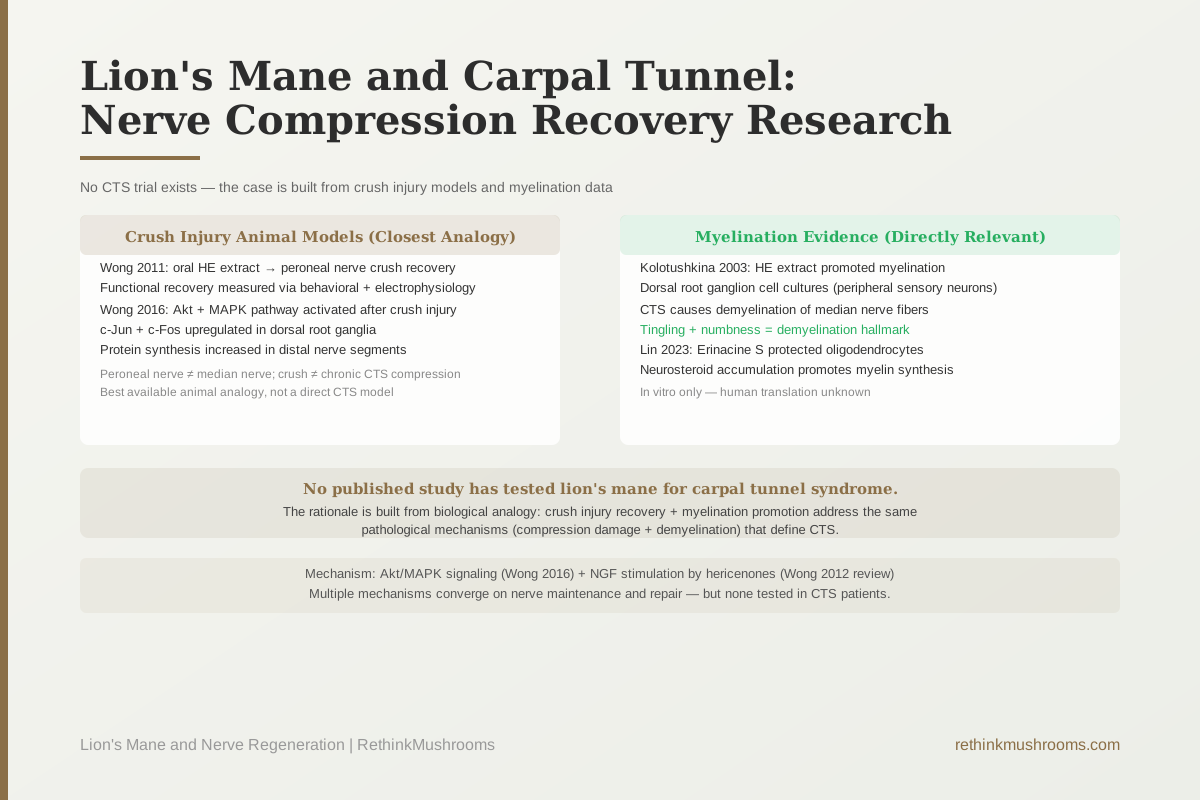
Akt/MAPK signaling pathway activated by lion's mane after peripheral nerve compression injury (Wong 2016)
Wong and colleagues found that oral lion's mane extract promoted peripheral nerve regeneration after crush injury and identified the Akt and MAPK signaling cascades as the mechanism, the same type of compression-induced nerve damage that occurs in carpal tunnel syndrome.
Wong et al., Chinese Journal of Integrative Medicine, 2016
crush injury model
the animal model most analogous to carpal tunnel: peroneal nerve compressed and functionally recovered with oral lion's mane
myelination promoted
Kolotushkina 2003: lion's mane extract promoted myelination in dorsal root ganglion cell cultures
no CTS trial exists
no published study has tested lion's mane specifically for carpal tunnel syndrome in animals or humans
Wong et al., Chinese Journal of Integrative Medicine, 2016
 View as image ↗
Carpal tunnel syndrome affects millions of people annually and is the most common peripheral nerve compression disorder. The median nerve, compressed at the wrist by swelling or structural changes in the carpal tunnel, undergoes progressive demyelination and functional loss if the compression is not relieved. Standard treatment involves splinting, corticosteroid injection, or surgical decompression. No published study has tested lion's mane mushroom specifically for carpal tunnel syndrome.
What exists is something more indirect but still worth understanding: a body of animal model research testing lion's mane in nerve crush injury, which creates compression-type nerve damage similar in mechanism to carpal tunnel, combined with older in vitro research on myelination and newer findings on oligodendrocyte protection. The connection is biological analogy, not direct clinical evidence.
This article covers what the research shows, why the crush injury model is the relevant analogy, and what the evidence honestly does and does not establish for carpal tunnel recovery.
For a broader overview of lion's mane and nerve regeneration, see Lion's Mane for Neuropathy: Can It Regenerate Damaged Nerves?. For the full peripheral nerve evidence timeline, see Peripheral Nerve Regeneration and Lion's Mane: What Studies Show.
Key Takeaways
- Wong and colleagues (International Journal of Medicinal Mushrooms, 2011) found that oral aqueous lion's mane extract administered after crush injury to the rat peroneal nerve promoted peripheral nerve regeneration and functional recovery, using the closest available animal model to nerve compression injuries like carpal tunnel syndrome
- Wong and colleagues (Chinese Journal of Integrative Medicine, 2016) identified the intracellular mechanism: lion's mane extract activates Akt and MAPK signaling pathways, c-Jun and c-Fos gene expression in dorsal root ganglia, and increases protein synthesis in distal nerve segments after peripheral nerve injury
- Kolotushkina and colleagues (Fiziol Zh, 2003) showed that Hericium erinaceus extract promoted myelination of neurons in dorsal root ganglion cell cultures, directly relevant to carpal tunnel because chronic median nerve compression causes demyelination
- Lin and colleagues (Phytomedicine, 2023) found that Erinacine S, a novel diterpenoid from lion's mane mycelium, protected oligodendrocytes (myelin-producing cells) from damage and promoted neuronal regeneration via neurosteroid accumulation
- Wong and colleagues (International Journal of Medicinal Mushrooms, 2012) compiled a comprehensive neuroregenerative potential review establishing the mechanistic basis for lion's mane in peripheral nerve injury and identifying NGF stimulation by hericenones and erinacines crossing the blood-brain barrier as the primary pathways
- No published study has tested lion's mane for carpal tunnel syndrome in animals or humans; the carpal tunnel rationale is built from analogy to crush injury models and mechanistic extrapolation from myelination and NGF evidence
What Carpal Tunnel Syndrome Does to the Median Nerve
Carpal tunnel syndrome occurs when the median nerve, which runs through a narrow passage at the wrist formed by bones and ligaments, is compressed by swelling of the surrounding tissue. The compression initially disrupts the myelin sheath that wraps around the nerve fibers. This disruption slows or blocks nerve signal transmission, producing the characteristic symptoms: tingling, numbness, and weakness in the thumb, index, and middle fingers.
With chronic compression, demyelination progresses. The Schwann cells that produce myelin in peripheral nerves are damaged or unable to maintain the myelin sheath adequately. In severe cases, the nerve axons themselves are damaged, which produces more permanent functional deficits.
Two things about this pathophysiology are directly relevant to the lion's mane evidence base. First, lion's mane has been tested in nerve crush injury models where compression produces the same demyelination process. Second, lion's mane has been tested directly for its ability to promote myelination in cell culture.
Neither of these constitutes direct evidence for carpal tunnel syndrome. But the biological connection is more than generic "nerve support" marketing. The specific pathological mechanisms overlap.
The Crush Injury Analogy: The Closest Available Evidence
The most directly relevant animal evidence comes from two studies by Wong and colleagues on crush injury to the peroneal nerve in rats.
A crush injury is created by applying controlled mechanical compression to a peripheral nerve. This produces a combination of axonal disruption and demyelination that shares pathological features with nerve compression syndromes like carpal tunnel: the nerve is physically compressed rather than cut, some fiber integrity is maintained, but function is impaired.
Wong and colleagues (2011) administered aqueous lion's mane extract orally to rats following peroneal nerve crush injury and found that the extract promoted peripheral nerve regeneration and functional recovery compared to controls.[1] The peroneal nerve controls dorsiflexion of the foot; functional recovery was measured through behavioral and electrophysiological tests of nerve function. The extract was taken orally, which demonstrates that bioactive compounds reach peripheral nerve tissue after systemic delivery.
Wong and colleagues (2016) extended the finding mechanistically, identifying the specific intracellular signaling cascade involved.[2] After administering Hericium erinaceus extract orally following peroneal nerve crush injury, they found upregulation of Akt and MAPK signaling pathways, increased c-Jun and c-Fos gene expression in dorsal root ganglia (the nerve cell bodies that receive signals from the periphery), and increased protein synthesis in distal nerve segments. Akt and MAPK are well-characterized cell survival and proliferation pathways; their activation in the context of nerve injury is consistent with a nerve repair response.
The analogy to carpal tunnel is imperfect: a crush injury produces more acute compression damage than the gradual, chronic compression of carpal tunnel syndrome. The gradual nature of carpal tunnel compression means the nerve damage accumulates over months or years, whereas crush injury produces immediate, severe compression. Additionally, the median nerve (carpal tunnel) and peroneal nerve (lower leg) are anatomically different. These differences limit how directly the crush injury findings translate to carpal tunnel outcomes.
The Myelination Connection: Directly Relevant to CTS Pathology
The most directly mechanistically relevant early study for carpal tunnel is a 2003 in vitro study by Kolotushkina and colleagues, published in Fiziol Zh.[3]
Using dorsal root ganglion cell cultures, the researchers showed that Hericium erinaceus extract promoted myelination of neurons. Dorsal root ganglion neurons are the peripheral sensory neurons whose processes run through peripheral nerves including the median nerve. The myelination finding is directly relevant to carpal tunnel because:
- CTS causes demyelination of the median nerve fibers
- This demyelination is the mechanism behind the characteristic sensory symptoms (tingling, numbness)
- Remyelination is the repair process that restores nerve function after decompression
- An agent that promotes myelination might accelerate remyelination after carpal tunnel decompression surgery or nerve decompression by other means
The Kolotushkina 2003 study is in vitro and cannot be directly translated to human outcomes. But it establishes that lion's mane compounds specifically promote the biological process that is disrupted in carpal tunnel syndrome.
Erinacine S: Oligodendrocyte Protection and Nerve Regeneration
Lin and colleagues published a 2023 study in Phytomedicine characterizing Erinacine S, a newly identified diterpenoid compound from Hericium erinaceus mycelium.[4]
Erinacine S protected oligodendrocytes from damage and promoted neuronal regeneration. The mechanism involved neurosteroid accumulation: neurosteroids (steroids synthesized in neural tissue) support myelin synthesis and nerve repair. Oligodendrocytes produce myelin in the central nervous system; their peripheral equivalents, Schwann cells, produce myelin in peripheral nerves including the median nerve.
While the Erinacine S study was primarily focused on central nervous system oligodendrocytes, the mechanism of myelin protection and neurosteroid-mediated nerve repair has peripheral relevance. Schwann cells in peripheral nerves share some biochemical pathways with central oligodendrocytes. This is speculative extrapolation rather than direct peripheral evidence, but the finding adds a newer compound to the lion's mane neuroregenerative picture.
The Comprehensive Review: What the Evidence Base Covers
Wong and colleagues published a review in 2012 in the International Journal of Medicinal Mushrooms synthesizing lion's mane's neuroregenerative potential for peripheral nerve injury.[5]
The review established the canonical reference framework for lion's mane peripheral nerve research: NGF stimulation by hericenones (fruiting body compounds) drives the primary mechanism for peripheral nerve support; erinacines (mycelium compounds) cross the blood-brain barrier and act on central nerve pathways; axonal regeneration has been demonstrated in crush injury models; myelination promotion has been shown in vitro.
This 2012 review preceded the 2016 Akt/MAPK mechanistic data and the 2023 Erinacine S and hericerin discoveries, so it is not the most current synthesis. But it remains the canonical reference that establishes the foundational mechanistic rationale for lion's mane in peripheral nerve injury.
What the Evidence Does and Doesn't Say for Carpal Tunnel
What the evidence establishes:
- Oral lion's mane extract promotes nerve regeneration and functional recovery after peroneal nerve crush injury in rats, using the closest available animal model to compression-type nerve damage
- The specific intracellular signaling pathway activated is Akt/MAPK, which supports nerve survival and repair
- Lion's mane extract promotes myelination in dorsal root ganglion cell cultures, directly relevant to the demyelination pathology of carpal tunnel
- Erinacine S protects oligodendrocytes and promotes neuronal regeneration via neurosteroid accumulation
- Multiple mechanisms converge on nerve maintenance and repair: NGF stimulation, myelination promotion, Akt/MAPK signaling, oligodendrocyte protection
What the evidence does not establish:
- That lion's mane supplementation treats, prevents, or accelerates recovery from carpal tunnel syndrome in humans
- That the doses or extract types used in animal models translate to effective human supplementation
- Any effect on the specific anatomical and clinical features of carpal tunnel syndrome (carpal tunnel width, median nerve conduction velocity, sensory and motor scores in human CTS patients)
- Any comparison to standard carpal tunnel treatments (splinting, corticosteroid injection, surgical decompression)
The biological rationale is coherent and specific to the mechanisms at play in carpal tunnel pathology. Direct clinical evidence does not exist. For people with carpal tunnel who are exploring supportive supplements, this means lion's mane is a pharmacologically plausible option based on mechanism rather than an evidence-based clinical recommendation.
For the compound-level explanation of why hericenones and erinacines drive these nerve-regenerative effects, see Hericenones and Erinacines: Lion's Mane's Brain-Boosting Compounds.
The Bottom Line
Lion's mane mushroom has not been tested directly for carpal tunnel syndrome in any published animal or human study. The biological rationale is built from three types of evidence: peroneal nerve crush injury recovery in rats with oral lion's mane extract (Wong 2011, with Akt/MAPK mechanism identified in Wong 2016), myelination promotion in dorsal root ganglion cells in vitro (Kolotushkina 2003), and oligodendrocyte protection from Erinacine S (Lin 2023). The crush injury model is the closest available analogy to carpal tunnel compression; the myelination data is directly relevant to CTS pathology. No CTS-specific trial exists.
Frequently Asked Questions
Sources & References
- 1RTHM-00442·Wong, Kah-Hui et al. (2011). “Peripheral Nerve Regeneration Following Crush Injury to Rat Peroneal Nerve by Aqueous Extract of Medicinal Mushroom Hericium erinaceus (Bull.: Fr) Pers. (Aphyllophoromycetideae)..” Evidence-based complementary and alternative medicine : eCAM.Study breakdown →PubMed →↩
- 2RTHM-00840·Wong, Kah-Hui et al. (2016). “Hericium erinaceus (Bull.: Fr.) Pers., a medicinal mushroom, activates peripheral nerve regeneration..” Chinese journal of integrative medicine.Study breakdown →PubMed →↩
- 3RTHM-00058·Kolotushkina, E V et al. (2003). “The influence of Hericium erinaceus extract on myelination process in vitro..” Fiziolohichnyi zhurnal (Kiev.Study breakdown →PubMed →↩
- 4RTHM-01734·Lin, Chun-Yu et al. (2023). “Erinacine S from Hericium erinaceus mycelium promotes neuronal regeneration by inducing neurosteroids accumulation..” Journal of food and drug analysis.Study breakdown →PubMed →↩
- 5RTHM-00500·Wong, Kah-Hui et al. (2012). “Neuroregenerative potential of lion's mane mushroom, Hericium erinaceus (Bull.: Fr.) Pers. (higher Basidiomycetes), in the treatment of peripheral nerve injury (review)..” International journal of medicinal mushrooms.Study breakdown →PubMed →↩