Lion's Mane (Hericium erinaceus)
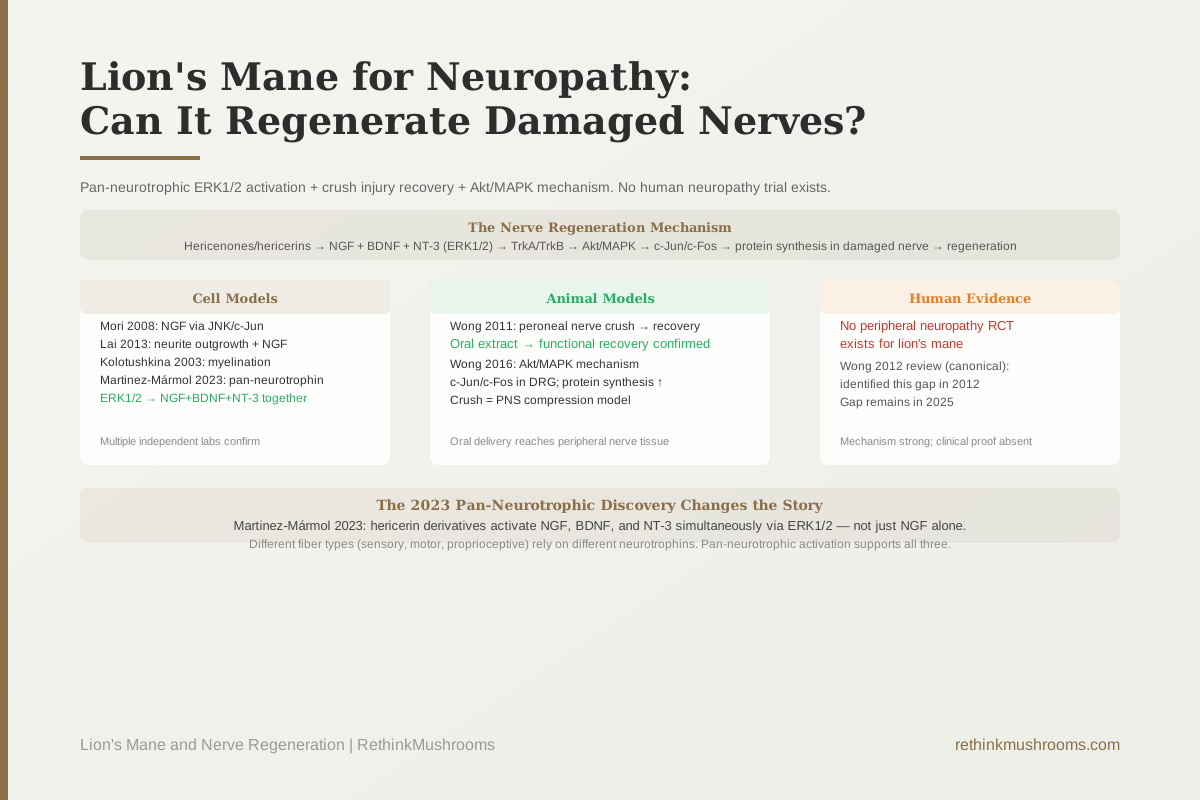
Pan-neurotrophic activation: hericerin derivatives from lion's mane activated NGF, BDNF, and NT-3 simultaneously in hippocampal neurons via ERK1/2, a discovery that reframes the nerve regeneration mechanism (Martinez-Mármol 2023)
Martinez-Mármol and colleagues found that hericerin derivatives from lion's mane fruiting body activate a pan-neurotrophic pathway in neurons, simultaneously stimulating all major neurotrophins via ERK1/2. This is more than NGF stimulation: it is activation of the full neurotrophin cascade that governs nerve survival, repair, and regeneration.
Martinez-Mármol et al., Journal of Neurochemistry, 2023
crush injury recovery
Wong 2011: oral lion's mane extract promoted peroneal nerve regeneration and functional recovery in rats after crush injury, the animal model most analogous to peripheral neuropathy
Akt/MAPK pathway
Wong 2016: the intracellular signaling cascade activated by lion's mane after peripheral nerve crush injury, driving c-Jun/c-Fos expression and protein synthesis in damaged nerves
no human RCT
no randomized controlled trial has tested lion's mane for any form of peripheral neuropathy in human patients; evidence is animal and cell model only
Martinez-Mármol et al., Journal of Neurochemistry, 2023
 View as image ↗
Peripheral neuropathy refers to damage or dysfunction of the peripheral nervous system: the nerves outside the brain and spinal cord that carry sensory signals from the body, motor commands to muscles, and autonomic signals to organs. When peripheral nerves are damaged by diabetes, trauma, chemotherapy, autoimmune disease, or other causes, the result is pain, numbness, weakness, or loss of function that can be progressive and difficult to treat.
The question of whether lion's mane mushroom can help regenerate damaged nerves is not a fringe supplement claim. It has a specific biological mechanism: hericenone and hericerin compounds from the fruiting body stimulate the neurotrophins that peripheral nerve repair requires. A 2023 discovery showed that hericerin derivatives activate not just NGF but a full pan-neurotrophic cascade simultaneously, which reframes the neuroregenerative potential as broader than previously understood.
For the overview of lion's mane, see What Is Lion's Mane Mushroom? The Brain Mushroom Explained. For the diabetic neuropathy-specific evidence, see Lion's Mane for Diabetic Neuropathy: Research and Mechanisms. For the carpal tunnel nerve compression evidence, see Lion's Mane and Carpal Tunnel Syndrome: Nerve Compression Recovery Research.
Key Takeaways
- Wong and colleagues (International Journal of Medicinal Mushrooms, 2012) published the canonical neuroregenerative review: NGF stimulation by hericenones from fruiting body, erinacines crossing the blood-brain barrier from mycelium, axonal regeneration in crush injury models, and myelination promotion in cell culture: this review established the complete neuroregenerative framework for lion's mane
- Wong and colleagues (International Journal of Medicinal Mushrooms, 2011) found that oral aqueous lion's mane extract promoted peripheral nerve regeneration and functional recovery in rats after peroneal nerve crush injury, the most directly relevant peripheral nerve animal model
- Wong and colleagues (Chinese Journal of Integrative Medicine, 2016) identified the intracellular mechanism: Akt and MAPK signaling pathways are upregulated in dorsal root ganglia after oral lion's mane administration following nerve crush injury, driving c-Jun and c-Fos gene expression and increased protein synthesis in distal nerve segments
- Martinez-Mármol and colleagues (Journal of Neurochemistry, 2023) found that hericerin derivatives from lion's mane activate a pan-neurotrophic ERK1/2 pathway in hippocampal neurons, simultaneously stimulating NGF, BDNF, and NT-3: the full spectrum of neurotrophins governing neuronal survival, growth, and repair
- Szucko-Kociuba and colleagues (International Journal of Molecular Sciences, 2023) and Contato and colleagues (Nutrients, 2025) both confirm in current reviews that the neurotrophic and neuroprotective evidence for lion's mane is consistent across research groups, while identifying human clinical trials as the major evidence gap
- No randomized controlled trial has tested lion's mane for peripheral neuropathy from any cause (diabetic, chemotherapy-induced, traumatic, idiopathic) in human patients; all direct neuropathy evidence is preclinical
What Peripheral Nerve Regeneration Requires
Peripheral nerves can regenerate in ways that central nervous system nerves (brain and spinal cord) typically cannot. When a peripheral nerve is damaged, the distal portion undergoes Wallerian degeneration (the axon distal to the injury breaks down), while the proximal stump can begin regrowing toward the denervated target tissue if conditions are right.
Several factors determine whether regeneration succeeds:
Neurotrophin support: Nerve growth factor (NGF), brain-derived neurotrophic factor (BDNF), and neurotrophin-3 (NT-3) are required for peripheral neuron survival and axonal regrowth. They are produced by Schwann cells, target tissues, and glial cells, and they signal through TrkA, TrkB, and TrkC receptors on the neuronal cell body.
Schwann cell guidance: The Schwann cells that previously wrapped the nerve fiber form a pathway (Bands of Büngner) that guides the regrowing axon toward its target. This guidance depends on Schwann cell health and function.
Myelination: As the axon regrows, Schwann cells must re-myelinate it to restore full signal conduction speed. Without remyelination, the nerve may function at reduced capacity even after structural regeneration.
Lion's mane compounds address multiple points in this process: neurotrophin stimulation (hericenones and hericerins), Akt/MAPK signaling activation that drives the protein synthesis required for nerve repair, and myelination promotion in dorsal root ganglion cultures.
The Animal Evidence: Crush Injury as a Peripheral Nerve Model
The most directly relevant animal evidence comes from the Wong laboratory's research on the peroneal nerve crush injury model.
Wong and colleagues published a 2011 study in the International Journal of Medicinal Mushrooms administering aqueous lion's mane extract orally to rats following controlled crush injury to the peroneal nerve.[2] A crush injury compresses the nerve without severing it, producing axonal damage and functional loss while maintaining the structural tube that guides regeneration. This is analogous to the type of injury underlying nerve compression syndromes and some forms of traumatic neuropathy.
The animals receiving lion's mane extract showed significantly better peripheral nerve regeneration and functional recovery compared to controls. Functional recovery was measured through behavioral tests of peroneal nerve function (the nerve controls dorsiflexion of the foot) and electrophysiological measurements of nerve conduction.
The 2016 follow-up study by Wong and colleagues published in the Chinese Journal of Integrative Medicine extended the 2011 finding by identifying the intracellular mechanism.[3]
After oral administration of Hericium erinaceus extract to rats following peroneal nerve crush injury, the study found:
- Upregulation of Akt and MAPK signaling pathways in dorsal root ganglia (the cell bodies of peripheral sensory neurons)
- Increased c-Jun and c-Fos gene expression (AP-1 transcription factor components that drive regeneration-related protein production)
- Increased protein synthesis in distal nerve segments (the damaged portion distal to the injury site)
Akt and MAPK are both cell survival and growth pathways. Their activation in damaged dorsal root ganglia after oral lion's mane administration shows that the mushroom compounds reach the peripheral nervous system and activate the molecular machinery of nerve repair.
For the detailed crush injury and carpal tunnel analogy, see Peripheral Nerve Regeneration and Lion's Mane: What Studies Show.
The 2023 Pan-Neurotrophic Discovery: More Than NGF
For years, the lion's mane neuroregenerative story focused primarily on NGF. The 2023 finding by Martinez-Mármol and colleagues in the Journal of Neurochemistry substantially expanded this picture.[4]
The study characterized hericerin derivatives, a class of aromatic compounds from lion's mane fruiting body, and found they activate a pan-neurotrophic pathway in hippocampal neurons: simultaneously stimulating NGF, BDNF, and NT-3 production via ERK1/2 (extracellular signal-regulated kinase) signaling.
The significance: peripheral nerve regeneration requires multiple neurotrophins working in concert. NGF supports small sensory fiber survival; BDNF supports larger diameter sensory and motor fibers; NT-3 is particularly important for proprioceptive fibers (those that sense body position and muscle stretch). Different types of peripheral neuropathy preferentially damage different fiber populations. An agent that activates all three neurotrophin pathways simultaneously is not targeting one fiber type: it is supporting the full complement of peripheral nerve neurons that depend on neurotrophic signaling for survival and repair.
The ERK1/2 convergence point is also mechanistically significant: ERK1/2 is directly upstream of CREB phosphorylation, which regulates the transcription of genes encoding synaptic proteins, structural proteins for axonal growth, and the neurotrophins themselves. Activating ERK1/2 turns on a genetic program for neuronal repair and plasticity.
What the Current Reviews Confirm
Two recent comprehensive reviews synthesize the current evidence state.
Szucko-Kociuba and colleagues (International Journal of Molecular Sciences, 2023) reviewed the full neurotrophic and neuroprotective evidence for lion's mane, confirming the consistency of NGF stimulation, BDNF effects, myelination promotion, and peripheral nerve animal model data across independent research groups.[5]
Contato and colleagues (Nutrients, 2025) published a comprehensive narrative review of lion's mane as a neuroprotective agent, integrating the neurotrophic, antioxidant, and anti-inflammatory mechanisms that together contribute to peripheral nerve protection.[6] The 2025 review confirmed that the evidence base is mechanistically coherent and growing, while noting that human clinical trials in specific neuropathy populations remain the major research gap.
The Wong 2012 canonical review, which established the original neuroregenerative framework for lion's mane, identified the same gap over a decade ago: strong preclinical evidence, no clinical trials.[1] The gap has narrowed in terms of mechanistic understanding (the 2023 pan-neurotrophic discovery significantly deepened the picture) but the clinical trial gap remains.
What the Evidence Does and Doesn't Establish
What the research shows:
- Oral lion's mane extract promoted peripheral nerve regeneration and functional recovery after crush injury in rats, with the Akt/MAPK intracellular signaling mechanism identified (Wong 2011, Wong 2016)
- Hericerin derivatives activate a pan-neurotrophic ERK1/2 pathway simultaneously stimulating NGF, BDNF, and NT-3, providing broader neurotrophin support than previously understood (Martinez-Mármol 2023)
- The canonical neuroregenerative review (Wong 2012) establishes the comprehensive mechanistic framework: NGF stimulation, blood-brain barrier crossing by erinacines, axonal regeneration, myelination promotion
What the evidence does not establish:
- That lion's mane improves neuropathy symptoms in humans with any form of peripheral neuropathy
- Any comparison with standard neuropathy treatments (gabapentin, duloxetine, alpha-lipoic acid, glycemic control)
- The dose, form, or duration required to produce measurable effects in human peripheral nerve conditions
- Whether the magnitude of nerve regeneration seen in acute crush injury models translates to chronic degenerative neuropathy conditions
The Bottom Line
Lion's mane promotes peripheral nerve regeneration through NGF stimulation (hericenones via JNK/c-Jun) and, as of 2023, a pan-neurotrophic ERK1/2 pathway activating NGF, BDNF, and NT-3 simultaneously (Martinez-Mármol 2023). Animal crush injury evidence shows functional recovery and identified Akt/MAPK as the intracellular mechanism (Wong 2011, Wong 2016). The Wong 2012 canonical review established the neuroregenerative framework. Two 2023-2025 reviews confirm consistent evidence. No human clinical trial has tested lion's mane for peripheral neuropathy from any cause.
Frequently Asked Questions
Sources & References
- 1RTHM-00500·Wong, Kah-Hui et al. (2012). “Neuroregenerative potential of lion's mane mushroom, Hericium erinaceus (Bull.: Fr.) Pers. (higher Basidiomycetes), in the treatment of peripheral nerve injury (review)..” International journal of medicinal mushrooms.Study breakdown →PubMed →↩
- 2RTHM-00442·Wong, Kah-Hui et al. (2011). “Peripheral Nerve Regeneration Following Crush Injury to Rat Peroneal Nerve by Aqueous Extract of Medicinal Mushroom Hericium erinaceus (Bull.: Fr) Pers. (Aphyllophoromycetideae)..” Evidence-based complementary and alternative medicine : eCAM.Study breakdown →PubMed →↩
- 3RTHM-00840·Wong, Kah-Hui et al. (2016). “Hericium erinaceus (Bull.: Fr.) Pers., a medicinal mushroom, activates peripheral nerve regeneration..” Chinese journal of integrative medicine.Study breakdown →PubMed →↩
- 4RTHM-01746·Martínez-Mármol, Ramón et al. (2023). “Hericerin derivatives activates a pan-neurotrophic pathway in central hippocampal neurons converging to ERK1/2 signaling enhancing spatial memory..” Journal of neurochemistry.Study breakdown →PubMed →↩
- 5RTHM-01798·Szućko-Kociuba, Izabela et al. (2023). “Neurotrophic and Neuroprotective Effects of Hericium erinaceus..” International journal of molecular sciences.Study breakdown →PubMed →↩
- 6RTHM-00921·Contato, Alex Graça et al. (2025). “Lion's Mane Mushroom (Hericium erinaceus): A Neuroprotective Fungus with Antioxidant, Anti-Inflammatory, and Antimicrobial Potential-A Narrative Review..” Nutrients.Study breakdown →PubMed →↩