Lion's Mane (Hericium erinaceus)
Erinacine S protected oligodendrocytes and promoted neuronal regeneration via neurosteroid accumulation, the most specific 2023 finding for spinal cord-relevant mechanisms (Lin 2023)
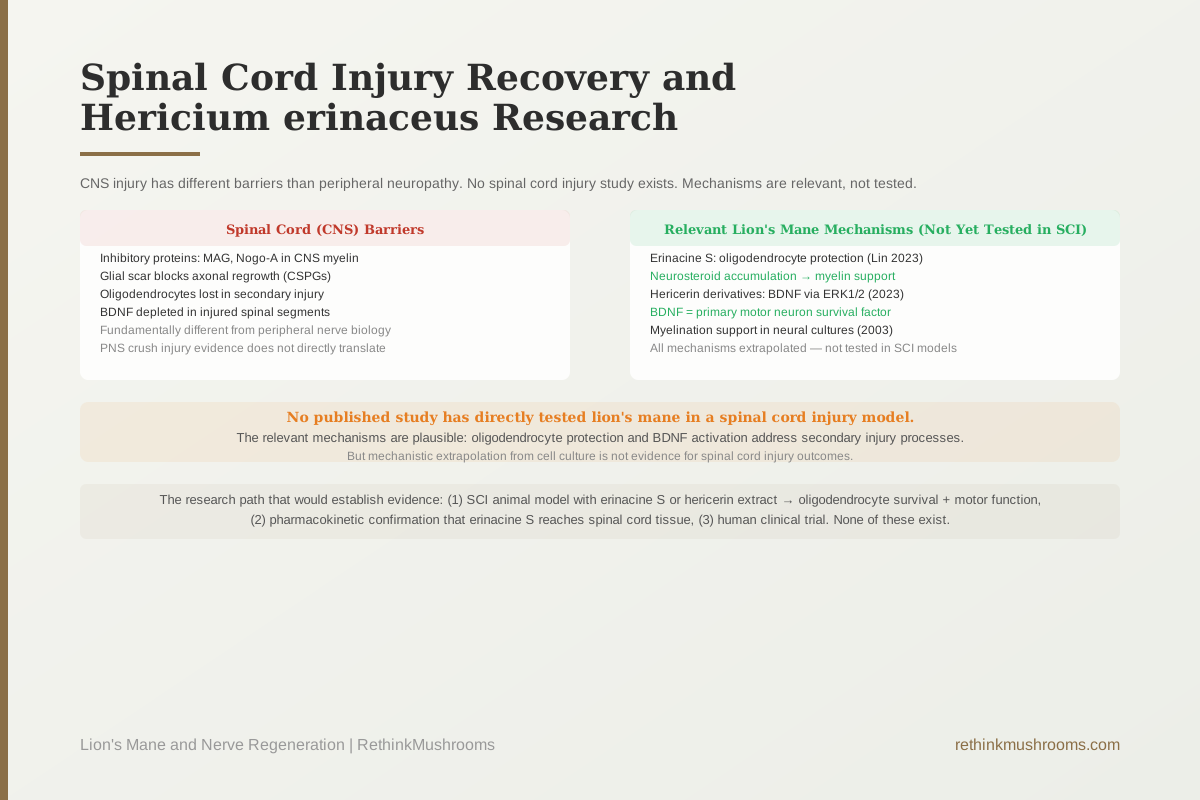
Lin and colleagues characterized Erinacine S, a diterpenoid from lion's mane mycelium, and found it protected oligodendrocytes (the myelin-producing cells of the central nervous system) from damage and promoted neuronal regeneration via neurosteroid accumulation: mechanisms directly relevant to spinal cord injury recovery.
Lin et al., Phytomedicine, 2023
CNS vs. PNS
spinal cord injury is central nervous system damage with fundamentally different regeneration barriers than peripheral neuropathy; the same mechanisms apply differently
BDNF activated
Martinez-Mármol 2023: hericerin derivatives activate BDNF via pan-neurotrophic ERK1/2 pathway; BDNF is the primary survival factor for spinal cord motor neurons
no SCI trial
no published study has directly tested Hericium erinaceus in a spinal cord injury animal model; the evidence is mechanistic extrapolation from oligodendrocyte and neurotrophin research
Lin et al., Phytomedicine, 2023
 View as image ↗
Spinal cord injury research is one of the most demanding areas of neuroscience because central nervous system damage does not regenerate the way peripheral nerve damage does. The spinal cord lacks the Schwann cell guidance tubes and permissive molecular environment that allow peripheral nerves to regrow. After spinal cord injury, surviving neurons face a hostile environment of scar tissue, inhibitory molecules, and inflammatory signals that actively block axonal regrowth.
This context is important before discussing lion's mane and spinal cord injury recovery, because the mechanisms relevant to peripheral neuropathy are relevant here in modified ways. The relevant question is not "does lion's mane regenerate damaged spinal cord axons?" but rather "does lion's mane protect the surviving neural tissue and support the CNS repair processes that do occur after injury?"
Two specific mechanisms from recent lion's mane research are relevant to this question: protection of oligodendrocytes (the myelin-producing cells of the CNS that are damaged after spinal cord injury) and activation of BDNF (brain-derived neurotrophic factor), the primary survival signal for spinal cord motor neurons.
For the peripheral nerve context, see Lion's Mane for Neuropathy: Can It Regenerate Damaged Nerves?. For the broader neuroplasticity evidence, see Lion's Mane and Neuroplasticity: Can a Mushroom Rewire Your Brain?.
Key Takeaways
- Lin and colleagues (Phytomedicine, 2023) characterized Erinacine S, a newly identified diterpenoid from lion's mane mycelium: it protected oligodendrocytes from damage and promoted neuronal regeneration via neurosteroid accumulation; oligodendrocytes produce the CNS myelin that spinal cord injury disrupts
- Martinez-Mármol and colleagues (Journal of Neurochemistry, 2023) found that hericerin derivatives activate a pan-neurotrophic ERK1/2 pathway simultaneously stimulating NGF, BDNF, and NT-3; BDNF specifically is the primary survival factor for spinal cord motor neurons, and its activation is directly relevant to neuroprotection after spinal cord injury
- Kolotushkina and colleagues (Fiziol Zh, 2003) demonstrated myelination promotion in dorsal root ganglion cell cultures; the principle that lion's mane compounds support myelination biology applies to the CNS myelination by oligodendrocytes that is disrupted after spinal cord injury
- Szucko-Kociuba and colleagues (International Journal of Molecular Sciences, 2023) published the most recent comprehensive review of lion's mane neurotrophic and neuroprotective effects, confirming that the mechanisms extend to CNS applications including oligodendrocyte biology
- No published study has directly tested Hericium erinaceus in a spinal cord injury animal model; all spinal cord-relevant evidence is mechanistic extrapolation from oligodendrocyte protection, myelination, and BDNF research conducted in other nervous system contexts
- Spinal cord injury involves fundamentally different biological barriers to regeneration than peripheral neuropathy; mechanisms that work in peripheral nerve models do not directly translate to spinal cord contexts
Why Spinal Cord Injury Is Biologically Different from Peripheral Neuropathy
The distinction between central nervous system (CNS) and peripheral nervous system (PNS) regeneration is fundamental to understanding what lion's mane research might or might not apply to.
In peripheral nerve injury, damaged axons can regrow. The key enablers: Schwann cells clear myelin debris and form guidance tubes (Bands of Büngner); the molecular environment is permissive for growth; and NGF and other neurotrophins provided by Schwann cells and target tissues actively promote regrowth. The peripheral nervous system has evolved for regeneration.
In spinal cord injury, the CNS environment is much less permissive:
Inhibitory molecules: myelin-associated glycoprotein (MAG), Nogo-A, and other CNS myelin proteins actively inhibit axonal regrowth. These molecules are absent in the peripheral nervous system.
Glial scar: after CNS injury, astrocytes form a glial scar that contains chondroitin sulfate proteoglycans (CSPGs), which are potent inhibitors of axonal growth.
Oligodendrocyte loss: the CNS myelin-producing cells (oligodendrocytes) are particularly vulnerable to the secondary injury cascade after spinal cord trauma. Unlike Schwann cells (which survive better and support regeneration), oligodendrocyte loss after spinal cord injury contributes to progressive demyelination and loss of function in surviving axons.
Limited BDNF availability: BDNF is the primary survival and maintenance signal for spinal cord motor neurons. Its reduction after injury contributes to motor neuron death. Restoring BDNF is a major therapeutic target in spinal cord injury research.
Given these differences, the relevant question for lion's mane is not whether it can regenerate CNS axons across glial scars (the primary spinal cord injury challenge) but whether it can: (1) protect surviving oligodendrocytes from secondary damage, and (2) restore BDNF signaling that supports motor neuron survival.
Erinacine S: Oligodendrocyte Protection
Lin and colleagues published a 2023 study in Phytomedicine characterizing Erinacine S, a newly identified diterpenoid compound from Hericium erinaceus mycelium.[1]
The findings: Erinacine S protected oligodendrocytes from damage and promoted neuronal regeneration. The mechanism involved neurosteroid accumulation: neurosteroids are steroid hormones synthesized in neural tissue that support myelin synthesis, oligodendrocyte survival, and neuronal maintenance. Erinacine S increased neurosteroid levels in neural tissue, producing a protective and regenerative cellular environment.
Oligodendrocyte protection after spinal cord injury is directly relevant to clinical outcomes. After the primary mechanical injury, a secondary injury cascade involving excitotoxicity, oxidative stress, and inflammation kills additional oligodendrocytes over hours to days. This oligodendrocyte death produces progressive demyelination of surviving intact axons, worsening functional deficits beyond what the initial mechanical damage caused.
An agent that protects oligodendrocytes during this secondary injury window could reduce the extent of demyelination and preserve the function of intact axons. This is different from regenerating damaged axons; it is about reducing the progression of damage in already-injured tissue.
The Lin 2023 finding was primarily conducted in cell culture models. Whether Erinacine S reaches oligodendrocytes in the spinal cord after oral administration, whether its neurosteroid-mediated protective mechanism is sufficient to reduce secondary injury at the concentrations achievable in vivo, and whether the timing of administration matters have not been tested in spinal cord injury models.
Hericerin Derivatives and BDNF: Motor Neuron Support
Martinez-Mármol and colleagues published a 2023 study in the Journal of Neurochemistry finding that hericerin derivatives from lion's mane activate a pan-neurotrophic ERK1/2 pathway in hippocampal neurons, simultaneously stimulating NGF, BDNF, and NT-3.[2]
The relevance to spinal cord injury is specific to BDNF. BDNF acts via the TrkB receptor on spinal cord motor neurons and is the primary neurotrophin governing motor neuron survival after injury. In spinal cord injury, BDNF levels in the affected segments fall due to reduced descending input and local neurotrophic support. This BDNF reduction contributes to motor neuron death and synaptic loss.
An agent that activates BDNF production would provide neurotrophic support to motor neurons in the injured spinal cord segments, potentially reducing motor neuron death during the secondary injury phase. The ERK1/2 convergence point identified in the Martinez-Mármol 2023 study is particularly relevant: ERK1/2 is directly upstream of CREB phosphorylation, which drives the transcription of synaptic maintenance proteins and neurotrophic factors including BDNF itself.
The Martin-Mármol 2023 study was conducted in hippocampal neurons, not spinal cord motor neurons. The mechanistic extrapolation to spinal cord injury is biologically plausible (BDNF's role in motor neuron survival is well-established) but not directly tested.
The Myelination Connection
The earliest lion's mane myelination evidence (Kolotushkina 2003, dorsal root ganglion cultures) was from peripheral sensory neurons.[3] But the principle that lion's mane compounds support myelination biology connects to CNS myelination through a different cell type: oligodendrocytes rather than Schwann cells.
Spinal cord injury disrupts CNS myelination through two mechanisms: direct physical disruption of myelin sheaths and death of oligodendrocytes that would otherwise maintain myelin. The Erinacine S oligodendrocyte protection finding (Lin 2023) suggests lion's mane compounds may support the survival of the cells responsible for CNS remyelination, while the broader myelination support evidence suggests the downstream myelination process might also be supported.
The 2023 comprehensive review by Szucko-Kociuba and colleagues confirmed that lion's mane's neurotrophic effects extend beyond peripheral nerve applications to CNS contexts, including oligodendrocyte biology.[4]
The Evidence Gap: What Has Not Been Tested
The most important statement about lion's mane and spinal cord injury is this: no published study has directly tested Hericium erinaceus in a spinal cord injury animal model.
All of the mechanisms discussed above are extrapolated from research conducted in other contexts: oligodendrocyte cell culture (Erinacine S), hippocampal neurons (hericerin pan-neurotrophic ERK1/2), peripheral nerve culture (myelination), and peripheral nerve crush injury animal models (Akt/MAPK, functional recovery). These findings are mechanistically relevant to spinal cord injury but are not evidence for spinal cord injury outcomes.
The gap between "lion's mane compounds protect oligodendrocytes in culture" and "lion's mane supplementation improves functional recovery after spinal cord injury in humans" is very large and has not been bridged by any study.
What the Evidence Does and Doesn't Say
What the mechanistic research establishes:
- Erinacine S from lion's mane mycelium protects oligodendrocytes (the CNS myelin-producing cells damaged by secondary spinal cord injury) and promotes neuronal regeneration via neurosteroid accumulation (Lin 2023)
- Hericerin derivatives activate BDNF production via pan-neurotrophic ERK1/2 signaling (Martinez-Mármol 2023); BDNF is the primary survival signal for spinal cord motor neurons
- Myelination is supported by lion's mane compounds in peripheral sensory neuron cultures (Kolotushkina 2003), with the principle extending to CNS oligodendrocyte biology
What the evidence does not establish:
- Any effect on spinal cord injury outcomes in any animal model or human patients
- Whether Erinacine S reaches spinal cord tissue after oral administration at protective concentrations
- Whether BDNF activation from hericerin compounds provides meaningful neuroprotection to injured spinal cord motor neurons in vivo
- Any comparison with current spinal cord injury rehabilitation protocols or therapeutic interventions under investigation
The Bottom Line
No published study has directly tested lion's mane in a spinal cord injury model. The mechanistically relevant evidence comes from: Erinacine S oligodendrocyte protection via neurosteroid accumulation (Lin 2023), hericerin pan-neurotrophic ERK1/2 BDNF activation (Martinez-Mármol 2023), and myelination support in neural cell cultures (Kolotushkina 2003). These mechanisms address oligodendrocyte loss and BDNF depletion that occur after spinal cord injury, but have not been tested in spinal cord injury contexts. CNS regeneration barriers differ fundamentally from peripheral nerve recovery.
Frequently Asked Questions
Sources & References
- 1RTHM-01734·Lin, Chun-Yu et al. (2023). “Erinacine S from Hericium erinaceus mycelium promotes neuronal regeneration by inducing neurosteroids accumulation..” Journal of food and drug analysis.Study breakdown →PubMed →↩
- 2RTHM-01746·Martínez-Mármol, Ramón et al. (2023). “Hericerin derivatives activates a pan-neurotrophic pathway in central hippocampal neurons converging to ERK1/2 signaling enhancing spatial memory..” Journal of neurochemistry.Study breakdown →PubMed →↩
- 3RTHM-00058·Kolotushkina, E V et al. (2003). “The influence of Hericium erinaceus extract on myelination process in vitro..” Fiziolohichnyi zhurnal (Kiev.Study breakdown →PubMed →↩
- 4RTHM-01798·Szućko-Kociuba, Izabela et al. (2023). “Neurotrophic and Neuroprotective Effects of Hericium erinaceus..” International journal of molecular sciences.Study breakdown →PubMed →↩