Maitake & Metabolic Health
0 studies have measured maitake's effect on leptin
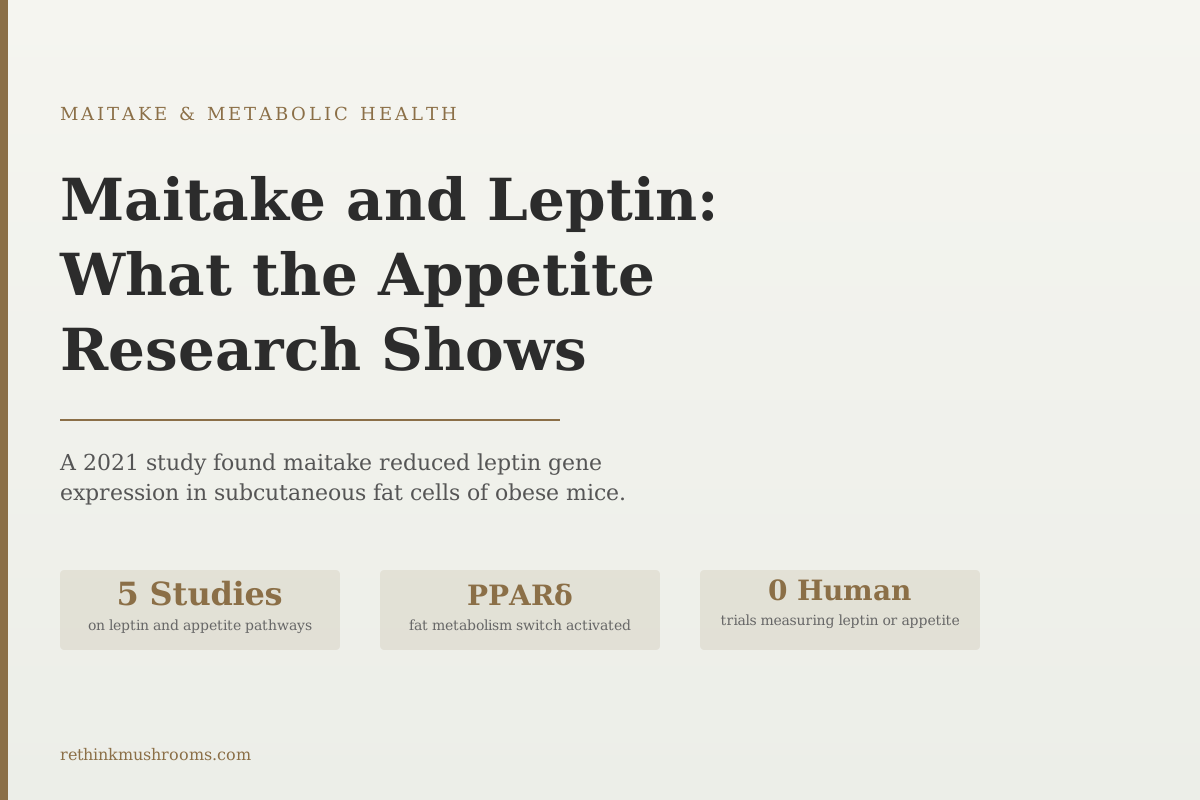
Maitake (Grifola frondosa) has documented anti-obesity and insulin-sensitizing effects in animal models, but no published study, in humans or animals, has ever measured its effect on leptin, leptin sensitivity, or appetite. The connection is a mechanistic hypothesis, not a finding.
Jiang et al., Food & Function, 2021; Aoki et al., 2018
0 studies
have measured maitake's effect on leptin or appetite hormones directly
PPARδ activated
maitake extract showed PPARδ agonist activity in obese mice, Aoki et al. 2018
5 animal studies
trace maitake's effects on body weight, glucose, and insulin resistance
Jiang et al., Food & Function, 2021; Aoki et al., 2018
 View as image ↗
Leptin is the hormone fat cells make to tell the brain you've eaten enough. In people with obesity, fat cells are producing it in abundance. The problem is that the brain has stopped listening. That failure of communication, called leptin resistance, is one of the central mechanisms that makes obesity self-sustaining.
Search for "maitake and leptin" and you will find confident claims that this mushroom lowers leptin or resets appetite hormones. Here is what the published literature actually contains: nothing. No study, in humans or in animals, has measured maitake's effect on leptin, leptin sensitivity, or appetite. What does exist is a body of animal research on maitake's effects on body weight, insulin resistance, fat-cell signaling, and gut bacteria, pathways that sit close to leptin biology without ever touching leptin directly.
This article separates the two. It lays out what maitake has actually been shown to do in metabolic research, explains why that makes a leptin connection biologically plausible, and is explicit about where the plausibility ends and the evidence stops.
This article focuses on maitake and the leptin-appetite question specifically. For a broader overview of what maitake is and what makes it biologically active, see What Is Maitake Mushroom? The Dancing Mushroom Explained.
Key Takeaways
- No published study has measured maitake's effect on leptin, leptin sensitivity, or appetite, in humans or animals. Every claim connecting maitake to leptin is mechanistic inference, not measurement.
- A 2021 Food & Function study (Jiang et al.) found Grifola frondosa reduced body weight, counteracted insulin resistance, alleviated fat-cell (adipocyte) enlargement, and regulated ceramide-linked lipid metabolism in high-fat-diet mice, but it did not measure leptin.
- A 2018 study (Aoki et al.) found lipid-soluble maitake extract has PPARδ agonist activity, lowered blood cholesterol, and improved glucose tolerance in obese mice.
- Maitake polysaccharides F2 and F3 improved insulin resistance in diabetic rats by reactivating insulin receptor (IR) and IRS-1 signaling (Xiao et al., 2015), not through AMPK as is sometimes claimed.
- Because insulin resistance and leptin resistance overlap mechanistically, maitake's insulin-sensitizing effects could plausibly touch leptin signaling, but this has never been tested.
Fact Check
Does maitake lower leptin?
The claim
“Maitake reduces leptin or 'resets' appetite hormones, based on a study showing it lowered leptin gene activity in fat cells.”
Consumer supplement content, sometimes citing a '2021 study' that does not report any leptin measurement.
What research shows
UnsupportedNo published study, in humans or animals, has measured maitake's effect on leptin at any level, gene expression, blood concentration, or receptor sensitivity. A PubMed search for maitake or Grifola frondosa combined with leptin returns zero results.
Maitake does have real, replicated effects on adjacent systems (body weight, insulin sensitivity, fat-cell function). Those make a leptin connection worth studying. They are not the same as having studied it.
PubMed search, Grifola frondosa AND leptin (0 results), July 2026
How Leptin Gets Hijacked in Obesity, and Why the Mechanism Matters
Leptin is made by fat cells and released into the bloodstream in proportion to how much fat the body is carrying. It travels to the hypothalamus, the region of the brain that governs hunger and energy expenditure, and triggers signals that reduce appetite and increase calorie burning. The system is designed as a feedback loop: more fat means more leptin, more leptin means less appetite, less appetite means less fat.
In theory, obesity should self-correct. In practice, the loop breaks.
In most people with obesity, blood leptin levels are elevated, not depleted. The fat cells are doing their job. The problem is that neurons in the hypothalamus have lost their ability to respond to the leptin signal. This condition is leptin resistance, and it is mechanistically analogous to insulin resistance: the signal is being sent at high volume, but the receiver has gone quiet.
Several processes contribute to leptin resistance. One involves the fat cells themselves. As fat cells enlarge and accumulate lipid, they produce leptin in excess. The sustained high circulating levels of leptin down-regulate leptin receptors on hypothalamic neurons, a compensatory blunting that worsens over time. A second mechanism involves chronic low-grade inflammation in the hypothalamus, where inflammatory signaling molecules interfere directly with leptin receptor pathways.
A third factor has emerged more recently: disrupted gut microbiota. The microbial community in the gut regulates production of short-chain fatty acids and gut hormones that communicate with appetite centers in the brain. Gut dysbiosis, the loss of healthy microbial diversity, can reduce these appetite-suppressing gut signals and worsen central leptin resistance through inflammatory mechanisms.
Understanding this system explains why maitake's metabolic evidence is worth looking at carefully, and why it stops short of a leptin claim. The relevant question is not whether maitake raises or lowers serum leptin, because no one has measured that. The answerable question is whether maitake influences the upstream conditions that drive leptin resistance: fat cell behavior, PPARδ-mediated fat cell function, insulin sensitivity, or gut microbiota composition. There, the evidence is real.
Evidence Map
Where the Maitake–Leptin Chain Breaks
Measured in animals
Weight & fat mass
Reduced body-weight gain and adipocyte hypertrophy in high-fat-diet mice
Jiang 2021
Insulin sensitivity
Lower fasting glucose, insulin, and HOMA-IR via IR / IRS-1 reactivation
Xiao 2015; Manohar 2002
Fat-cell signaling
PPARδ agonist activity and lower blood cholesterol in obese mice
Aoki 2018
Gut microbiota
Shifted microbial composition alongside hypoglycemic effect
Chen 2019
this link
Never measured with maitake
Leptin production
Whether maitake changes how much leptin fat cells make
Leptin sensitivity
Whether the hypothalamus responds better to the leptin signal
Appetite / hunger
Whether any of this reduces food intake or subjective hunger
Maitake’s documented effects (left) sit on pathways that overlap with leptin biology, which is why the leptin connection is plausible. But no published study — in humans or animals — has measured maitake’s effect on leptin production, leptin sensitivity, or appetite (right). Everything crossing the dashed line is inference, not measurement.
What the 2021 Study Actually Found, and What It Didn't
The study most often invoked in maitake-and-leptin claims is a 2021 paper in Food & Function by Jiang and colleagues.[1] It is a legitimate and useful anti-obesity study. It is worth reading for what it reports, and worth correcting for what it does not.
The researchers fed high-fat-diet obese mice Grifola frondosa and tracked its effects on lipid metabolism. Maitake significantly controlled body weight and blood glucose, counteracted the hyperlipidemia and insulin resistance triggered by the high-fat diet, alleviated fatty liver (hepatic steatosis), and reduced adipocyte hypertrophy, the enlargement of individual fat cells that accompanies weight gain. Using lipidomics, the team found that maitake regulated ceramide, a lipid metabolite tied to inflammation and insulin resistance, and restored lipid metabolism by suppressing Toll-like receptor 4 / NF-κB inflammatory signaling. An analysis of the intestinal microflora showed maitake reversed obesity-induced dysbiosis.
What the study did not do is measure leptin. There is no leptin gene expression result, no serum leptin measurement, and no FABP4 result in this paper. The finding sometimes circulated as "maitake reduced leptin mRNA in subcutaneous fat cells" does not appear in this study, and it does not appear in any other maitake study either. Treat the Jiang paper as strong evidence that maitake improves fat-cell and lipid-metabolism health in obese mice, and as silent on leptin.
The PPARδ Switch: How Maitake May Change Fat Cell Behavior
A 2018 study by Aoki and colleagues added mechanistic depth by identifying a molecular target.[2] The researchers showed that lipid-soluble extract from Grifola frondosa has PPARδ agonist activity, inducing the expression of PPARδ-target genes. When they administered the extract to high-fat-diet obese mice, it lowered total blood cholesterol, upregulated PPARδ-target genes in skeletal muscle, and improved glucose intolerance. Notably, the extract also restored glucose uptake in muscle cells through a PPARδ-independent insulin-signaling pathway, so more than one mechanism appears to be at work.
PPARδ is a protein that sits inside cells and binds to DNA, switching specific genes on or off. Think of it as a control switch for cellular energy decisions: when PPARδ is active, cells lean toward burning fatty acids rather than storing them.
Activating PPARδ does not directly lower leptin production. But it is connected to the broader set of conditions that govern leptin resistance. Cells that handle fatty acids more efficiently and produce fewer inflammatory signals are less likely to be in the enlarged, dysfunctional state that drives leptin overproduction. The PPARδ effects here and the reduced adipocyte hypertrophy from Jiang 2021 point in the same direction, toward healthier fat-cell function, from two different angles, without either study measuring leptin.
For maitake's effects on visceral fat specifically, examined across several animal studies, see Maitake and Visceral Fat Reduction: Animal Study Evidence.
Insulin Resistance and Leptin Resistance: Two Problems That Travel Together
Insulin resistance and leptin resistance are not the same thing, but they tend to occur in the same people, worsen through overlapping mechanisms, and are often improved by the same interventions. Both involve impaired cellular responses to a circulating hormone. Both are worsened by inflammation. Both are connected to the expansion and dysfunction of fat cells.
A 2015 study by Xiao and colleagues tested two specific polysaccharide fractions isolated from maitake, designated F2 and F3, in diabetic rats with established insulin resistance.[3] Both fractions significantly lowered fasting serum glucose, fasting serum insulin, and HOMA-IR (a standard index of insulin resistance) compared with diabetic controls.
Because insulin receptors and leptin receptors share overlapping intracellular signaling pathways, improvements in insulin sensitivity often correlate with improvements in leptin sensitivity. That correlation is the mechanistic bridge people are reaching for when they connect maitake to leptin, and it is a real bridge in principle. It has simply never been walked across experimentally with maitake.
An earlier study by Manohar and colleagues (2002) demonstrated the systemic insulin effect: a water-soluble maitake extract (Fraction X) significantly reduced both circulating glucose and circulating insulin in insulin-resistant KK mice, a model of type 2 diabetes.[4] The authors concluded the extract works primarily by enhancing peripheral insulin sensitivity, since lower insulin alongside lower glucose points to better sensitivity rather than simply more insulin secretion.
- Cell studiescompleted
PPARδ agonist activity and glucose uptake in muscle cells (Aoki 2018)
- Animal studiescurrent
Weight, glucose, insulin resistance, and fat-cell effects across mice and rats
- Small human trialsmissing
No trial has measured leptin, appetite, or metabolic hormones after maitake
- Large RCTsmissing
None
Maitake's metabolic effects are documented in cells and animals. Human evidence for any of it, and any leptin or appetite evidence at all, does not yet exist.
Aoki 2018; Xiao 2015; Manohar 2002; Jiang 2021; Chen 2019
For more on maitake's effects on blood sugar specifically, see Maitake and Blood Sugar: Research on Glycemic Control.
The Gut Connection: How Microbiome Changes Reach Appetite Signals
The gut microbiome influences appetite through a pathway most people do not associate with mushrooms or digestion. Certain gut bacteria ferment dietary fiber into short-chain fatty acids, mainly butyrate, propionate, and acetate. These short-chain fatty acids trigger the release of gut hormones, principally GLP-1 and PYY, from cells lining the intestinal wall. Those hormones then travel to the brain and reduce hunger. A gut with more SCFA-producing bacteria produces more of these appetite-suppressing signals.
The connection to leptin is indirect but real. Gut dysbiosis is associated with increased intestinal permeability. Bacterial fragments leak through the gut wall into circulation, drive systemic low-grade inflammation, and that inflammation impairs leptin receptor signaling in the hypothalamus.
A 2019 study by Chen and colleagues found that a novel maitake polysaccharide (GFP-N) significantly reduced blood glucose in type 2 diabetic mice and simultaneously modulated gut microbiota composition, the first report of a Grifola frondosa polysaccharide regulating intestinal microflora in vivo.[5] The glucose and gut changes appeared linked rather than independent.
This positions maitake's polysaccharides as candidate prebiotics. Indigestible polysaccharides reach the colon largely intact and can be selectively fermented by resident bacteria. If maitake's polysaccharides preferentially feed SCFA-producing bacteria, the downstream effects on appetite signaling and inflammation could be meaningful. That "if" has not been tested: no maitake study has measured GLP-1, PYY, short-chain fatty acids, or leptin as an outcome.
For a broader look at how the insulin, gut, and fat-cell pathways intersect in maitake's metabolic effects, see Maitake and Leptin Signaling: Research on Appetite Regulation and Metabolism.
What the Research Has Not Established, and What Would Change That
The gap between the animal evidence and human relevance is significant, and the gap on leptin specifically is total.
No study has measured leptin after maitake, in any species or at any level. No clinical trial has measured hunger, satiety scores, or food intake as an outcome after maitake. Every study reviewed above used animal models: high-fat-diet mice, diabetic KK mice, streptozotocin-induced diabetic rats. These models are useful for identifying mechanisms, but they do not substitute for human evidence, and none of them looked at leptin.
The animal limitations are also specific. Mice accumulate and lose fat mass rapidly relative to humans. Their leptin physiology resembles ours in broad strokes but differs in important details, including how leptin crosses the blood-brain barrier and how hypothalamic leptin resistance develops. Even if a future study did measure leptin in maitake-treated mice, translating that to human adipose tissue would remain uncertain.
Dose translation is also unclear. The studies above used a range of extracts and fractions (lipid-soluble extract, water-soluble Fraction X, purified polysaccharides F2, F3, and GFP-N), and mouse-to-human dose scaling is not straightforward given the metabolic-rate differences between species. There is no established human maitake dose for any metabolic outcome, let alone a leptin one.
Research Gaps
What would it take to earn a maitake-leptin claim?
What evidence would move maitake from 'plausible' to 'shown' on leptin and appetite?
Direct leptin measurement in animals
An animal study that actually assays serum leptin and leptin-receptor signaling after maitake, which no study has yet done
Appetite or food-intake outcomes
Measuring hunger, satiety, or intake rather than only weight and glucose
A human trial
An RCT measuring serum leptin, the leptin-to-adiponectin ratio, and subjective hunger in adults with metabolic syndrome on standardized maitake for 8 to 12 weeks
Evidence review, RethinkMushrooms, July 2026
Until that work is done, the honest summary is that maitake has documented metabolic effects in animals that make a leptin connection biologically reasonable, and that the connection itself remains untested.
This is not medical advice. Maitake is a food and supplement, not a treatment for obesity, diabetes, or any metabolic condition, and nothing here should replace guidance from a qualified clinician.
The Bottom Line
No published study, in humans or animals, has measured maitake's effect on leptin, leptin sensitivity, or appetite. Claims that a "2021 study" showed maitake lowering leptin gene activity are not supported by that study (Jiang et al., Food & Function) or any other. What the literature does show is a coherent set of adjacent animal findings: maitake reduces body weight and fat-cell enlargement, improves insulin sensitivity through IR/IRS-1 signaling, activates PPARδ, and modulates gut microbiota. Because insulin resistance and leptin resistance overlap, these effects make a leptin connection plausible. The mechanistic logic is sound. The leptin and appetite data do not exist yet.
Frequently Asked Questions
Sources & References
- 1RTHM-01369·Jiang, Xue et al. (2021). “Anti-obesity effects of Grifola frondosa through the modulation of lipid metabolism via ceramide in mice fed a high-fat diet..” Food & function.Study breakdown →PubMed →↩
- 2RTHM-00938·Aoki, Hana et al. (2018). “Grifola frondosa (Maitake) extract activates PPARδ and improves glucose intolerance in high-fat diet-induced obese mice..” Bioscience.Study breakdown →PubMed →↩
- 3RTHM-00410·Xiao, Chun et al. (2015). “Hypoglycemic effects of Grifola frondosa (Maitake) polysaccharides F2 and F3 through improvement of insulin resistance in diabetic rats..” Food & function.Study breakdown →PubMed →↩
- 4RTHM-00097·Manohar, V et al. (2002). “Effects of a water-soluble extract of maitake mushroom on circulating glucose/insulin concentrations in KK mice..” Diabetes.Study breakdown →PubMed →↩
- 5RTHM-01042·Chen, Yuqing et al. (2019). “Hypoglycemic activity and gut microbiota regulation of a novel polysaccharide from Grifola frondosa in type 2 diabetic mice..” Food and chemical toxicology : an international journal published for the British Industrial Biological Research Association.Study breakdown →PubMed →↩