Maitake Supplement Forms
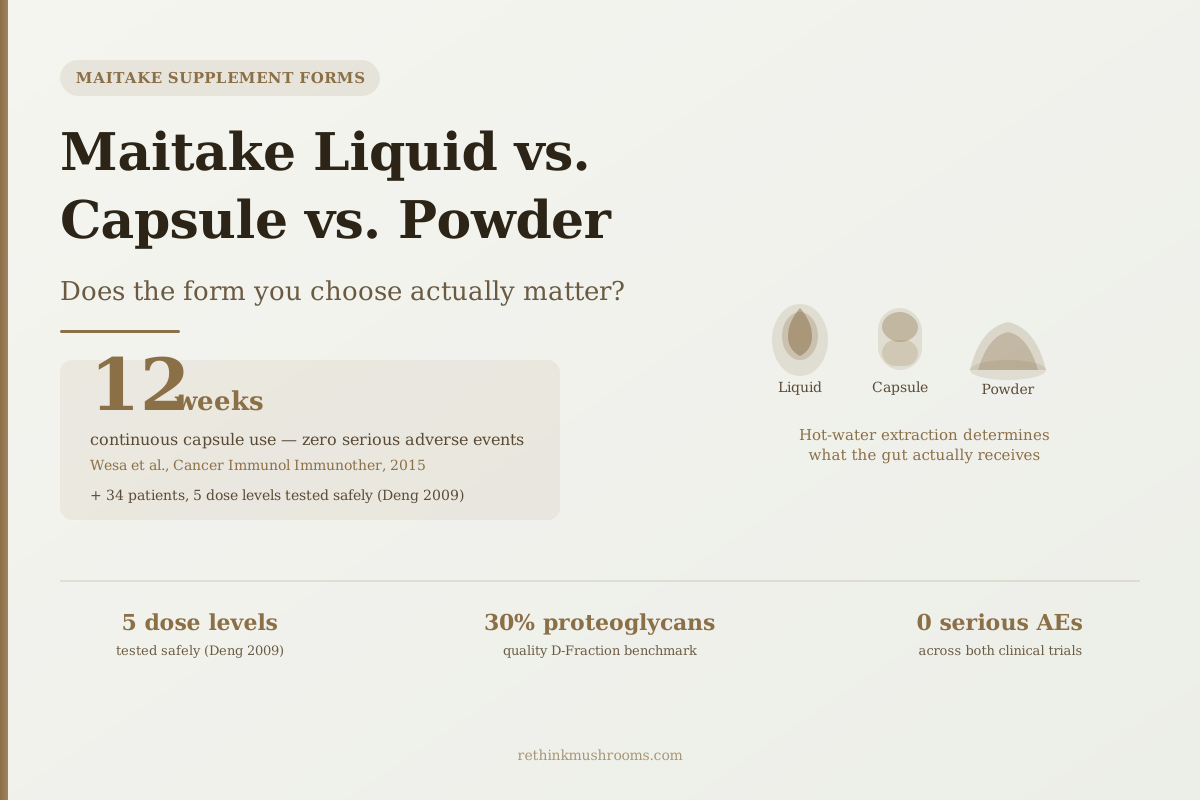
12 weeks
Capsule D-Fraction taken at therapeutic doses for three continuous months produced no serious adverse events — the longest published clinical safety record for any maitake supplement form.
Wesa KM et al., Cancer Immunol Immunother, 2015
5 dose levels
tested safely in Deng's 2009 dose-escalation trial
30% proteoglycans
standardization benchmark for quality D-Fraction
0 serious AEs
across both published maitake clinical trials
Wesa KM et al., Cancer Immunol Immunother, 2015
 View as image ↗
Walk into any supplement store and you'll find maitake in at least three forms: liquid drops, capsules, and bulk powder. The milligram numbers on the labels can look similar, and the price differences can be large. But the more important question isn't cost — it's whether these products are even delivering the same active compounds.
For maitake, the answer depends almost entirely on extraction. The beta-glucan compounds that drive D-Fraction's immune research are locked inside chitin cell walls. Hot-water extraction releases them. Products that skip this step — typically whole mushroom powders — contain the same molecules in theory, but most of what's inside the cell wall stays there through digestion. This article covers what the clinical trials actually used, what the evidence says about bioavailability across forms, and what to check on a supplement label before buying.
For a broader look at maitake's research history and primary active compounds, see what maitake mushroom is and why it's studied.
Key Takeaways
- Maitake beta-glucans are locked inside chitin cell walls — hot-water extraction is required to release them efficiently, and unextracted whole powder cannot guarantee this
- Liquid and capsule D-Fraction are both hot-water extracts; no clinical study has directly compared their bioavailability head-to-head
- Deng et al. (2009) established the liquid body-weight dosing protocol: approximately 1 drop per kilogram per day, divided across three doses
- Wesa et al. (2015) used capsule D-Fraction at 3 mg/kg twice daily for 12 weeks with zero serious adverse events — the most sustained capsule safety data available
- D-Fraction Pro 4X is four times more concentrated than standard liquid; the same body-weight dosing formula applies with one-quarter the drop count
- Whole mushroom powder shows food-level benefits in animal research but has not been the form used in the D-Fraction clinical trials that generated most of maitake's immune evidence
Why Maitake's Cell Walls Make Extraction Non-Optional
Maitake is a fungus, and like all fungi, its cells are encased in chitin. Chitin is the same tough structural material found in crustacean shells. It's insoluble and resistant to breakdown at body temperature. The beta-glucan compounds that give D-Fraction its immune activity are bound to a protein scaffold inside that chitin matrix, forming a complex structure that stays intact unless something actively breaks it open.
A 2001 review by Mayell in Alternative Medicine Reviews described the processing requirements for the major maitake extracts: hot-water extraction is the established method for freeing those bound beta-glucans from the cell wall — specifically the protein-and-beta-glucan complexes called proteoglycans that give D-Fraction its standardized identity.[1] The heat and water break down the chitin matrix, release the proteoglycans, and allow them to be concentrated and standardized to a specific percentage in the final product.
Without this step, a meaningful portion of the beta-glucans in raw mushroom material pass through the gut still enclosed in cell wall fragments. Some of that material is fermented by gut bacteria, which triggers downstream immune signaling as a secondary effect. But the concentration and consistency of active compound delivered to the immune system is substantially lower than in an extracted product standardized to a known proteoglycan percentage.
This is why the form question for maitake isn't just about convenience or absorption speed. It starts with whether the contents of the bottle were made accessible to the gut at all.
Liquid D-Fraction and capsule D-Fraction are both hot-water extracts. They start from the same place. The differences between them — concentration, dose format, how quickly they reach the gut — come after the extraction step, not as a substitute for it. Whole mushroom powder does not have that starting point.
Liquid D-Fraction: How the Body-Weight Dosing Protocol Was Established
The dosing protocol appearing on most commercial liquid D-Fraction products traces to one published trial: Deng et al. (2009), the only dose-escalation study of standardized maitake extract in human subjects.[2]
Deng enrolled 34 postmenopausal breast cancer patients and tested five dose levels: 0.1, 0.5, 1.5, 3.0, and 5.0 mg per kilogram of body weight, given twice daily for three weeks. The primary safety finding: all five dose levels were well-tolerated, with no serious adverse events recorded at any level across the three-week trial.
The body-weight scaling from this trial translated into the "1 drop per kilogram per day" dosing instruction found on many commercial liquid products. For a person weighing 70 kilograms, that comes to 70 drops per day — typically split as 23 to 24 drops three times daily. At standard liquid D-Fraction concentration, that dose corresponds to roughly 0.5 to 1.0 mg/kg, placing it in the middle range of what Deng found safe and immune-active.
One finding from Deng's trial runs counter to the intuition that higher doses produce stronger effects: the relationship between dose and immune response was not a straight upward line. Some immune parameters showed stronger stimulation at lower doses than at higher ones. The clinical interpretation is not that higher doses are harmful — all were safe — but that "more is better" is not supported for this specific extract. This is relevant for anyone choosing a more concentrated form and assuming they'll get proportionally greater benefit.
One practical note specific to liquid formulation: glycerin-based liquids maintain beta-glucan integrity better than alcohol-based tinctures over time. Alcohol can gradually degrade the structural integrity of the protein-bound beta-glucan complex. Most commercial D-Fraction liquid products use vegetable glycerin as the carrier, which preserves the active complex and accounts for the faintly sweet taste characteristic of these products.
For a detailed breakdown of clinical dose ranges across use cases, see the maitake D-Fraction dosage guide.
What 12 Weeks of Capsule D-Fraction Revealed About Sustained Use
While Deng's trial used liquid extract, the second published clinical trial — and the one with longer follow-up — used capsules.
Wesa et al. (2015) studied maitake extract in patients with myelodysplastic syndromes, a category of bone marrow disorders where immune function is already compromised.[3] Patients received 3 mg/kg twice daily in capsule form for 12 weeks. This is the longest continuous dosing period recorded in any published maitake clinical trial.
The results: well-tolerated throughout the full three months. Neutrophil and monocyte function — two immune cell types central to the body's first-line defenses — improved. No serious adverse events were recorded at the 3 mg/kg twice-daily dose.
This matters for the form comparison because it gives capsule D-Fraction its own clinical evidence base rather than just extrapolating from liquid trial results. The dose used by Wesa (3 mg/kg twice daily) overlaps with the upper-middle range of Deng's liquid trial. Both produced consistent biological effects.
What remains absent from the literature is a direct pharmacokinetic comparison — a study that measures blood levels of active compounds after equivalent oral doses of liquid versus capsule D-Fraction. That comparison hasn't been published. The theoretical argument for liquid having faster onset is reasonable: the active compounds enter the gut immediately without waiting for a capsule casing to dissolve. Whether this translates to measurably different outcomes in daily use, rather than just faster initial absorption, is not established.
What Deng and Wesa established together: standardized D-Fraction extract produces measurable immune effects in both major physical forms at body-weight-scaled doses, and both have clean safety profiles in published clinical populations. For daily supplementation, where consistent delivery across weeks matters more than absorption speed on any single day, the choice between forms comes down to practicality more than efficacy.
D-Fraction Pro 4X: What Four Times Concentrated Actually Means for Your Dose
Some maitake liquid products are labeled "D-Fraction Pro 4X" or carry similar concentration designations. These are the same hot-water extracted D-Fraction proteoglycan compound, processed to four times the active ingredient concentration per unit volume of liquid.
The practical consequence is straightforward: the body-weight dosing formula still applies, but the per-drop dose is four times higher. Where standard liquid requires approximately 1 drop per kilogram per day, a 4x concentrate requires approximately 0.25 drops per kilogram per day. For a 70 kilogram person, that comes to roughly 17 to 18 drops daily instead of 70.
A 4x concentrate is the same molecule as standard D-Fraction. The clinical evidence from Deng and Wesa applies equally to both product types. What changes is the volume of liquid consumed to reach a given dose.
Where a 4x concentrate provides practical value: for people taking higher therapeutic doses, the lower daily liquid volume is a meaningful convenience difference. For general wellness doses, the distinction is less relevant.
The caution worth repeating here follows directly from Deng's dose-escalation findings: higher concentration per drop makes precise measurement more important, not less.[2] The paradoxical immune response at higher doses in Deng's trial means underdosing and overdosing are both easier to do with a concentrated product if the conversion math isn't applied carefully.
Whole Mushroom Powder: Where Food-Level Evidence Ends and Extract Evidence Begins
Whole mushroom powder is dried, ground maitake fruiting body — the complete mushroom without extraction. It contains beta-glucans, protein, dietary fiber, and trace minerals in the ratios naturally present in the fungus.
Sato et al. (2013) fed mice whole dietary maitake mushroom and found reduced plasma cholesterol and changes in how liver genes related to fat metabolism were expressed, compared to control animals.[6] Whole maitake at dietary intake levels does produce measurable metabolic effects. This is consistent with maitake's traditional use as a culinary mushroom in Japan, where it's eaten as food rather than taken as a supplement.
The question is what "dietary intake" means compared to a supplement capsule. Sato's mice consumed maitake as a meaningful portion of their daily food — not a 1,000 mg capsule alongside a standard diet. At those food quantities, even with partial chitin enclosure, the total amount of beta-glucan reaching gut bacteria is substantially higher than what a typical whole powder supplement provides.
At 500 to 2,000 mg per capsule — the standard whole powder range — the chitin-enclosed fraction remains largely intact through digestion. Some beta-glucan reaches gut bacteria and triggers secondary immune signals through fermentation. But the consistent, measurable immune activation documented in the D-Fraction clinical trials was produced by extracted, standardized products at body-weight doses, not by whole powder at supplement amounts.
Whole mushroom powder occupies a legitimate place in the maitake product landscape. It is the most affordable form. It preserves the full nutritional profile of the mushroom, including compounds that extraction discards. And it functions as a nutritional food supplement rather than a targeted therapeutic extract. But if D-Fraction's immune effects are the reason for buying maitake, whole powder is not the equivalent product.
For a detailed look at how all four maitake extract types — D-Fraction, MD-Fraction, SX-Fraction, and whole powder — differ in research base and clinical application, see maitake supplement forms: whole mushroom vs. D-Fraction extract.
How Gut Bacteria Shape Bioavailability Regardless of Which Form You Take
One aspect of maitake polysaccharide bioavailability that applies across all three delivery forms is the role gut bacteria play in processing what arrives.
Guo et al. (2020) showed that Grifola frondosa polysaccharides reduced blood glucose and lipid levels in diabetic mice — and that part of this effect was linked to changes in gut microbiota composition the polysaccharides produced.[4] Beta-glucans are fermented by specific bacterial groups in the colon, particularly Lactobacillus and Bifidobacterium species, and the short-chain fatty acids and immune signals generated during that fermentation contribute to maitake's systemic effects. Some of the benefit reaches the immune system through this indirect pathway, not through direct absorption of intact polysaccharides into the bloodstream.
What this means for the liquid versus capsule question: by the time either form reaches the lower gut, the polysaccharide molecules are being processed by the same microbial machinery. Liquid might arrive faster because there's no capsule shell to dissolve. But once in the colon, the gut microbiome environment — not the delivery format — determines how much fermentation occurs and what downstream signals are produced.
This is relevant for anyone taking maitake during or after antibiotic use, which significantly alters gut microbiota composition, or for people with inflammatory bowel conditions affecting microbial balance in the colon. In those situations, the fermentation pathway that normally amplifies polysaccharide effects may be reduced regardless of which supplement form is used.
Maitake Liquid vs. Capsule vs. Powder: What to Look for on a Label
Given that extraction method and standardization determine whether a maitake product actually delivers its intended compounds, the label is the most practical quality check.
| Form | Standardization | Typical Daily Dose | Key Notes |
|---|---|---|---|
| Standard liquid D-Fraction | ~6,000 mg/2 oz | 5-6 drops 3x daily | Body-weight scaled; glycerin base preferred |
| D-Fraction Pro 4X liquid | 4x standard concentration | ~17-25 drops daily | Same molecule; lower volume per dose |
| D-Fraction capsule | 30% proteoglycans | 12-25 mg daily | Clinical trial form (Wesa 2015) |
| Whole mushroom powder | No standardization | 500-2,000 mg daily | Nutritional supplement; not equivalent to extract |
The systematic review by Ulbricht et al. (2009) covered the pharmacological profile of maitake extract and noted that clinical dosing guidance derives from body-weight-scaled protocols used with standardized extracts.[5] Products that don't disclose standardization cannot be reliably compared to the doses from which those protocols come.
Three label markers to check:
"Standardized to X% proteoglycans" confirms the active compound concentration was measured and controlled. Around 30% is the benchmark for quality D-Fraction. If this language is absent, the product likely contains whole powder or an extract with no standardization.
"Fruiting body" matters because both D-Fraction and MD-Fraction research was conducted exclusively on fruiting body extracts — not mycelium. Products that specify mycelium or don't identify the mushroom part used may be drawing on a different and weaker research base.
"Hot-water extract" or "aqueous extract" confirms the extraction method that releases beta-glucans from chitin was used. This language distinguishes extracted products from whole powder regardless of whether the finished form is liquid or capsule.
For a cost-focused comparison across mushroom supplement forms and what you're actually paying per milligram of active compound, see cost per dose: comparing mushroom supplement forms.
For what the research shows about safety across all maitake forms, including drug interactions, see maitake side effects and safety profile.
The Bottom Line
Liquid D-Fraction, capsule D-Fraction, and whole mushroom powder each deliver different concentrations of accessible beta-glucan to the gut. Both liquid and capsule forms are hot-water extracts with published clinical safety data: Deng's 2009 dose-escalation trial established the body-weight liquid dosing protocol, and Wesa's 2015 capsule trial provided 12 weeks of sustained therapeutic-dose safety evidence. No pharmacokinetic study has directly compared liquid and capsule bioavailability, but both have produced consistent immune effects in published trials. Whole mushroom powder delivers lower active compound concentrations at typical supplement doses and was not the form used in the D-Fraction immune research.
Frequently Asked Questions
Sources & References
- 1RTHM-00080·Mayell, M (2001). “Maitake extracts and their therapeutic potential..” Alternative medicine review : a journal of clinical therapeutic.Study breakdown →PubMed →↩
- 2RTHM-00289·Deng, Gary et al. (2009). “A phase I/II trial of a polysaccharide extract from Grifola frondosa (Maitake mushroom) in breast cancer patients: immunological effects..” Journal of cancer research and clinical oncology.Study breakdown →PubMed →↩
- 3RTHM-00745·Wesa, Kathleen M et al. (2015). “Maitake mushroom extract in myelodysplastic syndromes (MDS): a phase II study..” Cancer immunology.Study breakdown →PubMed →↩
- 4RTHM-01193·Guo, Wei-Ling et al. (2020). “Hypoglycemic and hypolipidemic activities of Grifola frondosa polysaccharides and their relationships with the modulation of intestinal microflora in diabetic mice induced by high-fat diet and streptozotocin..” International journal of biological macromolecules.Study breakdown →PubMed →↩
- 5RTHM-00319·Ulbricht, Catherine et al. (2009). “Maitake mushroom (Grifola frondosa): systematic review by the natural standard research collaboration..” Journal of the Society for Integrative Oncology.Study breakdown →PubMed →↩
- 6RTHM-00551·Sato, Mayumi et al. (2013). “Effect of dietary Maitake (Grifola frondosa) mushrooms on plasma cholesterol and hepatic gene expression in cholesterol-fed mice..” Journal of oleo science.Study breakdown →PubMed →↩