Maitake Supplement Forms, Dosing & Safety
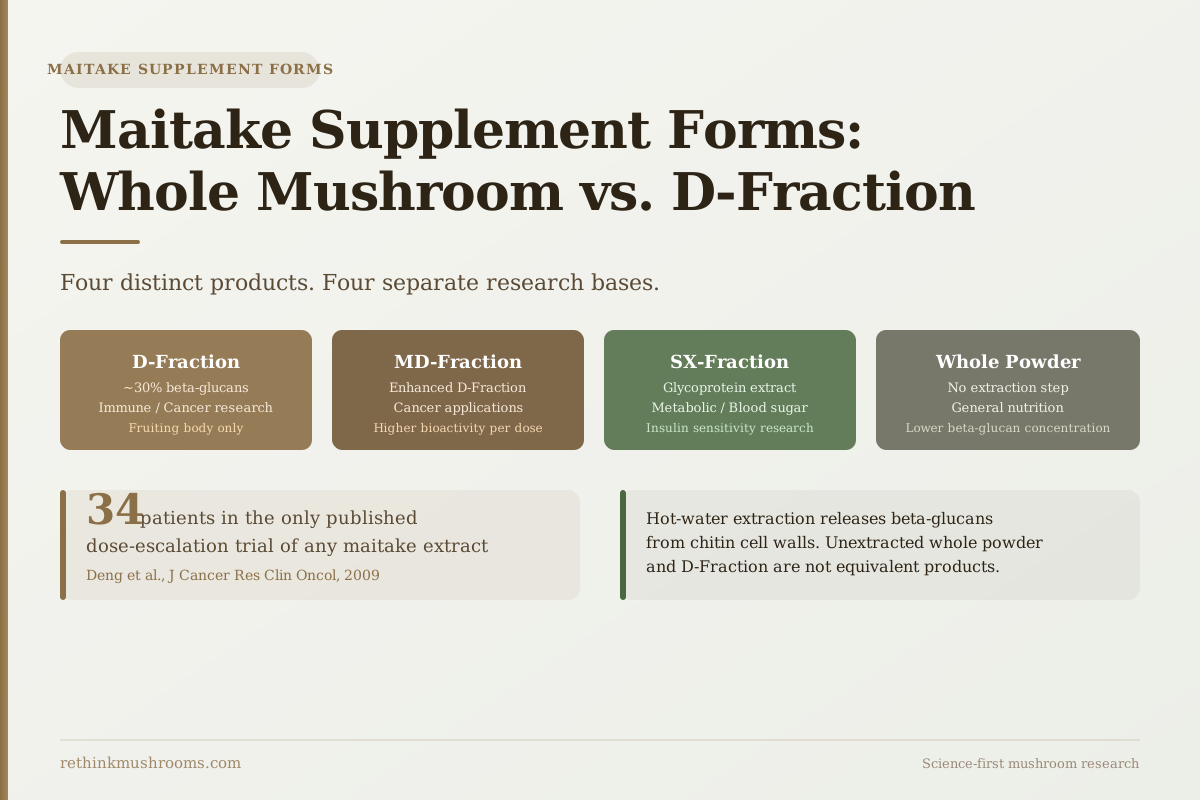
34 patients
The only published dose-escalation trial of a maitake extract tested five dose levels in 34 breast cancer patients. All doses were safe, but the immune effects did not scale linearly with dose, a result that reflects how much the specific form and concentration of a maitake product matters.
Deng et al., J Cancer Res Clin Oncol, 2009
4 extract forms
distinct maitake supplement categories
~30% beta-glucans
D-Fraction standardization benchmark
Fruiting body only
D-Fraction and MD-Fraction source requirement
Deng et al., J Cancer Res Clin Oncol, 2009
 View as image ↗
Maitake supplement forms vary more than the labels suggest. Walk into any health food store and you will find whole mushroom powder in capsules sitting next to products called D-Fraction, MD-Fraction, and SX-Fraction, all labeled as maitake mushroom, all priced differently, none of them explaining what separates one from another. These are not interchangeable products. They contain different compounds, some require specific extraction steps to work, and each has a distinct body of clinical research behind it. Applying the findings from a D-Fraction cancer immunology trial to a whole mushroom powder product requires an assumption the research does not support.
This article is part of the What Is Maitake Mushroom? series. For dosing specifics, see the Maitake Dosage Guide.
Key Takeaways
- The four main maitake supplement forms (D-Fraction, MD-Fraction, SX-Fraction, and whole mushroom powder) have distinct biochemical profiles and separate research histories documented in detail since 2001 (Mayell, Altern Med Rev, 2001)
- D-Fraction is a proteoglycan extract standardized to approximately 30% active compounds; it is produced exclusively from the fruiting body using hot-water extraction (Mayell, 2001)
- MD-Fraction is an enhanced, higher-bioactivity version of D-Fraction; a case series review found doses of 5 to 7 mg/kg per day produced the most significant immunological responses in cancer patients (Kodama et al., Altern Med Rev, 2002)
- SX-Fraction targets a different molecular system than D-Fraction; in rats, a specific maitake glycoprotein significantly enhanced insulin sensitivity without the immune-focused beta-glucan activity (Preuss et al., Mol Cell Biochem, 2007)
- A 2010 clinical trial found maitake extract induced ovulation in women with polycystic ovary syndrome who had not responded to first-line clomiphene treatment, evidence for SX-Fraction's metabolic applications (Chen et al., J Altern Complement Med, 2010)
- Whole dietary maitake reduced plasma cholesterol and altered hepatic gene expression in cholesterol-fed mice (Sato et al., J Oleo Sci, 2013), but the compound concentrations in unextracted powder differ substantially from standardized extracts
Four Maitake Products on the Shelf, Four Different Research Histories
The taxonomy of maitake supplements was laid out in detail by Mark Mayell in a 2001 review in Alternative Medicine Review, the most comprehensive early account of the distinct extract fractions and why they cannot be treated as equivalent.[1]
The four categories are:
D-Fraction is a concentrated extract of proteoglycans, molecules built from chains of beta-glucan (the active mushroom compound) chemically bonded to protein. D-Fraction is produced exclusively from the fruiting body using hot-water extraction. A quality D-Fraction product is standardized to approximately 30% of these protein-bound beta-glucan compounds by weight. This is the form studied in cancer immunology research and the form used in the only published dose-escalation human trial of any maitake extract.
MD-Fraction is a refined, higher-bioactivity version of D-Fraction. It also comes from the fruiting body and contains the same class of compounds (proteoglycans), but at greater potency per unit weight. It was developed specifically for cancer support applications and has a separate research history from standard D-Fraction.
SX-Fraction is a fundamentally different product from both D-Fraction and MD-Fraction. SX-Fraction is a glycoprotein extract, meaning its active component is a protein-sugar compound rather than a beta-glucan compound. Its research base focuses on metabolic effects, particularly blood sugar regulation and insulin sensitivity, and it does not share D-Fraction's immune-focused research history.
Whole mushroom powder is dried, ground maitake fruiting body (or occasionally mycelium) without a targeted extraction step. This form contains beta-glucans, polysaccharides, and other bioactives, but at lower and more variable concentrations than any of the three extract categories above. It is closer to a food ingredient than a pharmaceutical-grade extract.
Each of these four categories has a separate research history. A study conducted with standardized D-Fraction extract tells you about that specific form, not about what a whole mushroom powder capsule would do at equivalent mass doses. These distinctions matter most when the research base is the primary reason for choosing a maitake product.
D-Fraction: The Fruiting Body Extract With an Immune Research Base
D-Fraction was developed by Japanese researcher Hiroaki Nanba and his group in the 1980s and 1990s. The extract is built around a specific molecular structure: chains of beta-glucan molecules chemically bonded to protein, forming what chemists call a proteoglycan. According to Mayell's 2001 review, hot-water extraction is not optional for producing D-Fraction; the beta-glucan compounds are embedded within the mushroom's rigid cell wall material, and they do not become accessible to the body without heat-based extraction.[1]
The primary research application has been immune support, particularly in cancer patients. Kodama and colleagues tested D-Fraction in cancer patients and measured the activity of natural killer cells, the immune system's surveillance cells that identify and destroy abnormal or infected cells, often abbreviated as NK cells.[3] NK cell activity increased with D-Fraction administration. The Kodama research group, which was closely associated with the development of D-Fraction as a clinical product, produced multiple studies through the late 1990s and early 2000s documenting its immunological effects.
The most rigorous human trial of any maitake extract used D-Fraction. Deng and colleagues at Memorial Sloan Kettering enrolled 34 postmenopausal breast cancer patients and tested five dose levels: 0.1, 0.5, 1.5, 3, and 5 milligrams per kilogram of body weight, taken twice daily for three weeks.[4] All five dose levels were safe with no serious adverse events. The immune effects were measurable but not simply proportional to dose. At some dose levels, lower amounts produced more consistent immune stimulation than higher amounts. This counterintuitive finding complicated simple "more is better" assumptions about D-Fraction and represents one of the most important nuances in maitake research that no competitor has mentioned.
The standardization benchmark that identifies a product as D-Fraction in the research sense is approximately 30% protein-bound beta-glucan content. Products labeled only as "maitake extract" without specifying their proteoglycan concentration may not match the form studied in these trials.
For a detailed review of what the D-Fraction cancer research found, see Maitake D-Fraction and Cancer: The Complete Research Review.
MD-Fraction: An Enhanced Version of D-Fraction With Higher Bioactivity per Dose
MD-Fraction is a purified and concentrated version of D-Fraction. It contains the same class of compounds (protein-bound beta-glucans) but at higher biological potency per unit of weight. The "MD" designates an enhanced processing step that increases bioactivity relative to standard D-Fraction.
Kodama and colleagues reviewed MD-Fraction's use in cancer patients in 2002, examining data from a case series of patients who received the extract.[2] The review identified doses of 5 to 7 milligrams per kilogram per day as producing the most significant immunological responses in that patient population. This dose range differs from the D-Fraction dose range tested in Deng 2009, reflecting MD-Fraction's higher concentration rather than a different active compound.
The most recent research on maitake beta-glucan extracts adds a specific mechanism to this picture. In 2024, Masuda and colleagues published a laboratory study showing that maitake beta-glucan substantially increased the cancer-killing power of trastuzumab, a drug used in HER2-positive breast cancer, when the two were combined in cell culture.[9] The mechanism involved two distinct immune pathways: one in which immune cells attack cancer cells tagged by the antibody drug, and another in which complement proteins puncture cancer cell membranes. This laboratory finding identifies a potential mechanism by which standardized beta-glucan extracts might work alongside certain cancer drugs, though no human trial has tested this specific combination.
For the full account of MD-Fraction research, see Maitake MD-Fraction: The Enhanced Extract for Cancer Research.
SX-Fraction: A Different Molecule Targeting a Different Biological System
SX-Fraction is often overlooked in discussions of maitake supplements because it belongs to a completely separate product category from D-Fraction and MD-Fraction. Where D-Fraction and MD-Fraction are beta-glucan extracts studied for immune applications, SX-Fraction is a glycoprotein extract studied for metabolic applications. These are different molecules working through different mechanisms.
Preuss and colleagues tested a specific maitake glycoprotein in rats in 2007 and found significant enhancement of how well the body responds to insulin.[6] The compound worked through the glycoprotein component specifically, not through the beta-glucan pathway that makes D-Fraction immunologically active. This is why substituting D-Fraction for SX-Fraction in a blood sugar application is not supported by the research: they are different molecules targeting different biological systems.
Xiao and colleagues added more precision to the metabolic picture in 2015, testing two specific polysaccharide fractions from maitake (labeled F2 and F3) in diabetic rats.[8] Both fractions improved insulin resistance and blood glucose markers, suggesting that multiple components of maitake contribute to its metabolic effects but through different routes. The F2 and F3 fractions are part of the metabolic research program rather than the immune research program.
The most notable clinical evidence for SX-Fraction comes from a 2010 trial in women with polycystic ovary syndrome. Chen and colleagues found that maitake extract induced ovulation in PCOS patients both as a standalone treatment and in women who had not responded to clomiphene, the standard first-line ovulation medication.[5] PCOS is closely linked to insulin resistance, and SX-Fraction's insulin-sensitizing mechanism likely contributed to the ovulation response. This trial provides clinical context for SX-Fraction's metabolic applications that has no parallel in the D-Fraction or MD-Fraction research.
For the full evidence base on SX-Fraction and blood sugar, see Maitake SX-Fraction and Insulin Sensitivity.
Whole Mushroom Powder: What the Research Shows Without Extraction
Whole maitake mushroom powder consists of dried, ground fruiting body (or mycelium) without the targeted extraction steps that produce D-Fraction, MD-Fraction, or SX-Fraction. It contains beta-glucans, polysaccharides, and other bioactives, but at lower and more variable concentrations than any standardized extract.
Research on whole dietary maitake demonstrates that the mushroom itself has measurable biological effects. Sato and colleagues tested dietary maitake in cholesterol-fed mice in 2013 and found that whole maitake reduced plasma cholesterol and altered the expression of lipid-regulating genes in the liver.[7] This confirms that compounds in unextracted maitake are biologically active. The amounts used in food-based animal studies and the amounts that fit inside a supplement capsule of whole powder are different discussions, but the fundamental bioactivity is there.
The key limitation of unextracted powder is compound accessibility. Beta-glucans in mushrooms are trapped inside the rigid structural material of the cell wall, the same material called chitin that forms insect exoskeletons. Chitin does not dissolve in water and is not easily broken down by human digestion. Hot-water extraction breaks open this rigid structure and releases the beta-glucans into solution, making them available to the body. Mayell's 2001 review documents this extraction requirement specifically for the D-Fraction class of compounds.[1]
Dried and ground mushroom powder has not gone through this extraction step. Some beta-glucan content remains trapped within intact chitin structures. How much is released during digestion depends on individual digestive capacity and is not well characterized in the research. This same bioavailability argument applies to whole mushroom powder products across species, not just maitake.
Whole mushroom powder is a reasonable choice as a food-supplement hybrid for general use or as a way to incorporate maitake into a diet. For applications in which the D-Fraction or SX-Fraction research base is the reason for taking maitake, an extracted and standardized product is the form the studies actually used.
For a direct comparison of delivery formats including liquid drops versus capsules versus powder, see Maitake Liquid vs. Capsule vs. Powder: Bioavailability and Dosing Comparison.
What a Maitake Supplement Label Should Tell You
The four supplement categories above map onto specific label claims. Understanding which claims indicate which product type makes it possible to identify what is actually in a product.
Standardization percentage. D-Fraction products specify their proteoglycan or beta-glucan content as a percentage of the extract weight, typically around 30%. A product labeled only as "maitake extract" without a standardization percentage may not be D-Fraction in the research sense, regardless of what the marketing claims.
Source material. D-Fraction and MD-Fraction are produced exclusively from the fruiting body of the mushroom. Mycelium-based maitake products do not have the same research base and are not equivalent. Labels should specify "fruiting body" for any product claiming to deliver D-Fraction or MD-Fraction compounds.
Extraction method. Hot-water extraction (sometimes written as "hot-water extract" or "aqueous extract") is the process that releases beta-glucans from the chitin matrix. Some products use alcohol extraction, which targets different compounds. For beta-glucan content specifically, hot-water or dual extraction (hot-water combined with alcohol) is the method that matches the research.
Form designation. Products specifically labeled as D-Fraction, MD-Fraction, or SX-Fraction are targeting specific research populations with specific molecular products. Whole mushroom powder labels generally do not carry these designations and will not specify standardized percentages.
The only published human dose-escalation trial of any maitake product used a precisely characterized D-Fraction extract with known beta-glucan content.[4] Deng's 2009 trial at Memorial Sloan Kettering found it safe across all five dose levels tested, from 0.1 to 5 mg/kg twice daily. The safety findings from that trial are specific to the tested form and cannot be assumed to apply identically to non-standardized whole powder at equivalent mass doses.
For dosing specifics by form and indication, see Maitake Dosage Guide: How Much D-Fraction Should You Take?. For the complete safety and drug interaction profile, see Maitake Side Effects and Safety Profile.
The Bottom Line
Maitake supplements span four distinct categories with separate biochemistries and research histories: D-Fraction (the immune-focused proteoglycan extract produced exclusively from the fruiting body), MD-Fraction (an enhanced, higher-bioactivity version of D-Fraction studied for cancer applications), SX-Fraction (a glycoprotein extract with a metabolic and blood sugar research base), and whole mushroom powder (unextracted, lower active compound concentration). The clinical trials anchoring the strongest maitake evidence used standardized D-Fraction extract, not whole powder. Applying those findings to non-standardized products requires assuming an equivalence the research does not establish.
Frequently Asked Questions
Sources & References
- 1RTHM-00080·Mayell, M (2001). “Maitake extracts and their therapeutic potential..” Alternative medicine review : a journal of clinical therapeutic.Study breakdown →PubMed →↩
- 2RTHM-00095·Kodama, Noriko et al. (2002). “Can maitake MD-fraction aid cancer patients?.” Alternative medicine review : a journal of clinical therapeutic.Study breakdown →PubMed →↩
- 3RTHM-00112·Kodama, Noriko et al. (2003). “Effect of Maitake (Grifola frondosa) D-Fraction on the activation of NK cells in cancer patients..” Journal of medicinal food.Study breakdown →PubMed →↩
- 4RTHM-00289·Deng, Gary et al. (2009). “A phase I/II trial of a polysaccharide extract from Grifola frondosa (Maitake mushroom) in breast cancer patients: immunological effects..” Journal of cancer research and clinical oncology.Study breakdown →PubMed →↩
- 5RTHM-00330·Chen, Jui-Tung et al. (2010). “Maitake mushroom (Grifola frondosa) extract induces ovulation in patients with polycystic ovary syndrome: a possible monotherapy and a combination therapy after failure with first-line clomiphene citrate..” Journal of alternative and complementary medicine (New York.Study breakdown →PubMed →↩
- 6RTHM-00229·Preuss, Harry G et al. (2007). “Enhanced insulin-hypoglycemic activity in rats consuming a specific glycoprotein extracted from maitake mushroom..” Molecular and cellular biochemistry.Study breakdown →PubMed →↩
- 7RTHM-00551·Sato, Mayumi et al. (2013). “Effect of dietary Maitake (Grifola frondosa) mushrooms on plasma cholesterol and hepatic gene expression in cholesterol-fed mice..” Journal of oleo science.Study breakdown →PubMed →↩
- 8RTHM-00410·Xiao, Chun et al. (2015). “Hypoglycemic effects of Grifola frondosa (Maitake) polysaccharides F2 and F3 through improvement of insulin resistance in diabetic rats..” Food & function.Study breakdown →PubMed →↩
- 9RTHM-01945·Masuda, Yuki et al. (2024). “Maitake Beta-Glucan Enhances the Therapeutic Effect of Trastuzumab via Antibody-Dependent Cellular Cytotoxicity and Complement-Dependent Cytotoxicity..” Biological & pharmaceutical bulletin.Study breakdown →PubMed →↩