Maitake Safety
5 dose levels tested
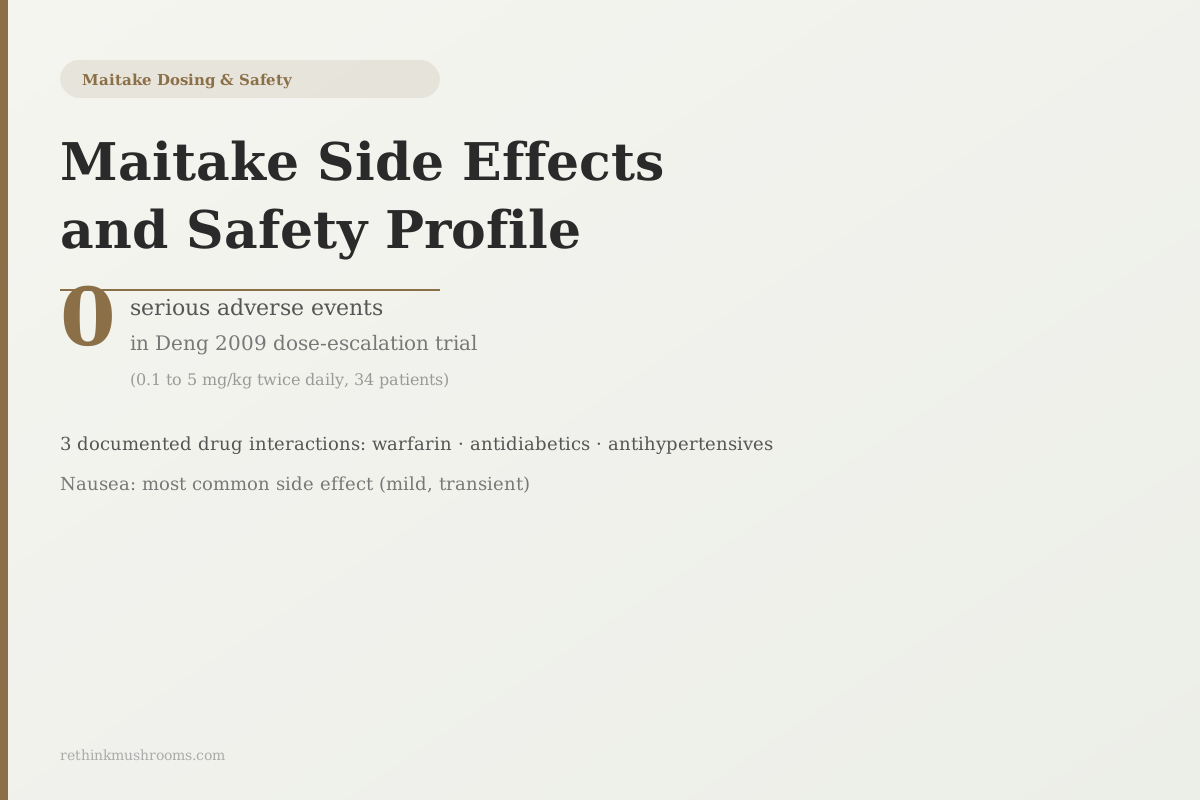
Deng's 2009 trial gave maitake extract to 34 breast cancer patients at five escalating doses and recorded no serious adverse events at any level.
Deng et al., J Cancer Res Clin Oncol, 2009
12 weeks
of sustained therapeutic dosing monitored in Wesa 2015 with no safety signal
34 patients
enrolled across five dose levels in the only published maitake dose-escalation trial
3 drug classes
with documented interaction potential per the 2009 systematic review
Deng et al., J Cancer Res Clin Oncol, 2009
 View as image ↗
Most articles covering maitake mushroom side effects work from the same starting point: a list of what maitake's active compounds might theoretically do when combined with certain medications. That information isn't useless. But it's a different question from what the published clinical trials actually recorded when researchers gave maitake to real patients and systematically watched what happened. Maitake (Grifola frondosa) has two published clinical trials with explicit adverse event monitoring, and that data is the most important safety resource available, yet it appears in almost none of the popular safety coverage.
Key Takeaways
- The only published dose-escalation trial (Deng 2009) found no serious adverse events at any of five dose levels up to 5 mg/kg twice daily in 34 breast cancer patients
- Wesa 2015 monitored safety over 12 consecutive weeks at 3 mg/kg twice daily in MDS patients and found the extract well tolerated throughout
- Nausea is the most commonly reported side effect across the maitake literature; no serious adverse event has appeared in any published clinical trial
- Three drug interaction categories have a documented mechanistic basis: anticoagulants (blood thinners), antidiabetics (blood sugar medications), and antihypertensives (blood pressure medications)
- The immunosuppressant interaction is theoretical only; no clinical case report documents it occurring in a patient
- Standard surgical guidance recommends stopping maitake two weeks before elective surgery due to its antiplatelet activity, the same precaution applied across many botanical supplements
What Happened When Researchers Actually Monitored Maitake Safety
The maitake safety literature has exactly two published clinical trials with systematic adverse event monitoring. Both came from Memorial Sloan Kettering. Both provide the clearest picture available of what maitake extract does and doesn't do in human patients.
In 2009, Deng and colleagues enrolled 34 postmenopausal breast cancer patients in a dose-escalation study of a maitake polysaccharide extract.[1] Each participant received the extract twice daily at one of five doses: 0.1, 0.5, 1.5, 3, or 5 milligrams per kilogram of body weight. They took it for three weeks while the research team monitored both immune markers and adverse events. The result: no serious adverse events at any dose level tested, including the highest dose of 5 mg/kg twice daily.
To put that dosing in perspective: a 150-pound (68 kg) person at 5 mg/kg twice daily would receive 680 milligrams of extract per dose, far above what any commercial maitake supplement recommends. That's the range the clinical trial found to be well tolerated. Both trials used a standardized polysaccharide extract; for more on how supplement forms compare in terms of bioavailability, see Maitake Supplement Forms: Whole Mushroom vs. D-Fraction Extract.
In 2015, Wesa and colleagues gave patients with myelodysplastic syndrome (MDS, a bone marrow condition that impairs normal blood cell production) a fixed therapeutic dose of 3 mg/kg twice daily and tracked outcomes over twelve consecutive weeks.[2] The result: well tolerated across the full twelve weeks, with enhanced activity in neutrophils and monocytes (two types of white blood cells that are part of the immune system's front line), and no safety signal that prompted stopping the trial.
Twelve weeks at a therapeutic dose is meaningful duration data. A supplement that causes problems tends to reveal them over extended use. Wesa's trial found none.
These two trials don't answer every question. Both enrolled patients with existing medical conditions, not healthy adults. Neither was large enough to catch rare adverse events that occur in fewer than 1 in several hundred people. But they represent the actual human evidence: not projections from mechanism, not extrapolations from animal studies, not anecdotes.
The Side Effects That Did Appear: Nausea, No Serious Events
Across both clinical trials and the systematic review of the full maitake literature, nausea is the most consistently reported side effect.[3] It's mild; it didn't prompt any patient to withdraw from either the Deng or Wesa trials.
Gastrointestinal discomfort (stomach upset, loose stools) appears occasionally in case reports and patient surveys, at rates typical for any mushroom supplement. No grade 3 or grade 4 adverse events (the clinical trial classifications for serious or life-threatening reactions) have appeared in any published maitake study.
The Ulbricht 2009 systematic review, which compiled all available evidence on maitake safety, lists nausea and mild gastrointestinal effects as the documented side effects, with skin reactions appearing rarely at the level of individual case reports.[3] None of these required medical intervention in any of the documented instances.
Four Drug Interactions: Which Are Documented, Which Are Theoretical
This is where the distinction between "observed in clinical records" and "theoretically possible based on mechanism" matters most. Competitor articles list warnings without making this distinction. The Ulbricht 2009 systematic review does make it, and that nuance changes how the risk should be interpreted.[3]
The interactions most commonly flagged fall into four categories, ordered by the strength of the underlying evidence:
- Warfarin and anticoagulants: may increase bleeding time; monitor INR; discontinue 2 weeks before surgery
- Diabetes medications: additive blood sugar-lowering effect; monitor glucose levels
- Blood pressure medications: additive blood pressure-lowering effect; monitor blood pressure
- Immunosuppressants: theoretical only; no clinical case report documents this in a patient
Warfarin and Blood Thinners
Maitake's immune-activating fibers (called beta-glucans) slow the process by which blood platelets clump together to form clots. This antiplatelet activity creates a theoretical pathway for maitake to amplify the blood-thinning effect of warfarin or other anticoagulants, pushing bleeding time further than the medication alone would produce.
This interaction is mechanism-based. No clinical case report in the systematic review documents a patient experiencing excess bleeding from combining maitake with warfarin. But the mechanism is credible and consistent with how beta-glucan-containing substances are generally categorized by pharmacologists.
For people taking warfarin, the practical consideration is more frequent monitoring of INR (the standard test that measures how long it takes blood to clot) when adding a maitake supplement. Standard surgical guidance also recommends stopping supplements with antiplatelet properties two weeks before elective procedures.
Diabetes Medications
Maitake polysaccharides reduce blood glucose through multiple pathways, including improving how cells respond to insulin. This blood sugar-lowering effect is documented in both animal studies and preliminary human data; it is not hypothetical. Adding maitake to a regimen that already includes a blood sugar-lowering medication (metformin, insulin, sulfonylureas) creates a situation where both are working in the same direction.[3]
The risk of blood sugar dropping too low (a state called hypoglycemia) is real for people on antidiabetic medications who add maitake without adjusting their glucose monitoring. This is the most credible of the four interactions on this list, because the active mechanism is established rather than speculative.
Blood Pressure Medications
Animal studies have found that maitake lowers blood pressure. Combined with antihypertensive medications that are already lowering blood pressure, there is a possibility of additive reduction, with pressure dropping further than the medication alone would produce.[3]
This interaction is less well-characterized than the blood sugar concern. The animal evidence supports the mechanism, but the clinical significance in people taking standard blood pressure medications hasn't been directly tested in a human trial. It represents a monitoring consideration rather than a documented clinical event.
Immunosuppressants
Maitake's core documented activity is immune activation: it increases the activity of natural killer cells, neutrophils, and other parts of the immune system. Immunosuppressant medications (used after organ transplants or for autoimmune conditions) work in the opposite direction: they calm immune activity to prevent rejection or flare-ups.
The theoretical concern is that maitake could counteract the immunosuppressant and allow the immune system to become more active than the medication intends.[3] The systematic review notes this concern. But it remains theoretical; no clinical case report documents this interaction occurring in a patient.
The stakes of this interaction being real are high for transplant patients, where immune activation could trigger rejection. For that reason, the theoretical concern warrants a conversation with a prescriber before adding maitake, even without documented cases.
Cancer Patients on Conventional Treatment: A Genuinely Different Question
For patients receiving chemotherapy or targeted cancer therapies, the interaction question becomes more complex and less clearly one-directional.
A 2024 laboratory study by Masuda and colleagues found that maitake beta-glucan enhanced the anti-cancer activity of trastuzumab (the targeted therapy sold as Herceptin) through two immune mechanisms: the process where immune cells directly attack antibody-tagged cancer cells, and the process where the complement system (a network of proteins that marks threats for destruction) targets cancer cells.[5]
This is in-vitro data, conducted in cultured cells rather than patients. It doesn't establish that combining maitake with trastuzumab is beneficial or safe in humans. But it illustrates that the interaction between maitake extracts and conventional cancer treatment may be additive in a favorable direction, not only in a potentially harmful one.
Earlier work by Kodama and colleagues on MD-Fraction (a concentrated, enhanced form of the standard D-Fraction extract) similarly suggested that maitake extracts may function as immune adjuncts alongside conventional cancer treatment rather than simply running independently.[4]
There is also the paradox from Deng 2009 to keep in mind.[1] That trial found lower doses (0.1-1.5 mg/kg) sometimes produced more consistent immune activation than the highest doses tested, where some immune parameters showed suppression rather than stimulation. The "more is better" assumption is directly contradicted by the best available dose-finding data. For the complete cancer research evidence base on maitake, see Maitake D-Fraction and Cancer: The Complete Research Review.
Allergic Reactions: Rare, and the Same as Any Culinary Mushroom
Maitake is a food. It's consumed as a culinary ingredient across Japan and East Asia, and its allergenic profile is comparable to other edible mushrooms: low prevalence, with occasional individual sensitivities.
Supplement-grade extracts concentrate the active fractions but show no evidence of producing allergic reactions at rates higher than comparable botanical supplements. Skin itching, headache, and gastrointestinal discomfort appear occasionally in broad supplement user surveys, but these are difficult to attribute specifically to maitake when people typically take multiple supplements simultaneously.
People with documented allergies to mushrooms or fungi broadly should approach any fungal supplement with appropriate caution, maitake included. That is a low-prevalence group, but it's a clear risk category. For people asking about autoimmune conditions specifically: maitake activates immune function through macrophages, natural killer cells, and other immune components, a mechanism that, in theory, could be relevant for conditions where the immune system is already overactive. No clinical trial has studied maitake in autoimmune populations.
The Surgery Rule: Why the Two-Week Pause Applies to Maitake
Because maitake slows platelet clumping through its beta-glucan structure, it falls under the same pre-surgical precaution applied to garlic, omega-3 fatty acids, ginkgo biloba, and a long list of other botanical supplements that share antiplatelet properties.[3]
Standard integrative oncology and surgical guidance recommends discontinuing all supplements with possible anticoagulant or antiplatelet activity two weeks before elective surgery. The two-week window lets the body clear the supplement and normalize bleeding measurements before a procedure where unexpected bleeding would be a problem.
This isn't a warning that maitake is especially dangerous. It's a category precaution that applies across dozens of supplements with this mechanism. Maitake's placement in that category comes from its beta-glucan-mediated antiplatelet activity, not from documented surgical bleeding incidents in patients who were taking it.
Does More Maitake Mean More Risk? The Dose-Escalation Data Says No
The Deng 2009 trial answered this question directly.[1]
Adverse events didn't meaningfully increase as doses went from 0.1 mg/kg up to 5 mg/kg. The trial found no dose-response relationship for side effects; higher doses didn't produce more problems. What it did find was a paradoxical dose-response for immune activity: lower doses sometimes produced more consistent immune system activation than the highest doses. The immune cell markers the researchers tracked didn't simply climb with dose; they responded in a complex, non-linear pattern.
Wesa's twelve-week trial reinforced the safety picture at a fixed therapeutic dose.[2] Three milligrams per kilogram twice daily for three months produced no safety events worth reporting.
The clinical trial data does not support the concern that escalating to higher doses dramatically escalates risk. The more meaningful safety consideration is the drug interaction categories listed above, which apply at typical supplement doses and are not simply dose-dependent in the same linear way.
For a detailed breakdown of what doses were used across clinical studies and how those relate to commercial supplement dosing, see Maitake Dosage Guide: How Much D-Fraction Should You Take?. For comparison with safety profiles of other medicinal mushrooms, see Lion's Mane Side Effects: What the Research Says About Safety and Cordyceps Side Effects: What the Safety Research Shows.
The Bottom Line
The two published clinical trials with explicit adverse event monitoring (Deng 2009, Wesa 2015) found maitake extract well tolerated at doses up to 5 mg/kg twice daily, with nausea the most commonly reported side effect and no serious adverse events recorded in either study. The primary safety considerations are drug interactions, particularly with blood thinners, diabetes medications, and blood pressure drugs. The risk is real but comes from additive pharmacological effects rather than direct toxicity. The immunosuppressant interaction remains theoretical, with no documented clinical case.
Frequently Asked Questions
Sources & References
- 1RTHM-00289·Deng, Gary et al. (2009). “A phase I/II trial of a polysaccharide extract from Grifola frondosa (Maitake mushroom) in breast cancer patients: immunological effects..” Journal of cancer research and clinical oncology.Study breakdown →PubMed →↩
- 2RTHM-00745·Wesa, Kathleen M et al. (2015). “Maitake mushroom extract in myelodysplastic syndromes (MDS): a phase II study..” Cancer immunology.Study breakdown →PubMed →↩
- 3RTHM-00319·Ulbricht, Catherine et al. (2009). “Maitake mushroom (Grifola frondosa): systematic review by the natural standard research collaboration..” Journal of the Society for Integrative Oncology.Study breakdown →PubMed →↩
- 4RTHM-00095·Kodama, Noriko et al. (2002). “Can maitake MD-fraction aid cancer patients?.” Alternative medicine review : a journal of clinical therapeutic.Study breakdown →PubMed →↩
- 5RTHM-01945·Masuda, Yuki et al. (2024). “Maitake Beta-Glucan Enhances the Therapeutic Effect of Trastuzumab via Antibody-Dependent Cellular Cytotoxicity and Complement-Dependent Cytotoxicity..” Biological & pharmaceutical bulletin.Study breakdown →PubMed →↩