Matsutake Research
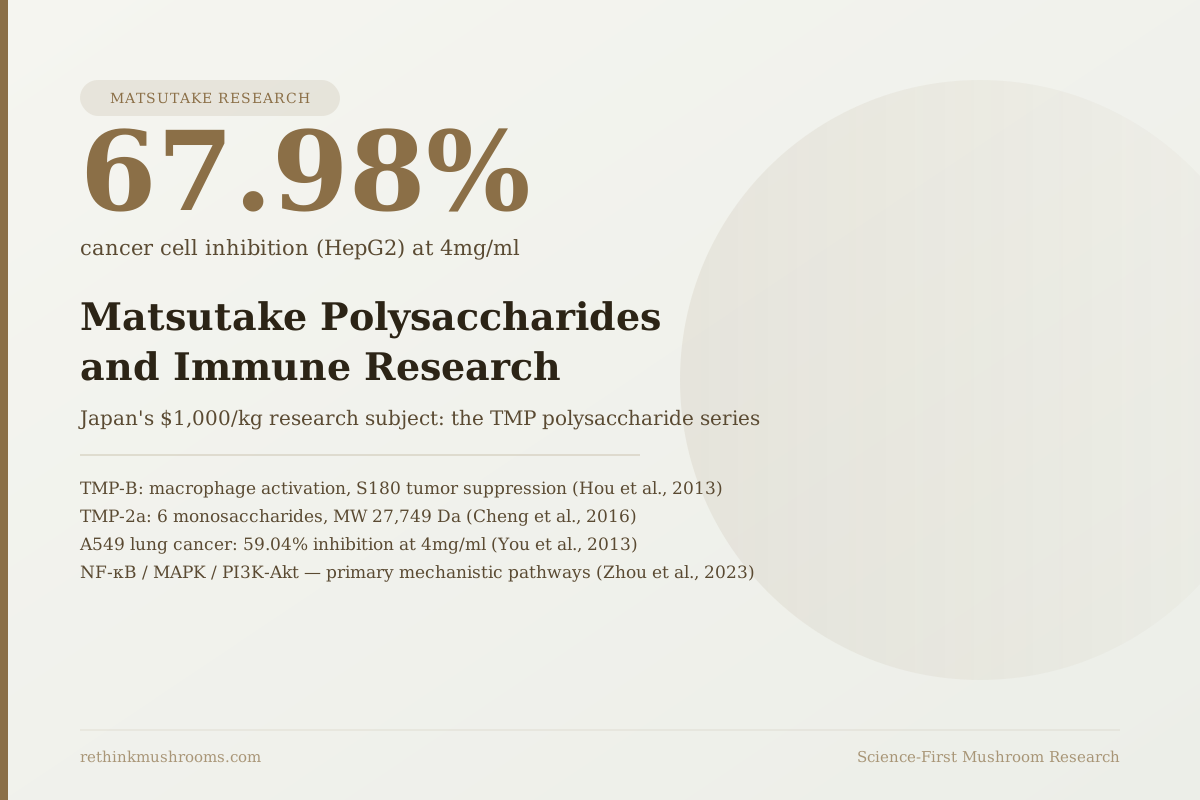
67.98% cancer cell inhibition
Polysaccharides extracted from Tricholoma matsutake inhibited liver cancer cell (HepG2) growth by 67.98% and lung cancer cell (A549) growth by 59.04% at 4mg/ml in laboratory studies, published in Food Chemistry.
You et al., Food Chemistry, 2013
4+
distinct polysaccharide fractions isolated and characterized from Tricholoma matsutake
S180
mouse tumor suppression confirmed with TMP-B polysaccharide (Hou et al., 2013)
2023
year of the most recent comprehensive review of matsutake chemistry and bioactivity (Zhou et al., Crit Rev Food Sci Nutr)
You et al., Food Chemistry, 2013
 View as image ↗
Matsutake sells for up to $1,000 per kilogram in Japan, making it one of the most expensive ingredients in any cuisine anywhere on earth. The reasons are well-documented: it cannot be cultivated, it takes years to develop in the wild, and its supply has collapsed as Japanese pine forests have declined. But there is a less-discussed reason Japanese researchers have spent decades studying this mushroom: its chemistry.
Since the early 2000s, food scientists and pharmacologists in China, Japan, and Korea have isolated and characterized multiple polysaccharide fractions from Tricholoma matsutake. The recurring finding across five independent research groups: these polysaccharides activate immune cells, stimulate anti-inflammatory and pro-immunity cytokines, and inhibit cancer cell growth in laboratory and animal models.
This article synthesizes that research. It is the most comprehensive English-language summary of matsutake polysaccharide science written for a non-specialist audience. For the broader context of matsutake as a mushroom (biology, price, culture, cultivation mystery), see what is matsutake? The world's most expensive mushroom. For the place of matsutake within the broader category of specialty mushrooms with deep medicinal traditions, see what is Agarikon? The ancient mushroom with 2,000 years of use.
Everything in this article is preclinical research: laboratory cell studies and animal models. No human clinical trials on matsutake polysaccharides exist. That context matters and is addressed directly in the limitations section.
Key Takeaways
- Five independent research groups have isolated and characterized polysaccharide fractions from Tricholoma matsutake, collectively establishing a profile of immune-active compounds now called TMP (Tricholoma matsutake polysaccharide) fractions
- The best-characterized fraction, TMP-B (Hou et al., 2013), promotes macrophage proliferation, stimulates cytokine release (TNF-alpha, IL-6, IL-1-beta), inhibits S180 mouse tumor growth in vivo, and shows antimicrobial activity. It has one of the broadest bioactivity profiles documented for a single mushroom polysaccharide
- You et al. (Food Chemistry, 2013) found matsutake polysaccharide fractions inhibited HepG2 liver cancer cell growth by 67.98% and A549 lung cancer cell growth by 59.04% at 4mg/ml in cell culture
- Cheng et al. (2016) structurally characterized TMP-2a as a heteropolysaccharide composed of six monosaccharides with a molecular weight of 27,749 Da, advancing the structural biology needed to understand how polysaccharide structure relates to immune activity
- Hou et al. (2017) confirmed antitumor activity using polysaccharides from Maerkang (Tibetan region) matsutake, showing the bioactive profile is consistent across geographic variants of the species
- All evidence is preclinical (in vitro cell studies and animal models); no human clinical trials exist, and laboratory activity does not predict clinical efficacy
Why Japan Spent Research Money on a $1,000/kg Mushroom
The economic logic behind matsutake research is not obvious at first. Researchers studying a compound that cannot be cheaply sourced face immediate supply constraints. But matsutake's place in Japanese culture and traditional medicine created scientific interest independent of cultivation economics.
In Japan, matsutake has been prized since at least the Heian period (794-1185 CE), mentioned in classical literature and used in ceremonial and medicinal contexts for over a thousand years. Its distinctive aroma (primarily from a compound called 1-octen-3-ol combined with methyl cinnamate, which produces the characteristic spicy-pine scent) was associated in traditional medicine with vitality-restoring properties.
That heritage created a research question: was there a biochemical basis for the traditional medicinal reputation? Starting in the late 1990s and accelerating through the 2000s and 2010s, research groups in China and Japan began isolating and characterizing the polysaccharides in matsutake. Polysaccharides (large molecules made of chains of sugar units) were already known from other medicinal mushrooms to have immunomodulatory properties. PSK from Turkey Tail is approved in Japan as a cancer adjuvant. Lentinan from Shiitake is used as a pharmaceutical drug. The hypothesis was reasonable: matsutake might contain similar compounds.
The 2023 comprehensive review by Zhou, El-Seedi, and Xu in Critical Reviews in Food Science and Nutrition synthesized three decades of this research, confirming that matsutake contains proteins, polysaccharides, steroids, phenolics, volatile aromatics, and nucleoside derivatives, and that the polysaccharide fraction has the most documented bioactivity.[6]
The Matsutake Polysaccharide Research Series: Four Key Compounds
Between 2010 and 2017, four research groups isolated and characterized distinct polysaccharide fractions from Tricholoma matsutake and tested their biological activity. The findings are summarized in the table below.
| Compound | Source Study | Structural Features | Key Bioactivity |
|---|---|---|---|
| TMP-A (antioxidant) | Ding et al., 2010 | Characterized backbone linkages | DPPH radical scavenging, antioxidant |
| TMP-B | Hou et al., 2013 | Acidic polysaccharide | Macrophage activation, S180 tumor suppression, cytokine release |
| TM-P2 (multiple fractions) | You et al., 2013 | Multiple fractions with distinct MW | 67.98% HepG2 inhibition, 59.04% A549 inhibition at 4mg/ml |
| TMP-2a | Cheng et al., 2016 | 6 monosaccharides, 27,749 Da | Immunologically active, structural archetype |
| Maerkang TMP | Hou et al., 2017 | From Tibetan regional variant | HepG2 and SMMC-7721 cancer cell inhibition |
Ding et al., 2010 (Int J Biol Macromol) isolated the first structurally characterized polysaccharide from T. matsutake and confirmed antioxidant activity via DPPH radical scavenging assays.[2] The study identified the monosaccharide composition and backbone linkages, establishing the structural chemistry that subsequent groups built on.
Hou et al., 2013 (Pharmacognosy Magazine) isolated TMP-B, the most comprehensively studied matsutake polysaccharide.[1] TMP-B promoted macrophage proliferation in cell culture and stimulated cytokine release including tumor necrosis factor-alpha (TNF-alpha), interleukin-6 (IL-6), and interleukin-1-beta (IL-1-beta). In a mouse tumor model using S180 sarcoma cells, TMP-B inhibited tumor growth in living animals. It also showed antimicrobial activity against several bacterial strains.
You et al., 2013 (Food Chemistry) characterized multiple polysaccharide fractions from matsutake and tested antiproliferative activity against two human cancer cell lines.[3] At 4mg/ml: 67.98% inhibition of HepG2 (liver cancer) cells, 59.04% inhibition of A549 (lung cancer) cells. The fractions also showed significant antioxidant activity.
Cheng et al., 2016 (Natural Product Research) isolated TMP-2a, a homogenous polysaccharide (meaning a single, pure polysaccharide fraction rather than a mixture) and determined its precise molecular architecture.[4] TMP-2a is composed of six monosaccharide units (fucose, glucosamine, galactose, glucose, mannose, and glucuronic acid) and has a molecular weight of 27,749 Da. This structural precision is important: it allows researchers to study which specific chemical features drive bioactivity and why different polysaccharide fractions may have different potencies.
Hou et al., 2017 (International Journal of Biological Sciences) used matsutake collected from the Maerkang region of Tibet, confirming that the antitumor properties of T. matsutake polysaccharides are not unique to Japanese specimens.[5] The Maerkang TMP inhibited growth of HepG2 (liver cancer) and SMMC-7721 (hepatocellular carcinoma) cell lines without toxicity to normal cells. It also showed antitumor effects in an animal model.
How TMP Polysaccharides Activate Immune Cells: The Macrophage and Cytokine Story
The most consistent finding across the TMP polysaccharide research is macrophage activation. Macrophages are immune cells that identify and destroy pathogens, cancer cells, and cellular debris. They are the immune system's first responders and also serve as important messengers: when macrophages are activated, they release cytokines (small protein signals) that recruit and coordinate the rest of the immune response.
TMP-B, studied by Hou and colleagues in 2013, promoted macrophage proliferation and triggered release of TNF-alpha, IL-6, and IL-1-beta in cell culture experiments.[1] These are all pro-inflammatory cytokines: TNF-alpha coordinates early immune responses to infection and abnormal cells; IL-6 drives fever and acute phase immune activation; IL-1-beta amplifies local inflammation at sites of infection or injury.
The mechanism by which polysaccharides activate macrophages runs through a class of receptors on the macrophage surface called toll-like receptors (TLRs), specifically TLR2 and TLR4. These receptors evolved to recognize molecular patterns associated with bacteria and other pathogens. Polysaccharides from mushrooms (particularly the beta-glucan and hetero-polysaccharide fractions) structurally resemble pathogen-associated patterns closely enough to bind these receptors and trigger an immune response even in the absence of actual infection.
The Zhou 2023 review identified NF-kappaB (a protein complex that acts as an immune activation switch inside cells), MAPK (a chain of protein activations that cells use to respond to external signals), and PI3K-Akt (a cell growth and survival pathway) as the primary intracellular routes through which TMP polysaccharides exert their biological effects.[6] Put plainly: the polysaccharides bind to surface receptors, those receptors activate multiple internal cell signaling networks, and those networks produce the downstream effects (cytokine release, immune cell activation, cell proliferation regulation).
For a broader comparison of how mushroom polysaccharides activate immune cells across multiple species, see how mushroom sugars activate cancer-fighting immune cells.
Cancer Cell Inhibition: What the Numbers Mean
The cancer inhibition data from matsutake polysaccharide studies requires careful framing. The numbers are real. Their clinical significance is uncertain.
You et al.'s 2013 paper found 67.98% inhibition of HepG2 cells and 59.04% inhibition of A549 cells at 4mg/ml.[3] HepG2 is a human liver cancer cell line grown in laboratory dishes. A549 is a human lung cancer cell line. These are widely used research tools. The inhibition percentages tell us that the polysaccharide fraction at this concentration reduced cancer cell growth by these amounts in a controlled laboratory dish.
What 4mg/ml means in practice: this is the concentration in the laboratory dish, not a dose that anyone would take. The relationship between in vitro (cell dish) concentrations and in vivo (living body) tissue concentrations involves absorption, distribution, metabolism, and excretion, none of which the cell study addresses. A compound may show impressive activity at 4mg/ml in a dish and fail to reach cancer tissue at useful concentrations when taken orally, or be metabolized before reaching target cells.
Hou et al.'s 2013 S180 animal model study is one step closer to clinical reality: tumor growth was suppressed in living mice.[1] Animal models share more physiology with humans than cell culture dishes do. But mice are not humans, and S180 is a mouse-specific sarcoma model that does not directly model any specific human cancer type.
Hou et al.'s 2017 Maerkang study adds geographical replication: the finding is not limited to Japanese matsutake but extends to the Tibetan regional variant.[5] This matters because it suggests the bioactive polysaccharides are not a quirk of one population's chemistry but a consistent feature of the species.
For the broader anticancer research picture across traditional uses and molecular mechanisms, see matsutake and anti-cancer research: traditional medicine meets science.
Structure-Activity Relationships: Why the Chemistry Matters
One of the most scientifically valuable aspects of the TMP polysaccharide research is that multiple groups have characterized the structural chemistry of different fractions, allowing researchers to begin understanding which structural features drive bioactivity.
Cheng et al.'s TMP-2a characterization is the most detailed: six monosaccharide units, precisely identified, with a molecular weight of 27,749 Da.[4] The inclusion of glucuronic acid (an acidic sugar unit) and glucosamine (an amino sugar) alongside the neutral sugars gives TMP-2a an electronically complex surface that may help explain its interaction with immune cell receptors.
Ding et al.'s 2010 study established baseline structural data for the first characterized matsutake polysaccharide and showed antioxidant activity.[2] The structural diversity across fractions (acidic polysaccharides, neutral glucans, hetero-polysaccharides with varying monosaccharide compositions) may explain why multiple fractions all show immune and antitumor activity by different mechanisms rather than through a single shared pathway.
This is scientifically important: if different structural types of matsutake polysaccharides all show bioactivity through different receptors and pathways, the mushroom's immune effects are likely to be robust to extraction method and processing variation. The bioactivity is not concentrated in one specific compound that might be lost in processing. For the broader matsutake compound profile (aroma compounds, steroids, nucleoside derivatives), see matsutake bioactive compounds and immune research.
The Honest Limitations: What Preclinical Evidence Does and Doesn't Tell Us
Every study cited in this article is preclinical. That is not a minor caveat: it is the central context for interpreting the research.
Preclinical evidence means: laboratory cell studies (in vitro) and animal models (in vivo). In vitro studies tell us what happens when cells in a dish are exposed to a compound. In vivo animal studies tell us what happens in a living organism, but one with different physiology from humans. Neither establishes that a compound produces the same effects in human patients.
The history of cancer pharmacology includes many compounds that showed impressive in vitro and animal model activity and failed in human clinical trials. The failure modes are well-documented: poor oral absorption, rapid metabolism before reaching target tissues, different off-target effects in humans, immune system differences between species, and the fundamental difference between growing tumors in mice and the complexity of human cancer.
None of this means the TMP polysaccharide research is unimportant. It establishes a biological rationale for the traditional medicinal reputation of matsutake. It identifies specific compounds, mechanisms, and molecular targets for further research. It provides the preclinical foundation that would justify a clinical trial if funding and supply were available. These are genuine contributions.
What it does not establish is that consuming matsutake or matsutake extracts produces immune enhancement or cancer protection in humans. The evidence for that would require human clinical trials, which do not yet exist for matsutake polysaccharides specifically.
The Zhou 2023 review concluded that matsutake's health-promoting evidence was promising but needed clinical validation before any health claims could be substantiated.[6]
Price, Supply, and the Research Gap
Matsutake's immune research faces a fundamental supply problem. Clinical trials require consistent, standardized doses of a test compound. For most pharmaceuticals or herbal extracts, this means a controlled cultivation or synthesis process. Matsutake cannot be cultivated. Wild harvest varies by year, region, and season. The price of $1,000/kg makes large-scale clinical trials economically unrealistic.
This is not unique to matsutake: many traditional medicines with promising preclinical evidence have never progressed to clinical trials because supply, cost, or other logistical barriers make trials impractical. It means the preclinical evidence will likely remain the best available data for matsutake polysaccharides for the foreseeable future.
For the biology behind why matsutake cannot be cultivated and what that means for its price and availability, see why matsutake can't be cultivated: the mycorrhizal mystery.
The Bottom Line
Five independent research groups have characterized polysaccharide fractions from Tricholoma matsutake and documented immunomodulatory and antiproliferative activity. TMP-B (Hou 2013) activates macrophages, stimulates cytokines, and suppresses S180 mouse tumor growth. You et al. (2013) found 67.98% and 59.04% inhibition of liver and lung cancer cell lines respectively. Cheng et al. (2016) established the structural precision of TMP-2a (six monosaccharides, 27,749 Da). Hou et al. (2017) confirmed the bioactive profile is consistent across Tibetan regional variants. Zhou et al.'s 2023 comprehensive review synthesizes the evidence and identifies NF-kappaB, MAPK, and PI3K-Akt as the primary mechanistic pathways. All evidence is preclinical; no human clinical trials exist.
Frequently Asked Questions
Sources & References
- 1RTHM-00523·Hou, Yiling et al. (2013). “Anti-microorganism, anti-tumor, and immune activities of a novel polysaccharide isolated from Tricholoma matsutake..” Pharmacognosy magazine.Study breakdown →PubMed →↩
- 2RTHM-00336·Ding, Xiang et al. (2010). “Structure elucidation and antioxidant activity of a novel polysaccharide isolated from Tricholoma matsutake..” International journal of biological macromolecules.Study breakdown →PubMed →↩
- 3RTHM-00572·You, Lijun et al. (2013). “Structural characterisation of polysaccharides from Tricholoma matsutake and their antioxidant and antitumour activities..” Food chemistry.Study breakdown →PubMed →↩
- 4RTHM-00775·Cheng, Hua et al. (2016). “Isolation and structural elucidation of a novel homogenous polysaccharide from Tricholoma matsutake..” Natural product research.Study breakdown →PubMed →↩
- 5RTHM-00875·Hou, Yiling et al. (2017). “Structure elucidation and antitumor activity of a new polysaccharide from Maerkang Tricholoma matsutake..” International journal of biological sciences.Study breakdown →PubMed →↩
- 6RTHM-01840·Zhou, Yifan et al. (2023). “Insights into health promoting effects and myochemical profiles of pine mushroom Tricholoma matsutake..” Critical reviews in food science and nutrition.Study breakdown →PubMed →↩