Emerging & Specialty Mushrooms
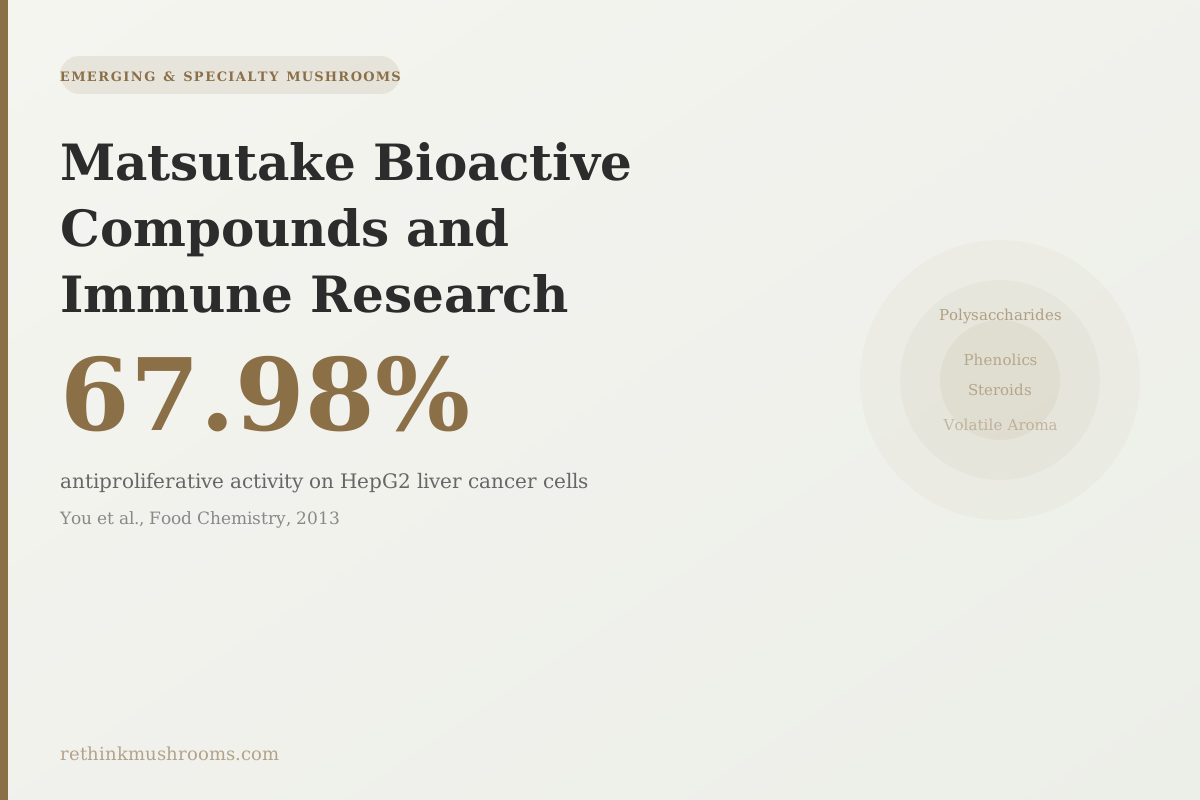
67.98% antiproliferative activity on liver cancer cells
Polysaccharide fractions isolated from Tricholoma matsutake inhibited liver cancer cell (HepG2) proliferation by 67.98% and lung cancer cells (A549) by 59.04% at 4mg/ml in laboratory conditions.
You et al., Food Chemistry, 2013
8 compound classes
identified in the 2023 comprehensive review: polysaccharides, phenolics, steroids, and more
Macrophages
activated by TMP-B polysaccharide including proliferation and cytokine stimulation (Hou 2013)
Preclinical only
all immune and anticancer evidence is from cell studies and animal models
You et al., Food Chemistry, 2013
 View as image ↗
Most discussions of matsutake stop at the price. A single specimen can sell for $2,000 in Japan. But the science that has accumulated around this mushroom, largely unknown outside specialist literature, documents a set of matsutake bioactive compounds (polysaccharides, phenolics, steroids, and volatile aroma molecules) with documented immunological and antioxidant properties in laboratory models. A 2013 study by Hou and colleagues isolated a polysaccharide fraction called TMP-B that stimulated macrophage proliferation, triggered cytokine release, and inhibited S180 tumor growth in living mice.[1] None of this appears in consumer mushroom content, and all of it is preclinical.
For the cultural background on what matsutake is, where it grows, and why it remains uncultivable, see What Is Matsutake?. This article focuses specifically on the compound chemistry and the immune and antioxidant research. For the broader landscape of specialty medicinal mushrooms with comparable depth of bioactive research, the emerging specialty mushrooms guide covers related species.
Key Takeaways
- A 2023 comprehensive review identified eight compound classes in matsutake: polysaccharides, proteins, amino acids, fatty acids, steroids, nucleosides, phenolics, and volatile aroma compounds (Zhou et al., 2023)
- TMP-B polysaccharide from matsutake activated macrophage proliferation, stimulated cytokine release (TNF-α, IL-6, IL-1β via NF-kB), and inhibited S180 tumor growth in an animal model (Hou et al., 2013)
- Multiple polysaccharide fractions showed 67.98% and 59.04% antiproliferative activity against HepG2 (liver) and A549 (lung) cancer cell lines at 4mg/ml in laboratory conditions (You et al., 2013)
- Three structurally characterized polysaccharides have been isolated from matsutake: Ding 2010, You 2013, and Cheng 2016 establish distinct molecular weights and monosaccharide compositions for different fractions
- The distinctive matsutake aroma comes from methyl cinnamate and 1-octen-3-ol, the most studied volatile compounds in the species, scientifically characterized but not pharmacologically tested
- All immune and anticancer evidence is preclinical; no human clinical trials on matsutake bioactive compounds exist
Matsutake Bioactive Compounds: Eight Chemical Families in the 2023 Review
Zhou, El-Seedi and Xu published a comprehensive review of matsutake in Critical Reviews in Food Science and Nutrition in 2023, synthesizing the full myochemical profile and health research across the available literature.[2] The review identified eight classes of bioactive compounds in Tricholoma matsutake.
| Compound Class | Key Examples | Primary Research Focus |
|---|---|---|
| Polysaccharides | TMP-B, TM-P2, TMP-2a | Immune activation, antitumor, antioxidant |
| Phenolics | Caffeic acid, ferulic acid, cinnamic acid | Antioxidant, anti-inflammatory |
| Steroids | Ergosterol, brassicasterol | Cell membrane function, vitamin D precursor activity |
| Volatile aroma compounds | Methyl cinnamate, 1-octen-3-ol | Characteristic scent, antimicrobial |
| Nucleosides | Adenosine | Immune signaling context |
| Proteins and amino acids | Glutamic acid, aspartic acid | Nutritional, umami flavor chemistry |
| Fatty acids | Linoleic acid, oleic acid | Nutritional, membrane function |
| Nucleic acid derivatives | Ergothioneine | Antioxidant |
The breadth of this compound profile is one reason matsutake research attracted investment in Japan, Korea, and China despite the impossibility of cultivating the species at commercial scale. Each compound class offers a separate research angle, and the overlap between culinary interest (aroma, flavor, texture) and biomedical interest (immune activity, anticancer mechanisms) is unusual among food mushrooms.
The mechanistic targets identified across the compound research include NF-kB (the master inflammatory/immune regulator), MAPK (a stress-activated immune signaling cascade), and PI3K-Akt (a growth and survival signaling pathway targeted in cancer research). These are not matsutake-specific targets; they are the same pathways many medicinal mushroom compounds act on. What is specific to matsutake is the particular compound structures and their potency at those targets.
The Polysaccharide Chemistry: Three Characterized Fractions with Different Structures
The polysaccharide research on matsutake began with structural characterization: identifying what specific sugar polymers are present, what molecular weights they have, and what monosaccharide building blocks they contain. This chemistry matters because immune activity depends on polysaccharide structure. Two polysaccharides with different branching patterns will interact differently with immune receptors.
Ding and colleagues published the first structural characterization of an antioxidant matsutake polysaccharide in 2010.[3] The study isolated a novel polysaccharide from T. matsutake and established its baseline chemistry: monosaccharide composition and backbone linkage patterns. The polysaccharide showed significant antioxidant activity in laboratory assays, establishing that matsutake contains structurally active polysaccharides before any immune or anticancer testing.
You and colleagues built on this foundation in 2013, isolating multiple polysaccharide fractions from matsutake and characterizing their antioxidant and antitumor activities.[4] The fractions showed DPPH radical-scavenging activity (a standard measure of antioxidant capacity) alongside the antiproliferative activity against cancer cell lines discussed in the next section.
The most chemically detailed characterization came from Cheng and colleagues in 2016, who isolated a homogenous polysaccharide designated TMP-2a.[5] TMP-2a consists of six monosaccharides: fucose, glucosamine, galactose, glucose, mannose, and glucuronic acid. Its molecular weight is 27,749 daltons. This level of structural specificity is what distinguishes serious polysaccharide research from general "extract" studies. Knowing the molecular weight and monosaccharide composition allows researchers to compare TMP-2a against polysaccharides from other mushroom species and understand why it behaves the way it does in immune assays.
For the deeper immunological implications of polysaccharide structure, the matsutake polysaccharide and immune research article covers the full range of characterized fractions and their comparative bioactivities.
How Matsutake Polysaccharides Activate Macrophages and Stimulate Cytokines
The most important immune mechanism evidence for matsutake comes from Hou and colleagues' 2013 study in Pharmacognosy Magazine, which tested a polysaccharide designated TMP-B across several biological systems.[1]
TMP-B produced three distinct immune effects. First, it promoted macrophage proliferation, meaning it increased the number of macrophages, the large immune cells that engulf pathogens and dead cells and coordinate both innate and adaptive immune responses. Second, it stimulated cytokine release from those macrophages: TNF-α, IL-6, and IL-1β were all produced in response to TMP-B exposure. These are the same pro-inflammatory cytokines that signal other immune cells to activate against threats. Third, in an in vivo S180 sarcoma tumor model, TMP-B inhibited tumor growth.
This breadth of activity in one compound from one study is notable. Macrophage activation, cytokine stimulation, and in vivo tumor suppression are three distinct biological readouts, and TMP-B showed activity across all three. The NF-kB pathway, identified in the Zhou 2023 review as a primary mechanistic target for matsutake compounds, is likely the upstream regulator of the cytokine response observed here.
Macrophage-activating polysaccharides are not unique to matsutake; beta-glucans from turkey tail, shiitake, and reishi have well-characterized macrophage activation profiles. What distinguishes matsutake is the specific structural features of TMP-B relative to those better-studied polysaccharides, and whether its particular architecture confers any different potency at shared molecular targets. That comparison research has not yet been published. For how macrophage-activating polysaccharides work as a class, including the receptor-level mechanisms, see the article on how mushroom sugars activate cancer-fighting immune cells.
The Anticancer Cell Line Data: Specific Numbers from Laboratory Studies
The antiproliferative data from You and colleagues' 2013 study in Food Chemistry are the most cited specific numbers in the matsutake research literature, and they deserve to be read carefully.[4]
At a concentration of 4.0 mg/ml, matsutake polysaccharide fractions showed:
- 67.98% antiproliferative activity against HepG2 (human liver cancer) cells
- 59.04% antiproliferative activity against A549 (human lung cancer) cells
These are in vitro numbers: cells in a laboratory dish at a specific concentration. In vitro antiproliferative activity is a standard first step in cancer research. It establishes that a compound can interfere with cancer cell growth under controlled conditions. It does not establish that the compound reaches cancer cells in a living body at effective concentrations, or that the effects translate to clinical outcomes in cancer patients.
The in vivo data from Hou 2013 extends this picture: TMP-B inhibited S180 tumor growth in living mice, which is a more biologically realistic model than cell culture. In a living animal, the compound has to survive digestion, be absorbed, reach tumor tissue at sufficient concentration, and overcome the tumor microenvironment. That TMP-B produced tumor suppression in vivo adds biological plausibility to the in vitro numbers.
The limitation is that all of this is still preclinical. There are no human clinical trials on matsutake polysaccharides for cancer. The research is at the mechanistic characterization stage. For a fuller treatment of the anticancer evidence, including what the established molecular pathways suggest about potential human applications, see the matsutake anticancer research article. For a cross-species perspective on mushroom lectins and carbohydrate-binding proteins with anticancer potential, the mushroom lectins article covers related compounds from multiple species.
The Aroma Compounds: The Chemistry Behind the Spicy-Pine Scent
Matsutake's most famous property is its smell. Described as spicy pine, cinnamon, and wet forest, the aroma is strong enough to permeate packaging and is considered by some Japanese chefs to be the defining culinary characteristic, more important than the texture or taste.
The Zhou 2023 review characterizes the primary volatile compounds responsible: methyl cinnamate and 1-octen-3-ol.[2] Methyl cinnamate is an ester of cinnamic acid with a warm, spicy, balsamic character. 1-octen-3-ol is the same compound responsible for the general "mushroom" smell in many fungal species, earthy and slightly metallic at low concentrations and more complex at the concentrations found in fresh matsutake.
These volatile compounds are scientifically characterized but not pharmacologically studied in the same way as polysaccharides. The aroma chemistry research focuses on agricultural science (maintaining and detecting genuine matsutake versus adulterated products) rather than biomedical applications. Methyl cinnamate has separately documented antimicrobial properties in other contexts, but no matsutake-specific aroma compound research has examined immune or anticancer applications.
The aroma compounds are relevant to the matsutake price story in a different way: they are extremely difficult to preserve. Fresh matsutake loses its characteristic scent within days of harvest. Dried matsutake retains a fraction of the volatile profile. This preservation challenge reinforces why Japanese cuisine prizes fresh matsutake available only during a few weeks each autumn, which further concentrates demand into a very limited supply window.
Why the Bioactive Profile Connects to Price
The explanation usually given for matsutake's price is supply and demand: it cannot be cultivated, it takes five to six years to develop from shiro (the underground mycelial ring) to fruiting body, and Japanese pine forest habitat has declined from roughly 12,000 tonnes of annual harvest in the 1940s to approximately 60 tonnes today. All of that is accurate and important.
But the bioactive compound profile adds another dimension. Matsutake accumulated significant research investment in Japan and East Asia partly because of cultural medicinal tradition and partly because the research kept finding real biology: structurally distinct polysaccharides, macrophage activation, antioxidant activity, and anticancer cell line inhibition. The compound richness confirmed that matsutake's status as a prized medicinal ingredient had scientific basis, which further justified the research funding that produced the studies cited here.
The species sits at an unusual intersection: a luxury culinary ingredient with a documented bioactive profile that would attract research interest even if it were cheap and widely available. The combination of inaccessibility, cultural prestige, and genuine scientific intrigue is what makes matsutake one of the more scientifically interesting entries in the specialty mushroom research landscape. For comparison with another traditionally prized mushroom from Southeast Asia that is more accessible but similarly documented, see the tiger milk mushroom research.
The Bottom Line
Matsutake contains eight classes of bioactive compounds, with polysaccharides being the most extensively studied. Three structurally characterized polysaccharide fractions show antioxidant and antiproliferative activity in laboratory studies. TMP-B from Hou 2013 provides the best immune mechanism evidence, showing macrophage activation, cytokine stimulation, and in vivo tumor suppression. The anticancer cell line data from You 2013 shows up to 67.98% antiproliferative activity at 4mg/ml. All evidence is preclinical; no human clinical trials on matsutake bioactive compounds exist. The aroma compounds methyl cinnamate and 1-octen-3-ol are chemically characterized but not pharmacologically studied.
Frequently Asked Questions
Sources & References
- 1RTHM-00523·Hou, Yiling et al. (2013). “Anti-microorganism, anti-tumor, and immune activities of a novel polysaccharide isolated from Tricholoma matsutake..” Pharmacognosy magazine.Study breakdown →PubMed →↩
- 2RTHM-01840·Zhou, Yifan et al. (2023). “Insights into health promoting effects and myochemical profiles of pine mushroom Tricholoma matsutake..” Critical reviews in food science and nutrition.Study breakdown →PubMed →↩
- 3RTHM-00336·Ding, Xiang et al. (2010). “Structure elucidation and antioxidant activity of a novel polysaccharide isolated from Tricholoma matsutake..” International journal of biological macromolecules.Study breakdown →PubMed →↩
- 4RTHM-00572·You, Lijun et al. (2013). “Structural characterisation of polysaccharides from Tricholoma matsutake and their antioxidant and antitumour activities..” Food chemistry.Study breakdown →PubMed →↩
- 5RTHM-00775·Cheng, Hua et al. (2016). “Isolation and structural elucidation of a novel homogenous polysaccharide from Tricholoma matsutake..” Natural product research.Study breakdown →PubMed →↩