Emerging & Specialty Mushrooms
296-fold
That is the span of reported molecular weights for Morchella esculenta polysaccharide, from 4.7 kDa to 1,391.5 kDa. Different extraction methods pull out genuinely different molecules from the same species, and independent groups disagree about which sugar dominates. The single most-quoted figure in morel chemistry describes exactly one of those preparations.
Ajith et al., Natural Product Research, 2025
81,835 Da
the best-characterised single preparation (Liu et al., 2016) — one point inside that range
0
human trials of any morel polysaccharide, for any endpoint
5
rodent disease models: obesity, atherosclerosis, NAFLD, immunosuppression, microbiota
Ajith et al., Natural Product Research, 2025
 View as image ↗
Most people know morels as the honeycomb-capped mushrooms that restaurants charge a premium for in spring. What the culinary world has largely missed is that morels are also one of the more chemically interesting functional mushrooms studied over the last decade.
The reason comes down to a class of compounds called polysaccharides, long chains of sugar molecules that function as the mushroom's primary structural and immunologically active components. Almost every medicinal mushroom species that has been researched produces polysaccharides, but the specific sugars they use and how those sugars are linked together determines what the polysaccharide does in the body.
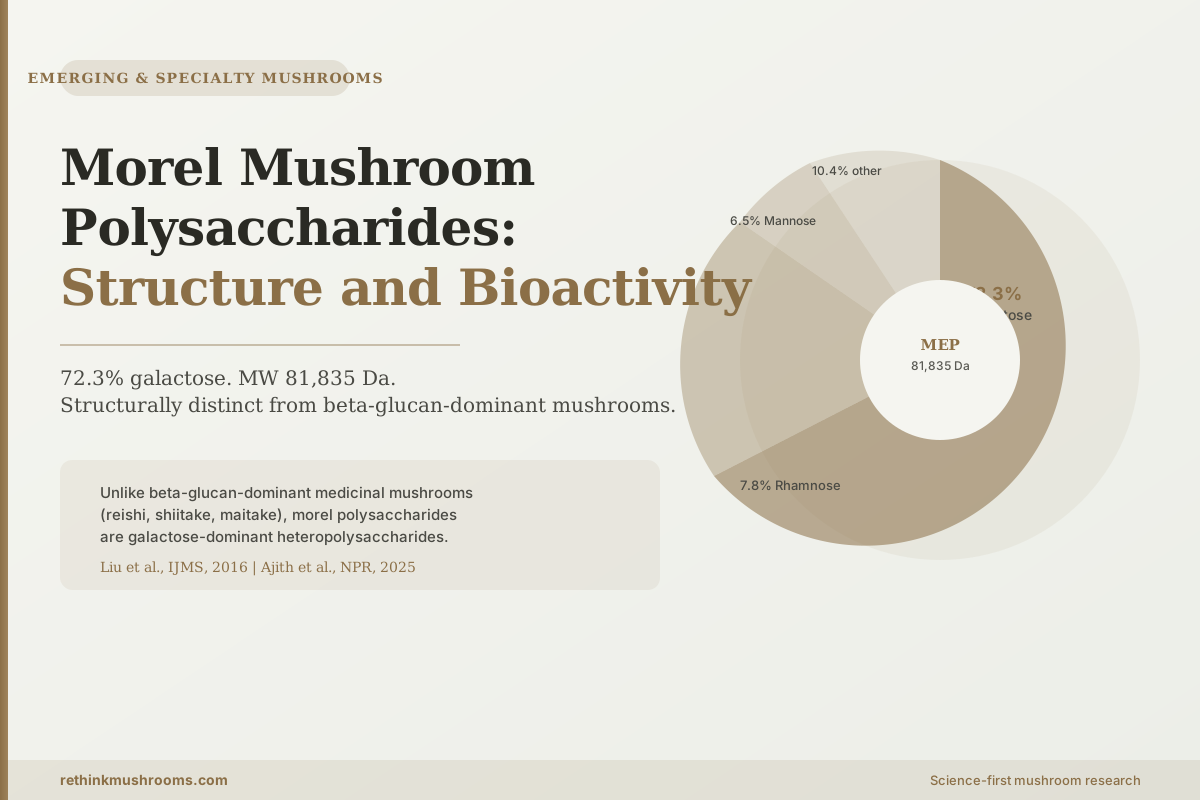
There is a widely repeated claim that morel polysaccharide is 72.3% galactose, and that this makes morels fundamentally different from the beta-glucan mushrooms like reishi, shiitake and maitake. That figure is real and it comes from a good paper. It also describes one specific preparation, and the rest of the literature does not agree with it. This article covers what the primary chemistry actually shows: what has been measured, where the measurements diverge, what biological activities follow, and how far that evidence reaches. For the broader picture of morels as a functional food, see the article on morel mushroom medicinal properties beyond culinary luxury. The morel cluster sits inside the wider emerging and specialty mushrooms research area.
Key Takeaways
- There is no single "morel polysaccharide." Reported molecular weights span 4.7 kDa to 1,391.5 kDa, a 296-fold range, and independent characterisations name different dominant sugars (Ajith et al., 2025)
- The famous 72.3% galactose figure is the galactose term in a 5.4:5.0:6.5:7.8:72.3 molar ratio, measured in one polysaccharide of 81,835 Da extracted by pulsed electric field from submerged fermentation (Liu et al., 2016)
- A different M. esculenta polysaccharide, MCP, was characterised at 169,000 Da and is mannose-dominant, with galactose its smallest of three sugars (Wang et al., 2021); a hot-water extract of wild fruiting bodies showed a possible beta-glucan-type structure by FT-IR (Badshah et al., 2021)
- Extraction changes both structure and function: from one fermentation, the extracellular fraction was the stronger digestive enzyme inhibitor while the intracellular fraction was better at glucose adsorption and diffusion retardation (Guo et al., 2024)
- A 2025 pharmacology review and a 2022 obesity study independently converge on the same anti-inflammatory axis — TLR4, NF-κB, COX-2 and iNOS — though the same review also describes morel beta-glucans activating NF-κB, leaving the direction unresolved (Ajith et al., 2025; Rehman et al., 2022)
- Cell-line work shows growth inhibition of HT-29 colon cells (Liu et al., 2016) and of HepG-2 liver and Hela cervical cells with macrophage activation (Li et al., 2017). Every result in this field is in vitro or in rodents; no human trial of any morel polysaccharide has been published
What Polysaccharides Are and Why Structure Determines Function
A polysaccharide is a long chain of simple sugar molecules, called monosaccharides, linked together. The specific sugars used and the way they are bonded determine what the whole chain does biologically.
This matters for morels because the answer to "what is morel polysaccharide made of" turns out to depend on which morel polysaccharide you mean.
The Molecular Fingerprint: One Preparation, Not One Molecule
Liu and colleagues published the most detailed structural characterisation of a morel polysaccharide to date in the International Journal of Molecular Sciences in 2016.[1] They grew M. esculenta in submerged fermentation, applied pulsed electric field extraction to recover the endo-polysaccharide, and purified it by column and gel permeation chromatography.
Liu et al. (2016) · International Journal of Molecular Sciences
- Population
- Submerged fermentation culture of Morchella esculenta — no animals or humans
- Intervention
- Pulsed electric field extraction of the endo-polysaccharide, purified by column and gel permeation chromatography
- Finding
- Average molecular weight 81,835 Da. Monosaccharides xylose, glucose, mannose, rhamnose and galactose in a molar ratio of 5.4:5.0:6.5:7.8:72.3, confirmed by gas chromatography, FT-IR and ¹H / ¹³C NMR. Apoptosis assays showed inhibition of human HT-29 colon cancer cell proliferation in a time- and dose-dependent manner within 48 hours.
preliminary Excellent structural chemistry. The antitumor result is cell culture only — it establishes that the molecule affects HT-29 cells in a dish, not that morels affect cancer in people.
Liu et al., International Journal of Molecular Sciences, 2016
The molecular weight came out to approximately 81,835 Daltons, and galactose dominated the monosaccharide profile. It is worth being precise about that number: 72.3 is the galactose term in a molar ratio of 5.4:5.0:6.5:7.8:72.3 for xylose, glucose, mannose, rhamnose and galactose.[1] Those parts total 97, so galactose accounts for roughly three-quarters of the sugar residues counted rather than 72.3% of the molecule's mass. Either way the conclusion holds for this preparation: it is galactose-dominant, and it is a heteropolysaccharide rather than a beta-glucan.
The problem is what happens when other groups characterise morel polysaccharide.
Structure Map
There Is No Single “Morel Polysaccharide”
Four characterisations of Morchella esculenta polysaccharide, all from peer-reviewed primary literature, disagree about the most basic facts: which sugar dominates, how big the molecule is, and whether it is beta-glucan-like at all. Across the published range the molecular weight spans nearly 300-fold.
Reported molecular weight (log scale)
MEP — Liu 2016
[1]Pulsed electric field, submerged fermentation
The source of the widely-quoted "72.3% galactose" figure. That number is the galactose term in a 5.4:5.0:6.5:7.8:72.3 molar ratio — roughly three-quarters of the sugar residues counted.
MCP — Wang 2021
[12]Extracted from M. esculenta, tested in LDLR-deficient mice
A different morel polysaccharide from the same species, twice the molecular weight and dominated by mannose rather than galactose — with galactose the smallest of its three sugars.
Hot-water polysaccharides — Badshah 2021
[2]Hot-water extraction, wild fruiting bodies (northern Pakistan)
FT-IR indicated the sugar nature and a possible beta-glucan-type structure — the opposite of the "morels are not beta-glucan mushrooms" framing. This preparation also showed moderate radical scavenging plus AChE and BChE inhibition.
IPS and EPS — Guo 2024
[4]Submerged fermentation, intracellular vs extracellular
Both neutral and triple-helical, both built from galactose, glucose and mannose — but in different molar ratios, with different glycosidic bond types and different particle sizes. One fermentation run yields two structurally distinct polysaccharides.
How to read it: these are not contradictory results so much as different molecules. Extraction method, whether the material is wild fruiting body or fermented mycelium, and which fraction is purified all change what comes out of the column. That means a bioactivity demonstrated for one morel polysaccharide does not automatically transfer to another one, and a supplement label reading “morel polysaccharides” does not specify which of these you are getting.
Sources: Liu et al. (2016) [1]; Badshah et al. (2021) [2]; Guo et al. (2024) [4]; Ajith et al. (2025) [5]; Wang et al. (2021) [12]. Composition bars normalise each reported molar ratio to 100% of the sugars counted and show relative dominance, not absolute mass fraction.
Badshah and colleagues isolated polysaccharides from wild morels in northern Pakistan using hot-water extraction and published in Molecules in 2021.[2] Their FT-IR analysis indicated the sugar nature and a possible beta-glucan-type structure — the opposite of the "morels are not beta-glucan mushrooms" framing. They did not report monosaccharide percentages. What they did report was moderate free radical scavenging by the deproteinised polysaccharides, plus inhibition of acetylcholinesterase and butyrylcholinesterase, which they suggested might be relevant to Alzheimer's and Parkinson's disease and which no one appears to have followed up.
Wang and colleagues characterised a different M. esculenta polysaccharide, MCP, at 1.69 × 10⁵ Da — roughly twice the Liu molecule — composed of glucose, mannose and galactose in a molar ratio of 1:1.9:0.51.[12] That is mannose-dominant, with galactose the smallest of its three sugars.
And the 2025 review by Ajith and colleagues, surveying the field, reports morel polysaccharides ranging from 4.7 kDa to 1,391.5 kDa, built from xylose, glucose, mannose, rhamnose and galactose in various molar ratios.[5]
Fact check
Is morel polysaccharide 72.3% galactose?
The claim
“Morel polysaccharides are 72.3% galactose, which makes morels structurally distinct from beta-glucan mushrooms like reishi and shiitake.”
A single well-cited 2016 structural paper, repeated across supplement marketing and health content as though it described the species rather than one laboratory preparation.
What research shows
OverstatedThe 72.3 figure is the galactose term in a molar ratio from one polysaccharide, extracted by pulsed electric field from submerged fermentation. Other characterisations of M. esculenta polysaccharide report a mannose-dominant fingerprint (Wang 2021) or a possible beta-glucan-type structure (Badshah 2021), across a molecular weight range spanning 296-fold.
The Liu measurement is sound and the galactose dominance is real for that preparation. What does not follow is that it describes morel polysaccharide in general, or that morels can be cleanly filed as 'not a beta-glucan mushroom.' Extraction method, wild fruiting body versus fermented mycelium, and which fraction is purified all change the molecule.
Liu et al., 2016 [1]; Badshah et al., 2021 [2]; Ajith et al., 2025 [5]; Wang et al., 2021 [12]
Why Extraction Method Changes What You Get
The clearest demonstration that extraction is not neutral comes from a single experiment.
Guo and colleagues, publishing in the International Journal of Biological Macromolecules in 2024, ran one submerged fermentation of M. esculenta and purified two polysaccharides from it: the intracellular polysaccharide (IPS) retained inside the mycelial cells, and the extracellular polysaccharide (EPS) secreted into the growth medium.[4]
Both were neutral and adopted a triple-helical conformation, and both were built from galactose, glucose and mannose — but in different molar ratios, with different glycosidic bond types, different surface morphology by SEM, and different particle sizes. The molecular weight and particle size of IPS were higher than those of EPS; IPS was more viscous, while EPS was more thermally stable.
Both fractions inhibited alpha-amylase and alpha-glucosidase as non-competitive inhibitors. But they were not equally good at it, and the fraction that won on enzyme inhibition was not the fraction that won overall.
Mechanism Split
One Fermentation, Two Polysaccharides, Two Different Routes to Lower Blood Sugar
Guo and colleagues purified both the intracellular and the extracellular polysaccharide from a single submerged fermentation of M. esculenta. Both reduced glucose availability in vitro — but the fraction that was better at blocking digestive enzymes was not the fraction that was better at trapping glucose. Which one “wins” depends entirely on which mechanism you measure.
Secreted into the growth medium
- Molecular weight
- Lower
- Particle size
- Smaller
- Sulphate content
- Higher
- Galactose molar ratio
- Higher
- Thermal stability
- Greater
Leads on
Digestive enzyme inhibition
Blocks alpha-amylase and alpha-glucosidase as a non-competitive inhibitor, slowing the breakdown of starch into absorbable glucose. Guo attributes the advantage to its higher sulphate content and galactose ratio alongside its smaller size.
Also active, but trails on
Glucose adsorption / diffusion retardation
Retained inside the mycelial cell
- Molecular weight
- Higher
- Particle size
- Larger
- Apparent viscosity
- Higher
- Sulphate content
- Lower
- Thermal stability
- Lower
Leads on
Glucose adsorption / diffusion retardation
Physically binds glucose and slows its movement through the intestinal contents, blunting the rate of absorption rather than the rate of starch breakdown. Guo attributes this to its higher molecular weight and apparent viscosity.
Also active, but trails on
Digestive enzyme inhibition
How to read it: both mechanisms reduce the glucose that reaches the bloodstream after a meal, and enzyme inhibition is the same mechanism the diabetes drug acarbose uses. But this is a test-tube assay on purified fractions, not a feeding study — no dose-response curves or inhibition constants are reported, and no one has tested either fraction in a person. Bar widths show which fraction led on which mechanism, not measured effect sizes.
Source: Guo et al., International Journal of Biological Macromolecules (2024) [4]. Qualitative comparison; the source reports directional differences rather than numeric effect sizes.
EPS showed the stronger digestive enzyme inhibitory activity, which Guo attributed to its higher sulphate content and galactose molar ratio combined with its lower molecular weight and particle size.[4] IPS, with its higher molecular weight and apparent viscosity, showed stronger glucose adsorption capacity and glucose diffusion retardation — physically trapping glucose and slowing its movement rather than blocking its production.
Two fractions from one culture, two different routes to the same outcome. Which one is "better" depends entirely on which mechanism is being measured, and neither has been tested in an animal, let alone a person.
Beyond Polysaccharides: What Else Is in Morel Chemistry
Polysaccharides are the most studied morel compounds, but they are not the only ones documented.
Wu and colleagues reviewed M. esculenta bioactive ingredients in Applied Biochemistry and Biotechnology in 2021 and catalogue polysaccharides alongside polyphenolic compounds, proteins and protein hydrolysates, noting that several crude extracts also show strong bioactivities.[3]
Sunil and Xu, reviewing the mycochemical profile in Food Research International in 2022, list vitamins, proteins, steroids, minerals, polysaccharides and polynucleotides among the active constituents of the fruiting body.[9]
Tietel and Masaphy's 2018 review in Critical Reviews in Food Science and Nutrition attributes morel health benefits mainly to polysaccharides, and to phytochemicals including phenolic compounds, tocopherols, ascorbic acid and vitamin D.[10] Tocopherols are the family of molecules that includes vitamin E, and they are lipid-soluble antioxidants that protect fatty cell membranes — chemically distinct from the water-soluble polysaccharide fraction and acting by a different route.
One clarification worth making, because it circulates as a morel-specific selling point: the vitamin D story is not unique to morels. Ergosterol, the fungal sterol that converts to vitamin D2 under ultraviolet light, is a standard component of fungal cell membranes and is found across edible mushroom species. Morels are documented as containing vitamin D among their phytochemicals; they are not unusual among mushrooms for doing so.
Claims that morels contain alkaloids, saponins, terpenoids, quinones or lipoxygenase enzymes appear in some popular write-ups, but none of the reviews cited here document those compound classes in M. esculenta. They are not part of the evidence base this article rests on.
Three Mechanisms Linking Chemistry to Function
Across the corpus, three mechanistic stories are supported by primary or review-level evidence.
Immune modulation via macrophage activation and the NF-κB axis. The 2025 Ajith review describes soluble morel beta-glucans as immunostimulatory, driving proinflammatory cytokine production and NF-κB activation, which leads to phagocytosis and resident macrophage proliferation without excess inflammation.[5] The review attributes the macrophage-stimulating capacity to the arabinose, mannose, galactose and xylose constituents. The same review also describes an anti-inflammatory action via NF-κB dephosphorylation, TLR4 blockade, and inhibition of COX-2 and iNOS.
That apparent contradiction is not a transcription error on our part — both appear in the same paper, and it matters.
Mechanism Convergence
Two Independent Sources, One Inflammatory Axis
A 2025 pharmacology review and a 2022 in vivo obesity study arrived at the same four molecular targets without depending on each other. Convergence of this kind is what separates a mechanism with a real evidential basis from a plausible-sounding story — though both accounts remain preclinical.
TLR4
Toll-like receptor 4
Surface sensor that triggers the inflammatory cascade, classically in response to bacterial endotoxin.
NF-κB
Nuclear factor kappa B
The master transcriptional switch for inflammatory gene expression.
COX-2
Cyclooxygenase-2
Downstream enzyme producing inflammatory prostaglandins; the target of NSAIDs.
iNOS
Inducible nitric oxide synthase
Downstream enzyme producing high-output nitric oxide during inflammation.
Cytokines
Proinflammatory cytokines
Signalling proteins that amplify and sustain the inflammatory response.
Unresolved in the cited literature
The same review also describes morel beta-glucans activating NF-κB to drive phagocytosis and macrophage proliferation — the opposite direction from the anti-inflammatory account above. Both appear in the same paper, and neither source explains what determines which way the switch moves. Treat “morel polysaccharides modulate inflammation” as directionally undetermined rather than reliably anti-inflammatory.
Sources: Ajith et al., Natural Product Research (2025) [5]; Rehman et al., AMB Express (2022) [7]. Both accounts are preclinical; no human data exist for any of these targets.
Gut microbiota and short-chain fatty acid signalling. Morel polysaccharide reaches the large intestine substantially intact, where gut bacteria ferment it into short-chain fatty acids. Huo and colleagues published two 2020 studies on this. The first, in Bioscience of Microbiota, Food and Health, found that a heteropolysaccharide from wild morels increased operational taxonomic units and microbial diversity along the mouse intestine, most markedly in the small intestine, where Firmicutes decreased significantly and Bacteroidetes increased. SCFA-producing bacteria, especially Lachnospiraceae, rose in both cecum and colon, and SCFA production increased overall.[8]
Blood sugar regulation via enzyme inhibition and glucose adsorption. This is the Guo 2024 work described above, and it is mechanistically separate from anything antioxidant.[4] It is worth stating plainly because "antioxidant" gets used as a catch-all explanation for whatever a functional food does. Slowing starch digestion is a different mechanism from scavenging radicals, with a different validated pharmaceutical analogue.
Antitumor Activity at the Cellular Level
Two studies tested morel polysaccharides against cancer cell lines in vitro.
Liu and colleagues showed that MEP inhibited the proliferation and growth of human HT-29 colon cancer cells in a time- and dose-dependent manner within 48 hours, via apoptosis.[1] Dose-dependence is consistent with a genuine pharmacological interaction rather than non-specific toxicity.
Li and colleagues purified three polysaccharide fractions — MP-1, MP-3 and MP-4 — from soybean residue fermented with M. esculenta, and tested them against two human cancer cell lines.[6] MP-1 produced 68.01% growth inhibition of HepG-2 liver cancer cells at 50 μg/mL, and all three fractions induced apoptosis in HepG-2 and Hela cervical cancer cells by arresting the cell cycle at the G0/G1 phase. Separately, MP-3 stimulated proliferation of RAW 264.7 macrophages to 313.57% at 25 μg/mL — an immune-activating effect distinct from direct cytotoxicity.
Two clarifications, because this study is frequently misreported. The immune cells activated were macrophages, not natural killer cells. And no colorectal line such as HCT-116 was tested here; the only colon data in this corpus is Liu's HT-29 work.
Wu's 2021 review lists antitumor ability among the consistently reported activities of morel polysaccharides, alongside antioxidant, anti-inflammatory, immunoregulatory, hypoglycaemic and atherosclerosis-prevention effects.[3]
All of this is preclinical. Cell-culture results establish that these molecules engage apoptotic and immune machinery in a dish. They do not establish that eating morels prevents or treats cancer, and whether these concentrations are achievable in a human through diet or supplementation is untested. For the population-level picture on mushroom intake and cancer risk, see daily mushroom consumption and cancer risk reduction.
What the Animal Studies Show
Five rodent studies across four disease models make up the most advanced tier of morel polysaccharide evidence.
Huo's second 2020 paper, in Food & Function, tested wild morel polysaccharide in both healthy and cyclophosphamide-treated mice — cyclophosphamide being a chemotherapy agent used to induce immunosuppression.[11] In the immunosuppressed animals, the polysaccharide restored spleen weight and increased white blood cell and lymphocyte counts in peripheral blood and spleen. It raised Bacteroidetes and SCFA-producing Ruminococcaceae relative to the cyclophosphamide controls, and increased acetic, propionic, butyric and valeric acid production. In healthy mice the SCFA pattern differed — valeric acid rose while acetic acid fell — a reminder that these effects are context-dependent rather than uniformly "boosting."
Rehman and colleagues tested morel polysaccharide in a high-fat-diet mouse model of obesity.[7] Supplementation attenuated obesity parameters and reduced colonic inflammation via regulation of TLR4, iNOS and COX-2 and inactivation of NF-κB. It also restored the Firmicutes-to-Bacteroidetes ratio, increased Lactobacillus, inhibited Enterococcus, raised tight junction protein expression and lowered circulating lipopolysaccharide endotoxin.
Wang and colleagues found that MCP reduced both en face and sinus atherosclerotic lesions in LDLR-deficient mice fed a high-fat diet for 15 weeks, lowering total and LDL cholesterol and triglycerides and attenuating hepatic lipid accumulation, apparently by activating AMPKα and inhibiting SREBP2 and LXRα.[12]
The same group extended this to liver disease in 2025, showing that morel polysaccharide reduced hepatic and serum triglyceride and cholesterol in high-fat-diet mice and ameliorated steatosis, inflammation and fibrosis in a methionine-choline-deficient NASH model, via the AMPK/Sirt1 pathway and upregulated PPAR-α.[13]
The through-line is coherent: morel polysaccharide reaches the colon, shifts the microbiota toward SCFA producers, tightens the gut barrier, lowers endotoxin load, and damps the TLR4/NF-κB inflammatory axis — with downstream metabolic effects in liver and vasculature. Five studies, four disease models, independent groups, consistent direction. That is a genuinely respectable preclinical package. It is also entirely in mice.
For how morel chemistry connects to the wider set of health applications, see morel mushroom medicinal properties beyond culinary luxury. For a polysaccharide-driven mushroom with a far deeper human evidence base to compare against, see turkey tail mushroom.
Where the Research Stands and What Is Missing
Evidence Map
Strong at the Bottom, Empty at the Top
Morel polysaccharide research is inverted compared with most supplement categories. The chemistry is unusually well characterised and independently replicated; the human evidence does not exist at all. Bar width reflects how far each tier reaches toward a claim about people.
Human clinical trial
gapDoes not yet exist
No human trial has tested a morel polysaccharide against any endpoint — not glucose, not inflammation, not immune function, not a tumour outcome. There is also no published human pharmacokinetic data, so the doses used in animals cannot be translated.
Rodent disease models
preclinicalRehman 2022 · Wang 2021 · Wang 2025 · Huo 2020 (×2)
The closest the field gets to a health claim. Five mouse studies across four different disease models: diet-induced obesity with colonic inflammation, atherosclerosis in LDLR-deficient mice, NAFLD and NASH, chemotherapy-induced immunosuppression, and healthy-gut microbiota shifts. Different preparations, consistent direction of effect.
In vitro cell and enzyme assays
preclinicalLiu 2016 · Li 2017 · Guo 2024 · Badshah 2021
Cancer cell lines (HT-29 colon; HepG-2 liver; Hela cervical), a macrophage activation model, digestive enzyme inhibition, radical scavenging, and cholinesterase inhibition. Establishes that the molecules do something to cells and enzymes in a dish.
Structural chemistry
well replicatedLiu 2016 · Badshah 2021 · Guo 2024 · Wang 2021 · Ajith 2025
The strongest rung by a distance, and the reason this article exists. Molecular weight, monosaccharide ratios, glycosidic bond types, helical conformation and particle size have been characterised repeatedly by independent groups using PEF, hot water and submerged fermentation. The finding is that the preparations genuinely differ from one another.
Narrative reviews
preclinicalWu 2021 · Sunil 2022 · Tietel 2018 · Ajith 2025
Four reviews summarise the above. They are useful maps of the field, but they inherit the preclinical ceiling of the studies they cite and none of them are systematic reviews or meta-analyses.
How to read it: a thoroughly characterised molecule is not the same thing as a proven one. Knowing the exact molecular weight and sugar ratio of a polysaccharide tells you nothing about whether eating it changes anything in a person. The structural rung being the strongest is genuinely useful — it is what makes the preparations comparable and the animal work interpretable — but the top rung is where a health claim would have to come from, and it is empty. Nothing here is medical advice.
Sources: Liu 2016 [1]; Badshah 2021 [2]; Wu 2021 [3]; Guo 2024 [4]; Ajith 2025 [5]; Li 2017 [6]; Rehman 2022 [7]; Huo 2020 [8]; Sunil 2022 [9]; Tietel 2018 [10]; Huo 2020 [11]; Wang 2021 [12]; Wang 2025 [13]. Bar widths are illustrative of evidential reach, not quantitative effect sizes.
What is well established: the structural chemistry, characterised repeatedly by independent groups using different methods — and the finding that those methods yield materially different molecules.[1][2][4][12]
What is suggestive: converging rodent evidence across obesity, atherosclerosis, NAFLD and immunosuppression, sharing a plausible gut-barrier and inflammatory mechanism.
What is missing: everything about humans. No clinical trial has tested any morel polysaccharide against any endpoint. There is no human pharmacokinetic data, so no one knows what fraction of an oral dose survives digestion or what plasma concentrations are achievable. Without that, the animal doses cannot be translated, and the in vitro concentrations cannot be assumed reachable.
There is also an unresolved question inside the mechanism itself. The same review that describes morel polysaccharides suppressing NF-κB also describes them activating it. Until something explains what determines the direction, "modulates inflammation" is the most that can honestly be claimed.
Safety
ModerateMorel polysaccharides are not a treatment for anything
Concern
Preclinical results in cancer, diabetes, obesity and liver disease are routinely marketed as though they were human findings. No morel polysaccharide has been tested in a human trial for any endpoint, and there is no human pharmacokinetic data to translate animal doses. Separately, the 296-fold variability between preparations means a supplement labelled 'morel polysaccharides' does not tell you which molecule is in the bottle or which of these preclinical results, if any, could apply to it.
What the research says
Treat morels as a nutritious culinary mushroom with interesting and genuinely well-characterised chemistry, not as a therapy. Do not substitute them for evidence-based treatment of diabetes, cardiovascular disease, liver disease or cancer, and discuss any supplement with a clinician — particularly alongside glucose-lowering or lipid-lowering medication, given the enzyme-inhibition and cholesterol findings in preclinical models. This article is educational and not medical advice.
Particularly relevant for: Anyone considering morel supplements for a metabolic, immune or oncological indication
What to do
Do not replace prescribed treatment with morel products; raise any supplement with your clinician before starting.
Evidence base as cited throughout: no human trial exists for any morel polysaccharide endpoint
Morels also require thorough cooking and can be confused with false morels; identification and preparation are covered separately in morel foraging safety and identifying true vs. false morels. For the cell-line anti-cancer data in more depth, see morel mushroom anti-cancer research, and for a contrast with a better-characterised specialty compound base, ganoderic acids and anti-tumor research.
The Bottom Line
Morchella esculenta polysaccharide is not one molecule. Reported preparations span 4.7 kDa to 1,391.5 kDa and disagree on composition: the best-characterised is galactose-dominant at 81,835 Da (Liu 2016), another is mannose-dominant at 169,000 Da (Wang 2021), and a hot-water extract of wild fruiting bodies showed a possible beta-glucan-type structure (Badshah 2021). Extraction method changes function as well as structure — from one fermentation, the extracellular fraction was the better digestive enzyme inhibitor while the intracellular fraction was better at glucose adsorption (Guo 2024). Mechanistically, a 2025 review and a 2022 obesity study converge on the TLR4/NF-κB/COX-2/iNOS axis, though the direction of NF-κB modulation is unresolved. Cell-line work shows growth inhibition of HT-29 colon, HepG-2 liver and Hela cervical cells with macrophage activation, and five rodent studies span obesity, atherosclerosis, NAFLD and chemotherapy-induced immunosuppression with a consistent gut-barrier and anti-inflammatory through-line. All evidence is preclinical; no human trial of any morel polysaccharide has been published as of 2026.
Frequently Asked Questions
Sources & References
- 1RTHM-00805·Liu, Chao et al. (2016). “Characteristics and Antitumor Activity of Morchella esculenta Polysaccharide Extracted by Pulsed Electric Field..” International journal of molecular sciences.Study breakdown →PubMed →↩
- 2RTHM-01327·Badshah, Syed Lal et al. (2021). “Isolation, Characterization, and Medicinal Potential of Polysaccharides of Morchella esculenta..” Molecules (Basel.Study breakdown →PubMed →↩
- 3RTHM-01454·Wu, Haishan et al. (2021). “Recent Advances on Bioactive Ingredients of Morchella esculenta..” Applied biochemistry and biotechnology.Study breakdown →PubMed →↩
- 4RTHM-01897·Guo, Weihong et al. (2024). “Comparative study on physicochemical properties and hypoglycemic activities of intracellular and extracellular polysaccharides from submerged fermentation of Morchella esculenta..” International journal of biological macromolecules.Study breakdown →PubMed →↩
- 5RTHM-02047·Ajith, Thekkuttuparambil Ananthanarayanan et al. (2025). “Morchella esculenta polysaccharides: a functional food with potential immunomodulatory properties..” Natural product research.Study breakdown →PubMed →↩
- 6RTHM-00889·Li, Shuhong et al. (2017). “Purification, antitumor and immunomodulatory activity of polysaccharides from soybean residue fermented with Morchella esculenta..” International journal of biological macromolecules.Study breakdown →PubMed →↩
- 7RTHM-01607·Rehman, Ata Ur et al. (2022). “Morchella esculenta polysaccharide attenuate obesity, inflammation and modulate gut microbiota..” AMB Express.Study breakdown →PubMed →↩
- 8RTHM-01205·Huo, Wenyan et al. (2020). “Polysaccharide from wild morels alters the spatial structure of gut microbiota and the production of short-chain fatty acids in mice..” Bioscience of microbiota.Study breakdown →PubMed →↩
- 9RTHM-01622·Sunil, Christudas et al. (2022). “Mycochemical profile and health-promoting effects of morel mushroom Morchella esculenta (L.) - A review..” Food research international (Ottawa.Study breakdown →PubMed →↩
- 10RTHM-01012·Tietel, Zipora et al. (2018). “True morels (Morchella)-nutritional and phytochemical composition, health benefits and flavor: A review..” Critical reviews in food science and nutrition.Study breakdown →PubMed →↩
- 11RTHM-01206·Huo, Wenyan et al. (2020). “Effects of polysaccharides from wild morels on immune response and gut microbiota composition in non-treated and cyclophosphamide-treated mice..” Food & function.Study breakdown →PubMed →↩
- 12RTHM-01452·Wang, Dandan et al. (2021). “Polysaccharide MCP extracted from Morchella esculenta reduces atherosclerosis in LDLR-deficient mice..” Food & function.Study breakdown →PubMed →↩
- 13RTHM-02202·Wang, Dandan et al. (2025). “Hepatoprotective effects of polysaccharide from Morchella esculenta are associated with activation of the AMPK/Sirt1 signaling pathway in mice with NAFLD..” International journal of biological macromolecules.Study breakdown →PubMed →↩